Quality Factors: McCall’s and ISO 9126 Models with a Worked Scoring Example
Build both quality models around one maintainability audit. This guide maps their vocabulary, calculates McCall-style and ISO-style scores, and ends with exam-focused checks.
KnowledgeGate Team
Exam prep & CS education
Updated 25 Sep 20265 min read

McCall and ISO 9126 are often memorised as two lists. That works until a question changes the vocabulary from factor to criterion, or from characteristic to subcharacteristic, and the familiar list suddenly feels unusable. One maintainability audit provides fixed observations for two transparent scores, which can then be compared by meaning. The scores help a team compare releases, but neither model prescribes these values, weights or pass lines as universal standards.
Quality factors in software engineering: factor, criterion and metric
A quality factor, called a characteristic in ISO 9126, is a user-visible quality objective such as reliability or maintainability. A criterion or subcharacteristic is a narrower property that contributes to that objective. A metric is the observation and rule used to assign a value.
For example: maintainability -> modularity -> 18 of 20 audit checks passed -> 0.90. The final number depends on the audit rule, normalisation and weights chosen for the project. The conceptual chain is what the model contributes. For broader context across metrics, testing, QA/QC and reliability, use Software Quality in Software Engineering. The McCall-to-ISO comparison isolates model vocabulary and maintainability scoring.
McCall’s quality model: three perspectives and eleven factors
McCall groups eleven quality factors according to three ways of viewing a software product:
Product operation | Product revision | Product transition |
|---|---|---|
Correctness | Maintainability | Portability |
Reliability | Flexibility | Reusability |
Efficiency | Testability | Interoperability |
Integrity | ||
Usability |
Product operation asks how the software behaves in use. Product revision asks how safely and economically it can change. Product transition asks how well it moves to, or cooperates with, other environments.
Three vocabulary traps matter. Integrity means protection against unauthorised access or modification, not database referential integrity. Flexibility is the effort needed to adapt the product to new needs. Portability is the effort needed to move it to another hardware or software environment.
McCall’s factor-criteria-metric chain: calculate maintainability
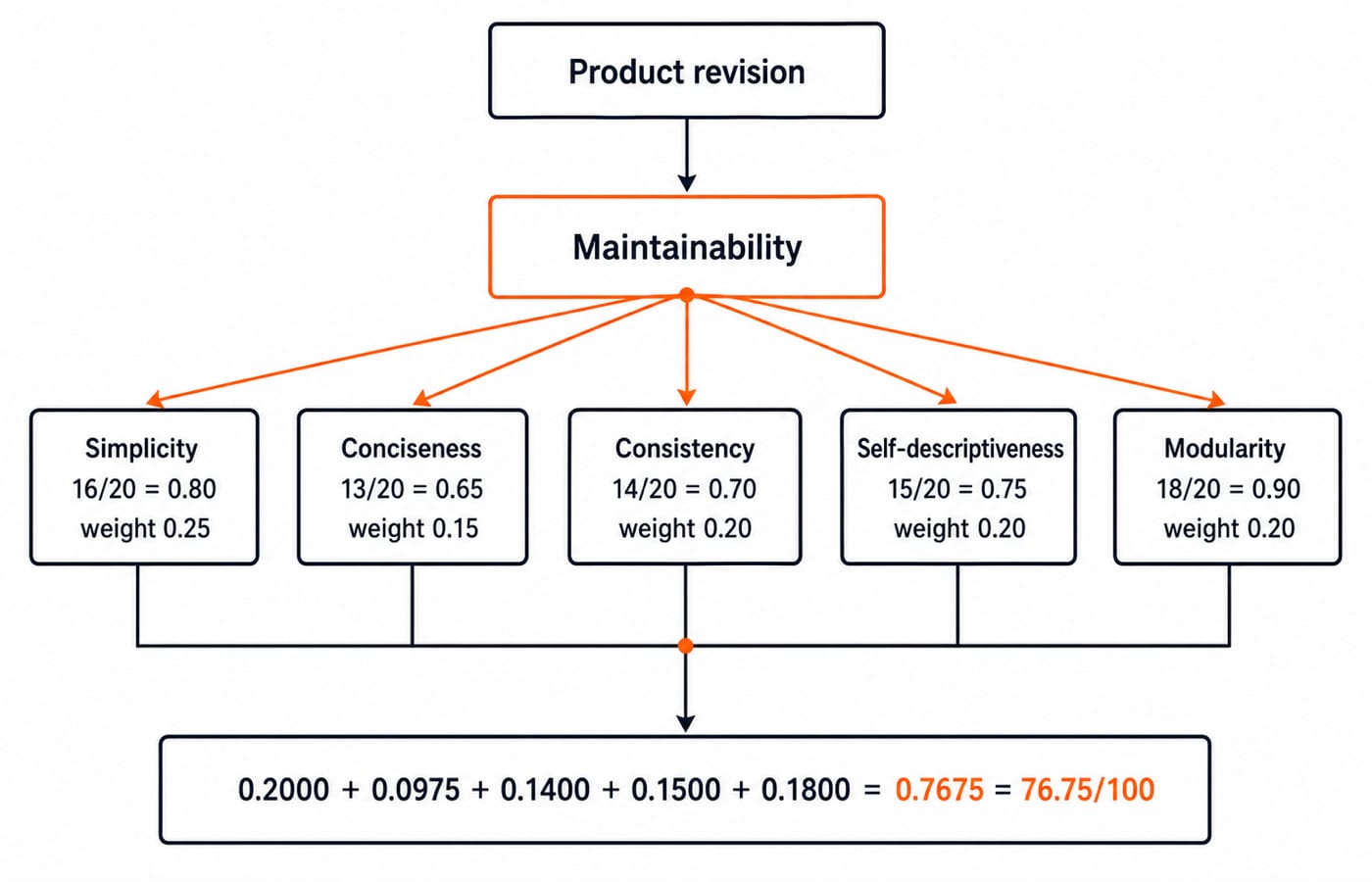
Consider a deliberately small codebase audit. Each normalised value is the passed checks divided by 20, and the five weights total 1.00.
Criterion | Audit result | Normalised value | Weight |
|---|---|---|---|
Simplicity | 16/20 checks | 0.80 | 0.25 |
Conciseness | 13/20 | 0.65 | 0.15 |
Consistency | 14/20 | 0.70 | 0.20 |
Self-descriptiveness | 15/20 | 0.75 | 0.20 |
Modularity | 18/20 | 0.90 | 0.20 |
Using Q_maint = Σ(w_i x m_i), every contribution is:
0.25 x 0.80 = 0.20000.15 x 0.65 = 0.09750.20 x 0.70 = 0.14000.20 x 0.75 = 0.15000.20 x 0.90 = 0.1800
Therefore, Q_maint = 0.2000 + 0.0975 + 0.1400 + 0.1500 + 0.1800 = 0.7675, or 76.75/100. The checklist, normalisation rule and weights are pedagogical project choices. McCall supplies the relationship among factors, criteria and metrics, not universal weights or a universal pass score.
ISO 9126 quality model: product quality and quality in use
ISO 9126 describes product quality through six characteristics and named subcharacteristics:
Product-quality characteristic | Subcharacteristics |
|---|---|
Functionality | Suitability, accuracy, interoperability, security, functionality compliance |
Reliability | Maturity, fault tolerance, recoverability, reliability compliance |
Usability | Understandability, learnability, operability, attractiveness, usability compliance |
Efficiency | Time behaviour, resource utilisation, efficiency compliance |
Maintainability | Analysability, changeability, stability, testability, maintainability compliance |
Portability | Adaptability, installability, co-existence, replaceability, portability compliance |
The model also gives a second view, quality in use, comprising effectiveness, productivity, safety and satisfaction. The measurement context keeps these views distinct. Internal metrics inspect the product without executing it, such as examining code structure. External metrics observe executing software, such as response behaviour during a test. Quality-in-use measures capture a user’s outcome in a stated environment.
Product-quality characteristics therefore describe the software product. Quality-in-use characteristics describe what users achieve with that product in context. Treating the two lists as equivalent loses this boundary.
ISO 9126 maintainability: score the same release
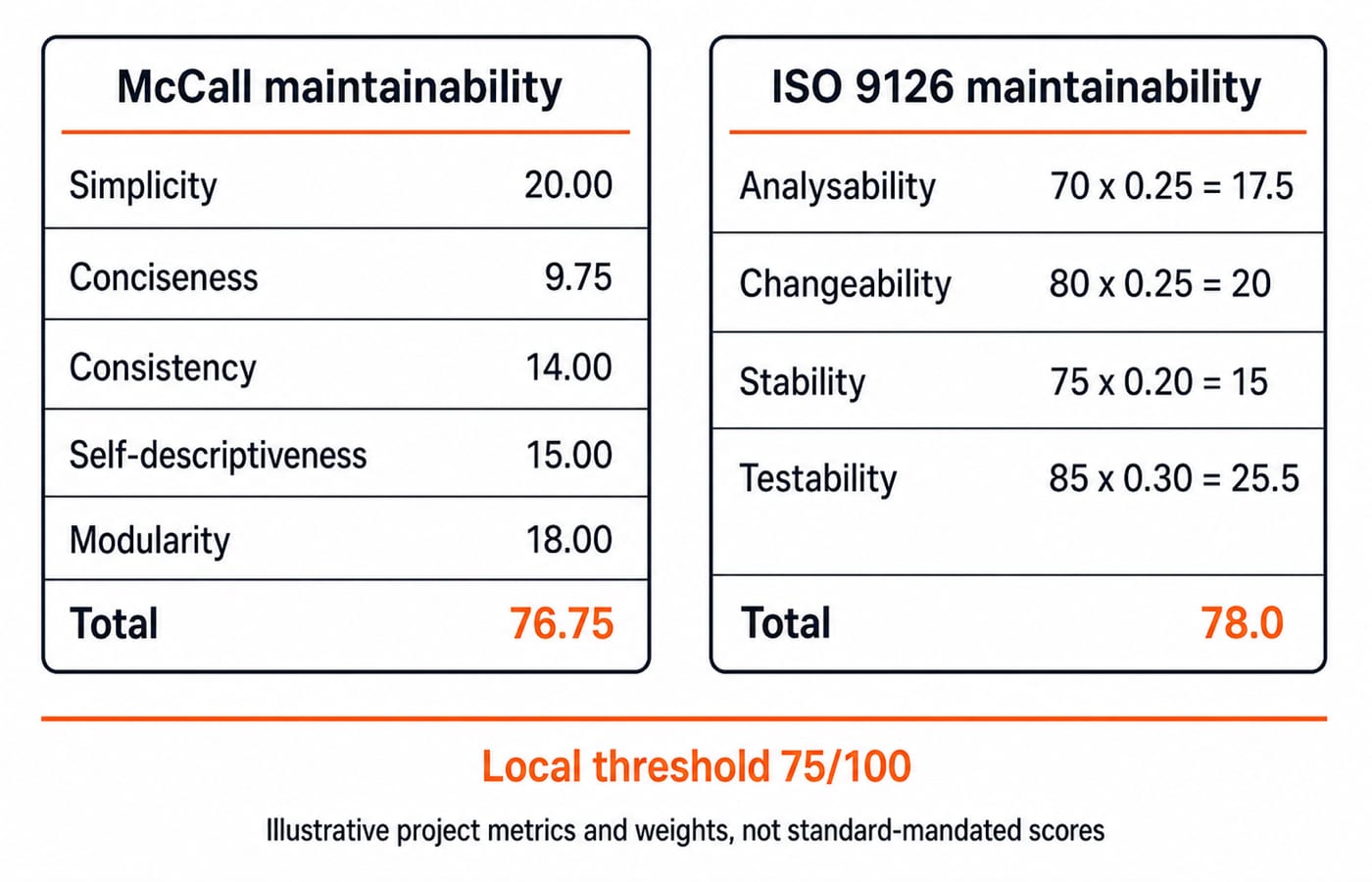
The same release can be expressed through four ISO 9126 maintainability subcharacteristics. Here, every score comes from a fixed operational observation.
Subcharacteristic | Operational observation | Score | Weight |
|---|---|---|---|
Analysability | 14/20 fault-localisation tasks completed within 30 minutes | 70 | 0.25 |
Changeability | 16/20 change requests completed within the team’s effort target | 80 | 0.25 |
Stability | 15/20 regression scenarios unaffected by the changes | 75 | 0.20 |
Testability | 17/20 changed units directly covered by executable tests | 85 | 0.30 |
The team’s illustrative weighted calculation is:
70 x 0.25 + 80 x 0.25 + 75 x 0.20 + 85 x 0.30
= 17.5 + 20 + 15 + 25.5 = 78.0/100
Suppose this project sets a local acceptance line of 75/100. The McCall-style score is 76.75, and the ISO-style score is 78.0, so both clear that project threshold. This does not make the constructs interchangeable. ISO 9126 does not prescribe these measures, weights or the threshold.
McCall vs ISO 9126: map similarities without forcing one-to-one matches
Map the overlap carefully:
McCall factor | Closest ISO 9126 home | Boundary |
|---|---|---|
Correctness | Functionality, especially suitability and accuracy | Not identical |
Reliability | Reliability | Direct match |
Efficiency | Efficiency | Direct match |
Integrity | Functionality, especially security | Nested security |
Usability | Usability | Direct match |
Maintainability and testability | Maintainability | Nested testability |
Portability | Portability | Direct match |
Interoperability | Functionality, especially interoperability | Nested interoperability |
Flexibility and reusability | No exact one-to-one top-level ISO 9126 characteristic | No forced match |
Both are hierarchical. McCall groups factors by operation, revision and transition; ISO 9126 uses characteristics and subcharacteristics, plus quality in use. The IBPS SO IT Officer Software Engineering Professional Knowledge guide shows the same traps elsewhere.
Quality-factor exam patterns and traps: classify, match and recalculate
Questions commonly ask you to place a McCall factor under its perspective, match an ISO characteristic with a subcharacteristic, distinguish product quality from quality in use, or recompute a weighted score after one input changes.
The key distinctions are:
Where is interoperability in McCall? Product transition.
Is integrity part of McCall reliability? No. It is a separate product-operation factor.
Where does analysability belong in ISO 9126? Maintainability.
Where does effectiveness belong? Quality in use.
What if modularity falls from
0.90to0.50at weight0.20? The reduction is0.20 x 0.40 = 0.08, so the total falls from0.7675to0.6875, or68.75/100.
For the wider route, use UGC NET CS Exam Preparation. For application practice, continue with the UGC NET Computer Science and Applications Test Series. Our practice bank has about 20 live questions on this topic, so you can drill the calculation until it is automatic.
Quality factors: the short version and next step
Retrieve McCall as three perspectives and eleven factors, followed by factor -> criterion -> metric. Retrieve ISO 9126 as six product characteristics, their subcharacteristics, and a separate quality-in-use view. The scores 76.75 and 78.0 show how two vocabularies can assess one release without becoming interchangeable constructs. For full Software Engineering coverage, continue with NTA-UGC-NET Paper - 2. For this concept alone, redraw both tables and then recompute 68.75 without looking.
Keep learning

ICT in Education MCQs: 12 Solved Questions on Digital Learning Tools
Solve 12 ICT in Education MCQs, then use clear explanations and a five-layer model to separate files, tools, platforms and public initiatives.
Updated 3 Oct 20268 min readUGC NET Computer Science

Requirements Elicitation Techniques and Use Case Development: Worked Library Example
Follow a fictional library reservation from interviews and observation through testable requirements, a UML use-case model, UC-07, and acceptance checks.
Updated 28 Sep 20266 min readUGC NET Computer Science

Cohesion and Coupling MCQs: 10 Solved Questions on Functional Independence
Practise 10 solved MCQs on cohesion, coupling, functional independence, module dependencies, and the distinctions that make closely matched options easier to separate.
Updated 24 Sep 20267 min readUGC NET Computer Science

Cryptography and Digital Security Technologies: Encryption, Hashes, Signatures and Mobile Security
Learn what encryption, hashes, MACs and signatures actually guarantee. Follow a full RSA calculation and map layered controls onto a mobile payment path.
Updated 23 Sep 20265 min readUGC NET Computer Science