

COCOMO and Cost Estimation Models MCQs: 12 Solved Questions
Test your COCOMO basics with 12 solved MCQs. Each answer explains model levels, effort and duration equations, unit conversion, cost drivers and common traps.
KnowledgeGate Team
Exam prep & CS education
Updated 11 Nov 20267 min read
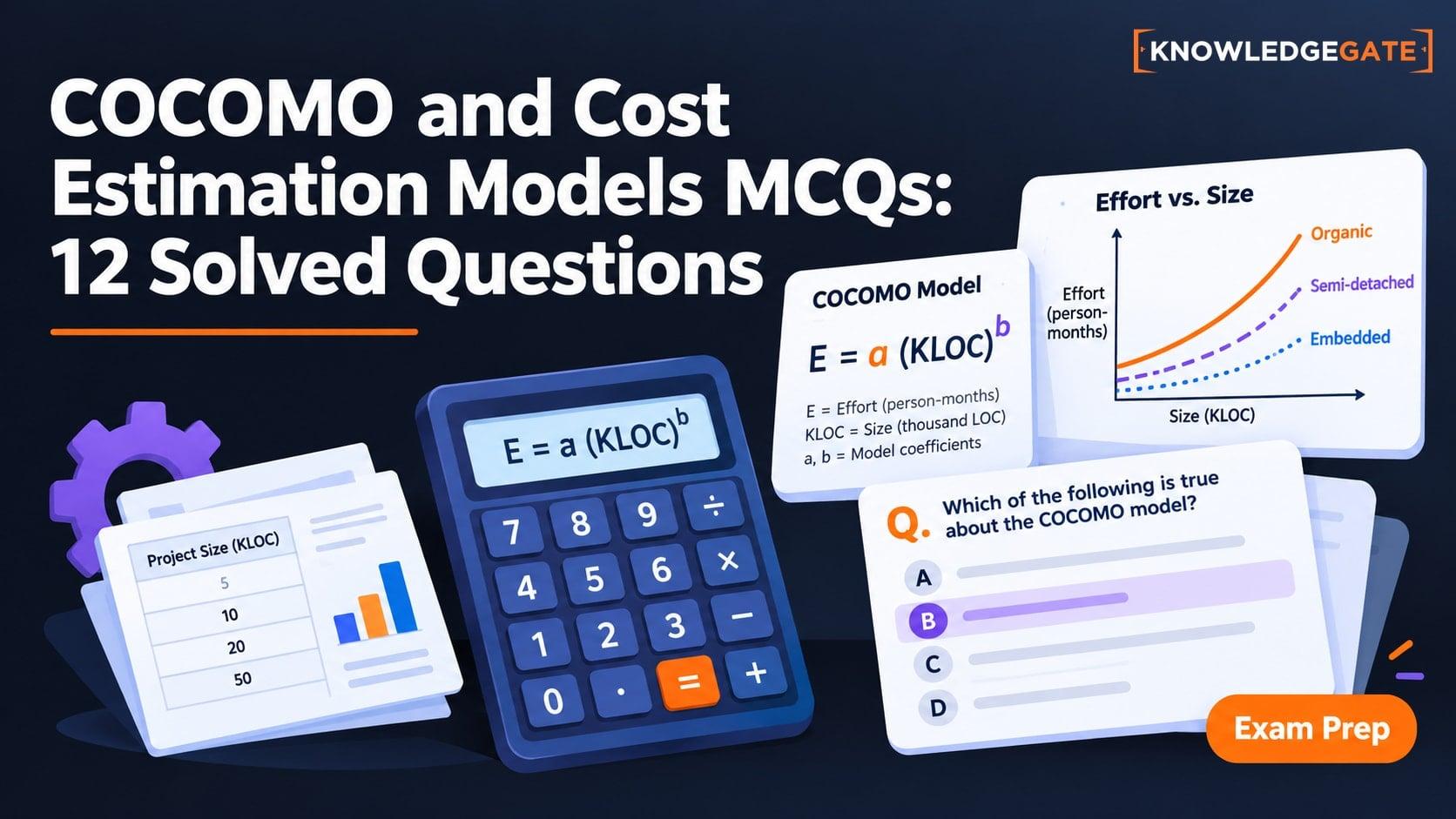
COCOMO questions mix vocabulary, model levels, coefficients, units and powers. COCOMO involves both concepts and calculations; choose an option before checking each answer.
Use Estimation and Scheduling in Software Engineering for the end-to-end workflow from function points and LOC through COCOMO, CPM and PERT. Solve the 12 questions below for the narrower skill of identifying cost-estimation methods and calculating COCOMO effort and duration. Answer links open the exact question when a stable page exists and otherwise open the COCOMO practice page.
Build the estimation map before attempting the MCQs
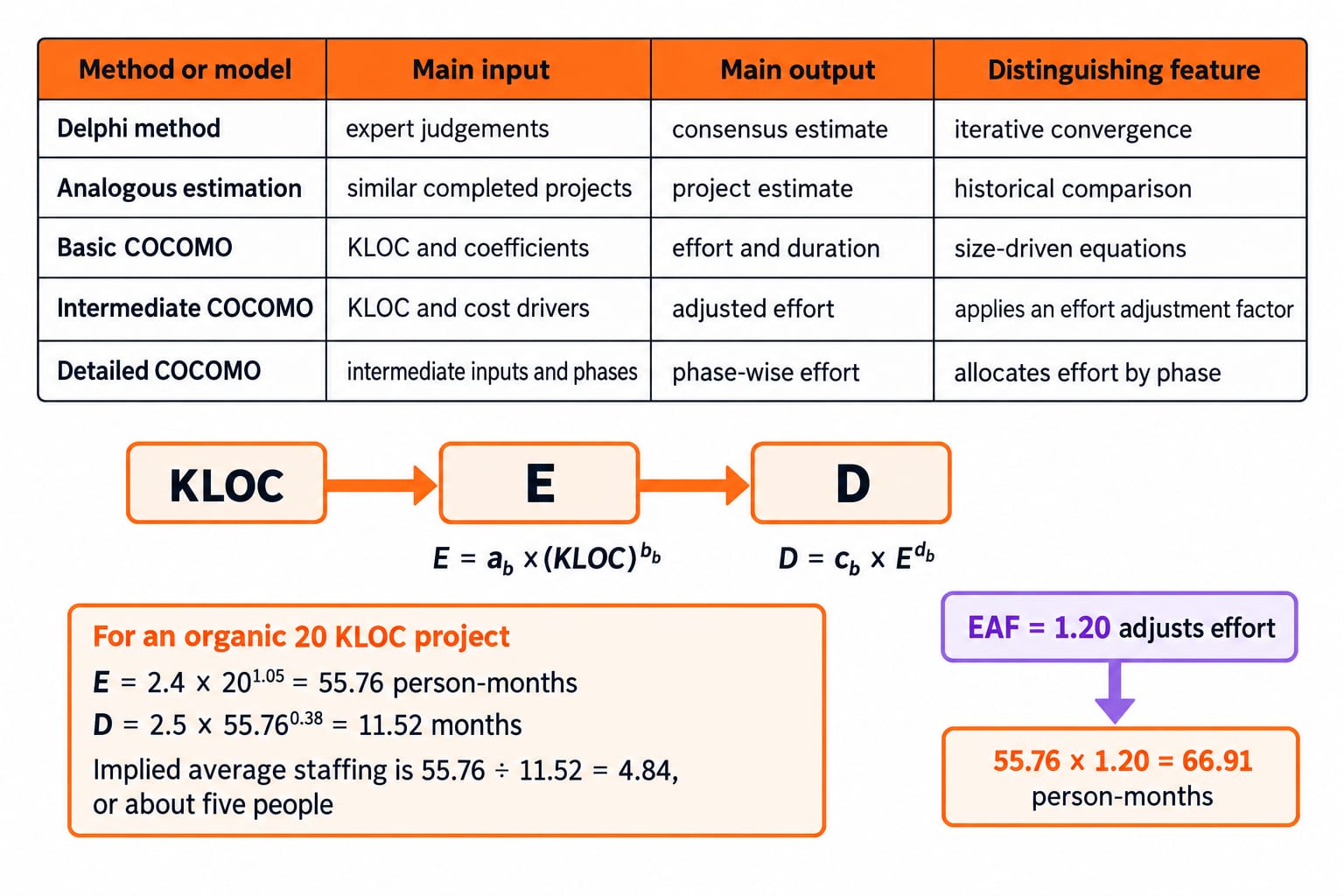
COCOMO uses size to estimate effort and duration. Delphi elicits a consensus from expert estimates, while analogous estimation transfers evidence from a similar completed project.
Method or model | Main input | Main output | Distinguishing feature |
|---|---|---|---|
Delphi method | expert judgements | consensus estimate | iterative convergence |
Analogous estimation | similar completed projects | project estimate | historical comparison |
Basic COCOMO | KLOC and coefficients | effort and duration | size-driven equations |
Intermediate COCOMO | KLOC and cost drivers | adjusted effort | applies an effort adjustment factor |
Detailed COCOMO | intermediate inputs and phases | phase-wise effort | allocates effort by phase |
For an organic 20 KLOC project, use E = a_b × (KLOC)^(b_b) and D = c_b × E^(d_b):
E = 2.4 × 20^1.05 = 55.76 person-months.D = 2.5 × 55.76^0.38 = 11.52 months.Implied average staffing is
55.76 ÷ 11.52 = 4.84, or about five people.
Illustratively, EAF = 1.20 adjusts effort to 55.76 × 1.20 = 66.91 person-months.
COCOMO MCQs 1-2: name and estimation target
Question 1
Bank attribution: UGC NET, Computer Science, December 2022.
COCOMO stands for
A. Consumed cost model
B. Constructive cost model
C. Common control model
D. Composition cost model
Answer: B. Constructive cost model.
COCOMO expands to COnstructive COst MOdel. It estimates effort and schedule from project size and coefficients; the other choices are not its name.
Question 2
Bank attribution: Bihar STET, Computer Science, 2025.
Delphi and COCOMO are techniques used for estimating:
A. Software size
B. Software reliability
C. Software complexity
D. Software development cost
Answer: D. Software development cost.
Delphi aggregates expert judgement; COCOMO calculates effort from size and parameters. Both support development-cost estimation. Size may be an input, but reliability and complexity are different targets.
Cost estimation MCQs 3-4: expert judgement and historical analogy
Question 3
Bank attribution: Bihar STET, Computer Science, 2025.
The Cost Estimation technique that involves expert judgments and consensus is called:
A. COCOMO
B. Delphi Method
C. Waterfall Model
D. Prototype Model
If experts estimate 40, 55 and 70 person-months, share reasons anonymously, then revise to 54, 56 and 55, they have used Delphi. COCOMO is algorithmic; Waterfall and Prototype are development processes.
Question 4
Bank attribution: TPSC, Computer Science, Programmer, 2026.
Which estimating technique uses historical data from similar projects?
A. Delphi technique
B. COCOMO model
C. Function point analysis
D. Analogous estimation
Answer: D. Analogous estimation.
A similar 24 KLOC project requiring 60 person-months gives a first estimate of 60 × 30 ÷ 24 = 75 person-months for 30 KLOC. A historical peer anchors analogous estimation; the other methods use experts, equations or functional size.
COCOMO MCQs 5-6: model outputs and the intermediate model
Question 5
Bank attribution: GATE, Computer Science, Information Technology, 2004.
In a software project, COCOMO (Constructive Cost Model) is used to estimate
A. effort and duration based on the size of the software
B. size and duration based on the effort of the software
C. effort and cost based on the duration of the software
D. size, effort and duration based on the cost of the software
In the 20 KLOC example, size is the input; E = 55.76 person-months and D = 11.52 months are outputs. Cost may then be derived from effort and a rate.
Question 6
Bank attribution: IBPS, 2023.
Which of the following statements is TRUE regarding the COCOMO?
A. COCOMO completely ignores cost drivers such as hardware and personnel factors.
B. COCOMO is mainly designed for managing Agile sprint backlogs and scrum cycles.
C. Intermediate COCOMO refines software effort estimation using cost drivers.
D. COCOMO estimates software quality using normalization and dependency analysis only.
E. COCOMO is primarily used for real-time packet scheduling in operating systems.
Answer: C. Intermediate COCOMO refines software effort estimation using cost drivers.
With nominal effort 55.76 and EAF = 1.20, Intermediate COCOMO gives 55.76 × 1.20 = 66.91 person-months. It adds cost drivers; the other options describe unrelated purposes or deny those drivers.
Basic COCOMO MCQs 7-8: equations and organic coefficients
Question 7
Bank attribution: GATE, Computer Science, Set 2, 2015.
Consider the basic COCOMO model, where E is the effort in person-months, D is the development time in chronological months, KLOC is the delivered source lines of code in thousands, and a_b, b_b, c_b, and d_b have their usual meanings. The basic COCOMO equations are of the form:
A. E = a_b × (KLOC)^(b_b), D = c_b × E^(d_b)
B. D = a_b × (KLOC)^(b_b), E = c_b × D^(d_b)
C. E = (a_b)^(b_b), D = c_b × (KLOC)^(d_b)
D. E = (a_b)^(d_b), D = c_b × (KLOC)^(b_b)
Follow KLOC → E → D: size enters the effort equation, and effort enters the duration equation. The other options reverse this order or omit the size term.
Question 8
Bank attribution: UGC NET, Computer Science, June 2025.
Estimation of software development effort for organic software in basic COCOMO is
A. E = 2.4 × (KLOC)^1.05 PM
B. E = 3.4 × (KLOC)^1.06 PM
C. E = 2.0 × (KLOC)^1.05 PM
D. E = 2.4 × (KLOC)^1.07 PM
Answer: A. E = 2.4 × (KLOC)^1.05 PM.
Organic-mode Basic COCOMO uses a_b = 2.4 and b_b = 1.05. Thus 2.4 × 20^1.05 = 55.76 person-months, matching A. Memorise coefficients as a mode-specific pair.
COCOMO MCQs 9-10: recover project size and calculate embedded effort
Question 9
Bank attribution: UGC NET, Computer Science, August 2024.
Given a project that uses the COCOMO model with an estimated effort of 2000 person-months and a productivity rate of 5 person-month per KLOC, what is the estimated size of the project in KLOC?
A. 200
B. 400
C. 100
D. 50
Divide effort by productivity: 2000 person-months ÷ 5 person-months/KLOC = 400 KLOC. Person-months cancel, leaving KLOC; multiplying would produce the wrong units.
Question 10
Bank attribution: Indian Space Research Organization, Computer Science, 2016.
A company needs to develop digital signal processing software for one of its newest inventions. The software is expected to have 20,000 lines of code. The company needs to determine the effort in person-months needed to develop this software using the basic COCOMO model. The multiplicative factor for this model is given as 2.2 for the software development on embedded systems, while the exponentiation factor is given as 1.50. What is the estimated effort in person-months?
A. 196.77
B. 206.56
C. 199.56
D. 210.68
Convert 20,000 LOC = 20 KLOC. Then E = 2.2 × 20^1.50; because 20^1.50 = 20 × √20 = 89.4427, effort is 2.2 × 89.4427 = 196.774 person-months, or 196.77.
COCOMO MCQs 11-12: calculate duration from LOC and function points
Question 11
Bank attribution: UGC NET, Computer Science, November 2017.
A simple stand-alone software utility is to be developed in C by a team of software experts for a computer running Linux. Its size is estimated at 20,000 lines of code. For the Basic COCOMO effort equation, use (a, b) = (2.4, 1.05); for the development-time equation, use (c, d) = (2.5, 0.38). Approximately how long will the project take to complete?
A. 10.52 months
B. 11.52 months
C. 12.52 months
D. 14.52 months
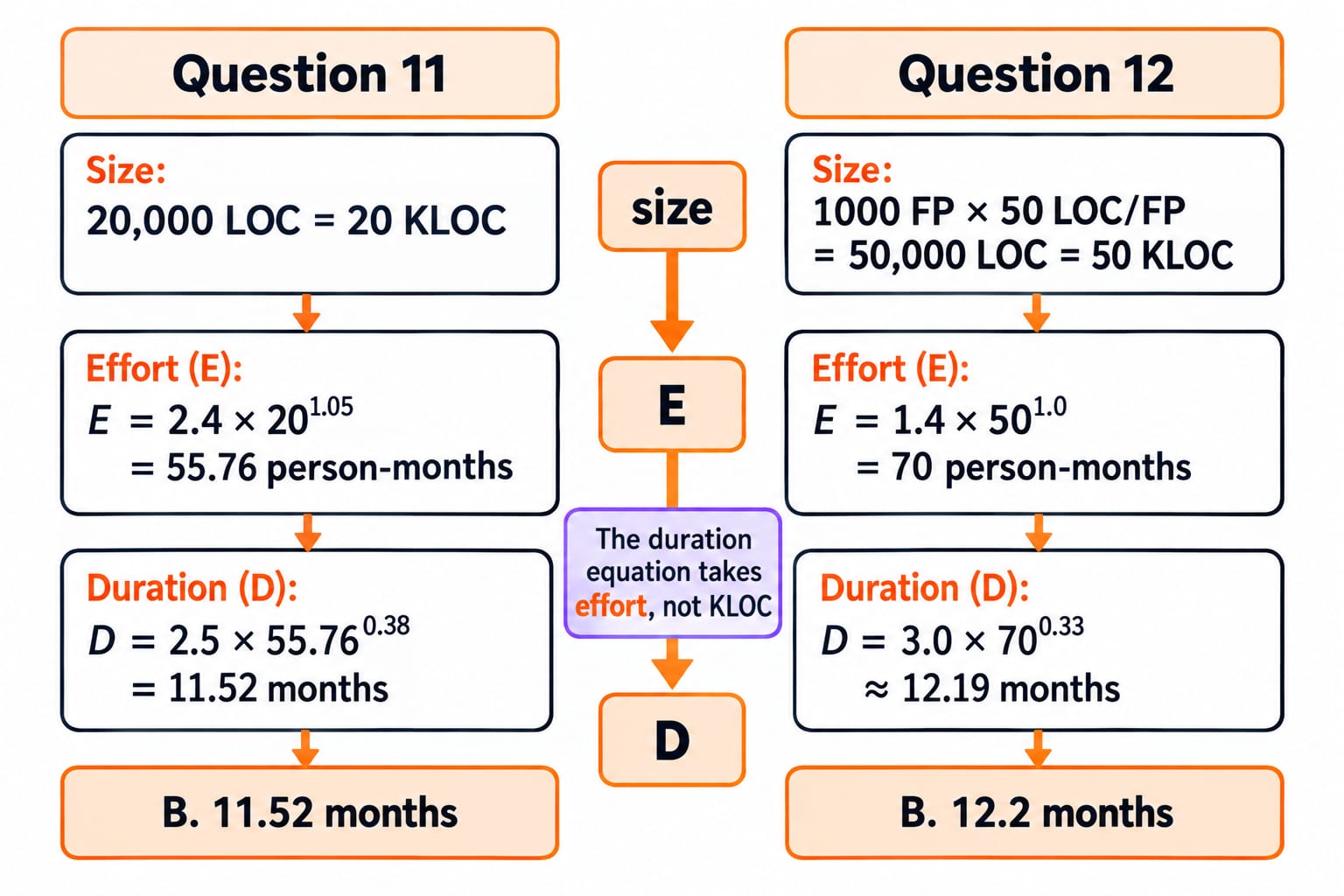
Use both stages: 20,000 LOC = 20 KLOC, so E = 2.4 × 20^1.05 = 55.76 person-months; then D = 2.5 × 55.76^0.38 = 11.52 months. The duration equation takes effort, not KLOC.
Question 12
Bank attribution: UGC NET, Computer Science, January 2017.
A software project is estimated at 1,000 function points and will use Java, with an accepted average of 50 lines of code per function point. For the Basic COCOMO effort equation, use a = 1.4 and b = 1.0; for the duration equation, use c = 3.0 and d = 0.33. Approximately how long will the project take to complete?
A. 11.2 months
B. 12.2 months
C. 13.2 months
D. 10.2 months
Convert first: 1000 FP × 50 LOC/FP = 50,000 LOC = 50 KLOC. Then E = 1.4 × 50^1.0 = 70 person-months and D = 3.0 × 70^0.33 ≈ 12.19 months, rounding to 12.2.
Diagnose the misses and choose the next practice step
For misses on Questions 1, 2 or 5, rebuild the input-output map. For 3 or 4, contrast expert judgement with analogy. For 6-8, rewrite KLOC → E → D; for 9-12, practise units, powers and two-stage calculations.
Redo all 12 tomorrow in 18 minutes, then rework Questions 10-12. Continue with NTA-UGC-NET Paper - 2, take the UGC NET Computer Science and Applications Test Series by Sanchit Sir, or browse UGC NET CS Exam Preparation.
Go deeper with the full courseUGC NET Computer Science (Paper 1 + Paper 2)
Keep learning
Estimation and Scheduling in Software Engineering: COCOMO, PERT and CPM Worked Examples
Follow one project from functional size to modelled effort and duration, then solve a dependency network, PERT uncertainty and schedule compression.
Updated 26 Jul 20267 min read82 viewsUGC NET Computer Science
McCall’s and ISO 9126 Quality Factors MCQs: 12 Solved Questions with Explanations
Solve 12 published MCQs on McCall’s model, ISO 9126, software measures and the ISO 25010 trap. Each answer includes a direct exam-focused explanation.
Updated 18 Nov 20267 min readUGC NET Computer Science
Prescriptive Process Models MCQs: 12 Solved Questions on Waterfall, Spiral and Incremental Models
Solve 12 MCQs on Waterfall, Spiral and Incremental models. Use sequence, risk, change and release cues to distinguish the models under exam pressure.
Updated 16 Nov 20267 min readUGC NET Computer Science
Agile Process Models MCQs: 12 Solved Questions on XP, Scrum and Adaptive Development
Solve 12 published agile process model MCQs, then use the explanations to separate Scrum roles, XP practices, adaptive planning, FDD order and agile values.
Updated 29 Oct 20267 min readUGC NET Computer Science