

SCM Change Control and Version Control MCQs: 10 Solved Questions
Solve 10 SCM MCQs with clear explanations of change control, version control, Git, audit trails, repository contents, releases, and variants.
KnowledgeGate Team
Exam prep & CS education
Updated 18 Nov 20267 min read
SCM, change control, version control, releases, variants, and audit trails overlap, but they answer different questions. Many learners recognise each term alone, then lose the mark when a stem tests its scope or a tool boundary. KnowledgeGate has 20+ questions live in its practice bank for this SCM subtopic. The questions test SCM scope, Git workflows, and the distinctions among versions, releases, and variants.
How to use this SCM MCQ set
Answer all 10 questions before reading the explanations. For a combination question, mark every statement true or false before choosing. Each time, identify the managed item and requested action, then decide whether it belongs to configuration management, change control, version control, an audit trail, or another tool.
Questions 1, 5 and 9 open directly on their verified question pages. The remaining question links open the relevant SCM module because those individual pages are unavailable. The NET CS category provides the broader course and practice route.
SCM scope and its four objectives, Questions 1-2
Question 1
Software Configuration Management is the discipline for systematically controlling

A. the changes due to the evolution of work products as the project proceeds.
B. the changes due to defects (bugs) being found and then fixed.
C. the changes due to requirement changes
D. all of the above
Answer: D, all of the above.
SCM controls changes whatever their trigger. CR-27 adds CSV export, BUG-81 corrects tax rounding, and REQ-014 raises the threshold from 5000 to 7500. All affect controlled work products needing identity, history, review, and a reproducible state. The trap is limiting SCM to bugs or requirements.
Question 2
A process which defines a series of tasks that have the following four primary objectives is known as
1. to identify all items that collectively define the software configuration.
2. to manage changes to one or more of these items.
3. to facilitate the construction of different versions of an application.
4. to ensure that software quality is maintained as the configuration evolves over time.

A. Software Quality Management Process
B. Software Configuration Management Process
C. Software Version Management Process
D. Software Change Management Process
Answer: B, Software Configuration Management Process.
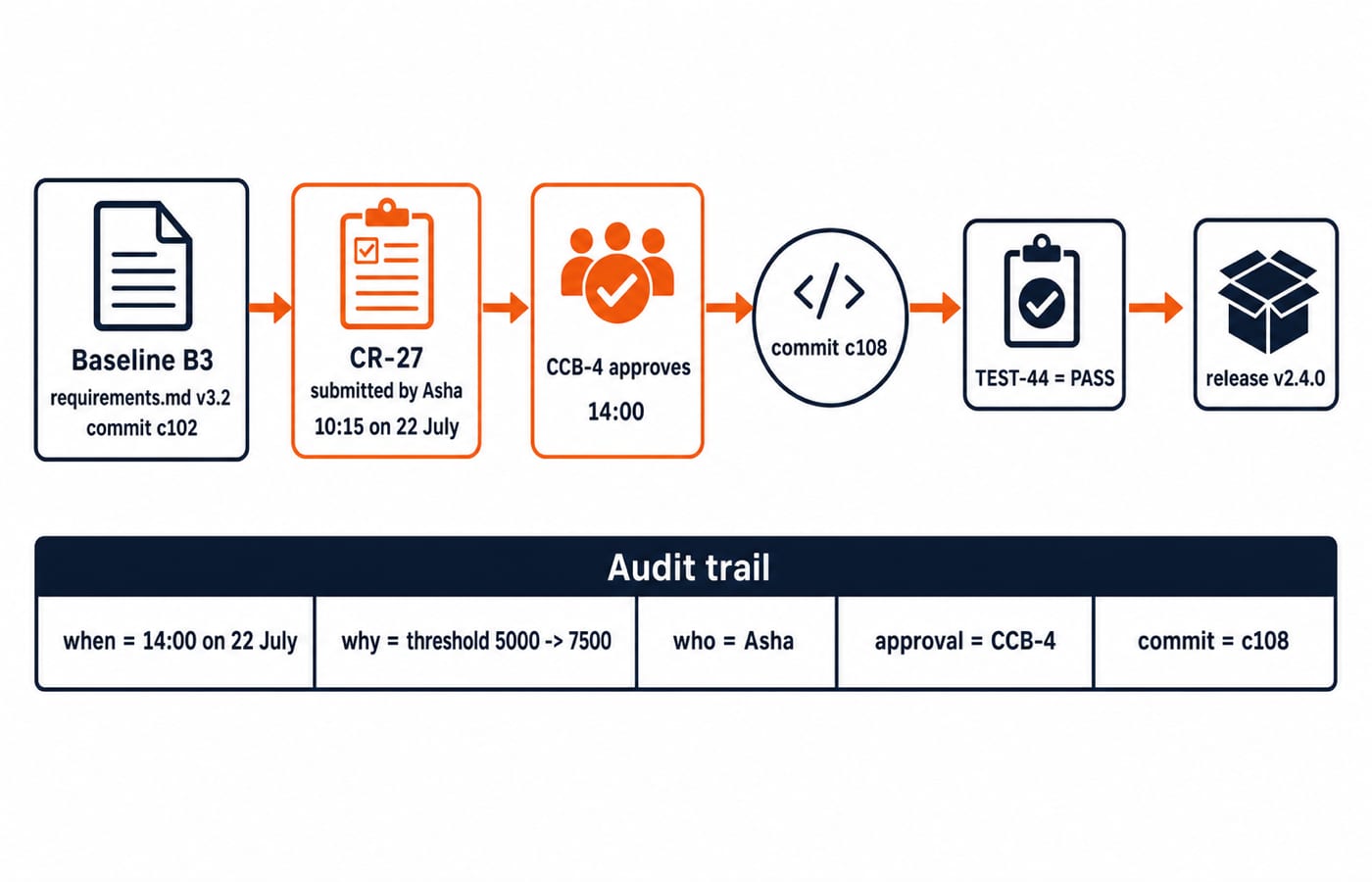
Map the objectives in order: (1) identify REQ-014, SRC-220, and TEST-44; (2) review CR-27; (3) build v2.4.0 from B3; (4) run TEST-44, record PASS, then advance to B4.
The alternatives are narrower: version management handles versions, change management handles proposals, and Software Quality in Software Engineering covers quality. SCM coordinates all four.
Configuration boundaries and audit trails, Questions 3-4
Question 3
Configuration management is not concerned with

A. controlling changes to the source code
B. choice of hardware configuration for an application
C. controlling documentation changes
D. maintaining versions of software
Answer: B, choice of hardware configuration for an application.
An architect chooses linux-x64 with 8 GB RAM. SCM versions deploy-linux.yaml, source, documentation, and build v2.4.0-linux-x64. Choosing 8 GB rather than 16 GB is an architecture or deployment decision. The shared word "configuration" is the trap. SCM controls software work products.
Question 4
UGC NET 2012 and 2013, Question 4
______ establishes information about when, why and by whom changes are made in a software.

A. Software Configuration Management
B. Change Control
C. Version Control
D. An Audit Trail
Answer: D, An Audit Trail.
For CR-27, record when = 14:00 on 22 July, why = threshold 5000 to 7500, who = Asha, approved by = CCB-4, and implemented in = c108. Change control decides whether it proceeds, version control stores states, and the audit trail preserves when, why, and who.
Git and source-code management tool boundaries, Questions 5-6
Question 5
Which of the following terms best describes Git?

A. Issue Tracking System
B. Integrated Development Environment
C. Distributed Version Control System
D. Web-based Repository Hosting Service
Answer: C, Distributed Version Control System.
A repository contains c101 -> c102. Mira and Dev clone its history, and Mira creates local c103 before pushing. That is the distributed property. An issue tracker records BUG-81, an IDE edits code, and a hosting service supports collaboration. Git can use that service, but is not the service.
Question 6
Which one of the following is not typically provided by Source Code Management Software ?

A. Synchronisation
B. Versioning and Revision history
C. Syntax highlighting
D. Project forking
Answer: C, Syntax highlighting.
Capability | Typical provider |
|---|---|
Synchronisation | SCM software |
Versioning and revision history | SCM software |
Project forking or branch collaboration | SCM software |
Syntax highlighting for | Illustrative editor |
An IDE may show both feature sets. Integration does not make syntax highlighting a source-control function.
What belongs in a repository and what version control supports, Questions 7-8
Question 7
In the context of Software Configuration Management (SCM), what kind of files should be committed to your source control repository?
A. Code files
B. Documentation files
C. Output files
D. Automatically generated files that are required for your system to be used
Choose the correct answer from the options given below:

A. A and B only
B. B and C only
C. C and D only
D. D and A only
Answer: A, A and B only.
Commit inputs src/tax.js and docs/tax-rule.md; regenerate dist/app.js outside this repository. Statement D is tempting, but the key tests the source-and-documentation rule. A team may track a generated artefact when delivery or reproducibility policy requires it. That exception does not change the answer.
Question 8
In Software Configuration Management (SCM), which of the following is a use-case supported by standard version control systems ?
(a) Managing several versions or releases of a software
(b) Filing bug reports and tracking their progress
(c) Allowing team members to work in parallel
(d) Identifying when and where a regression occurred
Code :

A. Only (a), (c), and (d)
B. Only (a), (b), and (c)
C. Only (a), (b), and (d)
D. Only (b), (c), and (d)
Answer: A, Only (a), (c), and (d).
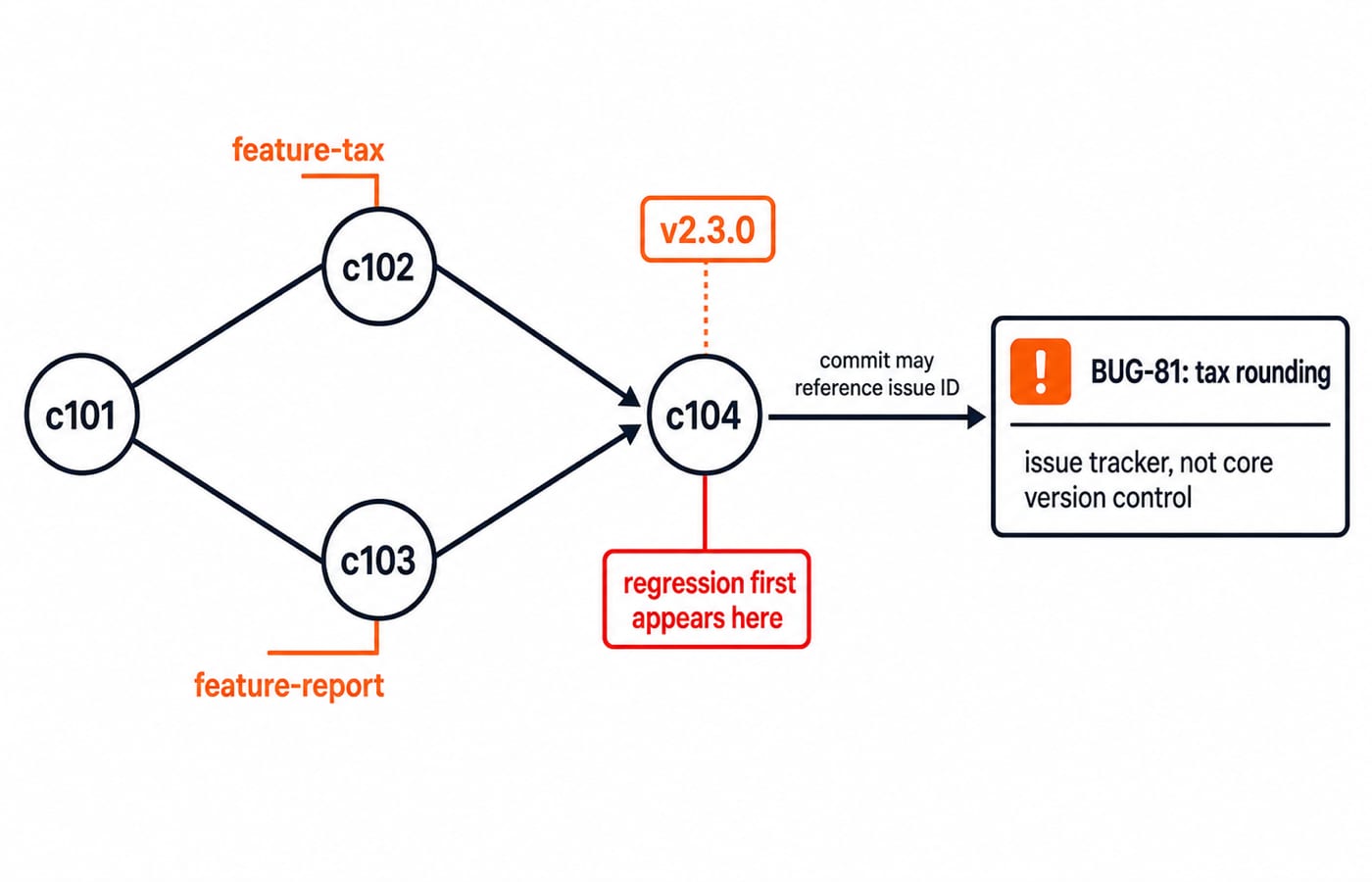
Tag v2.3.0 supports (a). Branches feature-tax and feature-report support parallel work, so (c) holds. Comparing c101, c102, and c104 finds a regression first present at c104, supporting (d). Progressing BUG-81 belongs to an issue tracker. Commits may mention it, but (b) is not a core VCS use case.
Version, release, and variant distinctions, Questions 9-10
Question 9
Match the terms related to Software Configuration Management (SCM) in List I with the descriptions in List II.

List I
I. Version
II. Release
III. Variant

List II
A. An instance of a system that is distributed to customers
B. An instance of a system which is functionally identical to other instances but designed for different hardware/software instances.
C. An instance of a system that differs, in some way, from other instances

Codes :

A. I-B; II-C; III-C
B. I-C; II-A; III-B
C. I-C; II-B; III-A
D. I-B; II-A; III-C
Answer: B, I-C; II-A; III-B.
v2.4.1 differs from v2.4.0, so version maps to C. R-2026.07 reaches customers, so release maps to A. Builds linux-x64 and windows-x64 provide identical functions on different platforms, so variant maps to B. The tuple is I-C; II-A; III-B.
Question 10
Which of the following is/are CORRECT statement(s) about version and release ?
I. A version is an instance of a system, which is functionally identical but nonfunctionally distinct from other instances of a system.
II. A version is an instance of a system, which is functionally distinct in some way from other system instances.
III. A release is an instance of a system, which is distributed to users outside of the development team.
IV. A release is an instance of a system, which is functionally identical but nonfunctionally distinct from other instances of a system.

A. I and III
B. II and IV
C. I and IV
D. II and III
Answer: D, II and III.
V18 adds CSV export over V17, so II fits version. R18 reaches users, so III fits release. I and IV use the variant description. A version can become a release, but the terms differ: V18-rc1 may stay internal while approved R18 crosses the distribution boundary.
Answer key, error diagnosis, and the next practice step
Question | Answer |
|---|---|
Q1 | D |
Q2 | B |
Q3 | B |
Q4 | D |
Q5 | C |
Q6 | C |
Q7 | A |
Q8 | A |
Q9 | B |
Q10 | D |
Diagnose by cluster. Q1-Q2 test SCM scope. Q3-Q4 separate decisions, control, and evidence. Q5-Q6 test tool boundaries. Q7-Q8 test repository and VCS responsibilities. Q9-Q10 test version, release, and variant language.
Retake all 10 in 12 minutes. For each miss, put CR-27, c108, v2.4.0, or R-2026.07 beside the correct term, then retry that two-question cluster. Continue with NTA-UGC-NET Paper - 2 for guidance and the NTA UGC NET Paper - 2 Test Series for practice. The IBPS SO IT Officer: Software Engineering PK Guide gives another applied context, without implying identical coverage.
The short version: SCM controls the evolving configuration, change control governs proposed modifications, version control preserves parallel histories and recoverable states, and an audit trail records when, why, and by whom a change happened.
Go deeper with the full courseUGC NET Computer Science (Paper 1 + Paper 2)
Keep learning
Software Configuration Management (SCM): Change Control, Version Control and a Worked Baseline Example
Git records changes, but SCM governs the complete controlled system. Follow CR-042 from an approved baseline through impact analysis, commits, tests, audit and release.
Updated 29 Aug 20266 min readUGC NET Computer Science
Software Configuration Management in Software Engineering: Baselines, Versioning and Change Control
Follow CampusLib CR-17 from impact analysis and approval through version control, build 42, configuration audits, rollback, and baseline B1.1.
Updated 8 Aug 20266 min readUGC NET Computer Science
Programmed I/O MCQs: 10 Solved Questions on Polling, CPU Time and Bus Control
Solve 10 Programmed I/O objective questions, including two step-by-step numericals, with clear explanations of polling, CPU involvement and bus control.
Updated 29 Oct 20267 min readComputer Organization MCQs

SSA and Control Flow MCQs: 10 Solved Questions with Step-by-Step Explanations
Practise ten SSA and control-flow questions from GATE and TPSC papers, then check a worked proof for every answer. Temporary counts, total names, CFG edges and backpatch lists each count differently.
Updated 30 Oct 20268 min readCompiler Design MCQs