Projection and Clipping MCQs: 12 Solved PYQs on Perspective, Parallel Views and Volume Trimming
Solve 12 projection and clipping PYQs, then revise the geometry behind perspective, orthographic, oblique and view-volume questions.
KnowledgeGate Team
Exam prep & CS education
Updated 23 Aug 20268 min read
Perspective projection changes apparent size with depth; parallel projection does not, and clipping keeps only geometry inside the view volume. Most errors come from mixing a projection's invariants with the perspective divide or checking only one clipping boundary. Answer each question before reading its explanation, then continue with UGC NET CS Exam Preparation or each linked solution.
1. Perspective vs parallel projection
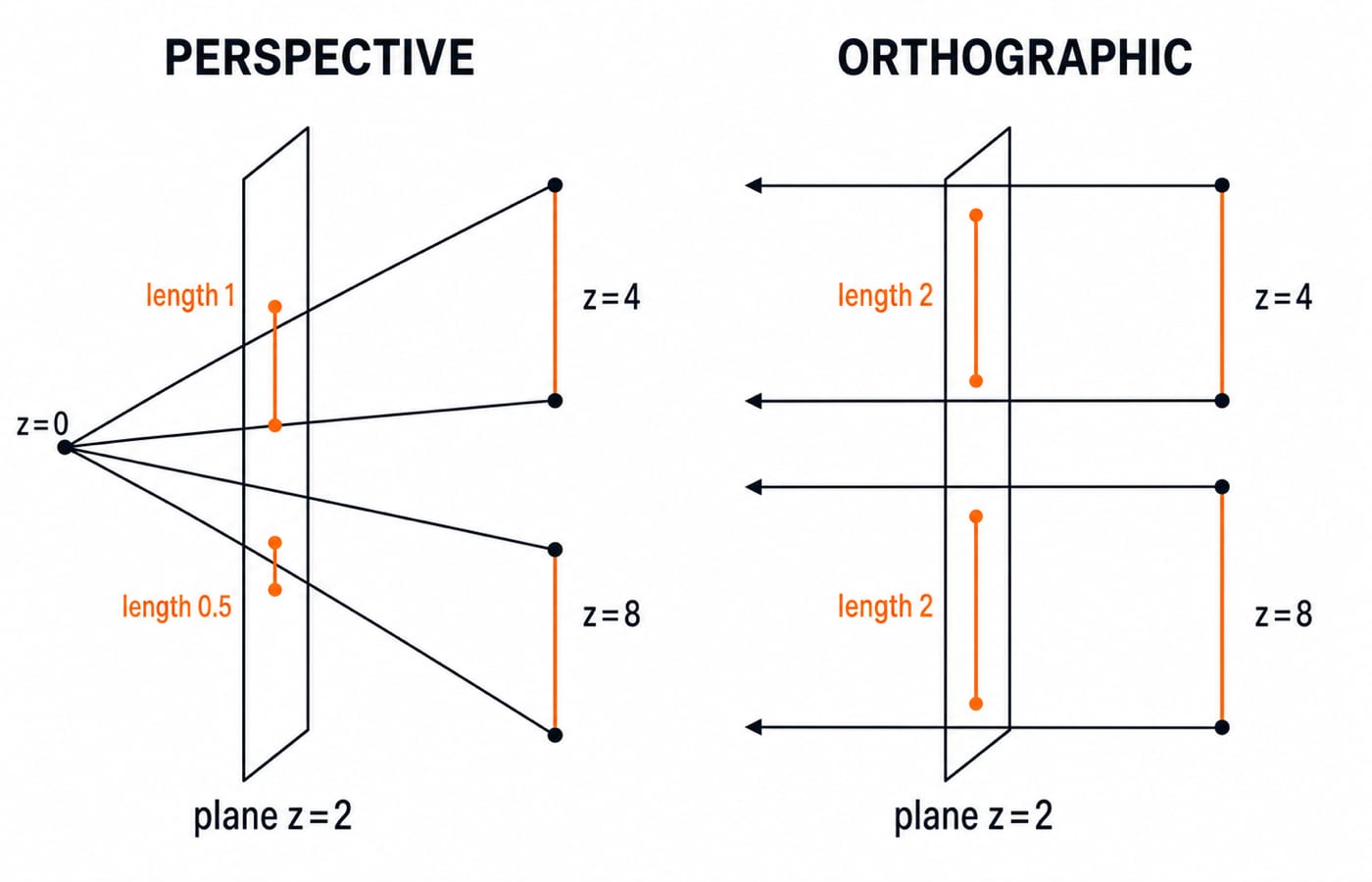
Perspective has a finite centre, converging projectors and depth-dependent size. Parallel projection preserves parallelism and depth-independent size. Both preserve lines. See UGC NET Computer Science High-Yield Topics.
For d=2, (x',y')=(dx/z,dy/z): (6,4,8)->(1.5,1) and (6,4,16)->(0.75,0.5). Doubling depth halves size; parallel projection keeps (6,4).
2. Projection property MCQs
Q1
UGC NET 2020, Computer Science, June
Given below are different properties of 3D projections from A-D. Identify the correct order on the basis of property true of (i) a perspective projection only, (ii) an orthographic projection only, (iii) both orthographic and projective transformations and (iv) neither orthographic nor projective transformation, respectively.
(A) Straight lines are mapped to straight lines
(B) Distances and angles are (in general) preserved
(C) Far away objects appear the same size as closer ones
(D) Requires homogeneous coordinates in order for it to be encoded into a linear transformation
Choose the correct answer from the options given below:
A. D,C,B,A
B. B,C,D,A
C. D,C,A,B
D. C,D,B,A
Answer: C. D,C,A,B. D is perspective-only because homogeneous coordinates are needed to express the transformation before the final divide. C belongs to orthographic projection, A holds for both, and ordinary distances and angles in B are not generally preserved by either.
Q2
UGC NET 2020, Computer Science, June
In the context of 3𝐷 Computer graphics, which of the following statements is/are correct?
(A) Under perspective projection, each set of parallel lines in the object do not stay parallel in the image (except those that are parallel to the viewplane to start with).
(B) Applying a perspective transformation in the graphics pipeline to a vertex involves dividing by its ′𝑧′ coordinate
(C) Perspective transformation is a linear transformation
Choose the correct answer from the options given below:
A. (A) and (B) Only
B. (A) and (C) Only
C. (B) and (C) Only
D. (A), (B) and (C)
Answer: A. (A) and (B) Only. Parallel lines not parallel to the view plane converge after perspective projection, and the final coordinates are divided by depth. That depth-dependent divide makes the Cartesian mapping nonlinear, so statement C is false.
Q3
UGC NET 2019, Computer Science, June
In the context of 3D computer graphics, which of the following statements is/are true?
P : Orthographic transformations keep parallel lines parallel.
Q : Orthographic transformations are affine transformations.
Select the correct answer from the options given below:
A. Both P and Q
B. Neither P nor Q
C. Only P
D. Only Q
Answer: A. Both P and Q. Orthographic projection uses parallel projectors and is an affine map. Affine maps preserve parallel lines, so both P and Q are true.
Q4
UGC NET 2018, Computer Science, December
In 3𝐷 Graphics, which of the following statements about perspective and parallel projection is/are true?
P : In a perspective projection, the farthest an object is from the center of projection, the smaller it appears
Q : Parallel projection is equivalent to a perspective projection where the viewer is standing infinitely far away
R : Perspective projections do not preserve straight lines.
A. P and Q only
B. P and R only
C. Q and R only
D. P, Q and R
Answer: A. P and Q only. Apparent size decreases with distance in perspective projection, and moving the viewer to infinity produces parallel projectors. Projective transformations still map straight lines to straight lines, so R is false.
3. Perspective distortion and vanishing-point MCQs
Q5
UGC NET 2016, Computer Science, August
In perspective projection (from 3D to 2D), objects behind the centre of projection are projected upside down and backward onto the view-plane. This is known as _____.
A. Topological distortion
B. Vanishing point
C. View confusion
D. Perspective foreshortening
Answer: C. View confusion. A point behind the centre of projection reaches the view plane with reversed orientation. That upside-down, backward result is view confusion, not ordinary perspective foreshortening.
Q6
UGC NET 2016, Computer Science, June
In perspective projection, if a line segment joining a point which lies in front of the viewer to a point in back of the viewer is projected to a broken line of infinite extent. This is known as _______.
A. View confusion
B. Vanishing point
C. Topological distortion
D. Perspective foreshortening
Answer: C. Topological distortion. The segment crosses the centre of projection, where the perspective denominator becomes zero. Its image therefore separates into two unbounded branches, which is topological distortion.
Q7
UGC NET 2015, Computer Science, June
Give the number of principal vanishing point(s) along with their direction for the standard prospective transformation :
A. Only one in the direction K
B. Two in the directions i and j
C. Three in the directions I, J and K
D. Only two in the directions J and K
Answer: A. Only one in the direction K. In the standard perspective transformation, lines parallel to the K direction meet at one finite principal vanishing point. The I and J directions remain parallel to the view plane, so they do not add finite principal vanishing points.
Q8
ISRO 2013, Computer Science
In graphics, the number of vanishing points depends on
A. the number of axes cut by the projection plane
B. the centre of projection
C. the number of axes which are parallel to the projection plane
D. the perspective projections of any set of parallel lines that are not parallel to the projection plane
Answer: A. the number of axes cut by the projection plane. Each principal axis that cuts the projection plane contributes one finite vanishing point. An axis parallel to the plane does not converge to a finite point in the image. See the solved question.
4. Parallel-projection MCQs
Orthographic projectors are perpendicular; oblique are not. Cavalier uses full receding scale and Cabinet half.
Q9
UGC NET 2025, Computer Science, June
Match List I with List II

List I | List II
A. Oblique    Projection | I. When the direction of projection is so chosen that the lines perpendicular to the plane of projection are foreshortened.
B. Cavelier Projection | II. When the direction of projection is so chosen that there is no foreshortening of lines perpendicular to the plane of projection.
C. Cabinet Projection | III. When the direction of projection is perpendicular to the plane of projection.
D. Orthographic Projection | IV. When the angle between the projectors and the plane of projection is not equal to 90°.

Choose the correct answer from the options given below:
A. A-III, B-II, C-IV, D-I
B. A-IV, B-II, C-I, D-III
C. A-III, B-I, C-IV, D-II
D. A-IV, B-I, C-III, D-II
Answer: B. A-IV, B-II, C-I, D-III. Oblique projectors meet the plane at a non-right angle, Cavalier keeps full receding scale, and Cabinet foreshortens the receding direction. Orthographic projectors are perpendicular, giving A-IV, B-II, C-I and D-III.
Q10
UGC NET 2014, Computer Science, December
Match the following:

List I | List II
a. Cavalier Projection | i. The direction of projection is chosen so that there is no foreshortening of lines perpendicular to the xy plane.
b. Cabinet Projection | ii. The direction of projection is chosen so that lines perpendicular to the xy plane are foreshortened by half their lengths.
c. Isometric Projection | iii. The direction of projection makes equal angles with all of the principal axes.
d. Orthographic Projection | iv. Projections are characterized by the fact that the direction of projection is perpendicular to the view plane.

Codes:
A. a-i, b-iii, c-iv, d-ii
B. a-ii, b-iii, c-i, d-iv
C. a-iv, b-ii, c-iii, d-i
D. a-i, b-ii, c-iii, d-iv
Answer: D. a-i, b-ii, c-iii, d-iv. Cavalier keeps full scale along the receding axis, while Cabinet halves it. Isometric projection uses equal angles to the principal axes and orthographic projection uses perpendicular projectors, so the mapping is a-i, b-ii, c-iii, d-iv.
Q11
UGC NET 2017, Computer Science, November
Which of the following is not true in case of Oblique Projections ?
A. Parallel projection rays are not perpendicular to the viewing plane.
B. Parallel lines in space appear parallel on the final projected image.
C. Used exclusively for pictorial purposes rather than formal working drawings.
D. Projectors are always perpendicular to the plane of projection.
Answer: D. Projectors are always perpendicular to the plane of projection. Oblique projection uses parallel rays at a non-right angle to the viewing plane, and parallel lines remain parallel in the image. Perpendicular projectors define orthographic projection, so option D is the statement that is not true of oblique projection.
5. Clipping MCQ
Q12
UGC NET 2021, Computer Science
Given below are two statements Statement
I: The maximum number of sides that a triangle might have when clipped to a rectangular viewport is 6. Statement
II: In 3D graphics, the perspective transformation is nonlinear in z.
In light of the above statements, choose the correct answer from the options given below
A. Both Statement I and Statement II are true
B. Both Statement I and Statement II are false
C. Statement I is true but Statement II is false
D. Statement I is false but Statement II is true
Answer: D. Statement I is false but Statement II is true. The intersection of a convex triangle and a rectangle can have up to 3+4=7 sides, so Statement I is false. After the perspective divide, the transformed depth contains a reciprocal-depth term, so Statement II is true.
In -2<=x<=2, -1<=y<=1, 1<=z<=10, segment A=(1,0,4) to B=(3,0,4) has P(t)=(1+2t,0,4) for 0<=t<=1. The x bounds give -3/2<=t<=1/2, which intersects the segment interval as 0<=t<=1/2. Because y=0 satisfies both y planes and z=4 satisfies both z planes throughout, the retained segment runs from A to (2,0,4).
6. Quick checking routine
First name the projection: perspective uses a Cartesian divide, orthographic uses perpendicular parallel rays, and oblique uses angled parallel rays. Next mark the invariant before checking options: perspective keeps straight lines but changes scale with depth, while parallel views preserve parallelism and depth-independent scale. For clipping, parameterise the primitive, solve every boundary inequality, and retain only their common parameter interval. For exam context, see UGC NET vs GATE Computer Science: Key Differences.
Keep learning

Ecosystem Fundamentals MCQs: 10 Solved Questions on Meaning and Ecological Organisation
Solve 10 ecosystem MCQs with clear explanations of ecological organisation, productivity, sustainability, environmental ethics, energy balance and conservation.
8 Sep 20268 min readMCQ Practice

Architectural and Component Design MCQs: 12 Solved Questions
Solve 12 bank MCQs on software architecture, component roles, repositories, MVC, DFDs, structure charts and UML, each with a direct worked explanation.
Updated 6 Sep 20268 min readMCQ Practice

C++ Constructors MCQs: 12 Solved Object-Initialization Questions
Solve 12 published C++ constructor questions by tracing object creation, copy semantics, arrays, access, virtual rules, and dynamic allocation.
Updated 5 Sep 20267 min readMCQ Practice

Clipping Algorithms MCQs: 11 Solved Cohen-Sutherland and Cyrus-Beck Questions
Solve 11 clipping questions with fresh explanations, checked outcodes, line classifications, boundary intersections and a practical revision routine.
Updated 3 Sep 20268 min readMCQ Practice