Introduction to Viewing MCQs and Problems: 10 Solved Questions with Explanations
Solve ten UGC NET and ISRO questions on viewing coordinates, raster addresses, 2-D and 3-D mapping, visibility and Liang-Barsky clipping, worked step by step.
KnowledgeGate Team
Exam prep & CS education
Updated 21 Aug 20268 min read

Many learners remember the window-to-viewport formula but mix up world, viewing, normalized-device and physical-device coordinates, then lose marks on scale factors, inclusive pixel counts or Liang-Barsky signs, especially when a familiar question quietly changes the coordinate convention or mapping direction. Ten questions follow, seven objective and three worked problems, taken from UGC NET and ISRO papers, with every scale factor, bound and clipped endpoint computed from the numbers the question itself gives. Solve each one before reading its explanation, the method behind Why PYQs Beat Buying Another Question Bank. To attempt the same questions under test conditions, open the Introduction to Viewing PYQ questions module.
Introduction to viewing coordinate systems: identify each stage correctly
The pipeline is object or world coordinates, viewing or camera coordinates, clip and normalized-device coordinates, then viewport or device coordinates. Terminology varies, so follow the question's definitions.
Question 1: coordinate definitions
UGC NET 2015
Which of the following statements is/are incorrect ?
(a) Mapping the co-ordinates of the points and lines that form the picture into the appropriate co-ordinates on the device or workstation is known as viewing transformation
(b) The right-handed cartesian co-ordinates system in whose co-ordinates we describe the picture is known as world co-ordinate system
(c) The co-ordinate system that corresponds to the device or workstation where the image is to be displayed is known as physical device co-ordinate system
(d) Left-handed co-ordinate system in which the display area of the virtual display device corresponds to the unit square whose lower left-hand corner is at the origin of the co-ordinate system, is known as normalized device co-ordinate system
Codes :
A.
(a) onlyB.
(a) and (b)C.
(c) onlyD.
(d) only
Answer: D, (d) only. Statements (a), (b) and (c) are the standard definitions of the viewing transformation, the world coordinate system and the physical device coordinate system. Statement (d) is the incorrect one: the normalized device coordinate system is the unit square running from (0,0) to (1,1), so it is fixed by that range rather than by handedness, and the absolute-value region the option describes is not that square.
Attempt this exact question on its UGC NET 2015 coordinate-definitions question page.
Question 2: mapping direction
Which of the following statements is/are TRUE?
(i) Viewing coordinate system simulates the effect of moving camera.
(ii) The process of converting an object coordinate in world coordinate system to normalized device coordinate is called viewport-to-window mapping.
A.
Only (i)B.
Only (ii)C.
Both (i) and (ii)D.
Neither (i) nor (ii)
Answer: A, Only (i). A viewing frame models the camera's view; world-to-NDC conversion belongs to viewing and projection. Viewport mapping comes later, from a normalized or window region to the display viewport, so (ii) reverses and misnames it.
Frame-buffer addressing: count the inclusive width before multiplying
Question 3: row-major pixel address
Indian Space Research Organization 2014
A frame buffer array is addressed in row major order for a monitor with pixel locations starting from (0,0) and ending with (100,100). What is address of the pixel(6,10)? Assume one bit storage per pixel and starting pixel location is at 0.
A.
1016B.
1006C.
610D.
616
Answer: D, 616. Locations 0 through 100 make the inclusive width 101. The question treats (6,10) as (row,column), so the address is 6×101+10=606+10=616. An explicit (x,y) convention would reverse the tuple, so settle that before multiplying.
Window-to-viewport mapping: solve scale and translation together
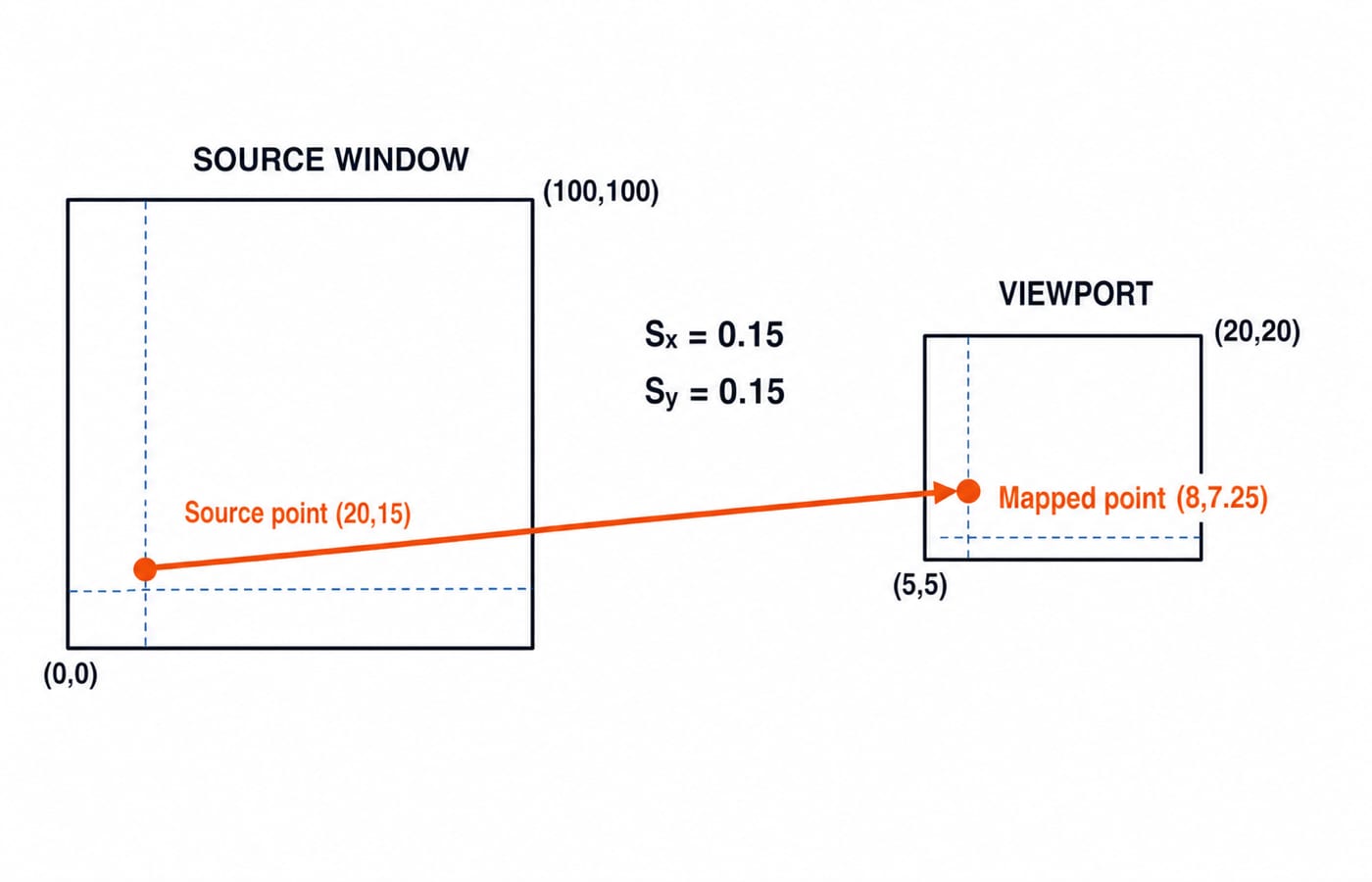
Use x_v=Xvmin+(x_w-Xwmin)(Xvmax-Xvmin)/(Xwmax-Xwmin), and the analogous y_v formula.
Question 4: window-to-viewport numerical
Indian Space Research Organization 2018
Perform window to viewport transformation for the point (20, 15). Assume that (Xwmin, Ywmin) is (0,0); (Xwmax, Ywmax) is (100,100); (Xvmin, Yvmin) is (5,5); (Xvmax, Yvmax) is (20,20). The value of x and y in the viewport is
A.
x = 4 , y = 4B.
x = 3 , y = 3C.
x = 8 , y = 7.25D.
x = 3 , y = 4
Answer: C, x = 8 , y = 7.25. Sx=Sy=(20-5)/(100-0)=0.15, so x_v=5+20(0.15)=8 and y_v=5+15(0.15)=7.25. Forgetting the translation 5 is the trap.
Question 5: derive the normalization matrix
UGC NET 2011
Subjective problem
Find the normalization transformation that maps a window with lower-left corner (1, 1) and upper-right corner (3, 5) onto a viewport with lower-left corner (0, 0) and upper-right corner (1/2, 1/2).
The window measures 3-1=2 across and 5-1=4 up, while the viewport measures 1/2 in both directions. So Sx=(1/2)/2=1/4 and Sy=(1/2)/4=1/8, which give xv=(x-1)/4 and yv=(y-1)/8. Written as one matrix acting on column vectors, translate by (-1,-1) first and scale second, and the product has rows (1/4, 0, -1/4), (0, 1/8, -1/8) and (0, 0, 1). Check both corners: (1,1) maps to (0,0) and (3,5) maps to (2/4, 4/8)=(1/2, 1/2), so the window fills the viewport exactly.
3-D window-to-viewport matrix: derive each entry
Question 6: normalized 3-D mapping matrix
UGC NET 2025
A normalized matrix that maps a 3D window specified by coordinates (1, 1, 1) and (4, 5, 6) on to a viewport specified by coordinates (2, 4, 2) and (8, 10, 8) is:
A.
[[2,0,0,0],[0,3/2,0,5/2],[0,0,6/5,4/5],[0,0,0,1]]B.
[[2,0,0,0],[0,3,0,5],[0,0,6,4],[0,0,0,1]]C.
[[2,1,0,1],[1,3,4,5],[0,0,2,4],[0,1,0,0]]D.
[[1,0,0,1],[2,3,0,5],[1,0,4,5],[0,0,0,1]]
Answer: A. Read option A as a 4x4 matrix acting on column vectors: its rows are (2, 0, 0, 0), (0, 3/2, 0, 5/2), (0, 0, 6/5, 4/5) and (0, 0, 0, 1), so the diagonal carries the scale factors and the last column carries the translations.
Scales are Sx=(8-2)/(4-1)=2, Sy=(10-4)/(5-1)=3/2, Sz=(8-2)/(6-1)=6/5. Translations are tx=2-2(1)=0, ty=4-(3/2)(1)=5/2, tz=2-(6/5)(1)=4/5. Corner checks are (1,1,1,1)->(2,4,2,1) and (4,5,6,1)->(8,10,8,1).
Visibility and shading terms: separate sorting, interpolation and depth
Question 7: Painter's algorithm, Gouraud shading and Z-buffer
UGC NET 2025
Which of the following statements are true.
A. Painters' algorithm is also called depth sort algorithm.
B. Gourad shading is on interpolating shading method.
C. Gourad shading is an averaging shading method.
D. The Z-buffer algorithm finds the largest depth value Z.
Choose the correct answer from the options given below:
A.
A, B OnlyB.
B, C OnlyC.
C, D OnlyD.
A, D Only
Answer: A, A, B Only. Painter's algorithm sorts the surfaces by depth and paints them far to near, which is why it is also called the depth-sort algorithm, so statement A is true. Gouraud shading computes an intensity at each vertex and interpolates those intensities across the polygon, so statement B is true and statement C misnames it: the averaging in Gouraud happens to the vertex normals, not to the shaded pixels. Statement D is false because the Z-buffer keeps whichever surface is nearest at each pixel, and that is the smallest depth value, not the largest.
Liang-Barsky clipping: move from bounds to visible endpoints
Use p=(-Delta x,Delta x,-Delta y,Delta y). Negative p updates entering u1, positive p updates leaving u2, and u1>u2 rejects.
Question 8: Liang-Barsky parameter bounds
UGC NET 2016
The Liang-Barsky line clipping algorithm uses the parametric equation of a line from (x1, y1) to (x2, y2) along with its infinite extension, which is given as :
x = x1 + (Delta x).u
y = y1 + (Delta y).u
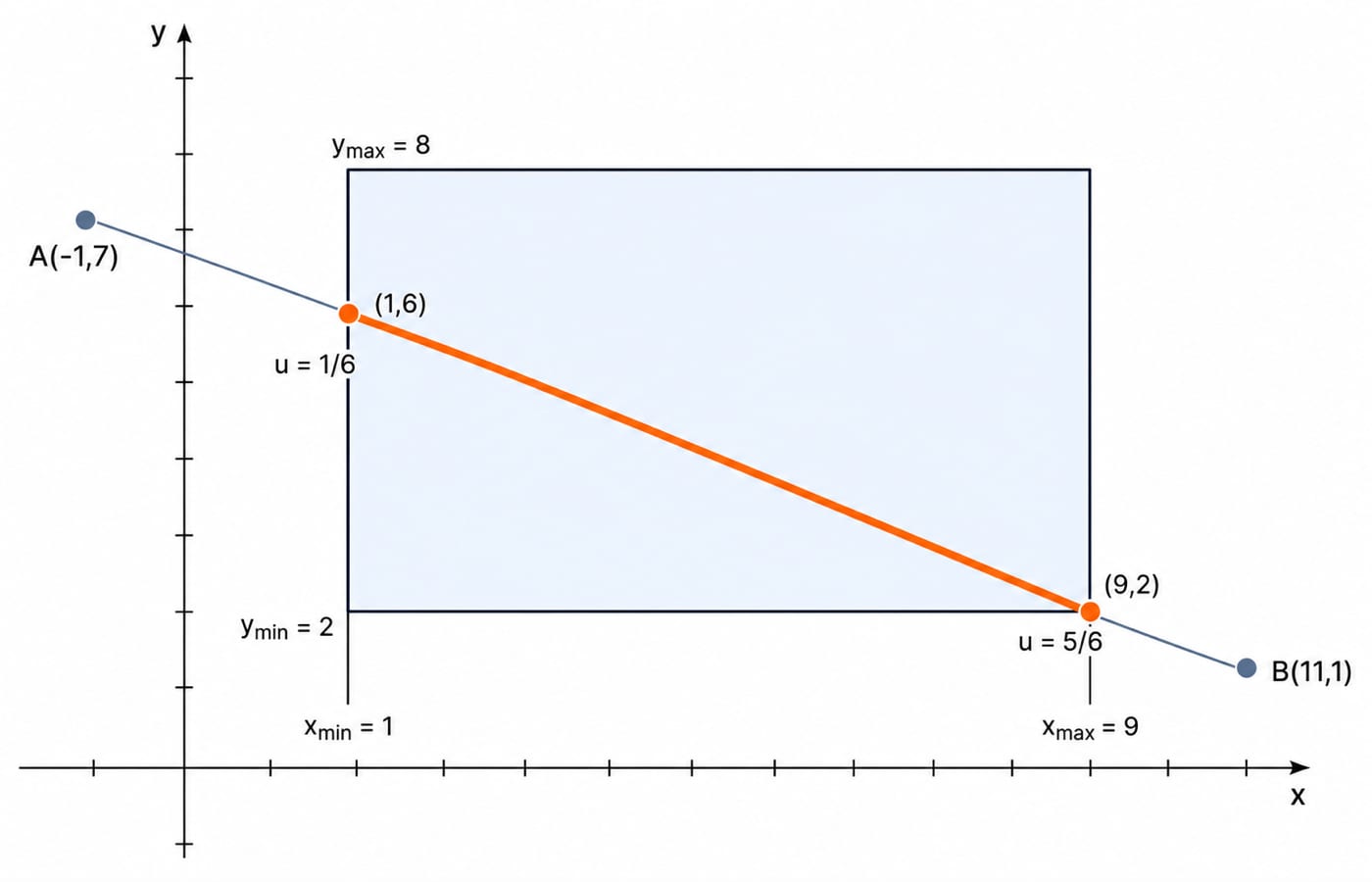
Where Delta x = x2 - x1, Delta y = y2 - y1, and u is the parameter with 0 <= u <= 1. A line AB with end points A(-1, 7) and B(11, 1) is to be clipped against a rectangular window with xmin = 1, xmax = 9, ymin = 2, and ymax = 8. The lower and upper bound values of the parameter u for the clipped line using Liang-Barsky algorithm is given as :
A.
(0, 2/3)B.
(1/6, 5/6)C.
(0, 1/3)D.
(0, 1)
Answer: B, (1/6, 5/6). Delta x=12, Delta y=-6, p=(-12,12,6,-6), q=(-2,10,5,1), giving ratios (1/6,5/6,5/6,-1/6). Hence u1=max(0,1/6,-1/6)=1/6, u2=min(1,5/6,5/6)=5/6. Substitution gives endpoints (1,6) and (9,2).
Question 9: explain Liang-Barsky and its advantage
Subjective problem
What is the Liang-Barsky line clipping algorithm? Explain the parametric equations and the use of the p and q inequalities to determine the clipping parameters u1 and u2. Highlight one major advantage this algorithm has over the Cohen-Sutherland algorithm.
Write x=x1+u Delta x, y=y1+u Delta y, 0<=u<=1. Use p=(-Delta x,Delta x,-Delta y,Delta y) and q=(x1-xmin,xmax-x1,y1-ymin,ymax-y1). Reject when p=0,q<0; negative p updates u1, positive p updates u2, and u1<=u2 is visible. Liang-Barsky narrows this interval first, usually requiring fewer intersection calculations than Cohen-Sutherland.
Question 10: calculate a clipped Liang-Barsky segment
Subjective problem
A clipping window is defined by the coordinates (XW_min = 1, YW_min = 1) and (XW_max = 10, YW_max = 10). Using the Liang-Barsky algorithm, determine the clipped portion of the line segment with endpoints P1(2, 2) and P2(12, 10). Show the calculation of pk, qk, and the parameters u1 and u2
Delta x=10, Delta y=8, p=(-10,10,-8,8), q=(1,8,1,8). Ratios (-0.1,0.8,-0.125,1) give u1=max(0,-0.1,-0.125)=0, u2=min(1,0.8,1)=0.8. Since u1<=u2, the segment is P(0)=(2,2) to P(0.8)=(2+8,2+6.4)=(10,8.4).
Introduction to viewing MCQ traps: five checks before choosing
Check | Concrete cue from this set |
|---|---|
Mapping direction | World-to-NDC is not viewport-to-window. |
Inclusive width |
|
Tuple convention | The question makes |
Scale and translation | Apply |
Entering and leaving | Bounds are |
The set spans viewing, clipping and visibility, so separate the operations instead of memorising answer letters. Use UGC NET Computer Science High-Yield Topics to place these topics in a revision cycle, and UGC NET Paper 1 vs Paper 2: what each tests to see why Computer Graphics sits on the Paper 2 side.
The short version: solve, recompute, then widen the syllabus
Use three passes: attempt without options, recompute numerical answers, then explain each rejected distractor in one line. Find nearby practice in UGC NET Preparation Courses & Test Series. For structured Computer Graphics coverage, continue with NTA-UGC-NET Paper - 2.
Keep learning

Ecosystem Fundamentals MCQs: 10 Solved Questions on Meaning and Ecological Organisation
Solve 10 ecosystem MCQs with clear explanations of ecological organisation, productivity, sustainability, environmental ethics, energy balance and conservation.
8 Sep 20268 min readMCQ Practice

Architectural and Component Design MCQs: 12 Solved Questions
Solve 12 bank MCQs on software architecture, component roles, repositories, MVC, DFDs, structure charts and UML, each with a direct worked explanation.
Updated 6 Sep 20268 min readMCQ Practice

C++ Constructors MCQs: 12 Solved Object-Initialization Questions
Solve 12 published C++ constructor questions by tracing object creation, copy semantics, arrays, access, virtual rules, and dynamic allocation.
Updated 5 Sep 20267 min readMCQ Practice

Clipping Algorithms MCQs: 11 Solved Cohen-Sutherland and Cyrus-Beck Questions
Solve 11 clipping questions with fresh explanations, checked outcodes, line classifications, boundary intersections and a practical revision routine.
Updated 3 Sep 20268 min readMCQ Practice