UGC NET vs GATE Computer Science: how the two exams differ and how to prepare both
UGC NET vs GATE Computer Science compared: purpose, question style, and depth, plus how the shared CS core lets you prepare both exams from one solid base.
KnowledgeGate Team
Exam prep & CS education
Updated 26 Jul 20265 min read96 views
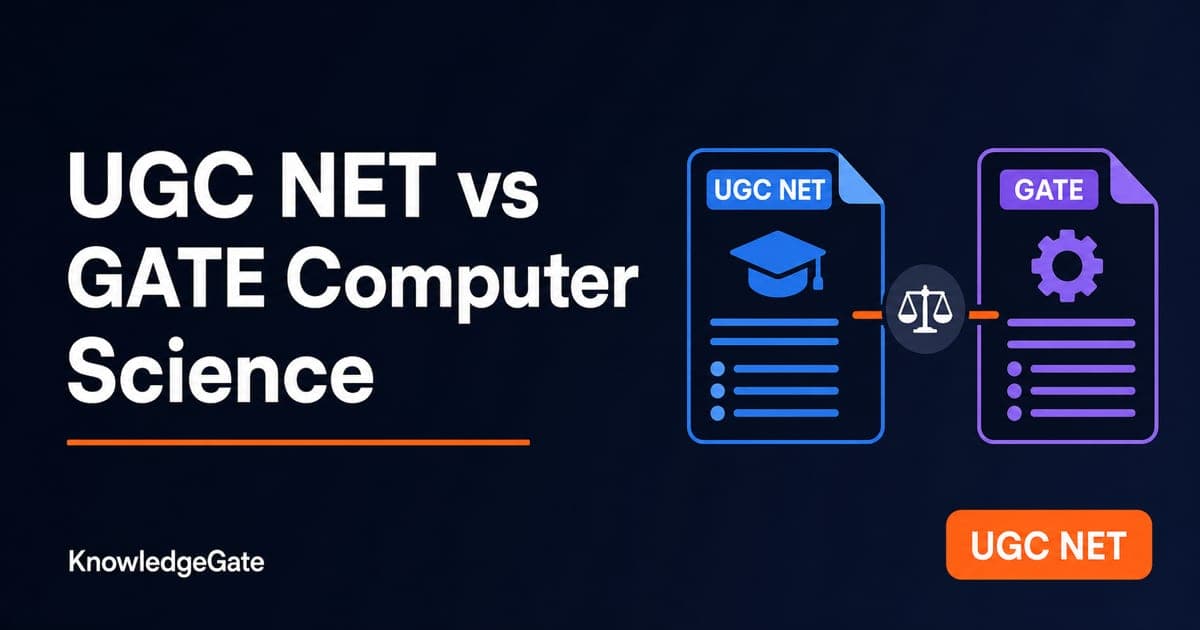
If you are a computer science graduate weighing higher study and a research or teaching career, two national exams keep coming up: UGC NET and GATE. They share most of a syllabus, which makes people assume they are interchangeable. They are not. They exist for different reasons, they ask questions in different styles, and understanding that difference is what lets you prepare both without wasting effort.
UGC NET vs GATE: different purpose, not just a different paper
The clearest difference is what each exam is for. GATE (the Graduate Aptitude Test in Engineering) primarily gates admission to postgraduate programmes such as M.Tech and M.S., and its score is widely used for recruitment to public-sector undertakings (PSUs). UGC NET, conducted by NTA, is an eligibility exam for the role of Assistant Professor and for the Junior Research Fellowship (JRF) that funds doctoral research.
So the two point at different futures. GATE leans toward PG admission and PSU recruitment; UGC NET leans toward college lectureship and funded research. Many CS graduates who want an academic path sit both, because a GATE score opens PG admission while a UGC NET (JRF) result opens the research-fellowship route.
UGC NET vs GATE Computer Science: question style and depth
The subjects overlap heavily, but the question style differs. GATE Computer Science is known for numerical depth: multi-step problems, calculation-heavy questions, and application of a concept to an unseen scenario. It rewards your ability to work through a problem, not merely recognise the idea.
Take page replacement in operating systems. A GATE-style problem may give you a reference string, a frame allocation, and a replacement policy, then ask you to trace the frame contents access by access and arrive at the resulting page-fault count. A NET-style question on the same topic is more likely to ask you to identify the defining rule of a policy, distinguish one policy from another, or match a behaviour with its correct name. Same syllabus line, two different demands.
UGC NET Computer Science leans more conceptual and factual across a broad surface. NET Paper 1 separately tests teaching aptitude, research aptitude, and the higher education system, none of which a GATE aspirant will have met. GATE does test general aptitude (verbal and numerical reasoning), but it has no paper of Paper 1's kind. Both are objective, but the flavour is different. The exact question counts, marking, and negative-marking rules for each sit in their respective notifications, so read those rather than assuming one carries over to the other.
A fair way to hold the difference in your head:
GATE Computer Science | UGC NET Computer Science | |
|---|---|---|
What it decides | PG admission (M.Tech, M.S.) and PSU recruitment. | Assistant Professor eligibility, and the JRF that funds doctoral work. |
Question style | Multi-step and numerical: trace a process, compute, arrive at a value. | Conceptual and factual: name the defining rule, tell two policies apart. |
Subject perimeter | Fewer subjects, examined to greater depth. | The same CS core, tested across a broader surface. |
Beyond the CS core | General aptitude: verbal and numerical reasoning, inside the same paper. | A separate Paper 1: teaching aptitude, research aptitude, and the higher education system. |
What preparation it rewards | Problem-solving reps on unseen scenarios. | Coverage and recall across the map, plus Paper 1 practice. |
The shared CS core lets you prepare both
Despite the different purpose and style, the subject spine is the same: database management systems, operating systems, computer networks, theory of computation, data structures, algorithms, computer organisation and architecture, and discrete mathematics. Learn a concept once, properly, and it serves both exams. What changes is the practice: for GATE you drill numerical, multi-step problems; for UGC NET you drill conceptual coverage and Paper 1 aptitude. The section-by-section map of exactly what transfers and what NET adds on top is in UGC NET CS vs GATE CS syllabus: overlap and extra topics.
That is why our subject teaching is shared across both tracks. The concept videos in GATE Guidance by Sanchit Sir teach the CS core that both exams draw on, and you can see the wider GATE line-up on the GATE Computer Science category page. For the UGC NET side, including the general Paper 1, the UGC NET Computer Science and Applications bundle packages both papers together.
How to prepare UGC NET and GATE together
If you are genuinely targeting both, sequence it so the shared work is done once:
Build the CS core to depth first. Study each subject to a level that survives a GATE-style follow-up: you should be able to trace a reference string through a page-replacement policy or run a safety check on paper, not only define the terms. Depth transfers down to NET; the reverse does not.
Add exam-specific practice on top. For GATE, numerical problem sets and previous-year problems worked end to end. For UGC NET, conceptual breadth across the whole map, plus Paper 1's teaching and research aptitude, which the GATE paper does not cover.
Give Paper 1 its own weekly slot. It is the block with the least GATE overlap, so it is the one that quietly rots if you leave it to the last month. Two or three hours a week from the start, treated as a subject rather than a chore, keeps it moving alongside the core. What Paper 1 asks, set next to Paper 2, is laid out in UGC NET Paper 1 vs Paper 2 explained.
Track the two calendars separately. Application windows and exam dates do not line up, and losing a deadline because you were buried in the other exam's syllabus is the cheapest mistake there is. Each authority publishes its own schedule and its own numbers.
A split that works over a year at both: give the first two-thirds of your calendar almost entirely to the shared core, subject by subject, with Paper 1 taking its two or three hours a week alongside. Move to a roughly even split between core revision and exam-specific practice only in the final third, once the core is stable enough that a wrong answer tells you something. Practice earlier than that mostly measures what you have not studied yet.
The mistake to avoid is treating the two as one exam with two names. The core is shared; the practice, the style, and the second NET paper are not. Plan for one core and two finishing routines.
The short version
UGC NET and GATE Computer Science share a subject spine but split on purpose (lectureship and JRF versus PG admission and PSU), on style (conceptual breadth versus numerical depth), and on Paper 1, which only NET has. Prepare the CS core once through GATE Guidance by Sanchit Sir, then add exam-specific practice, and take the packaged NET path from the UGC NET Computer Science and Applications bundle. Confirm every official number on the exam's own authority: NTA at ugcnet.nta.nic.in for NET, and the organising IIT's portal for GATE.
Keep learning
Cloud Computing Explained: Service Models, Worked Calculations and Exam Traps
Build a clean cloud-computing concept map, classify common scenarios, and solve VM-hour, availability and replicated-storage calculations step by step.
Updated 26 Oct 20265 min readUGC NET Computer Science
Windows System Keys Explained: Shortcut Meanings, a Worked Workflow and Exam Traps
Learn what Windows system keys do, how neighbouring shortcuts differ, and how to trace a two-desktop workflow without losing track of the final state.
Updated 25 Oct 20265 min readUGC NET Computer Science

Society, Law and Ethics in ICT: Concepts, Worked Example and Exam Traps
Learn a three-lens method for separating social impact, legal requirements and ethical judgment in ICT, then apply it to an exact hypothetical AI-proctoring audit.
Updated 24 Oct 20265 min readUGC NET Computer Science
Function Keys F1-F12 Explained: Uses, Worked Shortcut Map and Exam Traps
Learn what F1 through F12 do in named Windows and Microsoft application contexts, then solve a nine-command classification and avoid common modifier traps.
Updated 20 Oct 20266 min readUGC NET Computer Science