Clipping Algorithms MCQs: 11 Solved Cohen-Sutherland and Cyrus-Beck Questions
Solve 11 clipping questions with fresh explanations, checked outcodes, line classifications, boundary intersections and a practical revision routine.
KnowledgeGate Team
Exam prep & CS education
Updated 3 Sep 20268 min read
Clipping questions look visual, but most answers turn on a four-bit outcode, a bitwise test or one parameter. Memorising names without drawing the window can make you reverse top, bottom, right and left, or confuse line clipping with polygon clipping.
Clipping problems test purpose and terminology, Cohen-Sutherland decisions, candidate-line classification, Cyrus-Beck parameters and boundary intersections. Attempt every option before reading its explanation. For more practice, use the Introduction to Clipping topic hub. For the wider Computer Science route, use the UGC NET Preparation Courses & Test Series.
Related reading: line clipping algorithms and projection and viewing.
Clipping algorithms: the minimum concept sheet before the MCQs
Clipping keeps a graphical primitive's part inside a window and rejects its part outside. Line and polygon clipping process their boundaries; point and text clipping test other primitive types.
Algorithm | Main use |
|---|---|
Cohen-Sutherland | Line clipping |
Liang-Barsky | Line clipping |
Cyrus-Beck | Line clipping |
Nicholl-Lee-Nicholl | Line clipping |
Sutherland-Hodgman | Polygon clipping |
Use Top Bottom Right Left, or TBRL: centre 0000, top 1000, bottom 0100, right 0010 and left 0001. Two 0000 codes mean accept; a non-zero AND means reject; otherwise, calculate intersections.
For x_min = 0, x_max = 8, y_min = 0, y_max = 5, point A(9, 2) violates only the right boundary, so A = 0010. Point B(3, -1) violates only the bottom boundary, so B = 0100. Since 0010 AND 0100 = 0000, the segment AB cannot be rejected outright and clipping is required.
Clipping algorithms MCQs 1-3: purpose, technique and region-code width
Question 1
UPPSC Polytechnic Lecturer, 2022
Which of the following is known as clipping in computer graphics?
A. Removing objects and lines
B. Copying
C. Adding graphics
D. Zooming
Answer: A. Removing objects and lines.
Clipping is the viewing-pipeline step that removes objects, lines or their parts lying outside the window boundary, so only visible geometry moves forward for display. The discarded portions are not stored or moved; they are simply dropped from the scene. Copying duplicates content, adding graphics creates new primitives and zooming only rescales the view without discarding anything, so option A is the answer.
Question 2
UGC NET, June 2025
Which of the following technique is used for Clipping?
A. Stack based Seed
B. Scan Line Seed
C. Sutherland-Cohen
D. Inverse Scaling
Answer: C. Sutherland-Cohen.
The paper prints it as Sutherland-Cohen; the standard name is Cohen-Sutherland. Seed methods perform filling and inverse scaling is a transformation, so C is correct.
Question 3
In Cohen-Sutherland algorithm, a region is encoded using ____ bits.
A. 2
B. 3
C. 4
D. 5
Answer: C. 4.
A rectangle needs four outside tests: top, bottom, right and left. One bit per test produces the centre plus eight surrounding regions.
Cohen-Sutherland MCQs 4-6: outcodes, clipping facts and trivial acceptance
Question 4
DSSSB TGT Shift 4, 2021
Consider a rectangular window whose lower left hand corner is at (−3, 1) and upper right hand corner is at (2, 6). What is 4-bit region code for endpoint of line PQ having co-ordinates (−4, 2) and (−1, 8)?
A. P → 0001, Q → 0001
B. P → 1010, Q → 1001
C. P → 0001, Q → 1000
D. P → 0000, Q → 0110
Answer: C. P → 0001, Q → 1000.
In TBRL, P(-4, 2) violates only x < -3, so P = 0001; Q(-1, 8) violates only y > 6, so Q = 1000. Their AND is 0000, making it a candidate and confirming C.
Question 5
DSSSB TGT, 2023
Which of the given options best describes the truthfulness of the following statements?
i) Clipping process determines each element into the visible and invisible portion. The visible portion is selected. An invisible portion is discarded.
ii) Clipping can be applied through hardware as well as software.
iii) Point clipping, area clipping and text clipping are the types of clipping.
A. i-True, ii-True, iii-False
B. i-True, ii-True, iii-True
C. i-True, ii-False, iii-True
D. i-False, ii-False, iii-False
Answer: B. i-True, ii-True, iii-True.
Statement i restates the definition: clipping splits each element into visible and invisible portions, keeps the visible part and discards the rest. Statement ii is true because clipping runs either as a software routine or in display hardware that clips primitives on the fly. Statement iii is also true, since point clipping, area clipping and text clipping are all standard clipping types alongside line and curve clipping. With all three statements true, B is correct.
Question 6
In the cohen-Sutherland algorithm, if the codes of two points P and Q are 0000 and 0000, then the line segment joining the points P and Q will be _____ the clipping window.
A. Totally outside
B. Partially outside
C. Totally inside
D. Partially inside
Answer: C. Totally inside.
Outcode 0000 violates no boundary. A rectangle is convex, so a segment between two inside endpoints stays inside and is accepted immediately.
Cohen-Sutherland MCQs 7-8: visible lines and clipping candidates
Question 7
Which of the following statements regarding Cohen-Sutherland algorithm is INCORRECT?
A. In Cohen-Sutherland algorithm, line clipping process is divided into two phases.
B. In Visible clipping category, both endpoints of the line lie outside the window.
C. In Cohen-Sutherland algorithm, the plane is divided into nine regions.
D. In Cohen-Sutherland algorithm, the third clipping category is called Clipping Candidate.
Answer: B. In Visible clipping category, both endpoints of the line lie outside the window.
A trivially accepted line has two 0000 endpoints. Outside endpoints may define a candidate or a trivial reject, so B is incorrect.
Question 8
UGC NET, June 2016
Let R be the rectangular window against which the lines are to be clipped using 2D Sutherland-Cohen line clipping algorithm. The rectangular window has lower left-hand corner at (– 5, 1) and upper right-hand corner at (3, 7). Consider the following three lines for clipping with the given end point co-ordinates :
Line AB : A (– 6, 2) and B (–1, 8)
Line CD : C (– 1, 5) and D (4, 8)
Line EF : E (–2, 3) and F (1, 2)
Which of the following line(s) is/are candidate for clipping ?
A. AB
B. CD
C. EF
D. AB and CD
Answer: D. AB and CD.
Here A = 0001 and B = 1000, so AB has zero AND and is a candidate. Also, C = 0000 and D = 1010 make CD a candidate; both EF codes are 0000, so EF is visible. The answer is AB and CD.
Line-clipping MCQs 9-11: algorithm choice, intersection points and Cyrus-Beck
Question 9
UGC NET, December 2019
Which of the following algorithms is not used for line clipping?
A. Cohen-Sutherland algorithm
B. Southerland-Hodgeman algorithm
C. Liang-Barsky algorithm
D. Nicholl-Lee-Nicholl algorithm
Answer: B. Southerland-Hodgeman algorithm.
Option B is the polygon-clipping method Sutherland-Hodgman. The other three clip lines, so B is correct.
Question 10
UGC NET, June 2014
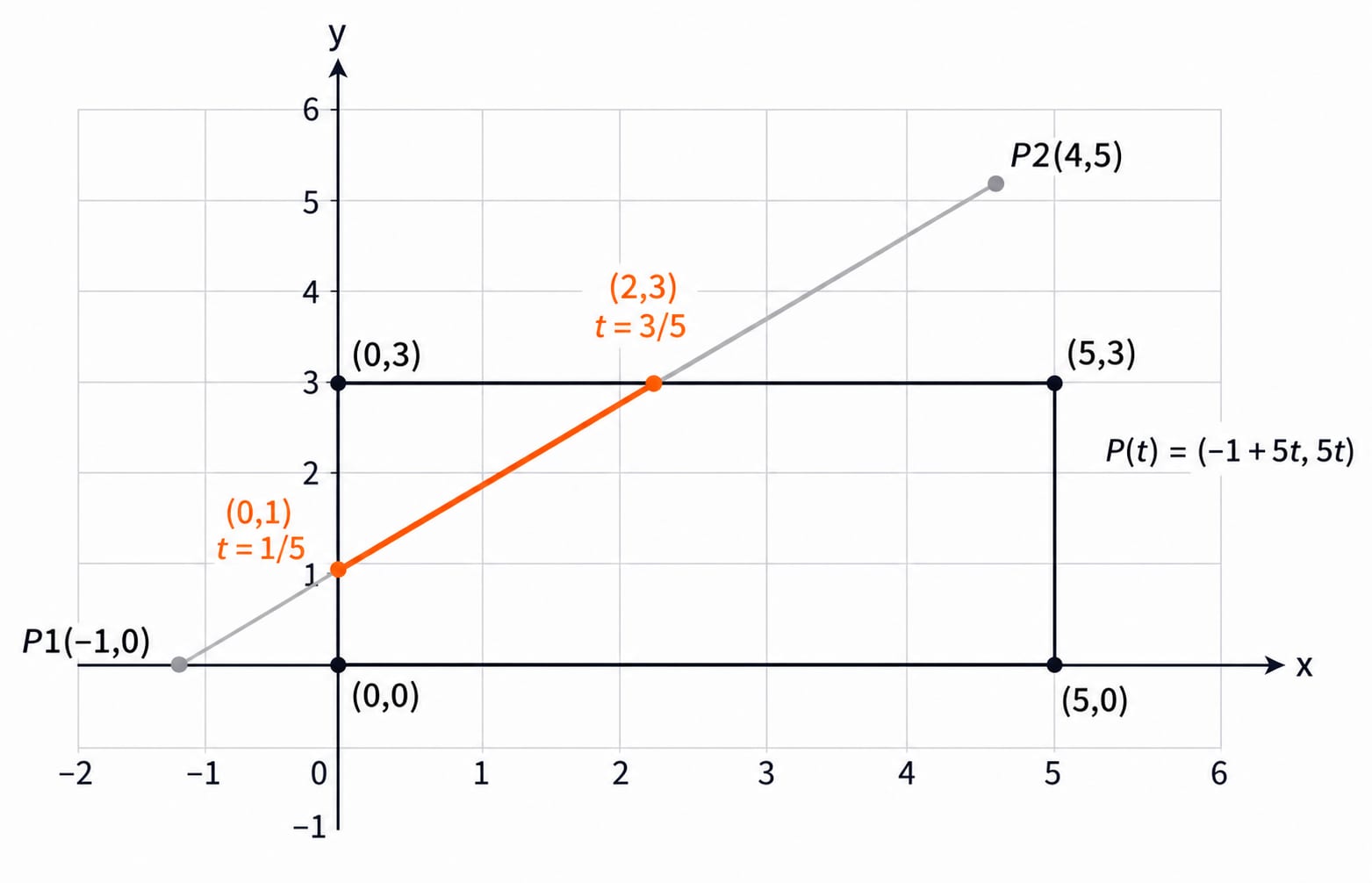
Consider a window bounded by the lines : x = 0; y= 0; x = 5 and y = 3. The line segment joining (–1, 0) and (4, 5), if clipped against this window will connect the points
A. (0, 1) and (2, 3)
B. (0, 1) and (3, 3)
C. (0, 1) and (4, 3)
D. (0, 1) and (3, 2)
Answer: A. (0, 1) and (2, 3).
Use P(t) = (-1,0) + t(5,5) = (-1 + 5t, 5t). At x = 0, t = 1/5 gives (0,1); at y = 3, t = 3/5 gives (2,3). These retained endpoints make A correct.
Question 11
UGC NET, December 2014
In Cyrus-Beck algorithm for line clipping the value of t parameter is computed by the relation :
(Here P1 and P2 are the two end points of the line, f is a point on the boundary, n1 is inner normal)
A.
B.
C.
D.
Answer: B. .
Rearranging P(t) = P1 + t(P2 - P1) with (P(t) - f_i) . n_i = 0 gives B. For P1 = (-2,1), P2 = (6,5), f_i = (0,0) and n_i = (1,0), t = 2/8 = 0.25; thus P(0.25) = (-2,1) + 0.25(8,4) = (0,2).
Clipping algorithm traps to avoid
Trap | What goes wrong | Correct move |
|---|---|---|
Changing bit order | Changing the bit order makes the same outcode produce conflicting answers. | Write TBRL first |
Using OR for rejection | Using OR wrongly rejects a line that crosses the clipping window. | Use |
Rejecting outside endpoints | Outside endpoints do not prove rejection because the line may cross the window. | Check shared bits; AB and CD are candidates |
Mixing algorithm families | Confusing line and polygon clippers leads you to choose the wrong algorithm. | Sutherland-Hodgman clips polygons |
Solving intersections first | Calculating intersection parameters before testing the outcodes wastes time. | Test before finding parameters |
Rushing parameters | Rushed arithmetic produces the wrong intersection point or t value. | Recheck |
Use a five-step routine under time pressure:
Draw and label the clipping window.
Write your chosen bit order.
Calculate both endpoint codes.
Apply the accept and reject tests.
Only then solve the required boundary parameter.
Place Computer Graphics in the Paper 2 map with UGC NET Computer Science Syllabus Areas: Paper 2. Use UGC NET Computer Science High-Yield Topics for broader prioritisation.
Clipping algorithms MCQs: the next practice step
Redo Questions 4, 8, 10 and 11 without looking. Focus on outcodes, candidate classification, parametric intersections and the Cyrus-Beck relation. Draw each window and show at least one line of calculation before choosing an option.
Remember methods, not isolated answers: TBRL uses four bits; 0000 with 0000 means totally inside; a non-zero outcode AND means trivial reject; and a zero AND with at least one non-zero code means clipping candidate. For a structured path through Unit 3 and the wider Computer Science syllabus, continue with NTA-UGC-NET Paper - 2. If clipping is your only target, return to the practice hub already linked above.
Keep learning
Ecosystem Fundamentals MCQs: 10 Solved Questions on Meaning and Ecological Organisation
Solve 10 ecosystem MCQs with clear explanations of ecological organisation, productivity, sustainability, environmental ethics, energy balance and conservation.
8 Sep 20268 min readMCQ Practice
Architectural and Component Design MCQs: 12 Solved Questions
Solve 12 bank MCQs on software architecture, component roles, repositories, MVC, DFDs, structure charts and UML, each with a direct worked explanation.
Updated 6 Sep 20268 min readMCQ Practice
C++ Constructors MCQs: 12 Solved Object-Initialization Questions
Solve 12 published C++ constructor questions by tracing object creation, copy semantics, arrays, access, virtual rules, and dynamic allocation.
Updated 5 Sep 20267 min readMCQ Practice
Python String MCQs: 12 Solved Questions on Slicing, Search and Methods
Solve 12 published Python string questions step by step. Trace indices, slices, return types and method contracts before checking each answer.
2 Sep 20267 min readMCQ Practice