

Project Method of Teaching: Steps, Types, Merits and Demerits
What makes a classroom activity a project? Follow a Class V paper-use investigation to understand learner responsibility, the teaching steps, four project types and practical assessment.
KnowledgeGate Team
Exam prep & CS education
Updated 27 Nov 20266 min read
A model, a group task and a teacher demonstration can look similar in a classroom description. The distinction lies in the learners' purpose and responsibility. For your CTET exam and course options, learn to identify who plans, decides and evaluates. The ordered steps and purpose-based types become clear through one classroom example, followed by the method's merits, limitations and common question traps.
Project Method of Teaching: Steps, Types, Merits and Demerits
The project method organises learning around purposeful activity in a meaningful situation. Learners help identify a purpose, plan their work, carry it out and reflect on the result. Activity becomes learning when pupils explain their decisions and evidence.
William Heard Kilpatrick is closely associated with the project method. John Dewey belongs to the broader experiential tradition, connecting education with experience and inquiry. This particular classification of projects is associated with Kilpatrick, not Dewey.
The teacher facilitates resources, scope and feedback; learners take meaningful decisions. Giving everyone identical instructions to copy a model does not, by itself, establish a project.
Consider a Class V group asking how the class can reduce paper use. The question gives its work a purpose. This post focuses on project purposes and stages; for the broader Kolb cycle linking experience and reflection, read experiential learning and reflection.
Steps of the project method, in order
A common classroom sequence has six stages:
Provide a situation. Draw attention to scrap sheets discarded after use on one side. Invite pupils to identify the problem.
Choose and state the purpose. Pupils choose to reduce new-sheet use and agree on what they will measure.
Plan. Arrange five baseline school days and five follow-up school days. Allocate roles and decide how to count consistently.
Execute. Collect baseline counts, then introduce the agreed reuse routine and collect follow-up counts.
Evaluate. Compare totals with the target. Discuss what the evidence shows and what else could explain the change.
Record and report. Present daily counts, calculations, conclusions and an improvement for the next cycle.
Some accounts combine these into purpose, planning, execution and evaluation. Recording also happens throughout; it is not postponed until the final report.
Planning precedes implementation. The teacher checks feasibility and sets learning criteria, while pupils decide the reuse routine. Learner responsibility requires guidance, not teacher withdrawal.
Worked example: a Class V paper-use project
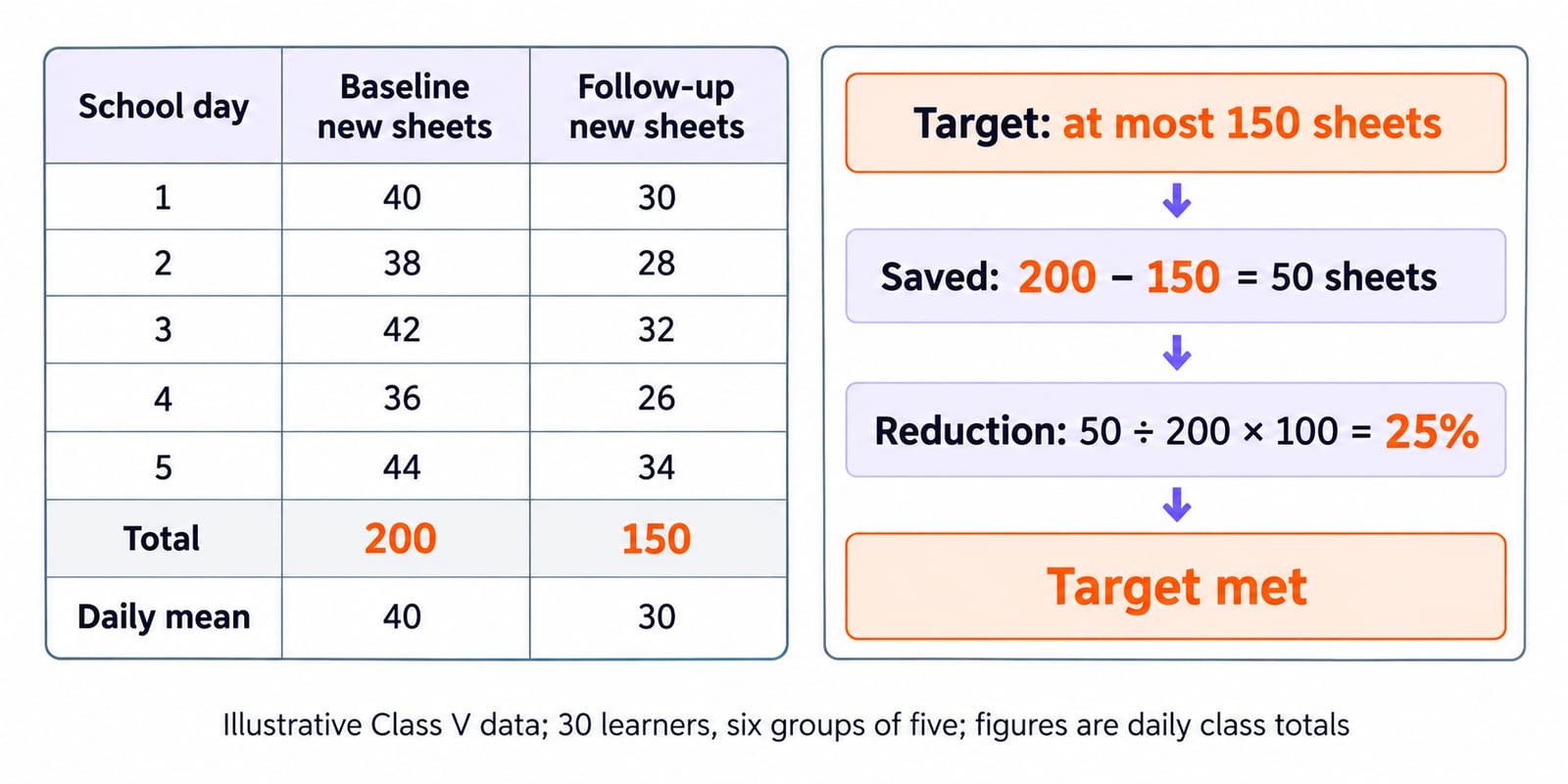
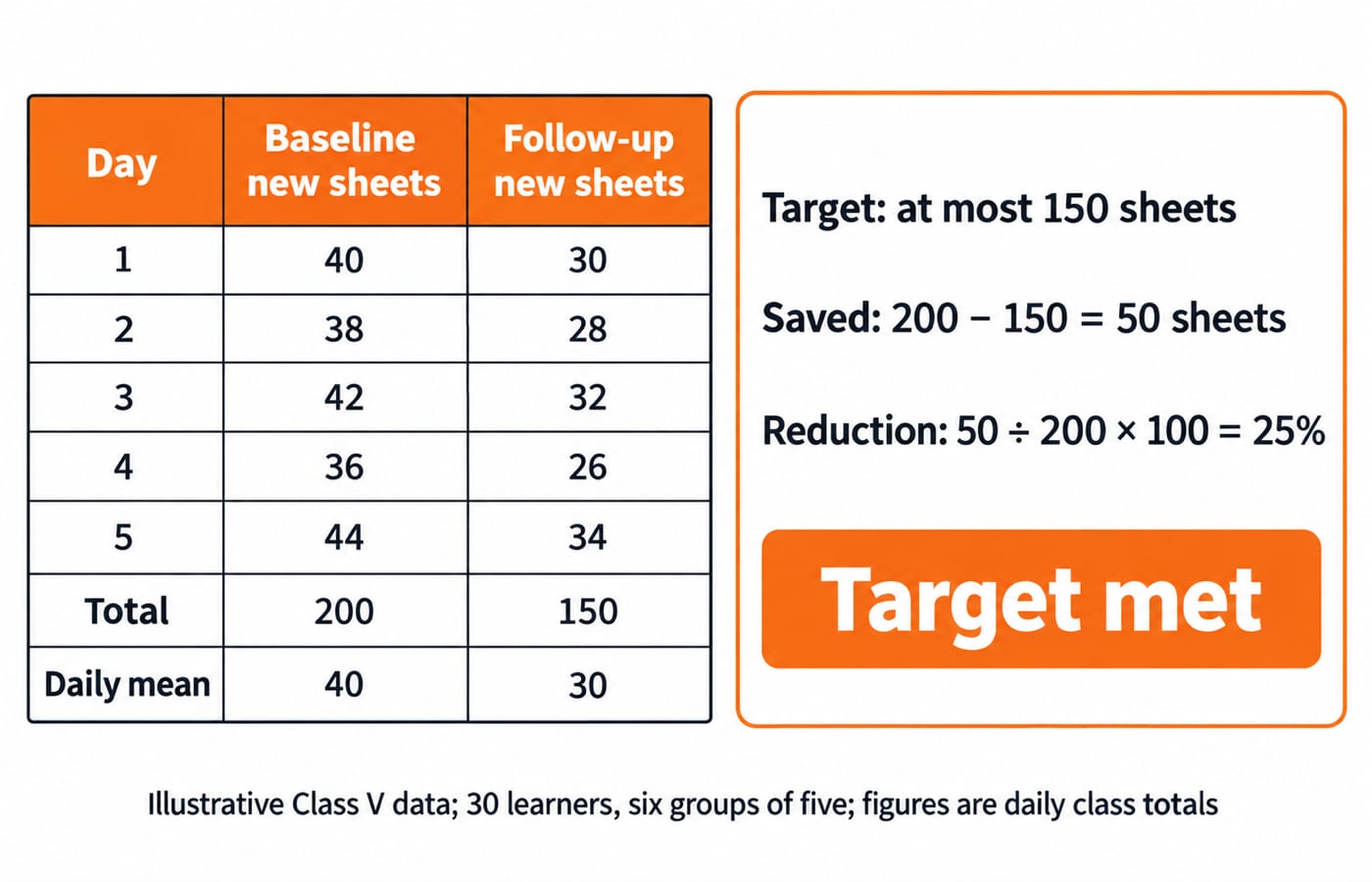
These illustrative classroom figures describe 30 learners in six groups of five: 6 x 5 = 30. Within each group, rotate five roles: counter, recorder, checker, organiser and reporter. Coordinate counting so that each new sheet enters the class log once.
All figures below are daily whole-class totals, not separate group measurements.
School day | Baseline new sheets | Follow-up new sheets |
|---|---|---|
1 | 40 | 30 |
2 | 38 | 28 |
3 | 42 | 32 |
4 | 36 | 26 |
5 | 44 | 34 |
Total | 200 | 150 |
Daily mean | 40 | 30 |
Baseline total = 40 + 38 + 42 + 36 + 44 = 200 sheets. Daily mean = 200 / 5 = 40 sheets.
The agreed target is a reduction of at least 25%. Required saving = 200 x 25 / 100 = 50 sheets, so the next five-day total must be at most 200 - 50 = 150 sheets.
Pupils introduce a tray for reusing single-sided paper. Follow-up total = 30 + 28 + 32 + 26 + 34 = 150 sheets. Daily mean = 150 / 5 = 30 sheets.
Reduction = 200 - 150 = 50 sheets. Percentage reduction = 50 / 200 x 100 = 25%. The class meets its target exactly.
Compare similar school days and discuss attendance or assigned-work changes. A before/after comparison alone does not establish causation. Report one improvement, such as clearer tray labels. Assess counting, explanations and individual contributions: meeting the shared target does not prove that every child learned.
Four types of projects: classify by the main purpose
The commonly taught Kilpatrick classification groups projects by purpose into four types:
Type | Dominant purpose and example |
|---|---|
Constructive or producer | Make something: design one reusable paper-tray organiser. |
Aesthetic or enjoyment | Appreciate an experience: listen to two poems and discuss their imagery. |
Problem-solving | Investigate a question: explain the change from 200 to 150 sheets. |
Drill or specific learning | Improve a skill: practise reading ten measuring-cylinder scales accurately. |
Classify by the main intention, not the materials. A chart is not automatically aesthetic, and a physical product need not be the central purpose.
Individual versus group projects describes organisation. Our example is a group, problem-solving project; the tray supports the investigation.
Merits and demerits, with practical safeguards
The project connects arithmetic with environmental responsibility: percentages answer a classroom question. Pupils make decisions and use evidence to defend conclusions. Rotating accountable roles also creates opportunities to practise cooperation. These are learning opportunities that the teacher must support and assess.
The demerits need practical responses:
Limitation | Classroom safeguard |
|---|---|
Ten observation days take time. | Keep the objective bounded and daily logs short. |
Unequal participation can hide learning gaps. | Rotate roles and ask every learner to explain the calculation. |
Resource differences can disadvantage pupils. | Supply common classroom materials instead of requiring purchases from home. |
Curriculum coverage and assessment require planning. A project should serve identified learning goals, with time reserved for explaining the underlying concepts. Combine the shared outcome with individual explanations; the neatness of the tray cannot substitute for understanding percentages.
Teacher guidance, including a brief demonstration, can support the work while pupils retain responsibility for its purpose and decisions.
Project, lecture and demonstration: avoid these traps
Compare the same topic across three methods:
Method | What happens in the paper-use lesson? |
|---|---|
Lecture | The teacher explains paper conservation; pupils listen and discuss. |
Demonstration | The teacher models sorting reusable sheets; pupils observe and question. |
Project | Pupils plan, collect daily counts, act and evaluate the result. |
No method is always superior. Choose according to the learning purpose and the support pupils need.
Avoid three shortcuts. Hands-on work alone does not establish learner purpose. Group work does not guarantee equal participation. Learner-centred teaching does not remove the need for teacher planning.
A short demonstration of accurate tallying within the ten-day investigation supports the project. It does not turn the whole activity into the demonstration method.
How to reason through a CTET-style question
According to CBSE's CTET September 2026 syllabus, CDP includes child-centred and progressive education, social contexts of learning and children as problem solvers. This project applies those themes. The six-stage sequence is a common teaching elaboration, not a CBSE prescription; the following item is original.
Illustrative, not a previous-year question: After pupils choose to reduce paper use, which teacher action best supports the project method?
(a) Dictate the final conclusion before observations.
(b) Help pupils plan comparable counts and review their evidence.
(c) Award marks only for the neatest tray.
(d) Leave pupils without any feedback.
Answer: (b). It scaffolds learner inquiry. Option (a) removes inquiry, (c) neglects learning evidence and (d) confuses autonomy with abandonment. Connect this reasoning with CDP concepts and theorists.
Short version and next step
Remember purpose, plan, action, evaluation. Learners own meaningful decisions; teachers guide. Saving 50 of 200 sheets gives a 25% reduction, but assessment also checks each learner's reasoning.
Before memorising a label, classify a fresh classroom task by its purpose. For further Paper 1 preparation, the CTET Paper 1 course is an optional next step.
Go deeper with the full courseCTET Paper 1 2026 — प्राथमिक शिक्षक (कक्षा 1–5)
Keep learning

Research Process Steps for Teaching Exams: Complete Notes with a Worked Classroom Study
Learn the complete research process through a connected classroom example. Follow the problem, design, data, calculations, interpretation and report in order.
Updated 10 Aug 20266 min readUGC NET Computer Science

BPSC Teaching CS PYQs: Four-Pass Revision Plan
Turn one 40-question PYQ set into four rounds that expose weak concepts, repair them, add a practice clock and test mixed recall with a usable error log.
Updated 30 Oct 20265 min read117 viewsBPSC Teaching

UPPSC Teaching PYQ Analysis: Build an Error-Led Revision Plan
Learn a repeatable way to verify teaching PYQs, separate topic from reasoning demand, diagnose errors and convert the evidence into next week's study calendar.
Updated 30 Oct 20266 min readUPPSC Teaching

User Interface Analysis and Design Steps: Worked Library Kiosk Example
Follow one constructed college-library kiosk from user and task analysis to screen flows, error recovery and a measured prototype revision.
Updated 30 Oct 20266 min readUGC NET Computer Science