BPSC Teaching CS PYQs: Four-Pass Revision Plan
Turn one 40-question PYQ set into four rounds that expose weak concepts, repair them, add a practice clock and test mixed recall with a usable error log.
KnowledgeGate Team
Exam prep & CS education
Updated 5 Aug 20265 min read70 views
You can keep solving the same BPSC TRE Computer Science papers and still repeat the same DBMS, OS and C-tracing mistakes. The problem is usually not effort, but the lack of a decision after each question. A four-pass loop over one PYQ set forces that decision: diagnose untimed, repair the reason, run the set against a clock, then test mixed recall. That repeated analysis teaches more than simply adding another set, as explained in Why Solving PYQs Beats Buying Another Question Bank. BPSC TRE runs in phases and each phase is a fresh recruitment cycle, so an older paper is a concept probe rather than a template for the current pattern.
1. Build one usable PYQ set and one error log
Begin with a clean 40-question set drawn from the BPSC TRE Computer Science papers available to you. Forty is a workable size, not a required one. Hide the answer key during Pass 1, and label the questions PYQ-01 to PYQ-40.
KnowledgeGate's BPSC Computer Science question set runs past 700 items, spread across TGT and PGT tier papers, so a 40-question set on one theme is realistic to assemble.
Your error log needs these columns exactly: question ID, topic, first answer, correct answer, confidence H/M/L, result C/W/U, cause, repair action, retest date, Pass 3 result and Pass 4 result. Fill the topic column from a closed list of subject areas (computer system and organisation, data structures, programming concepts, operating system, databases, networks) rather than free text, so the log stays countable. Use only five cause codes: concept, recall, procedure/tracing, misread and weak elimination.
Browse the BPSC TRE exam preparation page when you are choosing resources. Question counts, marks, duration and negative marking are set by each phase's notification, so read them off the official BPSC portal and copy them to the top of your log.
2. Pass 1: diagnose without a timer
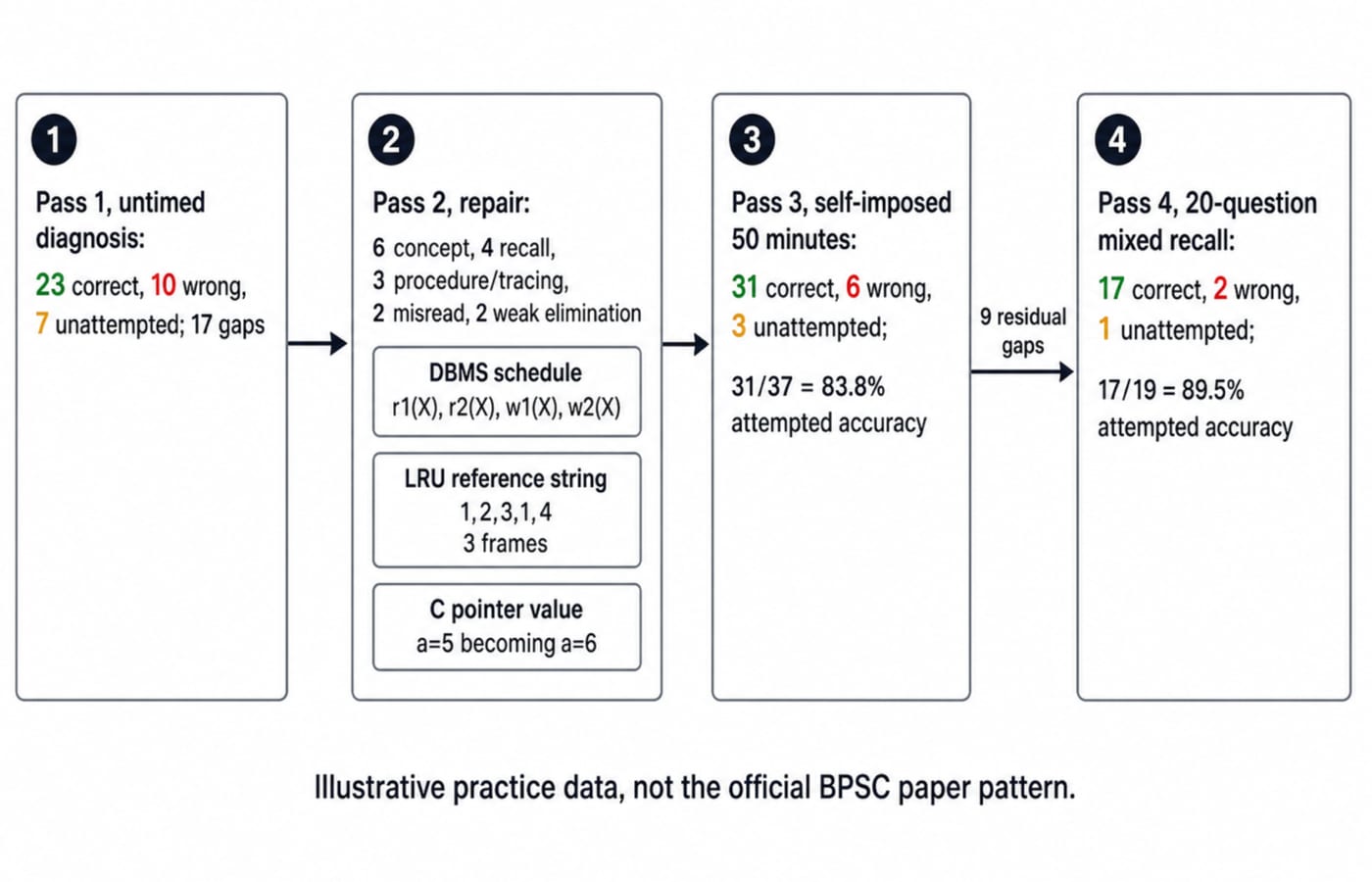
Solve all 40 questions without a countdown. Record an answer and confidence before opening the key. Suppose the result is 23 correct, 10 wrong and 7 unattempted. You attempted 23 + 10 = 33 questions, so attempted accuracy is:
23 / 33 x 100 = 69.7%
The more useful number is 17, the 10 wrong plus 7 unattempted items that must enter Pass 2. Sort them as 6 concept, 4 recall, 3 procedure/tracing, 2 misread and 2 weak elimination. These add to 17. Treat a high-confidence wrong answer as more urgent than a low-confidence skip. It reveals a false rule, not an acknowledged gap.
Sample row: PYQ-07 | DBMS serializability | first answer: serializable | correct answer: not conflict-serializable | confidence: H | result: W | cause: concept | repair: draw the precedence graph | retest: Day 9.
3. Pass 2: repair the reason, not the answer
Give each gap a 20-minute repair cycle: 8 minutes to relearn the rule, 7 minutes to solve the original without the key, and 5 minutes for one adjacent variant. The 6 concept gaps need 6 x (8 + 7 + 5) = 6 x 20 = 120 minutes. Split them into two 60-minute sessions.
Now repair PYQ-07 with an illustrative drill. For r1(X), r2(X), w1(X), w2(X), r2(X) before w1(X) creates T2 -> T1. Both r1(X) before w2(X) and w1(X) before w2(X) create T1 -> T2. The two directions form a cycle, so the schedule is not conflict-serializable.
For the adjacent variant r1(X), w1(X), r2(X), w2(X), every cross-transaction conflict points from T1 to T2. Only T1 -> T2 remains, so there is no cycle.
Add two quick checks. With three frames and 1,2,3,1,4, the second reference to page 1 makes it the most recent, so LRU evicts page 2 when 4 arrives while FIFO would evict page 1. The policy named in the question decides the answer. For int a=5; int *p=&a; (*p)++;, p points to a, so incrementing *p makes the printed value of a equal to 6.
If several concept gaps remain, the BPSC TRE 4.0 course is an optional structured repair resource. It does not replace re-solving the logged question and its adjacent variant.
4. Pass 3: solve the same set under a self-imposed clock
After a 48-hour gap, shuffle the 40 questions and use a 50-minute clock you set yourself. BPSC TRE is a pen-and-paper exam, so run this pass on paper with a hand-marked answer grid rather than on a screen. Aim for question 20 by minute 24 and question 40 by minute 48, keeping 2 minutes for marked items.
Suppose you record 31 correct, 6 wrong and 3 unattempted. Attempts equal 31 + 6 = 37, so 31 / 37 x 100 = 83.8%. That improves on 69.7%, but it counts only when you can justify the answer. Return all 9 wrong or unattempted items to the log.
The next progression from one timed PYQ set to fuller conditions is a teaching-exam mock strategy. The BPSC TRE 4.0 Test Series is an optional source of wider timed practice.
5. Pass 4: force mixed recall instead of memorising positions
After another 72-hour gap, create a 20-question mixed set from the 9 residual gaps and 11 adjacent questions on the same concepts. Randomise topic order and, where the source permits, answer-option order. This stops memory of the old sequence from masquerading as recall.
Use a self-imposed 25-minute clock. A result of 17 correct, 2 wrong and 1 unattempted means 19 attempts, so 17 / 19 x 100 = 89.5%. Keep the two wrong items and one skip active, and say the deciding rule aloud before closing them.
Move a topic out of the active log only after it is correct twice on different days and you can explain why every distractor fails. Otherwise, prepare a 10-question micro-set for the next week.
6. Fit the four passes into a realistic four-week cycle
Use this 7-hour weekly model:
Week | Work | Total |
|---|---|---|
1 | Two 2-hour untimed blocks, 2 hours to clean the log, 1-hour buffer | 7 hours |
2 | Four 90-minute repair sessions, one 60-minute retest | 7 hours |
3 | Two 75-minute timed blocks, two 75-minute reviews, 2 hours of patching | 7 hours |
4 | Three 60-minute mixed-recall blocks, 2 hours of log review, one 60-minute final retest, 1-hour buffer | 7 hours |
Use the weekly buffer for one missed hour. If you miss more than one block, drop a new set and finish the existing repair cycle. Never double the next day's load. With only 4 hours each week, preserve the pass order and stretch the same 28 hours across seven weeks. Keep one evening free every week. Continuity of the error log matters more than a perfect calendar.
7. Read the log, choose the next action and close
Repeated concept errors need lessons and fresh variants. Recall errors need short spaced prompts. Procedure errors need written steps. Misreads need qualifiers underlined. Weak elimination needs an explanation for every rejected option.
The four verbs are diagnose, repair, time and mix. The BPSC TRE 4.0 course covers concept repair when your own notes fall short, and the test series covers wider timed practice. Start one 40-question set and write the first error-log row today; by Pass 4 the log, not a feeling, tells you what to revise next.
Keep learning
BPSC Headmaster Selection Process: Written Exam, Merit List and Document Verification
Trace the completed 2024 BPSC Head Master route from one objective paper to provisional merit and certificate checks. Includes checked arithmetic and a practical six-week plan.
Updated 14 Aug 20264 min readBPSC Teaching

BPSC Teaching vs KVS/NVS: Bihar Posting, Transfers and Best Fit
Choose by document fit, mobility and work context, not by the recruiting body's name. Compare the Bihar state cadre against central-school postings and score the routes against your own constraints.
Updated 7 Aug 20266 min readBPSC Teaching

BPSC Computer Science: DBMS, SQL and Data Structures Worked Guide
Follow one student-result example from functional dependencies and 3NF through SQL aggregation, queues, stacks, hashing and max-heap extraction.
Updated 2 Aug 20266 min read53 viewsBPSC Teaching
BPSC Teaching Computer Science Preparation: A Practical 16-Week Plan
Use a sustainable 14-hour weekly model to diagnose six CS lanes, repair gaps, rotate practice, review mocks and finish with two focused revision passes.
Updated 30 Jul 20266 min read72 viewsBPSC Teaching