Program Control & I/O Handling MCQs: 12 Solved PYQs with Explanations
Practise 12 PYQs on program control and I/O handling. Trace PCs, memory overwrites, registers, flags, loops and interrupt handshakes step by step.
KnowledgeGate Team
Exam prep & CS education
Updated 21 Sep 20267 min read
Program control and I/O handling questions can demand an instruction-class decision, a PC path, a register or memory trace, a flag trace, or an I/O handshake. One missed overwrite or branch changes every later state. Attempt each item before reading its answer, then compare your trace with the worked transitions. For registers, buses, memory capacity and clock timing, solve CPU Organization Basics MCQs first. Then trace control instructions, accumulator loops and I/O signals here. GATE CS Exam Preparation places both in the wider subject.
Program Control and I/O Handling MCQ method: trace state before naming the instruction
Use PC or label | instruction | register or memory before | register or memory after | next PC or flag. Next PC decides control items; data, flags or signals decide others.
Instruction group | Class |
|---|---|
CALL/BUN/JNZ/LOOP | control transfer |
LDA/LOAD/MOV | data transfer |
ADD/AND/INC/XRA/shift | data manipulation |
IN/OUT/SKI/INTR-INTA | I/O or I/O control |
A mnemonic can change data and a flag, so trace both. Addressing Modes and Instruction Formats separates operation from operand location.
Basic computer instruction MCQs: skip conditions, branches and accumulator traces
Question 1. Match skip and increment instructions
Match List - I with List - II :
List - I
List - II
(A) SZA
(I) Increment M and skip it zero
(B) SKI
(II) Skip if AC is negative
(C) SNA
(III) Skip if input flag is on
(D) ISZ
(IV) Skip if AC is Zero
Choose the correct answer from the options given below:
(A)
(A)-(II),(B)-(IV),(C)-(I),(D)-(III)(B)
(A)-(IV),(B)-(III),(C)-(II),(D)-(I)(C)
(A)-(IV),(B)-(II),(C)-(I),(D)-(III)(D)
(A)-(III),(B)-(IV),(C)-(II),(D)-(I)
Answer: (B) (A)-(IV),(B)-(III),(C)-(II),(D)-(I). SZA tests zero AC, SKI the input flag, SNA the AC sign, and ISZ increments memory then skips on zero. Only SKI is I/O.
Question 2. Trace a basic-computer program with a store overwrite
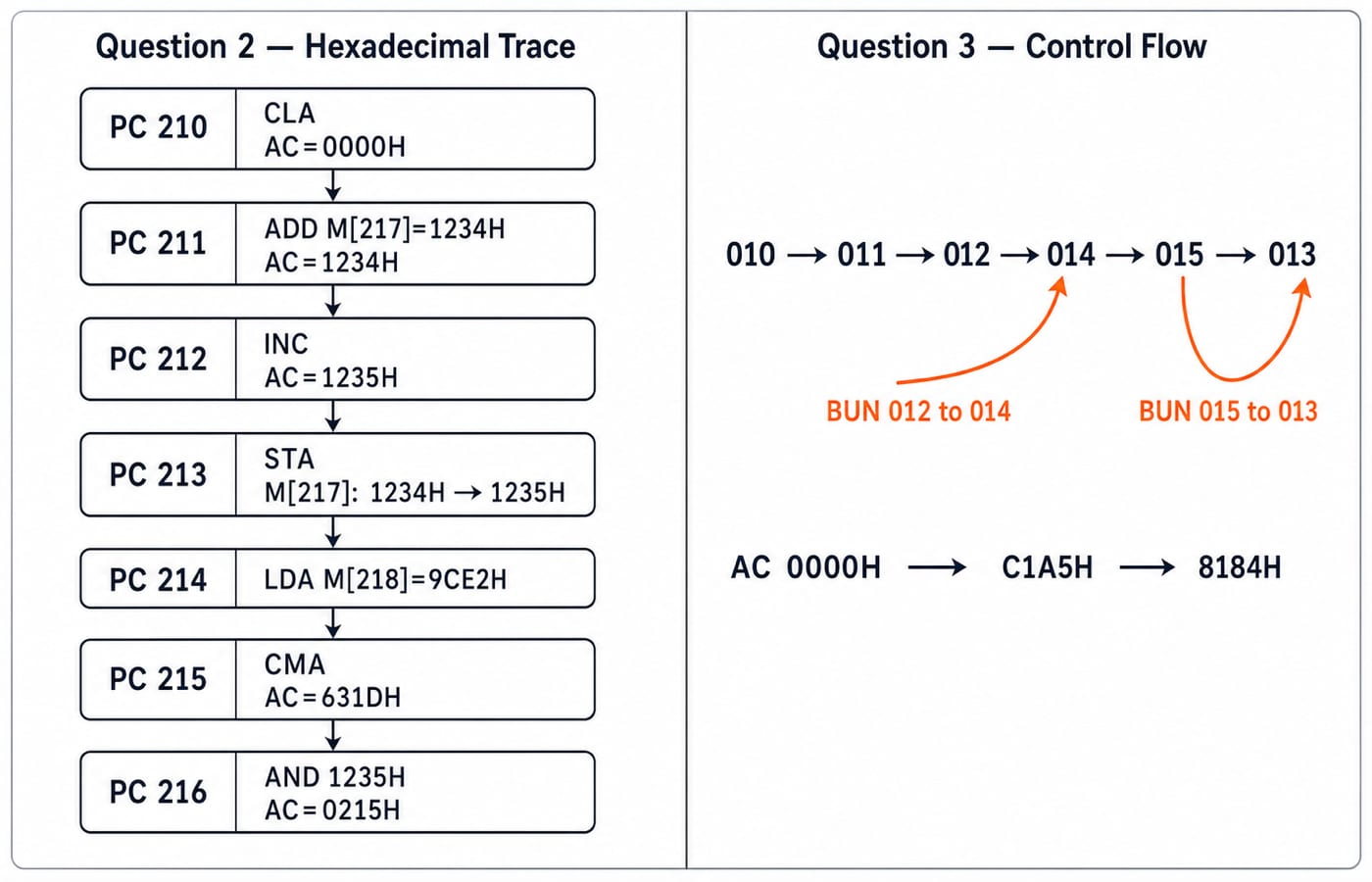
The following program is stored in memory unit of the basic computer. What is the content of the accumulator after the execution of program? (All location numbers listed below are in hexadecimal).
Location
Instruction
210
CLA
211
ADD 217
212
INC
213
STA 217
214
LDA 218
215
CMA
216
AND 217
217
1234H
218
9CE2H
(A)
1002H(B)
2011H(C)
2022H(D)
0215H
Answer: (D) 0215H. CLA, ADD 217, INC give 0000H -> 1234H -> 1235H; STA 217 stores 1235H at M[217]. LDA 218 loads 9CE2H; 16-bit CMA gives 631DH. Thus 631DH AND 1235H = 0215H: 6&1=0, 3&2=2, 1&3=1, D&5=5.
Question 3. Follow unconditional branches before the AND
The following program is stored in the memory unit of the basic computer. Give the content of accumulator register in hexadecimal after the execution of the program.
Location
Instruction
010
CLA
011
ADD 016
012
BUN 014
013
HLT
014
AND 017
015
BUN 013
016
C1A5
017
93C6
(A)
A1B4(B)
81B4(C)
A184(D)
8184
Answer: (D) 8184. PC follows 010 -> 011 -> 012 -> 014 -> 015 -> 013, first skipping and then returning to HLT. AC becomes 0000H -> C1A5H -> 8184H: C&9=8, 1&3=1, A&C=8, 5&6=4.
Program-loop MCQs: count the body, the register width and the exit test
Identify the decrementing instruction, counter width, and whether the body precedes the test.
Question 4. LOOP decrements CX and wraps AX
Consider the following program fragment in assembly language:
        mov ax, 0h
        mov cx, 0A h
do loop:
        dec ax
        loop doloop
What is the value of ax and cx registers after the completion of the doloop ?
(A)
ax=FFF5h and cx=0h(B)
ax=FFF6h and cx=0h(C)
ax=FFF7h and cx=0Ah(D)
ax=FFF5h and cx=0Ah
Answer: (B) ax=FFF6h and cx=0h. CX = 000AH makes 10 iterations and ends at zero. With one DEC AX per iteration, 0000H - 000AH = FFF6H in 16 bits.
Question 5. Accumulate a descending B value
The content of the accumulator after the execution of the following 8085 assembly language program, is :
MVI A, 42H
MVI B, 05H
UGC:  ADD B
DCR B
JNZ UGC
ADI 25H
HLT
(A)
82 H(B)
78 H(C)
76 H(D)
47 H
Answer: (C) 76 H. Adding 05H + 04H + 03H + 02H + 01H = 0FH takes A through 47H, 4BH, 4EH, 50H, 51H. Then 51H + 25H = 76H.
Question 6. Treat BC as one 16-bit loop counter
How many times will the following loop be executed ?
     LXI B, 0007 H
LOP :   DCX B
        MOV A, B
        ORA C
        JNZ LOP
(A)
05(B)
07(C)
09(D)
00
Answer: (B) 07. DCX B decrements 16-bit BC. B OR C is zero at 0000H; seven decrements get there from 0007H.
Flag and loop-control MCQs: rotate through carry and detect a reset loop
Question 7. Trace Carry through RAR before XOR
The content of the accumulator after the execution of the following 8085 assembly language program, is
MVI A, 35H
MOV B, A
STC
CMC
RAR
XRA B
(A)
00H(B)
35H(C)
EFH(D)
2FH
Answer: (D) 2FH. From 35H = 00110101₂, STC sets Carry and CMC resets it. RAR gives 1AH and Carry 1; 1AH XOR 35H produces 2FH, and XRA resets Carry.
Question 8. Explain why the loop never reaches 256
How many number of times the instruction sequence below will loop before coming out of the loop?
A1:  MOV AL, 00H
     INC AL
     JNZ A1
(A)
1(B)
255(C)
256(D)
Will not come out of the loop
Answer: (D) Will not come out of the loop. Each visit resets AL to 00H; INC AL makes 01H, so JNZ is always taken. Neither 255 nor 256 applies because nothing accumulates.
I/O handling MCQs: accumulator output and the INTR-INTA handshake
Question 9. Identify the value actually sent to PORT1
What will be the output at PORT1 if the following program is executed?
MVI B, 82H
MOV A, B
MOV C, A
MVI D, 37H
OUT PORT1
HLT
(A)
37H(B)
82H(C)
B9H(D)
00H
Answer: (B) 82H. MOV A, B puts 82H in the accumulator, which OUT PORT1 sends. The later instructions preserve A; 37H enters only D.
Question 10. Place the CALL opcode on the bus during acknowledge
GATE 2002 | Topic practice
A device employing the INTR line for device interrupt in 8085 puts the CALL instruction on the data bus while:
(A)
INTA is active(B)
HOLD is active(C)
READY is active(D)
None of these
Answer: (A) INTA is active. INTR requests service; during INTA, the device supplies CALL. HOLD requests bus ownership, while READY controls wait states.
Event | Meaning | Bus or output result |
|---|---|---|
OUT PORT1 | value currently in A | 82H |
INTR | device requests interrupt | no CALL opcode yet |
INTA active | processor acknowledges | device places CALL opcode on data bus |
Program-control classification MCQs: CALL, LOAD and the return address
Question 11. Separate control transfer from data manipulation
Which of the following are not data manipulation instructions?
A. Call
B. Load
C. And
D. Increment
E. Shift
Choose the correct answer from the options given below:
(A)
C & E only(B)
A & B only(C)
D & E only(D)
A & C only
Answer: (B) A & B only. Call is control transfer; Load is data transfer. And, Increment and Shift manipulate data, irrespective of which register they touch.
Question 12. Store the subroutine return address
KVS 2017
When a subroutine is called, the address of the instruction following the CALL instruction is stored in the ______.
(A)
program counter(B)
stack(C)
stack pointer(D)
accumulator
Answer: (B) stack. The address after CALL is the return address, pushed onto the stack. The stack stores it, the stack pointer marks the top, and the PC enters the subroutine.
Program Control and I/O Handling MCQs: traps, short version and next step
Cue | Correct first move | Typical error |
|---|---|---|
STA followed by a later read | update memory immediately | reuse the old 1234H |
BUN or CALL | trace next PC and saved return state | continue sequentially |
LOOP/DCX/JNZ | identify width and test point | count one too many |
RAR | write Carry beside the eight data bits | rotate as if Carry were absent |
OUT/INTR/INTA | identify accumulator value or handshake phase | choose a nearby but irrelevant register or signal |
One-minute check: recompute 631DH AND 1235H = 0215H; explain 16-bit 0000H - 000AH = FFF6H; justify AL = 01H at JNZ; recite INTR request -> INTA acknowledge -> CALL opcode on the data bus.
For a broader computer-organization sequence, use GATE Guidance by Sanchit Sir.
Reattempt every missed item. Label each miss PC, AC/register, memory, flag or I/O signal.
Keep learning
Instruction Formats and Addressing Modes MCQs: 12 Solved Cross-Concept Questions
Solve 12 cross-concept COA questions that connect addressing-mode choices with PC rules, memory references, opcode fields, and byte-aligned instructions.
3 Oct 20267 min readComputer Organization MCQs
Interrupt-Driven I/O MCQs: 12 Solved Questions with Explanations
Attempt 12 previous-year interrupt-driven I/O questions, then check each answer with a concise explanation. The set covers ISR order, vectoring, priority, and CPU-time numericals.
28 Sep 20268 min readComputer Organization MCQs
Bitmap and Pixmap MCQs: 12 Solved Pixel Depth and Memory Questions
Build a reliable pixel-memory method through 12 live MCQs covering bitmaps, pixmaps, lookup tables, uncompressed storage, refresh rates, masks, and dithering.
Updated 25 Sep 20267 min readComputer Organization MCQs
Assembly & Assembler Design MCQs: 11 Solved PYQs Explained
Attempt 11 published PYQs on assembler directives, language levels, tables, register-pair instructions, debugging and fixed-width arithmetic, then check each worked explanation.
Updated 24 Sep 20267 min readComputer Organization MCQs