Programmed I/O MCQs: 10 Solved Questions on Polling, CPU Time and Bus Control
Solve 10 Programmed I/O objective questions, including two step-by-step numericals, with clear explanations of polling, CPU involvement and bus control.
KnowledgeGate Team
Exam prep & CS education
Updated 20 Sep 20267 min read
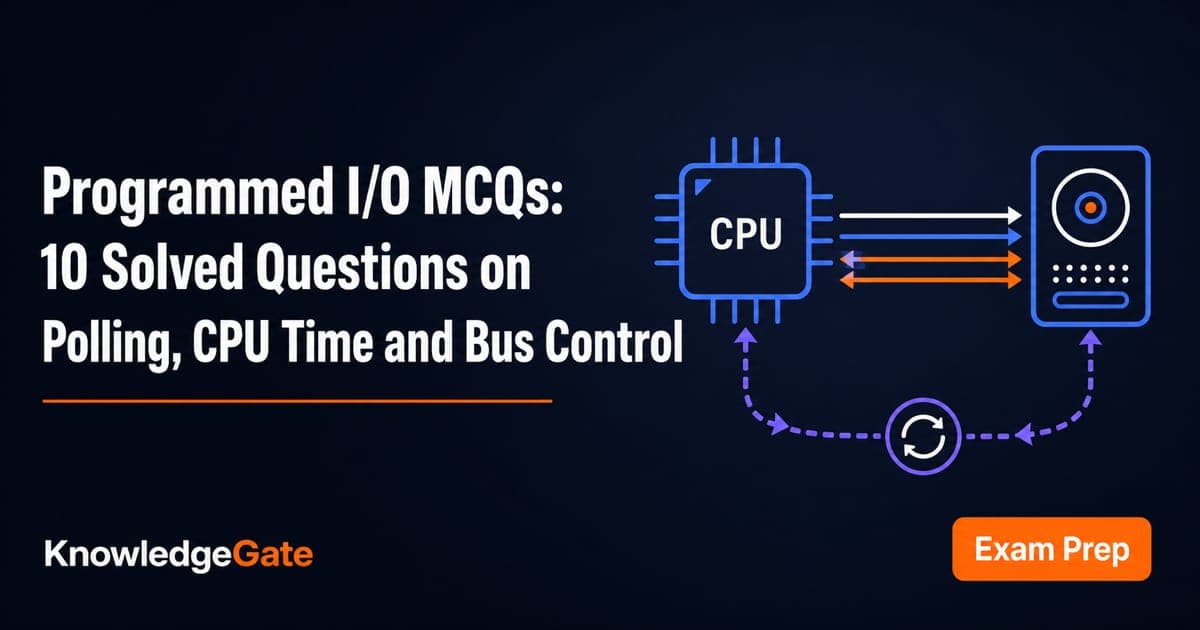
Programmed I/O questions reuse a small set of signals: polling, busy waiting, status flags, CPU-controlled transfer and wasted processor cycles. Numerical questions add two reliable moves: convert CPU cycles to time, and turn a minimum inter-arrival interval into a safe polling frequency. Recognise the control pattern before the options distract you. Use the GATE CS Exam Preparation path when revising Computer Architecture. Direct question pages are linked for Questions 1-5, 7 and 9. For Questions 6, 8 and 10, use the Programmed I/O practice hub.
Programmed I/O basics: who initiates and controls the transfer
In programmed I/O, the CPU executes instructions to read device status and transfer data. The processor stays in the control path, unlike interrupt-driven I/O or DMA.
Question 1: program instruction initiates the transfer
Source: DSSSB 2022
Which of the following data transfer modes between CPU and I/O devices has the data transfer initiated by the instruction of a computer program executed by the CPU?
A. Programmed I/O mode
B. Interrupt initiated I/O mode
C. Direct Memory Access (DMA) mode
D. Direct Register Access (DRA) mode
Answer: A. Programmed I/O mode. The phrase “instruction of a computer program executed by the CPU” identifies programmed I/O. An interrupt signal starts interrupt service, while a DMA controller moves a block without continuous CPU participation.
Question 2: CPU stays in a readiness loop
Source: DSSSB 2022
In which of the following data transfer modes does the CPU constantly monitor the peripheral and stay in a program loop until the peripheral device becomes ready for data transfer?
A. Direct Memory Access (DMA) mode
B. Direct Register Access (DRA) mode
C. Programmed I/O mode
D. Interrupt initiated I/O mode
Answer: C. Programmed I/O mode. “Constantly monitor” and “program loop” mean busy waiting. The CPU repeatedly reads the status register until the ready bit changes, so those cycles cannot do unrelated work.
Question 3: the CPU-cycle cost
Source: DSSSB 2022
Which of the following statements about programmed I/O mode of data transfer between CPU and I/O devices is correct?
A. The programmed I/O mode of data transfer is faster than interrupt mode of data transfer.
B. In this mode, there is wastage of the CPU cycles.
C. In this mode, the CPU can do other works when I/O devices are not ready for data transfer.
D. In this mode, the data transfer is initiated by the interrupt signal issued to the CPU.
Answer: B. In this mode, there is wastage of the CPU cycles. Repeated status checks consume cycles even when no byte moves. Options C and D instead describe the advantage and trigger of interrupt-driven I/O.
Polling and status flags: three names for the same exam clue
Polling is the repeated action, busy waiting is the CPU behaviour, and program-controlled or programmed I/O is the transfer method.
Question 4: constant peripheral monitoring
Source: DSSSB 2018
Which of the following data transfer schemes requires constant monitoring by the CPU of the peripheral devices?
A. Programmed IO
B. Interrupt-driven IO
C. Direct Memory Access (DMA)
D. Both, Interrupt-driven IO and DMA
Answer: A. Programmed IO. Constant CPU monitoring defines programmed I/O. Interrupt-driven I/O signals readiness, while DMA delegates movement to a controller after setup.
Question 5: repeated status-flag checks
Source: BPSC 2023
The method of accessing the I/O devices by repeatedly checking the status flags is
A. program-controlled I/O
B. memory-mapped I/O
C. I/O-mapped I/O
D. More than one of the above
E. None of the above
Answer: A. program-controlled I/O. Repeated checking is a control method. Memory-mapped and I/O-mapped I/O describe how device registers occupy and are addressed within address spaces.
Question 6: the one-word polling cue
Source: UP Police 2023. Programmed I/O practice in the learn module
Which type of I/O communication method requires the processor to check the device status repeatedly?
A. Cache Coherency
B. Polling
C. Direct Memory Access
D. Interrupt-driven I/O
Answer: B. Polling. Polling means periodic or continuous status-register reads by the processor. Cache coherency is unrelated, DMA uses a controller, and interrupt-driven I/O waits for a device signal.
All three questions reduce to one idea: the CPU repeatedly reads device status.
I/O connectivity and bus arbitration
Programmed I/O still uses an interface and shared buses. A question may therefore test the surrounding path without saying “busy waiting”.
Question 7: extending processor-bus connectivity
Source: BPSC 2023
What do we use to extend the connectivity of the processor bus?
A. PCI bus
B. Multiple bus
C. SCSI bus
D. More than one of the above
E. None of the above
Answer: A. PCI bus. PCI is an expansion or peripheral bus that connects more devices through the system I/O structure. SCSI is mainly a peripheral interface standard, while “multiple bus” is not the named standard requested.
Question 8: simultaneous bus requests
Source: MPPSC 2025. Programmed I/O practice in the learn module
What happens if the CPU and an I/O controller want to use the bus at the same time? Who decides who goes next?
A. DMA
B. Interrupt handler
C. Bus arbiter
D. CPU
Answer: C. Bus arbiter. It receives competing requests and grants bus ownership under the system’s arbitration rule. DMA is a transfer mechanism and an interrupt handler is software, so neither grants the shared bus.
The path is CPU instruction to I/O interface or controller to peripheral. A bus arbiter chooses a requester only when contention occurs.
Programmed I/O numericals: CPU time and safe polling frequency
Question 9: CPU time for a 2,000-byte block
Source: UGC NET January 2026
A system transfers data blocks of 2000 bytes with programmed I/O, each byte transfer takes 6 CPU cycles. With direct memory access (DMA), the block transfer takes 3000 cycles total, with CPU setup overhead of 200 cycles. The CPU clock is 1 GHz.
How much CPU time is consumed by programmed I/O?
A. 12 μs
B. 20 μs
C. 24 μs
D. 30 μs
Answer: A. 12 μs.
Programmed-I/O cycles =
2,000 bytes x 6 cycles/byte = 12,000 cycles.CPU time =
12,000 cycles / 10^9 cycles/s = 12 x 10^-6 s = 0.000012 s.In microseconds,
0.000012 s x 10^6 μs/s = 12 μs.
The DMA figures are distractors because the question asks only for programmed-I/O CPU time.
Question 10: minimum polling rate for a one-character buffer
Practice set: Programmed I/O practice in the learn module
In programmed I/O, software can poll periodically and let the processor do other work between checks. A keyboard has a single-character buffer. Characters arrive at an average rate of 2 per second, but the minimum gap between two key presses is 100 ms. What is the minimum number of times per second the processor must check the buffer to ensure that no character is overwritten?
The answer is a number rather than an option letter.
Answer: 10 times per second. The average rate does not set the safety bound because consecutive key presses may be only 100 ms apart. A single-character buffer must be checked within 100 ms = 0.1 s, so the minimum frequency is 1 s / 0.1 s = 10 checks per second.
Programmed I/O comparison table and elimination rules
Method | who notices readiness | CPU while waiting | who moves data | exam clue |
|---|---|---|---|---|
Programmed I/O | CPU polls | busy waits or returns to poll | CPU executes transfer instructions | repeated status checks |
Interrupt-driven I/O | device interrupts | CPU may do other work | interrupt service routine handles transfer | signal when ready |
DMA | CPU performs setup | CPU continues other work | DMA controller transfers a block | direct memory transfer |
Use four quick elimination rules:
“Program loop” or “repeatedly checks” means programmed I/O or polling.
“Device signals CPU” means interrupt-driven I/O.
“Controller transfers a block to memory” means DMA.
“Two requesters want the bus” means bus arbitration.
How to revise the surrounding Computer Architecture topics
The cycle-to-time conversion in Question 9 also appears in Pipelining in Computer Architecture Explained. The distinction between transfer control and data location becomes useful when studying Cache Memory: Mapping and Hit Ratio.
Use one 15-minute loop: spend 5 minutes writing the Programmed I/O, interrupt and DMA comparison from memory; 5 minutes solving 2,000 x 6 / 10^9; and 5 minutes explaining why a 100 ms minimum gap requires 10 checks per second. Do not treat memory-mapped I/O as a polling method. Also, protect a one-character buffer with the minimum inter-arrival time, not the average arrival rate.
Programmed I/O MCQs: the short version and next step
Programmed I/O is CPU-controlled. Polling consumes processor cycles. Bus arbitration resolves contention. Careful units solve the numericals.
For a structured GATE preparation path, continue with GATE Guidance by Sanchit Sir. If you are revising core CS beyond one exam topic, use the broader Zero to Hero Complete CS Course.
Now reattempt the set without the explanations. Finish by writing one line that distinguishes programmed I/O, interrupts and DMA.
Keep learning
Instruction Formats and Addressing Modes MCQs: 12 Solved Cross-Concept Questions
Solve 12 cross-concept COA questions that connect addressing-mode choices with PC rules, memory references, opcode fields, and byte-aligned instructions.
3 Oct 20267 min readComputer Organization MCQs
Interrupt-Driven I/O MCQs: 12 Solved Questions with Explanations
Attempt 12 previous-year interrupt-driven I/O questions, then check each answer with a concise explanation. The set covers ISR order, vectoring, priority, and CPU-time numericals.
28 Sep 20268 min readComputer Organization MCQs
Bitmap and Pixmap MCQs: 12 Solved Pixel Depth and Memory Questions
Build a reliable pixel-memory method through 12 live MCQs covering bitmaps, pixmaps, lookup tables, uncompressed storage, refresh rates, masks, and dithering.
Updated 25 Sep 20267 min readComputer Organization MCQs
Assembly & Assembler Design MCQs: 11 Solved PYQs Explained
Attempt 11 published PYQs on assembler directives, language levels, tables, register-pair instructions, debugging and fixed-width arithmetic, then check each worked explanation.
Updated 24 Sep 20267 min readComputer Organization MCQs