Disk Structure & Address MCQs: 10 Solved PYQs with CHS Calculations
Solve 10 published disk structure PYQs with concise explanations for geometry, capacity, sector addressing, CHS conversion, file placement, CLV and CAV.
KnowledgeGate Team
Exam prep & CS education
Updated 22 Sep 20267 min read

Disk questions mix physical terms such as surface, track, cylinder and sector with zero-based CHS arithmetic. You can know the definitions and still use platters instead of recording surfaces, forget that same-radius tracks form a cylinder, or drop the -1 for a contiguous file's last sector. Disk geometry, capacity, sector-address bits, CHS conversions, contiguous placement, and CLV versus CAV require careful handling. Attempt each on paper before reading the explanation. For the wider Computer Architecture path, use GATE Guidance by Sanchit Sir.
Disk structure MCQ method: draw the geometry, then write the units
A surface contains concentric tracks divided into sectors. Same-radius tracks across recording surfaces form a cylinder. A double-sided platter contributes two surfaces.
sectors per cylinder = surfaces x sectors per track
disk bytes = cylinders x surfaces x sectors per track x bytes per sector
sector-address bits = ceil(log2(total sectors))For zero-based CHS,
LBA = c x (H x S) + h x S + s, whereHis the number of surfaces andSis sectors per track.
Keep units beside intermediate values. The same powers-of-two discipline helps with Cache Memory: Mapping and Hit Ratio.
Tracks, cylinders and the disk access arm: Questions 1-2
A cylinder is the aligned tracks reachable at one arm radius.
Q1. Basic disk components (DSSSB 2021, TGT Shift 4)
A disk consists of ____ , ____ , ____ .
(a) track, segment and circle
(b) track, circle and cone
(c) drum, track and segment
(d) cylinder, tracks and sectors
Answer: (d) cylinder, tracks and sectors. Sectors divide tracks, tracks lie on surfaces, and aligned tracks form cylinders. The other nouns are not standard disk-addressing units. Source
Q2. Data reachable without moving the arm (UGC NET December 2011)
The maximum amount of information that is available in one portion of the disk access arm for a removable disk pack without further movement of the arm with multiple heads
(a) a plate of data
(b) a cylinder of data
(c) a track of data
(d) a block of data
Answer: (b) a cylinder of data. At one arm radius, heads switch among aligned tracks on different surfaces without seeking. Those tracks form a cylinder, the largest unit reachable before the arm moves. Source
Capacity calculations and powers of two: Questions 3-5
For capacity, cancel known factors. For address width, count sectors before taking log2.
Q3. Recover sectors per track from total capacity (KVS 2013)
The following data refer to a hard disk:
Number of tracks per side = 600
Number of sides = 2
Number of bytes per sector = 512
Storage capacity (in bytes) = 21,504,000
Determine the number of sectors per track for this hard disk.
(a) 35
(b) 40
(c) 45
(d) 50
Answer: (a) 35. sectors/track = 21,504,000 / (600 tracks/side x 2 sides x 512 bytes/sector). The denominator is 614,400, and 21,504,000 / 614,400 = 35; bytes cancel. Source
Q4. Capacity of one track and one surface (UGC NET June 2020)
Consider a disk with a sector size of 512 bytes, 2000 tracks per surface, 50 sectors per track, five double-sided platters, and average seek time of 10 milliseconds. If 𝑇 is the capacity of a track in bytes, and 𝑆 is the capacity of each surface in bytes, then (𝑇,𝑆) = _______
(a) (50𝐾,50000𝐾)
(b) (25𝐾,25000𝐾)
(c) (25𝐾,50000𝐾)
(d) (40𝐾,36000𝐾)
Answer: (c) (25𝐾,50000𝐾). With 1K = 1024 bytes, 50 x 512 = 25,600 bytes = 25K per track. A surface holds 2000 x 25K = 50,000K. Platter count and seek time are distractors. Source
Q5. Disk capacity and sector-address width together (GATE 2007)
Consider a disk pack with 16 surfaces, 128 tracks per surface and 256 sectors per track. 512 bytes of data are stored in a bit serial manner in a sector. The capacity of the disk pack and the number of bits required to specify a particular sector in the disk are respectively:
(a) 256 Mbyte, 19 bits
(b) 256 Mbyte, 28 bits
(c) 512 Mbyte, 20 bits
(d) 64 Gbyte, 28 bit
Answer: (a) 256 Mbyte, 19 bits. 16 x 128 x 256 = 2^19 sectors, requiring 19 bits. Capacity is 2^19 x 512 = 2^28 bytes = 256 Mbyte. The exponent 28 measures bytes, not sector-address bits. Source
Bits required to specify a sector: Question 6
Count sectors only. Bytes per sector do not affect sector-address width.
Q6. Sector-address width without the byte offset (UGC NET December 2018)
Consider a disk pack with 32 surfaces, 64 tracks and 512 sectors per track. 256 bytes of data are stored in a bit serial manner in a sector. The number of bits required to specify a particular sector in the disk is
(a) 18
(b) 19
(c) 20
(d) 22
Answer: (c) 20. 32 x 64 x 512 = 2^20 sectors, so 20 bits identify one. The 256 bytes/sector adds log2(256 x 8) = 11 bits only when identifying a bit inside it. Source
Convert between linear sector numbers and CHS addresses: Questions 7-8
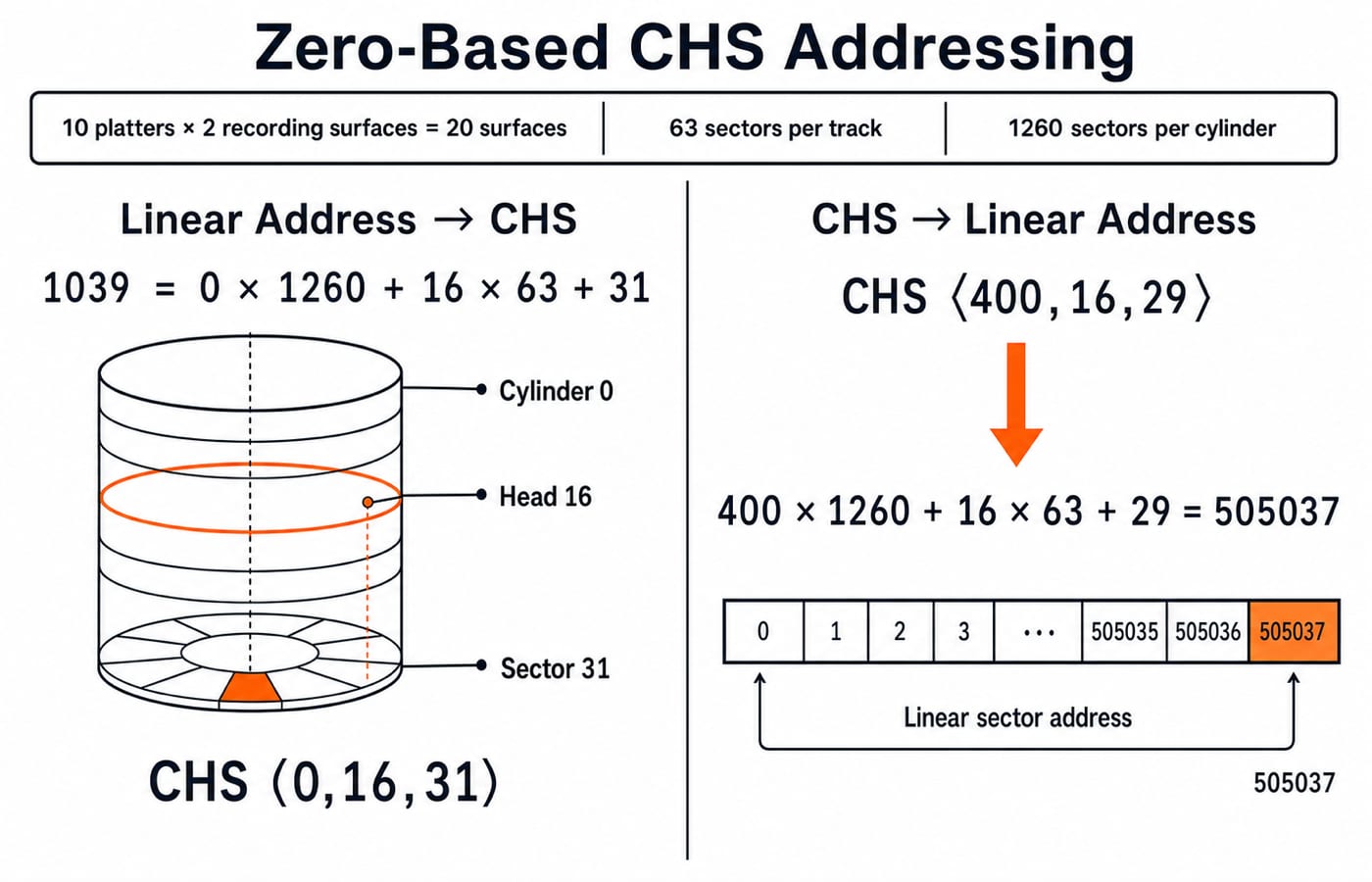
Ten double-sided platters mean H = 20. At S = 63, a cylinder holds 1260 sectors.
Q7. Convert sector 1039 to a CHS address (GATE 2009)
A hard disk has 63 sectors per track, 10 platters, each with 2 recording surfaces, and 1000 cylinders. A sector address is a triple (c, h, s), where c is the cylinder number, h is the surface number and s is the sector number. Thus, sector 0 is (0, 0, 0), sector 1 is (0, 0, 1), and so on. Using this disk geometry, the address of sector 1039 is
(a) (0, 15, 31)
(b) (0, 16, 30)
(c) (0, 16, 31)
(d) (0, 17, 31)
Answer: (c) (0, 16, 31). Since 1039 < 1260, the cylinder is 0. Then 1039 = 16 x 63 + 31, giving zero-based surface 16 and sector 31. Source
Q8. Convert CHS address <400,16,29> to a sector number (GATE 2009)
A hard disk has 63 sectors per track, 10 platters, each with 2 recording surfaces, and 1000 cylinders. A sector address is a triple (c, h, s), where c is the cylinder number, h is the surface number and s is the sector number. Thus, sector 0 is (0, 0, 0), sector 1 is (0, 0, 1), and so on. The address <400,16,29> corresponds to sector number:
(a) 505035
(b) 505036
(c) 505037
(d) 505038
Answer: (c) 505037. 400 x (20 x 63) + 16 x 63 + 29 = 504,000 + 1,008 + 29 = 505,037. Do not add one, because (0,0,0) maps to sector 0. Source
Contiguous file placement and recording velocity: Questions 9-10
Use inclusive file-end arithmetic. Keep CLV and CAV capacity models separate.
Q9. Cylinder containing the last sector of a file (GATE 2013, BARC 2013)
Consider a hard disk with 16 recording surfaces (0-15) having 16384 cylinders (0-16383) and each track contains 64 sectors (0-63). Data storage capacity in each sector is 512 bytes. Data are organized cylinder-wise and the addressing format is <cylinder no., surface no., sector no.> . A file of size 42797 KB is stored in the disk and the starting disk location of the file is <1200, 9, 40> . What is the cylinder number of the last sector of the file, if it is stored in a contiguous manner?
(a) 1281
(b) 1282
(c) 1283
(d) 1284
Answer: (d) 1284. A cylinder has 16 x 64 = 1024 sectors. The file uses 42,797 x 1024 / 512 = 85,594 sectors. Start index: 1200 x 1024 + 9 x 64 + 40 = 1,229,416. Inclusive last index: 1,229,416 + 85,594 - 1 = 1,315,009. Thus floor(1,315,009 / 1024) = 1284. The -1 includes the starting sector. Source
CHS says where data lies. File Systems and Disk Scheduling in OS covers the separate policy question: which request should the head serve next?
Q10. Capacity under CLV and CAV (GATE 2005, Information Technology)
A disk has 8 equidistant tracks. The diameters of the innermost and outermost tracks are 1 cm and 8 cm respectively. The innermost track has a storage capacity of 10 MB. What is the total amount of data that can be stored on the disk if it is used with a drive that rotates it with (i) Constant Linear Velocity (ii) Constant Angular Velocity?
(a) (i) 80 MB (ii) 2040 MB
(b) (i) 2040 MB (ii) 80 MB
(c) (i) 80 MB (ii) 360 MB
(d) (i) 360 MB (ii) 80 MB
Answer: (d) (i) 360 MB (ii) 80 MB. Diameters are 1, 2, 3, 4, 5, 6, 7, 8 cm. Under CLV, capacity follows circumference: 10 x (1 + 2 + 3 + 4 + 5 + 6 + 7 + 8) = 360 MB. Under CAV, 8 x 10 = 80 MB. Source
Disk structure and address traps, short version and next step
Cue | Correct move | Typical trap |
|---|---|---|
platter count | Double it only when both sides record | Using platters as surfaces |
cylinder | Use aligned tracks at one radius | Calling one track a cylinder |
capacity | Multiply all independent dimensions | Omitting surfaces |
sector bits | Take | Adding byte-offset bits |
CHS | Respect zero-based indexing | Adding one |
contiguous file end | Use | Missing the inclusive |
One-minute answer check: 35 sectors/track, (25K,50000K), 256 Mbyte and 19 bits, 20 address bits, (0,16,31), 505037, cylinder 1284, and 360 MB versus 80 MB.
Reverse the two GATE 2009 conversions, then repeat Q9 without options. Next, try Disk Scheduling MCQs: FCFS, SSTF, SCAN. Use the GATE Test Series for timed mixed practice, or compare the GATE CS Exam Preparation Courses & Test Series category.
Keep learning

Instruction Formats and Addressing Modes MCQs: 12 Solved Cross-Concept Questions
Solve 12 cross-concept COA questions that connect addressing-mode choices with PC rules, memory references, opcode fields, and byte-aligned instructions.
3 Oct 20267 min readComputer Organization MCQs

Interrupt-Driven I/O MCQs: 12 Solved Questions with Explanations
Attempt 12 previous-year interrupt-driven I/O questions, then check each answer with a concise explanation. The set covers ISR order, vectoring, priority, and CPU-time numericals.
28 Sep 20268 min readComputer Organization MCQs

Bitmap and Pixmap MCQs: 12 Solved Pixel Depth and Memory Questions
Build a reliable pixel-memory method through 12 live MCQs covering bitmaps, pixmaps, lookup tables, uncompressed storage, refresh rates, masks, and dithering.
Updated 25 Sep 20267 min readComputer Organization MCQs

Assembly & Assembler Design MCQs: 11 Solved PYQs Explained
Attempt 11 published PYQs on assembler directives, language levels, tables, register-pair instructions, debugging and fixed-width arithmetic, then check each worked explanation.
Updated 24 Sep 20267 min readComputer Organization MCQs