

Abstraction, Modularity and Information Hiding MCQs: 12 Solved Design Questions
Use 12 solved design-concept MCQs to separate abstraction, ownership, refinement, CRC roles and UML modelling choices.
KnowledgeGate Team
Exam prep & CS education
Updated 15 Nov 20267 min read

Abstraction, encapsulation, information hiding, modularity, aggregation, composition and refinement overlap in vocabulary but answer different design questions. Abstraction selects the essential view; information hiding protects changeable decisions; modularity assigns responsibility; refinement adds detail; aggregation and composition differ by ownership and lifetime. Classify each prompt before reading the options, then use the worked object or module trace to test the distinction.
How to use this design-concepts MCQ set
Use three passes. First, classify the prompt as a definition, relationship or modelling-process question. Second, eliminate options that confuse a public view with a hidden implementation. Third, test the remaining choice against one concrete object or module.
Record all 12 answers first. For matching or sequence items, solve each part before comparing complete tuples. Use Software Engineering for CS Teaching Exams for the wider subject map and UGC NET Preparation Courses & Test Series for broader study and practice. Use the official notification and syllabus for the current exam's requirements.
Abstraction, encapsulation, information hiding, and refinement, Questions 1-3
Question 1
Design-concepts practice prompt
Match List I with List II :
List I List II
(A) Localization (I) Encapsulation
(B) Packaging or binding of a collection of items (II) Abstraction
(C) Mechanism that enables designer to focus on (III) Characteristic of software that indicates the manner
essential details of a program component. in which information is concentrated in program
(D) Information hiding (IV) Suppressing the operational details of a program component
Choose the correct answer from the options given below :
A. (A)-(I), (B)-(II), (C)-(III), (D)-(IV)
B. (A)-(II), (B)-(I), (C)-(III), (D)-(IV)
C. (A)-(III), (B)-(I), (C)-(II), (D)-(IV)
D. (A)-(III), (B)-(I), (C)-(IV), (D)-(II)
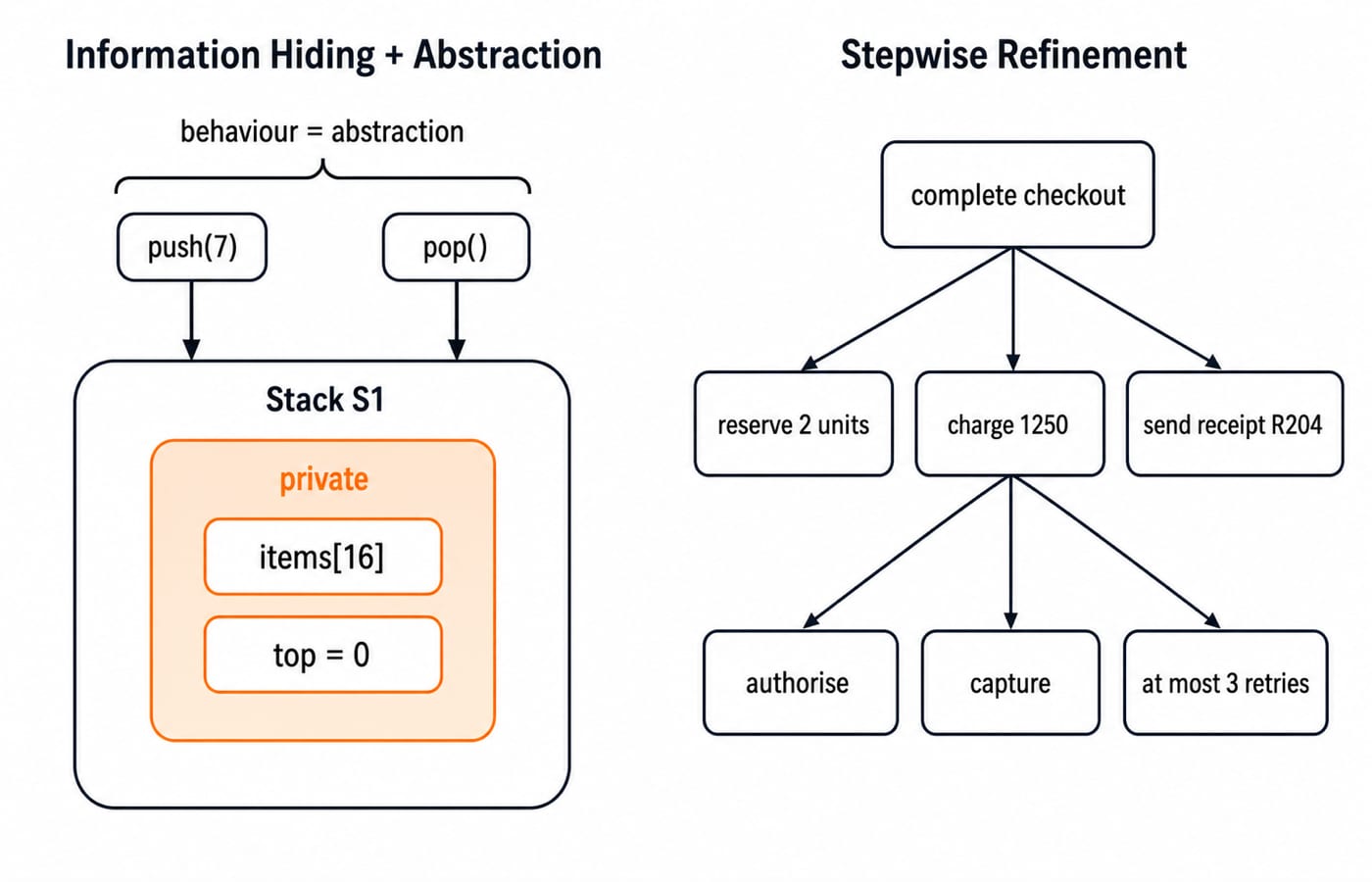
Answer: C. Localization concentrates information, encapsulation binds data and operations, abstraction exposes the essential view, and information hiding suppresses details. Stack S1 packages private items[16] and top = 0 with public push(7) and pop(). This one location controls dependencies, simplifying change and testing. For architecture, cohesion and coupling beyond these definition-level MCQs, use Software Design in Software Engineering.
Question 2
UGC NET 2020 question
The process of removing details from a given state representation is called _____
A. Extraction
B. Mining
C. Selection
D. Abstraction
Answer: D, Abstraction. Map M1 keeps roads R1 and R2 meeting at J4 but omits 27 building interiors. Extraction retrieves, mining finds patterns, and selection chooses members. Abstraction alone deliberately simplifies this route representation.
Question 3
Design-concepts practice prompt
A Design Concept Refinement is a :
A. Top-down approach
B. Complementary of abstraction concept
C. process of elaboration
D. All of the above
Answer: D. Level 0 says complete checkout. Level 1 becomes reserve 2 units, charge 1250, and send receipt R204. Level 2 expands charging into authorise, capture, and at most 3 retries. This top-down elaboration complements abstraction, so A, B and C are true.
Top-down design and object-oriented structure, Questions 4-5
Question 4
UGC NET 2022 question
A top down approach to programming calls for :
Statement I: Working from the general to the specific.
Statement II: Postpone the minor decisions.
Statement III: A systematic approach.
Statement IV: Intermediate coding of the problem
Which of the following is true ?
A. Statement I only
B. Statement I and Statement II only
C. Statement I, Statement II and Statement III only
D. Statement I, Statement II and Statement IV only
Answer: B. Begin with ProcessOrder(O204), then split it into validate 3 items, charge 1250, and dispatch, postponing the retry delay. That moves from general to specific. Being systematic or writing intermediate code does not define this approach.
Question 5
UGC NET 2014 question
Superficially the term “object-oriented”, means that, we organize software as a
A. collection of continuous objects that incorporates both data structure and behaviour.
B. collection of discrete objects that incorporates both discrete structure and behaviour.
C. collection of discrete objects that incorporates both data structure and behaviour.
D. collection of objects that incorporates both discrete data structure and behaviour.
Answer: C. Account A17 owns balance = 500 and deposit(200). After 500 + 200 = 700, the same discrete object has balance = 700. The key is data plus behaviour, not the distractors' vague continuous objects or discrete structure.
Composition and aggregation as whole-part relationships, Questions 6-7
Question 6
UGC NET 2016 question
Which of the following is a correct statement ?
A. Composition is a strong type of association between two classes with full ownership.
B. Composition is a strong type of association between two classes with partial ownership.
C. Composition is a weak type of association between two classes with partial ownership.
D. Composition is a weak type of association between two classes with strong ownership.
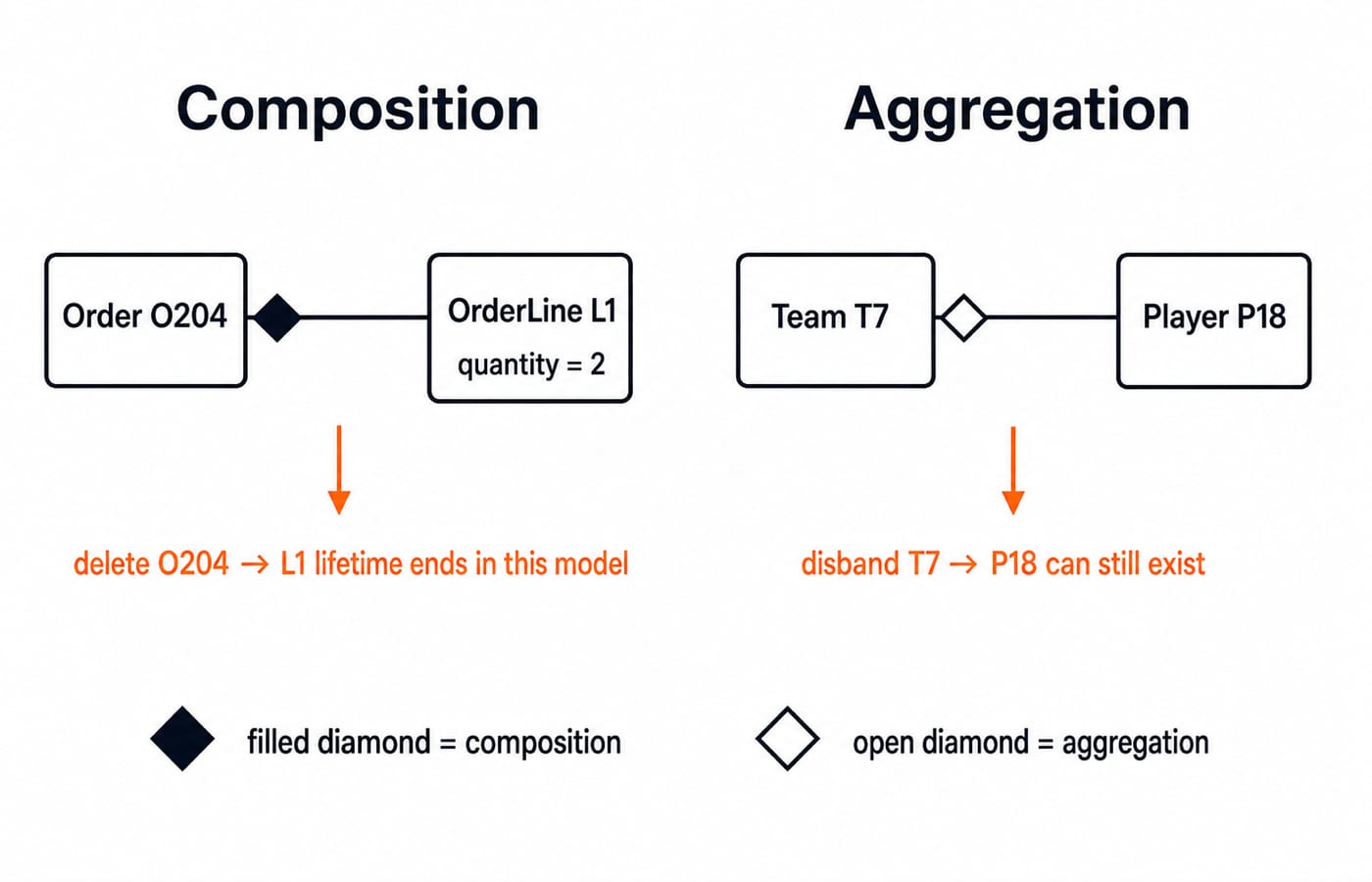
Answer: A. Order O204 fully owns OrderLine L1, with quantity = 2. Deleting O204 ends L1's lifetime in the model. A filled UML diamond represents that strong, full ownership.
Question 7
Design-concepts practice prompt
The “part-whole”, or “a-part-of”, relationship in which objects representing the components of something associated with an object representing the entire assembly is called as
A. Association
B. Aggregation
C. Encapsulation
D. Generalisation
Answer: B, Aggregation. Team T7 contains Player P18, but P18 survives its disbanding. Association is a general link, encapsulation is packaging, and generalisation is an is-a relation. Aggregation expresses whole-part objects with independent lifetimes.
Object-oriented design workflow and behavioural modelling, Questions 8-9
Question 8
Design-concepts practice prompt
The steps for analysis and design of object oriented system.
(A) Draw interaction diagrams
(B) Draw state chart and object diagram
(C) Draw use case and activity diagram
(D) Draw component and deployment diagram
(E) Draw class diagram
Choose the correct answer from the options given below :
A. (E) → (B) → (A) → (C) → (D)
B. (B) → (A) → (E) → (D) → (C)
C. (E) → (C) → (B) → (D) → (A)
D. (C) → (A) → (E) → (B) → (D)
Answer: D. For Place order O204, use case and activity diagrams capture requirements. Interaction orders create(O204), charge(1250), and confirm(). Classes assign Order and Payment; state and object views refine NEW -> PAID; component and deployment views place the result. The order is (C) -> (A) -> (E) -> (B) -> (D).
Question 9
UGC NET 2020 question
To create an object-behavioral model, the analyst performs the following steps:
(A) Evaluates all use-cases
(B) Builds state transition diagram for the system
(C) Reviews the object behaviour model to verify accuracy and consistency
(D) Identifies events that do not derive the interaction sequence
Choose the correct answer from the options given below:
A. (A), (B) and (C) Only
B. (A), (B) and (D) Only
C. (B), (C) and (D) Only
D. (A), (C) and (D) Only
Answer: A. Evaluate Pay order, model Order O204 moving CREATED -> PAID on pay(1250), then check it against the interaction. Statement D is false because relevant behavioural events should arise from modelled interactions.
CRC roles, UML stereotypes, and diagram-purpose matching, Questions 10-12
Question 10
UGC NET 2015 question
In CRC based design, a CRC Team consists of
(a) one or two users representatives
(b) several programmers
(c) project co-ordinators
(d) one or two system analysts
Codes :
A. (a) and (c)
B. (a), (b), (c) and (d)
C. (a), (c) and (d)
D. (a), (b) and (d)
Answer: C. U1 and U2 supply facts, C1 coordinates, and A1 and A2 form classes. Several programmers is not core.
Question 11
UGC NET 2014 question
What is true about UML stereotypes ?
A. Stereotype is used for extending the UML language.
B. Stereotyped class must be abstract
C. The stereotype indicates that the UML element cannot be changed
D. UML profiles can be stereotyped for backward compatibility
Answer: A. <<service>> and retries = 3 extend PaymentService without making it abstract or immutable. Profiles group extensions; compatibility is not the purpose.
Question 12
Design-concepts practice prompt
Match the following with respect to relationship between objects and classes :
List – I List – II
a. State diagram i. Useful for both abstract modelling and for designing actual program
b. Object diagram ii. Describes object classes
c. Class diagram iii. Useful for documenting test cases
d. Instance diagram iv. Describing the behaviour of a single class of objects.
Codes :
A. a - iv, b - i, c - ii, d - iii
B. a - ii, b - iii, c - iv, d - i
C. a - iii, b - iv, c - ii, d - i
D. a - ii, b - iv, c - i, d - iii
Answer: A. State tracks Order: CREATED -> PAID; object shows O204:Order; class describes Order and Payment; instance freezes TC-17 at 1250, PAID. Thus a - iv, b - i, c - ii, d - iii.
Answer key, trap diagnosis, and the next practice step
Question | 1 | 2 | 3 | 4 | 5 | 6 | 7 | 8 | 9 | 10 | 11 | 12 |
|---|---|---|---|---|---|---|---|---|---|---|---|---|
Answer | C | D | D | B | C | A | B | D | A | C | A | A |
Diagnose by cluster: Q1-Q3 abstraction, Q4-Q5 object structure, Q6-Q7 whole-part strength, Q8-Q9 modelling order, and Q10-Q12 UML tools.
Retake all 12 in 15 minutes. For each miss, note Stack S1: items[16], top = 0, Order O204 owns L1, or Team T7 aggregates P18, then retry that cluster. Use NTA-UGC-NET Paper - 2 for guided study and the NTA UGC NET Paper - 2 Test Series for practice.
Short version: abstraction selects essentials, information hiding protects decisions, modularity concentrates responsibility, refinement adds detail, and whole-part relations differ by lifecycle.
Go deeper with the full courseUGC NET Computer Science (Paper 1 + Paper 2)
Keep learning
Data Abstraction Explained: Hide Implementation Details with a Worked Java Example
See how a stable Account contract protects its invariant while the Java implementation changes from a running balance to a transaction ledger.
Updated 16 Nov 20265 min readProgramming Languages Survey

Abstraction and Interfaces in Java: Abstract Classes, Contracts and Runnable Examples
Learn when Java needs an abstract class, when it needs an interface, and how both work together in one runnable charge-calculation program with exact outputs.
Updated 6 Oct 20266 min readJava

OOPs Concepts in Java: Inheritance, Polymorphism, Abstraction and Encapsulation with Worked Interview Questions
Turn the four OOP pillars into predictable Java behaviour. Trace superclass references, subclass objects, overridden methods, hidden fields and common follow-ups.
Updated 30 Jul 20265 min readJava
Fundamentals of Systems and Information Systems: Types, Components and a Worked Inventory Model
Learn the system vocabulary, compare classifications and TPS, MIS, DSS and ESS, then follow one warehouse case from raw transactions to a 480-unit order.
Updated 15 Nov 20266 min readGATE Strategy & Roadmap