

E-Commerce and Digital Transactions Explained: Models, Flow and a Worked Funnel
Separate e-commerce from e-business, follow one order through its systems, and learn how to choose the right denominator in a transaction funnel.
KnowledgeGate Team
Exam prep & CS education
Updated 11 Nov 20266 min read
An online order is often reduced to “a website plus a payment”, although it crosses systems and creates distinct records. E-commerce is narrower than e-business, while digital transactions include electronic exchanges beyond retail; the checkout funnel accounts for all 2,000 attempts.
Start with three boundaries: e-commerce, e-business and digital transaction
E-commerce is electronically enabled exchange between parties, including discovery, ordering and post-order activity. E-business is broader, covering external commerce and internal work such as inventory, procurement, payroll and customer support. E-commerce is a subset, while internal payroll can be e-business without e-commerce.
A digital transaction is an electronically initiated, transmitted, processed or recorded exchange of an instruction, value, entitlement or status. It is not just payment. One purchase can create session, cart, order, authorisation, inventory, invoice, shipment, delivery and refund records. A bank transfer or digital government-service submission can be digital without being retail e-commerce.
Here is a boundary check. Browsing five product pages is digital interaction, but not yet an order. Submitting order O-204 is a digital commercial transaction. Updating warehouse stock from 18 to 17 is an internal e-business event caused by it. Electronic Data Interchange and E-Commerce: Secure Workflows, Cyber Law and Worked Examples traces standards, acknowledgements and replay controls through a full document workflow. O-204 instead separates storefront, payment, inventory, fulfilment and reconciliation states across one order.
Classify the trading relationship before the technology
The letters in B2C, B2B, C2C and C2B identify the parties. They do not identify the payment method or delivery channel.
Model | Seller side | Buyer side | Worked mini-scenario | What the platform must coordinate |
|---|---|---|---|---|
B2C | Business | Consumer | A retailer sells one keyboard to a learner | Catalogue, checkout, order and delivery |
B2B | Business | Business | A distributor receives a | Purchase order, approval, stock and invoice |
C2C | Consumer | Consumer | One student lists a used calculator for another | Listing, trust, communication and dispute handling |
C2B | Consumer | Business | A designer licenses | Submission, rights, approval and delivery |
A storefront has one seller controlling the catalogue and checkout, a layer covered in Web Technologies for Teaching Exams. A marketplace coordinates multiple sellers and buyers, often adding onboarding, commissions, disputes and split fulfilment. Both can sell physical goods, digital goods or services, but their delivery events differ.
Follow one order across actors, systems and states
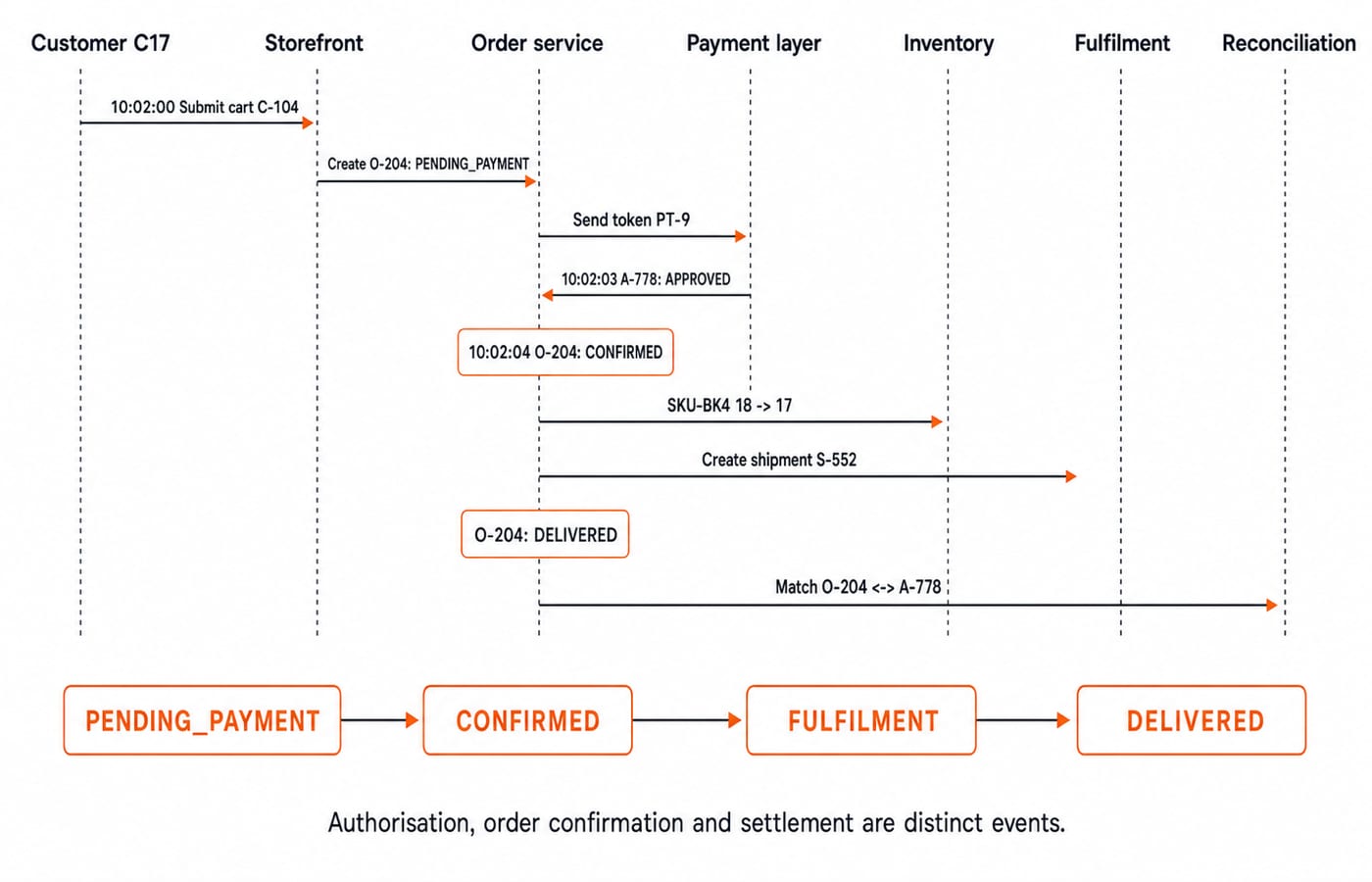
At 10:02:00, customer C17 submits cart C-104. The storefront creates order O-204 in PENDING_PAYMENT. The payment layer sends token PT-9, a reference rather than the customer's raw payment credential, and receives A-778 = APPROVED at 10:02:03. At 10:02:04, the order service changes O-204 to CONFIRMED. Inventory reduces SKU-BK4 from 18 to 17, fulfilment creates shipment S-552, delivery later changes the order to DELIVERED, and reconciliation matches O-204 with A-778.
The customer and merchant initiate the exchange. A storefront or marketplace presents it; order and inventory services manage state; a payment provider handles messages; issuing and acquiring institutions may participate; and fulfilment, notification and reconciliation handle later events. Providers may combine roles; architectures vary. Authorisation, capture, settlement and order confirmation remain distinct.
EDI is structured computer-to-computer exchange of business documents under an agreed format and process. A 40-unit purchase order followed by an acknowledgement and invoice can be EDI. A free-form email or scanned PDF is not automatically EDI merely because it is electronic.
Worked example: account for all 2,000 checkout attempts
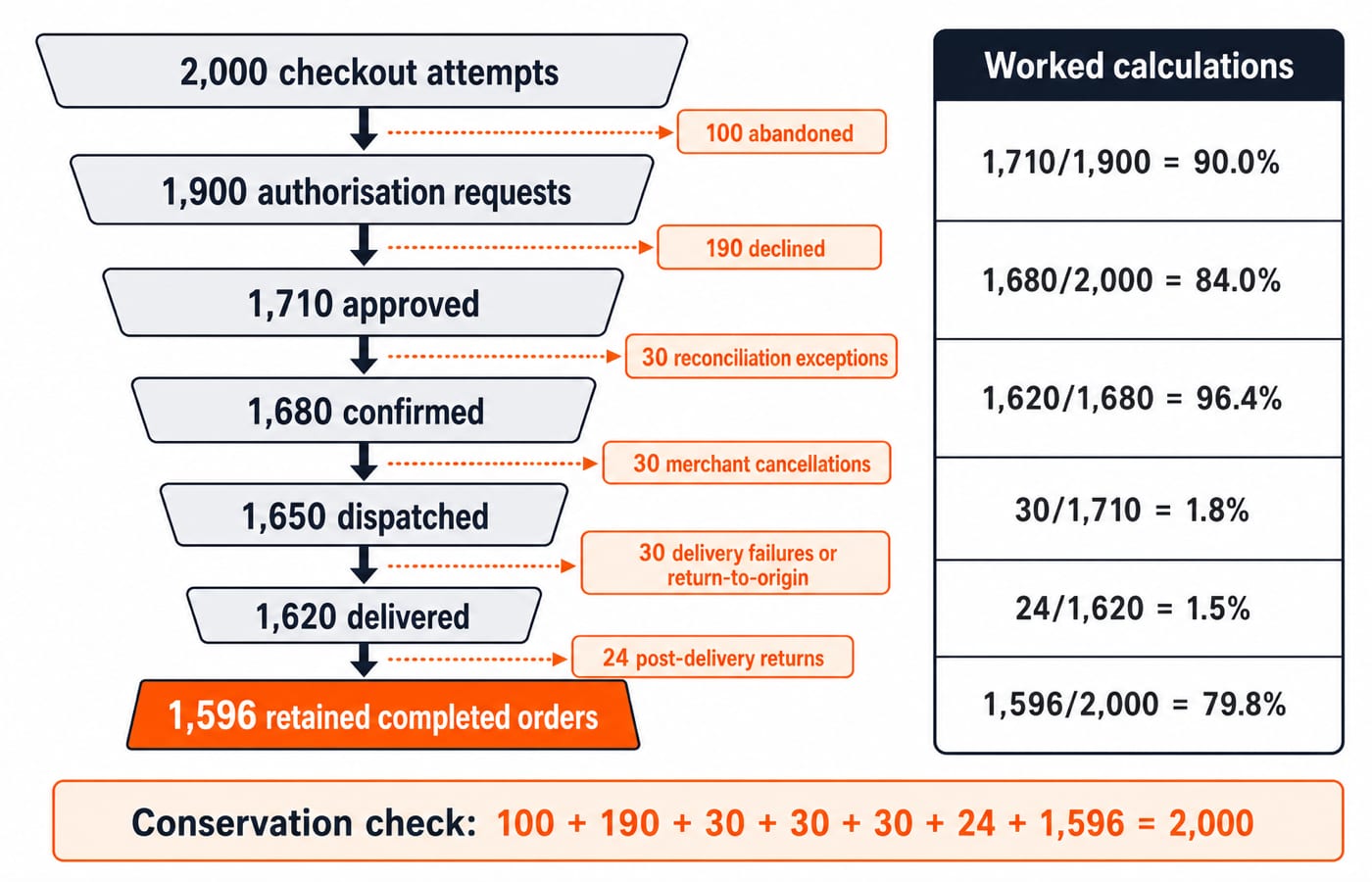
CampusCart records 2,000 checkout attempts in a fictional reporting window.
2,000 - 100 abandoned = 1,900authorisation requests.1,900 - 190 declined = 1,710approved authorisations.1,710 - 30 unmatched approved payments = 1,680confirmed orders.1,680 - 30 merchant cancellations = 1,650dispatched orders.1,650 - 30 delivery failures or return-to-origin cases = 1,620delivered orders.1,620 - 24 post-delivery returns = 1,596retained completed orders.
Rates require different denominators:
Authorisation approval rate:
1,710 / 1,900 x 100 = 90.0%.Checkout-to-confirmation rate:
1,680 / 2,000 x 100 = 84.0%.Confirmation-to-delivery rate:
1,620 / 1,680 x 100 = 96.4%to one decimal place.Reconciliation-exception rate among approved authorisations:
30 / 1,710 x 100 = 1.8%.Post-delivery return rate:
24 / 1,620 x 100 = 1.5%.Retained-completion rate from checkout:
1,596 / 2,000 x 100 = 79.8%.
The totals conserve all attempts: 100 + 190 + 30 + 30 + 30 + 24 + 1,596 = 2,000.
The 190 declines are not abandoned carts because they reached authorisation. The 30 reconciliation exceptions are approved payments without matched orders, not necessarily failed payments. The 24 later returns belong under delivered orders, not in the authorisation denominator. A production report must define states and its reporting window before comparing rates.
Build trust with security, evidence and recovery controls
Security objectives guide controls, but do not promise a risk-free transaction. Confidentiality uses protected communications and restricted access. Integrity uses validation and tamper-evident checks. Authentication establishes identity; authorisation decides permissions. Availability needs resilience and recovery planning. Privacy needs purpose limitation, data minimisation and controlled retention. Timestamps, IDs and audit logs preserve evidence. Computer Networks supplies the foundation beneath these controls.
For O-204, authenticate the session separately from authorising payment. Permit only inventory to change SKU-BK4. Make retries idempotent so one request ID cannot create a second order. Log transitions, reconcile O-204 with A-778, notify the customer of material changes, and route the 30 aggregate unmatched approvals through a defined exception path.
Encryption protects readable data using a key. Hashing produces a fixed-length digest useful for integrity checks, but alone does not prove who created a record. A correctly managed digital signature can support origin authentication and integrity. Encryption alone does not provide non-repudiation, and no single control removes all risk.
Treat policy and customer redress as part of the system boundary
Consent and terms, accurate records, minimal data collection, controlled access, clear cancellation and refund paths, invoice handling, complaints and evidence retention all affect fields, states and logs.
If A-778 is approved while O-204 remains unconfirmed, preserve both records, route the mismatch to reconciliation, inform the customer, and follow the applicable reversal, fulfilment or dispute process after checking provider and jurisdiction rules.
Common traps and exam distractors
E-commerce and e-business are not synonyms. E-business is broader.
B2B and B2C depend on the parties, not whether payment is digital.
EDI requires structured, agreed computer-to-computer exchange. Not every electronic document qualifies.
Approval, confirmation, capture, settlement, delivery and refund are distinct events that may disagree and need reconciliation.
1,710 / 1,900measures approval among payment requests.1,596 / 2,000measures retained completion from checkout.An abandoned checkout is not a declined payment if no authorisation request was sent.
Hashing does not encrypt a message or guarantee sender identity.
Cash on delivery does not make the whole purchase non-digital. Ordering, inventory and fulfilment can still be electronic.
How exams test the topic
Common question shapes include definition or subset matching; classifying a B2B, B2C, C2C or C2B scenario; ordering lifecycle events; statement pairs about EDI, security or payment states; and funnel arithmetic with a tempting denominator. For example, “approved out of payment requests” is 1,710 / 1,900 = 90.0%, not 1,710 / 2,000.
Use a 30-second method: identify the parties, underline the requested state, sketch the event order, mark the denominator before calculating, and reject absolute claims such as “always secure” or “all electronic documents are EDI”. Browse the Government Teaching Jobs category for related subject guides, and confirm any exam pattern against the conducting body's current notification.
The short version and next step
Remember the chain: discover -> cart -> order -> authorise -> confirm -> fulfil -> deliver -> reconcile -> return/refund if needed. Redraw 2,000 -> 1,900 -> 1,710 -> 1,680 -> 1,650 -> 1,620 -> 1,596, then explain every loss and denominator.
Computer Science teaching-exam aspirants can continue with the DSSSB TGT Computer Science 2026 Section B course for structured study.
Keep learning

Digital Payment Systems Explained: UPI Flow, Net Settlement and Exam Traps
Separate payment instruments, interfaces and rails, then follow a transfer of 750 units and reduce three inter-bank flows to one net obligation.
Updated 29 Oct 20266 min readUGC NET Computer Science
Digital India and e-Governance: Models, Service Architecture and Worked ICT Examples
See how an e-governance service works from request to decision. Follow a fictional application, calculate workload and uptime, and test its controls.
Updated 23 Aug 20265 min readDigital Logic

Cyber Threats and Malware Explained: Types, Attack Flow and a Worked Example
Learn how threats, vulnerabilities, exploits, attack vectors and malware differ. Then classify malware by behaviour and solve a simplified InvoiceSync spread scenario.
Updated 10 Nov 20265 min readTeaching Recruitment (Computer Science)
Software Engineering Basics Explained: SDLC, Process Models and Worked Example
Learn how software engineering extends beyond coding, how major process models differ, and how to choose and apply one in a constructed student portal project.
Updated 30 Oct 20266 min read111 viewsUGC NET Computer Science