Teaching aptitude for CS recruitment exams: what it tests and how to score
General teaching aptitude for computer science recruitment: learner psychology, teaching methods, evaluation and classroom management, with the tested distinctions and how the section is scored.
KnowledgeGate Team
Exam prep & CS education
Updated 18 Jul 20265 min read

A computer science teaching post selects a teacher, not just a programmer, and the paper reflects that. Alongside the CS subject core, most teaching recruitment exams carry a teaching-aptitude component that asks how learning happens, how good teaching is planned, and how a classroom is run and assessed. Strong CS candidates often leave these marks on the table because the material feels soft. It is not. It is a defined body of knowledge with predictable questions, and it is fully learnable.
The same material is tested in every teaching recruitment paper, whatever subject the post is for, so it earns marks well beyond the CS papers you are sitting.
Teaching aptitude: what the section covers
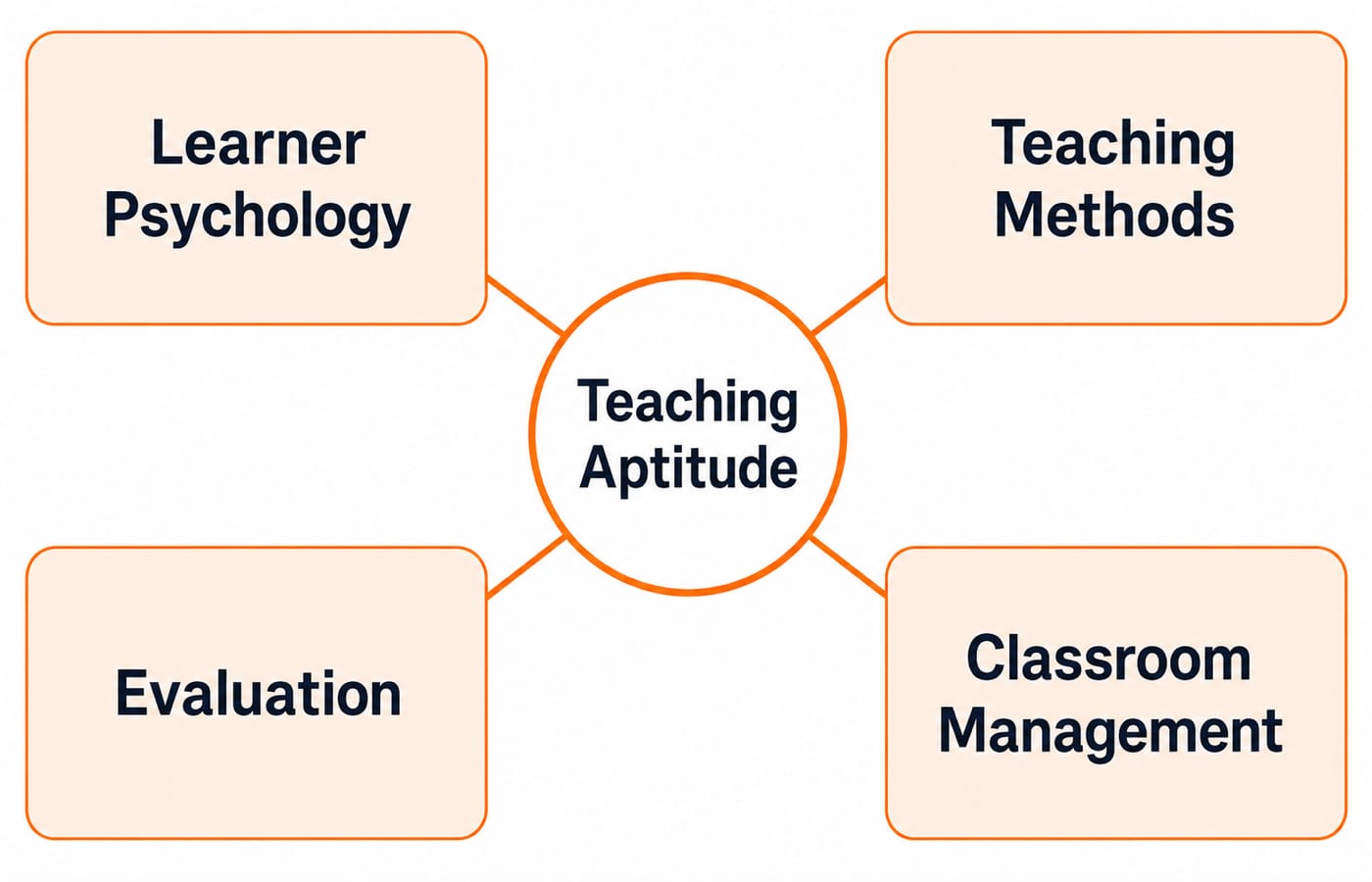
Teaching aptitude is the study of the principles and practices of effective teaching: how learners develop and learn, what methods and approaches teachers use, how learning is assessed, and how a classroom is managed. In an exam it is tested as conceptual, applied questions, often a short scenario asking which method, approach, or assessment fits best. Four pillars organise almost everything you will be asked.
Learner psychology: how students develop and learn
Good teaching starts from how learners think and grow, so this pillar underpins the rest.
Development. Learners pass through stages of cognitive, emotional, and social growth, and teaching should match the learner's stage and readiness.
Individual differences. Aptitude, prior knowledge, motivation, and pace differ across students, and effective teaching accounts for that spread rather than assuming one level.
Motivation. Intrinsic motivation comes from within the learner (curiosity, interest); extrinsic motivation comes from outside (rewards, marks). Sustained learning leans on the intrinsic kind, a distinction the paper likes.
Learning by understanding. Meaningful learning, connecting new ideas to what a learner already knows, outlasts rote memorisation. That contrast is a recurring question.
Teaching methods and approaches
This is the densest question pillar, because it has clean, nameable categories.
Teacher-centred vs learner-centred. In a teacher-centred method, the teacher directs and the lecture dominates. In a learner-centred method, students actively construct understanding through activity, discussion, and problem-solving. Modern teaching favours the learner-centred end, and questions often ask you to classify a described method.
Common methods. The lecture method (efficient for delivering content, weak on engagement), the demonstration method (show, then have learners do), the discussion method (draws out participation), and the project or activity method (learning by doing).
Inductive vs deductive. An inductive approach moves from specific examples to a general rule; a deductive approach states the rule first, then applies it. For example, a teacher who shows students several completed programs and asks them to infer the common rule they follow is teaching inductively, while one who states the rule first and then works through a single example is teaching deductively. Naming which is which from a described lesson is a standard item.
Teaching aids. Charts, models, and digital media that make a concept concrete support learning, especially for abstract topics.
Evaluation and assessment
How learning is measured is a pillar of its own, and its vocabulary is heavily tested.
Formative vs summative assessment. Formative assessment happens during learning to guide it (class questions, quizzes, feedback). Summative assessment happens at the end to judge achievement (a final exam). A short mid-unit quiz used to find out who has not yet grasped a topic is formative; the end-of-term paper that grades that learning is summative. This pair is the most examined idea in the whole section.
Continuous and comprehensive evaluation. Assessing learners regularly and across both scholastic and co-scholastic areas, rather than on one final test alone.
Validity and reliability. A valid test measures what it claims to measure; a reliable test gives consistent results across attempts. Keep the two apart, because questions swap them.
Classroom management
The fourth pillar is the practical craft of running a class so that learning can happen.
Discipline as structure. Effective management is about clear routines, expectations, and engagement, not punishment. A well-planned, active lesson prevents most disruption.
Inclusive practice. Managing a class of mixed abilities and backgrounds fairly, so every learner can participate.
Feedback and reinforcement. Timely, specific feedback and positive reinforcement shape behaviour and learning more effectively than criticism alone.
Time and attention. Managing pace and transitions between activities keeps a class engaged, and a lesson that is planned to fill the time productively leaves little room for disruption to begin with.
How teaching aptitude is tested in recruitment exams
Across DSSSB, KVS, and state PGT computer science papers, teaching aptitude appears as a set of conceptual, one-mark objective questions, frequently framed as a short classroom scenario. The dependable patterns: distinguish formative from summative assessment, classify a described method as teacher-centred or learner-centred, tell inductive from deductive, separate intrinsic from extrinsic motivation, and pick the sound classroom-management response. Because the questions are applied rather than factual recall, understanding the ideas beats memorising definitions. The exact question count and any sectional weightage vary by exam, so confirm both in the official notification for the paper you are sitting.
Work every scenario item in the same three steps.
Name the pillar. Decide whether the item is about learner psychology, teaching methods, evaluation, or classroom management.
Find the tested pair. Identify the two ideas the options are actually contrasting.
Match the principle. Choose the option the principle demands, not the one that merely sounds kind or modern.
Suppose a teacher gives a quick five-minute quiz midway through a topic, then reteaches the part most students missed. The pillar is evaluation, and the tested pair is formative versus summative assessment. The timing and use of the result settle the answer: the quiz happens during learning and guides the next teaching step, so it is formative. The distractor calls it summative simply because it is a test.
Our published question bank carries more than 700 teaching-aptitude questions, concentrated on exactly these pillars, so practising them trains the scenario-reading skill the section rewards.
Your next step
Treat teaching aptitude as learnable marks, not a soft afterthought, and practise the scenario questions until the categories are automatic. To prepare the full computer science teaching syllabus with the aptitude and general-studies components in place, the Teaching Recruitment Exams bundle covers the CS core across the major teaching posts, and the DSSSB Section A course focuses on the general-subjects paper where this material sits. Browse the wider set from the government teaching jobs category.
For the subject-specific counterpart, how a computer science curriculum itself is taught and questioned, read our computer science pedagogy for teacher exams guide.
Learn the four pillars, keep the tested pairs apart, formative versus summative, inductive versus deductive, intrinsic versus extrinsic, validity versus reliability, and read each scenario for the principle it is testing. Do that, and teaching aptitude turns into some of the most dependable marks on your paper.
Keep learning
Number System Concepts and Shortcuts: Solved Examples for Competitive Exams
Learn how to classify numbers, choose the right divisibility or prime-factor method, and verify remainders, factors, HCF, LCM, and unit digits.
Updated 22 Oct 20266 min readAptitude & Reasoning

Age Ratio-Based Problems: 12 Questions with Step-by-Step Solutions
Solve 12 age ratio-based questions from the KnowledgeGate practice bank. Each fresh solution shows how to form the equation, shift every age correctly, and verify the answer.
18 Oct 20267 min readAptitude & Reasoning

Mixture and Alligation: Rules, Shortcuts and Solved Examples for Exams
Learn how concentration, alligation and the retention factor solve the main mixture question types, with step-by-step examples and arithmetic checks.
Updated 14 Oct 20265 min readAptitude & Reasoning
Mental Ability Concepts and Shortcuts: Solved Examples for Competitive Exams
Learn a four-step reasoning process, then apply it to number patterns, mirror coding, directions, syllogisms, blood relations and ranking problems.
Updated 10 Oct 20267 min readAptitude & Reasoning