

Piaget’s Preoperational Stage: Traits, Examples and CTET Practice Questions
A four-year-old can use a box as a bus yet still judge quantity by height. Learn the key preoperational traits, teach them through concrete activity and test the distinctions with original practice items.
KnowledgeGate Team
Exam prep & CS education
Updated 16 Nov 20266 min read
A four-year-old may speak fluently and use a box as a bus, yet still insist that a taller glass contains more water. When a CTET-style stem gives only one short classroom incident, separating symbolic thought, egocentrism, centration, non-conservation and irreversibility can be difficult because several labels may seem plausible. The distinctions become clearer through a measured conservation demonstration and five original practice questions with immediate rationales.
1. Piaget’s preoperational stage at a glance
Piaget placed the preoperational stage approximately between ages 2 and 7, after the sensorimotor stage and before the concrete operational stage. The term does not mean that children cannot think, talk, remember or solve problems. It means they do not yet use reversible logical operations reliably.
For teaching, it can be divided into symbolic-function thought, roughly ages 2 to 4, and intuitive thought, roughly ages 4 to 7. Language, symbols and pretend play expand, but perspective-taking, conservation and logical reversal remain inconsistent. These ages are broad developmental ranges, not diagnostic deadlines.
Observed behaviour | Likely construct | Do not confuse with |
|---|---|---|
Uses a box as a bus | Symbolic function | Object permanence |
Gives their own view as another person’s view | Egocentrism | Selfishness |
Says the taller glass has more | Centration and non-conservation | Symbolic function |
Cannot imagine pouring the liquid back | Irreversibility | Lack of memory |
2. Symbolic function: when one thing can stand for another
A 3-year-old holds a banana to the ear as a telephone. A 4-year-old places four chairs in a row and calls them a bus. Another child draws one large circle with two dots and says it is “Mummy”. In each case, an object, arrangement or drawing represents something absent.
Symbolic function supports language, deferred imitation, drawing and pretend play. It is not object permanence, which develops earlier, or conservation, which concerns quantity after a visible transformation. No single action proves a diagnosis. A teacher can support meaning-making through role play, pictures, manipulatives and story retelling, then ask what each object represents without labelling the child.
3. Egocentrism: a perspective-taking limit, not selfishness
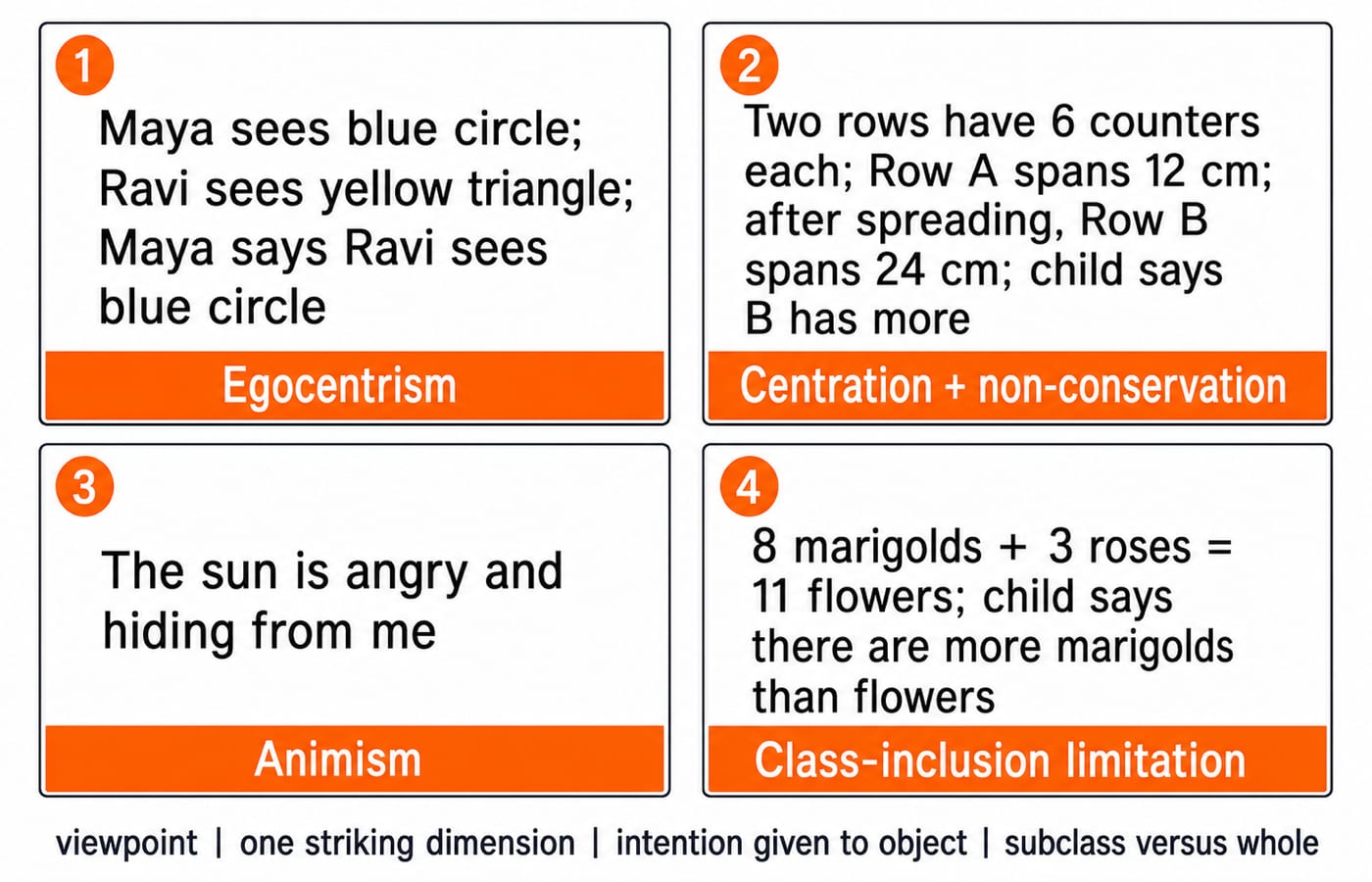
Maya, age 4, sits south of a vertical card and sees a blue circle. A puppet named Ravi sits north and sees a yellow triangle. Asked, “What does Ravi see?”, Maya answers, “The blue circle.” This suggests difficulty representing another viewpoint, not selfishness, rudeness or refusal to share.
The teacher can let Maya move to Ravi’s chair, name the yellow triangle, return and answer again. One successful switch does not show that perspective-taking is reliable everywhere. In a question stem, another person’s visual or mental viewpoint suggests egocentrism. Attention to one striking dimension, such as height or length, suggests centration.
4. Centration, conservation and irreversibility in one worked example
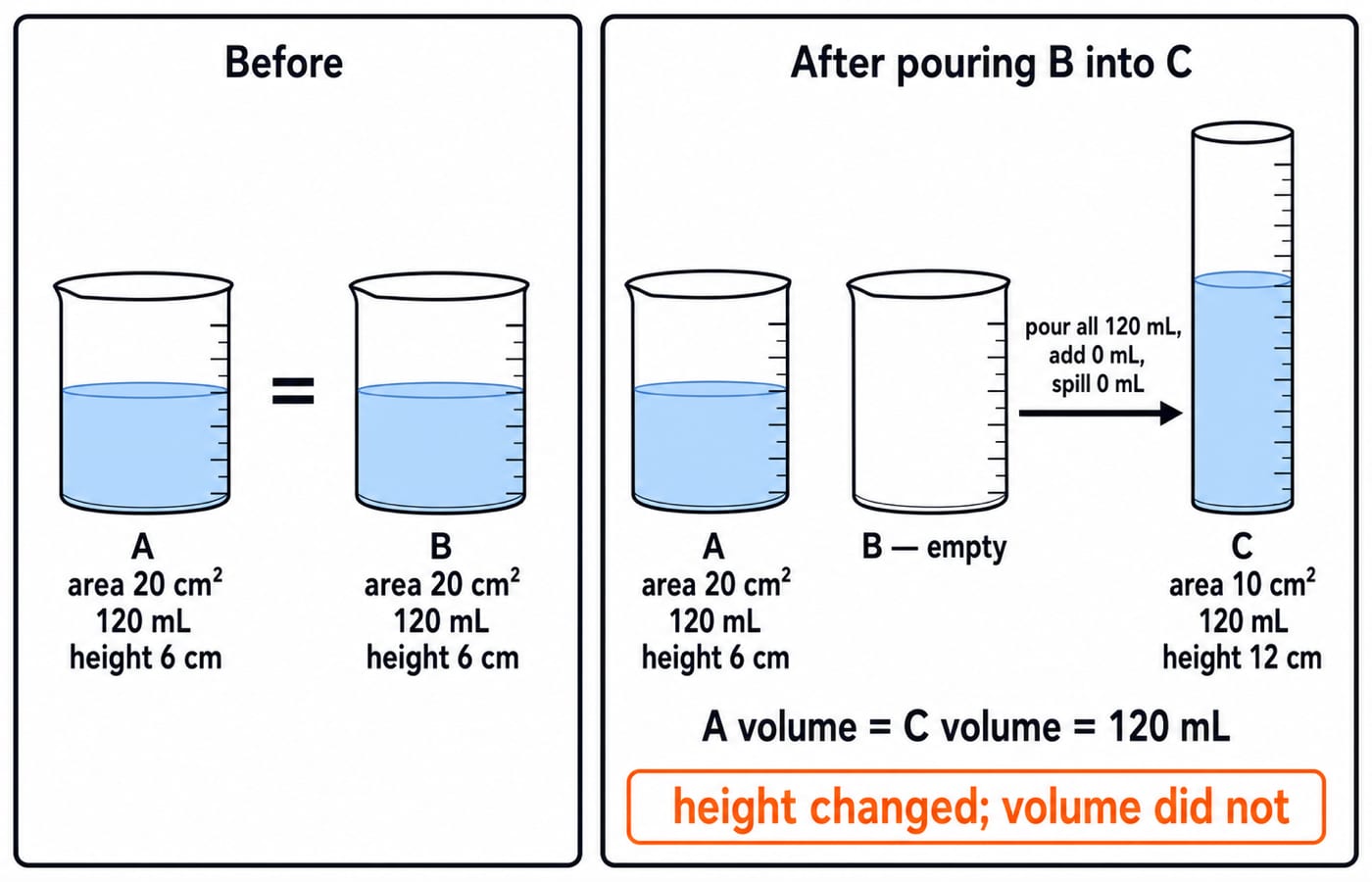
Take identical straight-sided transparent beakers A and B, each with an internal cross-sectional area of 20 cm². Put 120 mL of coloured water in each. Because 1 mL equals 1 cm³, the height in each is:
height = volume ÷ area = 120 cm³ ÷ 20 cm² = 6 cm
The child agrees that A and B are equal. In full view, pour all 120 mL from B into taller cylinder C, whose area is 10 cm². Add nothing and spill nothing. B is empty, A remains at 120 mL and 6 cm, and C’s height is:
120 cm³ ÷ 10 cm² = 12 cm
If the child says C has more because its level is higher, the focus on height is centration. The incorrect quantity judgement is non-conservation. Difficulty imagining C poured back into B shows irreversibility. The invariant is volume: only the container changed, so A and C still hold 120 mL each.
Ask the child to predict the result of pouring C back into B, perform the pour and compare A with B. Later, repeat with two rows of six counters and two equal clay balls. Concrete exploration matters more than memorising a verbal rule.
5. Animism, artificialism, transductive reasoning and class inclusion
“The sun is angry and is hiding from me” gives a non-human object intention or feeling, so it shows animism. “People built the mountains” treats a natural feature as human-made, so it shows artificialism. “I did not take my afternoon nap, so afternoon did not come” connects two particular events without a sound general causal rule, so it shows transductive reasoning.
For class inclusion, place 8 marigolds and 3 roses on a table, giving 11 flowers. A child who answers “marigolds” when asked whether there are more marigolds or flowers has not coordinated the visible subclass with the whole. This is not egocentrism. As the concept of pedagogy suggests, a sound response is to ask, sort, count, regroup and discuss, not ridicule the child or call the error laziness.
6. How CTET-style questions test the distinction
Teaching-eligibility questions commonly present a brief child-behaviour or teacher-response scenario and ask for the most defensible construct or action. For current section names, question counts, marks, dates and rules, consult the current CBSE CTET information bulletin through the official CTET portal. For the recurring theorist patterns, use this CTET previous-year analysis of CDP theorists.
The following set is original practice, not official CTET questions or reproduced PYQs.
Question 1
A five-year-old sees two rows with 7 buttons in each. The buttons in Row B are spread until that row is twice as long as Row A. The child says Row B has more buttons. Which explanation best fits?
(a) Egocentrism
(b) Centration and lack of conservation
(c) Symbolic function
(d) Object permanence
Answer: (b). The child focuses on row length and does not conserve number after spacing changes.
Question 2
A four-year-old sees a red star on one side of a card. A puppet on the opposite side sees a green square. The child says the puppet also sees the red star. Which trait is illustrated?
(a) Animism
(b) Artificialism
(c) Egocentrism
(d) Reversibility
Answer: (c). The child treats their own visual perspective as the puppet’s perspective.
Question 3
A child says the taller cylinder has more water after exactly 120 mL is poured from a shorter beaker into it. What should the teacher do first?
(a) Ask the child to memorise that tall and short vessels can be equal
(b) Mark the answer wrong and move on
(c) Ask for a prediction, pour the same 120 mL back and let the child compare
(d) Stop using containers until the child is older
Answer: (c). Concrete reversal makes the invariant available for observation and discussion.
Question 4
During pretend play, a child turns a cardboard box into a bus and announces four imaginary passenger stops. Which ability is most directly shown?
(a) Seriation
(b) Symbolic function
(c) Conservation
(d) Hypothetico-deductive reasoning
Answer: (b). The box and announced stops stand for objects and events that are not literally present.
Question 5
A child sees 8 marigolds and 3 roses. When asked whether there are more marigolds or more flowers, the child says “marigolds”. What has the child not yet coordinated?
(a) Class inclusion
(b) Object permanence
(c) Deferred imitation
(d) Perspective-taking
Answer: (a). The child does not yet relate the subclass of 8 marigolds to the whole set of 11 flowers.
Use a three-step routine: underline the observable evidence, name the single construct that directly explains it, then reject options describing a neighbouring but absent feature. KnowledgeGate has a Piaget question bank for further practice.
7. Piaget’s preoperational stage in the short version
Symbols expand through language, drawing and pretend play.
Own-view answers suggest egocentrism.
One-feature judgements suggest centration.
Changed appearance can defeat conservation.
Mentally undoing an action requires reversibility.
These are tendencies that help us understand reasoning, not labels for a child’s worth or intelligence. Use the CTET and UPTET preparation category to choose a route. Primary-level aspirants can continue with the CTET Paper 1 course, while upper-primary-level aspirants can use the CTET Paper 2 course. Reproduce the 120 mL demonstration, explain each inference aloud, then attempt scenario questions.
Go deeper with the full courseCTET Paper 1 2026 — प्राथमिक शिक्षक (कक्षा 1–5)
Keep learning

SBI PO Psychometric Test: Traits, Illustrative Question Types and Honest Practice
Understand what SBI has disclosed about its PO psychometric stage, then practise careful reading, workplace judgement and consistency without inventing an ideal personality.
Updated 30 Oct 20265 min readSBI Exams
NCF 2005 for CTET: Key Recommendations and Classroom Question Traps
Turn NCF 2005 recommendations into classroom decisions. Use an equal-strip fractions lesson to understand constructivism, diagnose mistakes and choose useful assessment responses.
Updated 19 Nov 20266 min readCTET & UPTET
Principles of English Language Teaching: CTET Notes with Classroom Examples
Turn language-teaching principles into classroom decisions. Follow a library timetable lesson, understand purposeful error correction, and practise matching an activity to its learning objective.
Updated 18 Nov 20265 min readCTET & UPTET
CTET Syllabus: Paper 1 and Paper 2 Section-by-Section Study Map
Choose the correct CTET paper, map every section into content and pedagogy tasks, and use worked examples plus a seven-day diagnostic to set priorities.
Updated 16 Nov 20265 min readCTET & UPTET