CTET Previous Year Analysis: The CDP Theorists and Pedagogy Patterns That Repeat
Across recent CTET cycles the same CDP theorists, concepts and question stems keep returning. Piaget and Vygotsky dominate, with Kohlberg a clear third, while assessment, child development principles and inclusive education carry the pedagogy half. What you must genuinely understand is a far shorter list than what you memorise.
KnowledgeGate Team
Exam prep & CS education
Updated 19 Jul 20266 min read76 views

Child Development and Pedagogy (CDP) looks like an ocean when you open the syllabus: a dozen theorists, a century of psychology, no obvious boundary. The previous year papers tell a smaller story: the same short list of theorists, concepts and question stems keeps returning, cycle after cycle.
Three theorists account for most of the questions, a handful of pedagogy clusters account for the rest, and the CDP you must genuinely understand turns out to be far smaller than the CDP you simply memorise.
CTET previous year papers: the honest version of the CDP syllabus
CDP is the shared spine of the exam: it appears in both Paper 1 and Paper 2, so the same theorists and the same stems face you whichever paper you write. Still deciding? Our CTET Paper 1 vs Paper 2 comparison walks through that choice.
The exact question counts, marks and timing for any cycle belong to the official notification at ctet.nic.in; confirm the current pattern there. What previous year papers give you is different: evidence of which concepts setters actually reach for, cycle after cycle.
CTET CDP theorist recurrence: what the question data shows
Our pedagogy question bank, built from previous year papers of CTET and other teaching exams, runs to close to 800 questions. Sort them by the theorist each one names, then look at how many of those come from CTET papers specifically, and the split is lopsided in an instructive way:
Theorist / theory | Questions naming them in our bank (approx.) | Of those, from CTET papers | What the paper usually asks |
|---|---|---|---|
Jean Piaget (cognitive development) | about 95 | nearly 40 | Identify the stage from a child's behaviour |
Lev Vygotsky (socio-cultural theory) | about 50 | nearly 40 | Apply ZPD or scaffolding to a classroom situation |
Lawrence Kohlberg (moral development) | about 35 | close to 20 | Identify the level from a moral reasoning scenario |
Jerome Bruner (discovery learning) | about 10 | just one | Recognise discovery learning and modes of representation |
Erik Erikson (psychosocial development) | under 10 | none so far | Match the stage to its psychosocial crisis |
A further handful of mixed questions name two or more theorists in one stem and ask you to attribute an idea to the right person; Piaget and Vygotsky are the pair setters like to contrast.
Two things stand out. First, Piaget and Vygotsky dominate CTET itself: among the questions drawn from CTET papers they are effectively tied at nearly 40 each, with Kohlberg a clear third. Second, the tail is a CTET-specific signal: Bruner and Erikson barely register in that CTET set, and Erikson turns up mostly in UGC NET and KVS papers instead.
Each of these ideas, from the principles of development through to constructivism, is taught in full in our CTET CDP high-yield concepts guide.
Piaget, Vygotsky, Kohlberg and Erikson: what the exam asks of each
Piaget: stage identification from behaviour
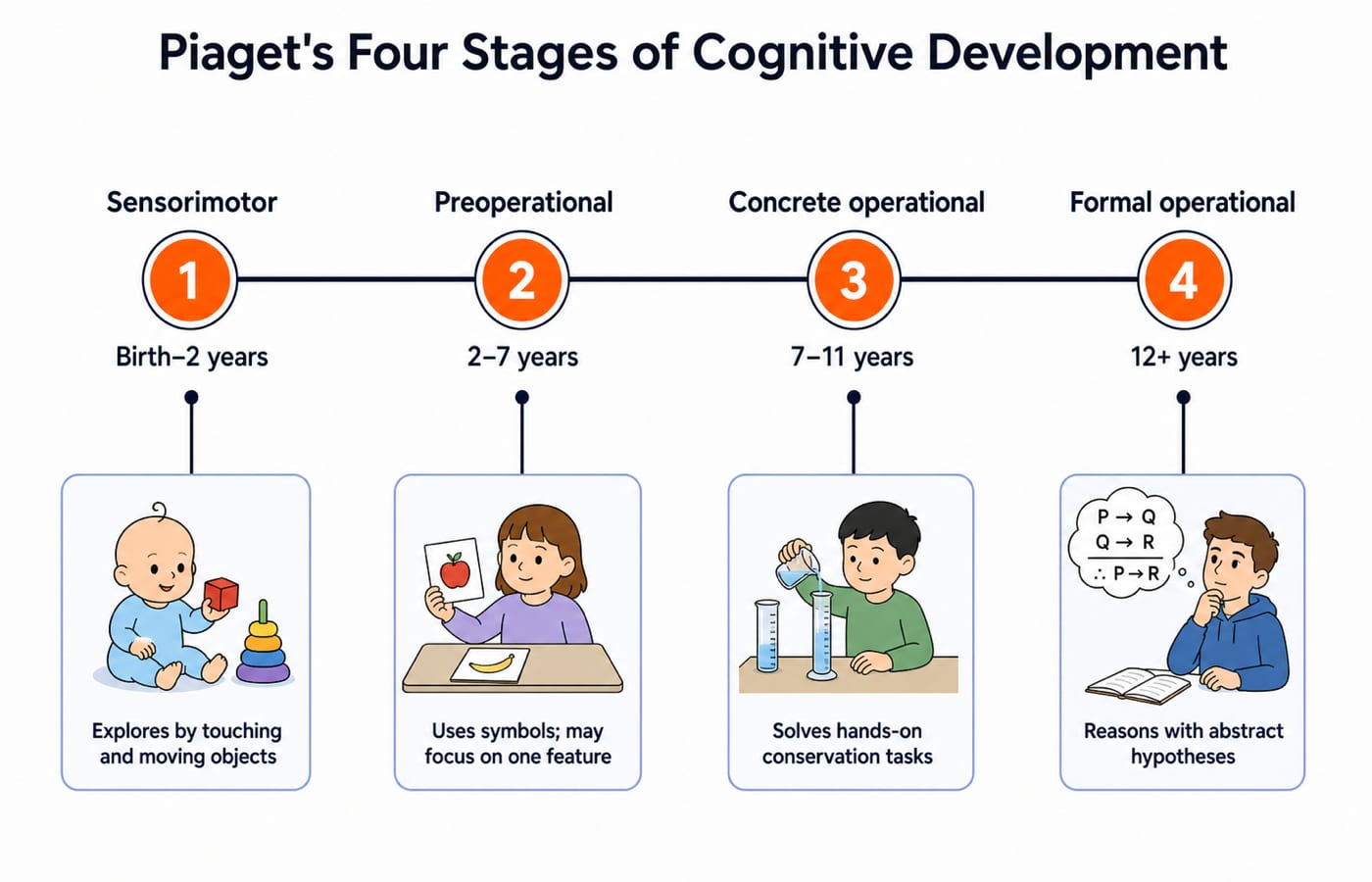
Piaget divides cognitive development into four stages: sensorimotor (birth to about 2 years), preoperational (about 2 to 7), concrete operational (about 7 to 11) and formal operational (11 onwards). The exam rarely asks you to list them. It describes a child's behaviour and asks you to name the stage.
So the real study unit is the behaviour marker, not the stage name. Object permanence signals the end of sensorimotor. Egocentrism and lack of conservation signal preoperational. Conservation and reversibility signal concrete operational. Abstract, hypothetical reasoning signals formal operational. Assimilation and accommodation are asked as definition-with-example questions.
Vygotsky: ZPD and scaffolding as classroom application
Vygotsky's zone of proximal development (ZPD) is the gap between what a child can do alone and what the child can do with help from a more knowledgeable other. Scaffolding is the temporary, adjusted support a teacher provides inside that zone and gradually withdraws.
CTET tests this as application: a stem describes a teacher giving hints, prompts or peer support, and asks which concept it exemplifies. You must recognise scaffolding when it is described as an ordinary classroom act.
Kohlberg: reading the reasoning, not the action
Kohlberg's theory has three levels, pre-conventional, conventional and post-conventional, with two stages each. The repeating trap: the paper gives you a moral decision and asks for the level, but the level is decided by the reasoning behind the decision, not the decision itself. A child who refuses to cheat out of fear of punishment is pre-conventional; one who refuses because rules keep the class fair is conventional.
Erikson: the pairs are worth one clean revision pass
Erikson is the opposite kind of task, a memory play: match the stage to its crisis (trust vs mistrust, autonomy vs shame, industry vs inferiority, identity vs role confusion). Learn the pairs and the age bands, give him one solid revision pass, and those marks are yours. He is thin in CTET papers themselves, so one pass is the right budget, not five.
CTET pedagogy patterns beyond the theorists
The theorists are only half the recurrence story. The biggest pedagogy clusters in the bank are not theorists at all. Assessment is the clearest example: assessment and evaluation alone accounts for over 100 questions, with assessment for learning vs assessment of learning and formative vs summative as its recurring pairs.
Three more clusters repeat reliably:
Child development principles (close to 100 questions): principle-identification stems such as development proceeding from general to specific, or being continuous and cumulative.
Inclusive education (about 35 questions on the concept alone): inclusion vs integration, and identifying dyslexia, dysgraphia and dyscalculia from a description of a learner's difficulty.
The teaching-learning process (our largest pedagogy cluster of all, at about 130 questions): "what should the teacher do" questions where child-centred, activity-based options are consistently the intended answers.
The stems repeat as much as the content: "According to X", "Which of the following best exemplifies", and the negative "Which of the following is NOT". Practising previous year questions trains you on the stems themselves, and the same patterns run across our teaching eligibility test courses generally.
A typical CTET scenario question, worked step by step
Stem: A teacher gives two equal balls of clay to a Class II child, rolls one into a long snake, and asks whether both pieces still have the same amount of clay. The child insists the snake has more. According to Piaget, the child is most likely in which stage?
Find the behaviour cue. The child judges quantity by appearance after a shape change. That is a failure of conservation.
Map the cue to the concept. Conservation is the understanding that quantity stays constant despite changes in shape or arrangement.
Map the concept to the stage. Conservation is absent in the preoperational stage and achieved in the concrete operational stage. This child lacks it.
Eliminate. Sensorimotor is ruled out by age and language; concrete operational and formal operational are ruled out because the child failed conservation. Answer: preoperational.
What carried you through was not the stage names but knowing which behaviour belongs to which stage. That is the memorise-understand difference the recurrence pattern keeps pointing at.
CTET CDP: what to memorise versus what to understand
Memorise (name-and-label questions):
Piaget's stage names and age bands
Kohlberg's three levels and six stage names
Erikson's stage-crisis pairs
Terminology of learning disabilities: dyslexia, dysgraphia, dyscalculia
Named frameworks and policies the syllabus lists, such as the NCF and the RTE Act (confirm current syllabus coverage in the official notification)
Understand (scenario and application questions):
Conservation, egocentrism and the behaviour markers of each Piaget stage
ZPD and scaffolding well enough to spot them in a plain classroom description
The reasoning-not-action rule in Kohlberg questions
Assessment for learning vs assessment of learning, and formative vs summative
Inclusion vs integration as a difference of principle, not vocabulary
The working rule: if the stem asks "who said it" or "what is it called", memorise. If it describes a child or a classroom, understand. Previous year papers lean heavily toward the second kind.
Your next step
Practice is what turns a pattern into marks: solve theorist-wise previous year questions until stage identification is reflex, then attempt full CDP sections under time. Our CTET Paper 1 course builds this in, with recorded CDP lectures, previous year questions and a goal-based question bank. Writing both papers? The CTET 2026 bundle covers both in one plan.
Before you lock your plan, confirm the current pattern and dates on the official notification at ctet.nic.in. The recurrence pattern tells you where to spend your hours; the notification tells you the rules of the day.
Keep learning

Guidance, Counselling and Mental Health for Teaching Exams: Concepts, Cases and Exam Traps
Learn to separate guidance, counselling and mental-health support, then apply the distinctions to learner cases without crossing a teacher's professional boundaries.
Updated 23 Oct 20266 min readCTET & UPTET

Classroom Management and Communication for Teaching Exams: Complete Notes and Worked Scenarios
Connect classroom management, communication, feedback, discipline, and teacher immediacy, then practise an exam-style vignette with a step-by-step solution.
Updated 19 Oct 20266 min readCTET & UPTET

Teaching-Learning Aids and ICT Integration for Teaching Exams: Notes with Worked Classroom Examples
Learn how to select and sequence teaching-learning aids, recognise genuine ICT integration, and solve classroom scenarios with worked calculations.
Updated 15 Oct 20265 min readCTET & UPTET

Nature, Objectives and Characteristics of Teaching: Concept Notes for Teaching Exams
Learn to separate what teaching is, what change it seeks and how an effective teaching process operates. A worked fraction lesson connects every concept.
Updated 10 Oct 20265 min readCTET & UPTET