

Sheldon and Eysenck’s Personality Theories for CTET: CDP Notes
Separate Sheldon’s body-based somatotypes from Eysenck’s behavioural dimensions. Use the mapping tables, solved E-N quadrant, and quick exam cues to revise both theories responsibly.
KnowledgeGate Team
Exam prep & CS education
Updated 15 Nov 20265 min read
Sheldon and Eysenck both classify personality, but they begin with different evidence. Sheldon links body-build components with proposed temperaments; Eysenck describes behavioural dimensions. The pair is useful for CTET classification questions only when the labels stay tied to their own model, never to a judgement about a child.
Sheldon vs Eysenck: the one-line distinction
The retrieval rule is Sheldon = constitutional or somatotype approach based on physique; Eysenck = trait or dimensional approach based on behaviour. Sheldon is commonly taught through three somatotype components. Eysenck uses continua, so a person can occupy different positions on each axis.
Comparison point | Sheldon | Eysenck |
|---|---|---|
Basis | Body constitution | Behavioural traits |
Core labels | Endomorphy, mesomorphy, ectomorphy | E, N, P |
Structure | Three rated somatotype components | Continuous trait dimensions |
First cue | Physique or somatotype | Extraversion, neuroticism or psychoticism |
Sheldon’s constitutional theory: three somatotypes and their paired temperaments
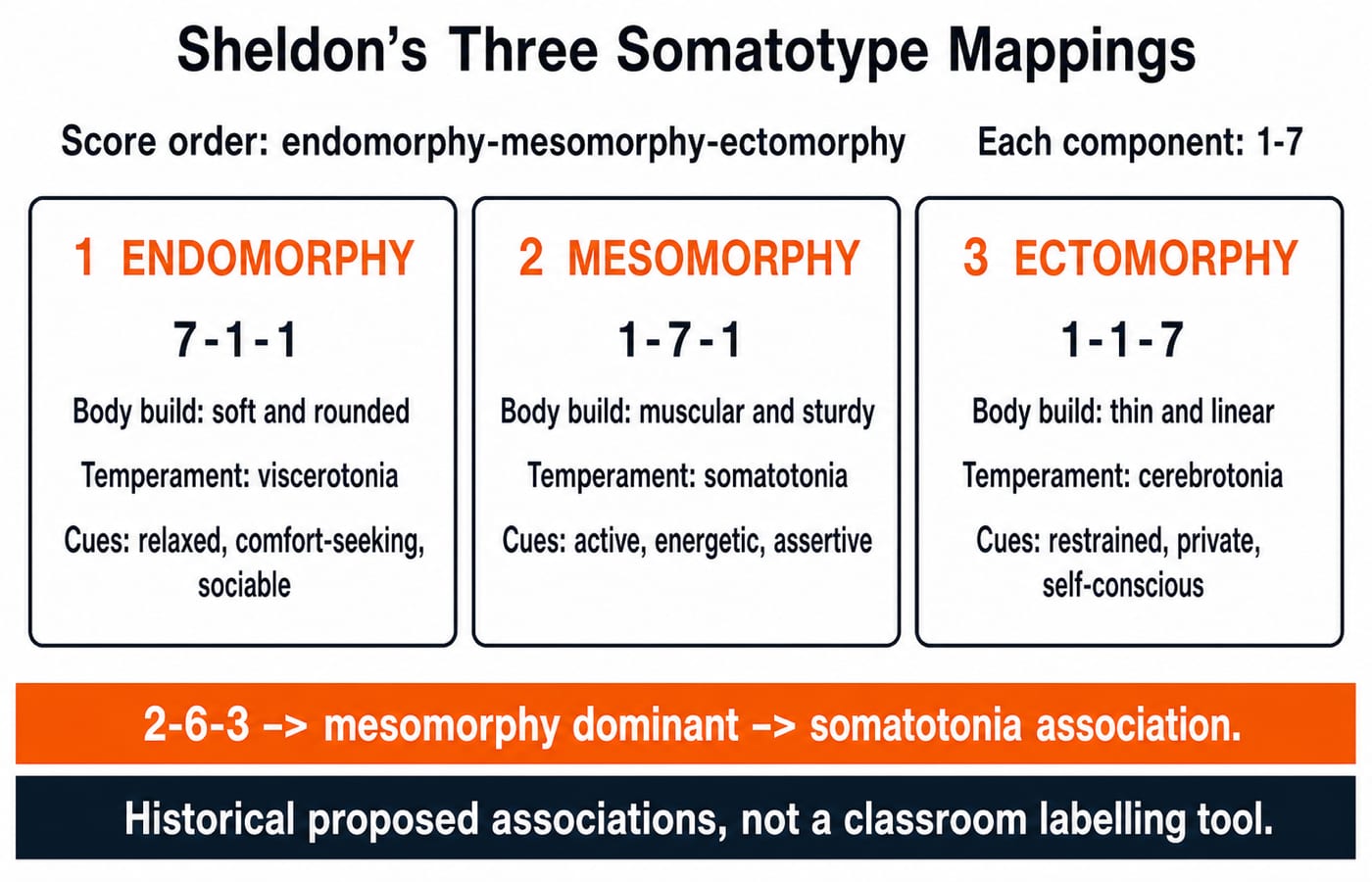
Sheldon proposed associations between body-build components and temperaments. They are historical pairings, not present-day facts about a person. A useful mapping is:
Component | Proposed build | Paired temperament | Recall cue |
|---|---|---|---|
Endomorphy | Soft, rounded | Viscerotonia | Relaxed, comfort-seeking, sociable |
Mesomorphy | Muscular, sturdy | Somatotonia | Active, energetic, assertive |
Ectomorphy | Thin, linear | Cerebrotonia | Restrained, private, self-conscious |
The score order is endomorphy-mesomorphy-ectomorphy, with each component historically rated from 1 to 7. In the illustrative profile 2-6-3, mesomorphy is the largest component, so the dominant association is somatotonia. The other two scores remain part of the profile. Ideal dominant patterns are 7-1-1, 1-7-1 and 1-1-7.
Read the labels as a mapping exercise. Endomorphy is paired with viscerotonia, mesomorphy with somatotonia, and ectomorphy with cerebrotonia. A mixed score does not erase the smaller components, and a tie would not justify inventing a single dominant type. The body-build descriptions belong to Sheldon’s historical classification, not to a classroom test of ability, motivation or conduct.
Eysenck’s model: E, N and P are dimensions, not diagnoses
Eysenck’s model uses three axes. E, extraversion-introversion, runs from outgoing and stimulation-seeking to reserved and quiet. N, neuroticism-emotional stability, runs from emotionally reactive to calm and stable. P, psychoticism, is a third trait dimension associated in the model with tough-mindedness and nonconformity. P is not psychosis and is never a diagnosis.
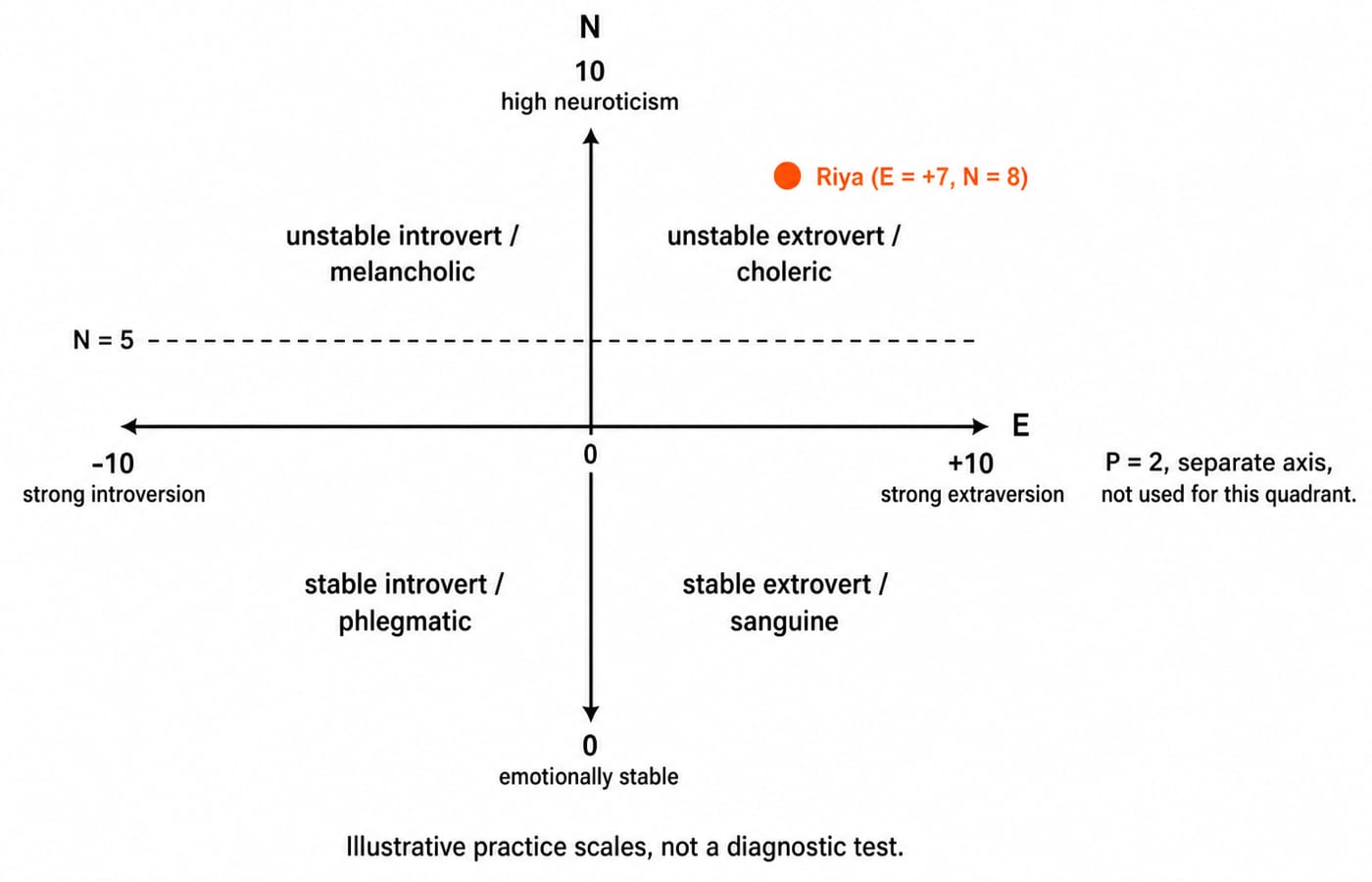
The older E-by-N arrangement gives four combinations:
E position | N position | Quadrant | Temperament |
|---|---|---|---|
High E | Low N | Stable extrovert | Sanguine |
High E | High N | Unstable extrovert | Choleric |
Low E | High N | Unstable introvert | Melancholic |
Low E | Low N | Stable introvert | Phlegmatic |
P remains a separate third dimension. It does not create or select an E-N quadrant, and high or low positions are not moral or clinical verdicts.
The quadrant labels depend on two independent readings. High E with low N is stable extrovert or sanguine; high E with high N is unstable extrovert or choleric. Low E with high N is unstable introvert or melancholic, while low E with low N is stable introvert or phlegmatic. Do not let the word “stable” replace the N reading, or let “introvert” answer a question that asks for the E-N combination.
A stem may give a verbal cue instead of a number. “Outgoing and emotionally reactive” means high E and high N, so it belongs to the unstable-extrovert quadrant. “Quiet and calm” means low E and low N, so it belongs to the stable-introvert quadrant. The verbal description still has to be split into the two axes before a label is chosen.
When a question includes P, first ask whether it is actually needed. If the stem asks for an E-N quadrant, P is background information; if it asks for the third PEN dimension, keep psychoticism as a separate term.
Worked example: place an Eysenck profile on the quadrant
Use an illustrative practice grid, not a questionnaire result: Riya has E = +7 on a -10 to +10 axis, N = 8 on a 0 to 10 axis, and P = 2 on a separate 0-10 practice scale. The grid defines E > 0 as extroverted and N >= 5 as unstable. Which E-N quadrant fits?
(a) Stable introvert/phlegmatic; (b) Unstable introvert/melancholic; (c) Stable extrovert/sanguine; (d) Unstable extrovert/choleric.
Read E: +7 is greater than 0, so the position is extrovert.
Read N: 8 is at least 5, so the position is unstable.
Intersect the positions: extrovert plus unstable gives (d), unstable extrovert/choleric.
Keep P separate; P = 2 does not decide this two-axis quadrant.
The arithmetic is only a threshold check: +7 is on the positive side of zero, and 8 meets the stated N threshold of 5. P is deliberately present as a distractor, because the model has three dimensions even though this quadrant uses two.
How CTET-style questions test these theories
Start with the basis word, identify the theorist, and retrieve only that model’s labels. Typical question moves include:
Physique or somatotype points to Sheldon; viscerotonia pairs with endomorphy and somatotonia with mesomorphy.
Extraversion and emotional instability combine to the unstable extrovert or choleric quadrant.
A statement that P means a clinical diagnosis is wrong because P is a trait dimension.
A muscular, active description maps to mesomorphy and somatotonia, while reserved and emotionally stable maps to low E plus low N, the phlegmatic quadrant.
Four common errors follow the same boundary problem. Calling endomorphy “introversion” mixes Sheldon with Eysenck. Calling extraversion emotional stability collapses E and N into one judgement. Calling P a psychotic person turns a model dimension into a diagnosis. Remembering only E and N drops the third PEN dimension. Correct each error by returning to the basis, the axis and the exact label the stem supplies.
In classroom use, both theories are best handled as historical classification material. A teacher can ask which label a stem describes, then separate that answer from observation of a real learner. Appearance is not evidence of intelligence, learning potential or character, and one behaviour is not a diagnosis.
The CTET previous-year analysis of CDP theorists gives a related way to read theorist questions. Use the models for classification practice, never to label a learner from appearance or one observation.
Short version and next step
Remember the chain: Sheldon: body build -> endomorphy/mesomorphy/ectomorphy -> viscerotonia/somatotonia/cerebrotonia. Eysenck: behavioural dimensions -> E-N-P -> four E-by-N quadrants. Redraw the three Sheldon cards and the E-N grid, then solve the Riya case once without looking.
For structured preparation, use the CTET Paper 1 course or CTET Paper 2 course. The teaching eligibility tests category places this topic inside the wider CDP plan.
For a broader personality framework, read the personality development notes and keep Sheldon’s historical associations separate from evidence-based classroom observation.
Go deeper with the full courseCTET Paper 1 2026 — प्राथमिक शिक्षक (कक्षा 1–5)
Keep learning

Personality Development for CTET and Teaching Exams: Complete Notes with Solved Examples
Build exam-ready personality notes from type and trait theories to Freud, Erikson, humanistic views and assessment. Then apply them to classroom cases and MCQs.
Updated 24 Jul 20265 min readCTET & UPTET

Classification of Intelligence Tests for CTET: Individual, Group, Verbal, Non-Verbal and Performance
Learn to separate individual and group administration from verbal, non-verbal and performance tasks, then apply the rule to CTET-style questions.
Updated 10 Nov 20266 min readCTET & UPTET

CTET Previous Year Analysis: The CDP Theorists and Pedagogy Patterns That Repeat
Across recent CTET cycles the same CDP theorists, concepts and question stems keep returning. Piaget and Vygotsky dominate, with Kohlberg a clear third, while assessment, child development principles and inclusive education carry the pedagogy half. What you must genuinely understand is a far shorter list than what you memorise.
Updated 30 Oct 20266 min read92 viewsCTET & UPTET
CTET CDP: the high-yield concepts and theorists you must know
A CTET Child Development and Pedagogy guide to the high-yield ideas: Piaget, Vygotsky, Kohlberg, constructivism, inclusive education and how CDP is tested.
Updated 31 Oct 20266 min readCTET & UPTET