NIMCET Exam Pattern: Build a Section-Wise Study Order
Use a self-made diagnostic to give Mathematics, Reasoning, Computer Awareness and English clear roles, then turn the evidence into a weekly plan and mock sequence.
KnowledgeGate Team
Exam prep & CS education
Updated 7 Aug 20266 min read

The NIMCET pattern looks like a list, so an aspirant may give every section equal time or let Mathematics consume the week. Both choices ignore your own baseline and the kind of work each section actually needs. A better order runs the other way: read the official brochure for NIMCET's own numbers, sit a diagnostic you build yourself, give each of the four sections a role, spend an 18-hour week on those roles, then move from sectional drills to a full mock.
Read the NIMCET pattern as four preparation jobs
The NIMCET 2026 Information Brochure names four sections: Mathematics, Analytical Ability and Logical Reasoning, Computer Awareness, and General English. It is also where the question count per section, the marking scheme, the total duration and the negative-marking rule live, and those four numbers should come from nowhere else.
Mathematics needs concept dependency and multi-step accuracy; Reasoning, representation and selection; Computer Awareness, connected recall and close-option discrimination; English, frequent reading, grammar and vocabulary. MCA entrance preparation covers these areas.
Mathematics leads, but it does not get to eat the week. The other three sections keep floors it may not cross.
Turn 48 practice items into a baseline
Build the diagnostic yourself out of past practice material. It will not mirror NIMCET's own question distribution, so read the result as evidence about you rather than as a predicted score.
Practice block | Items | Attempted | Correct | Incorrect | Unattempted | Time used | Attempt accuracy |
|---|---|---|---|---|---|---|---|
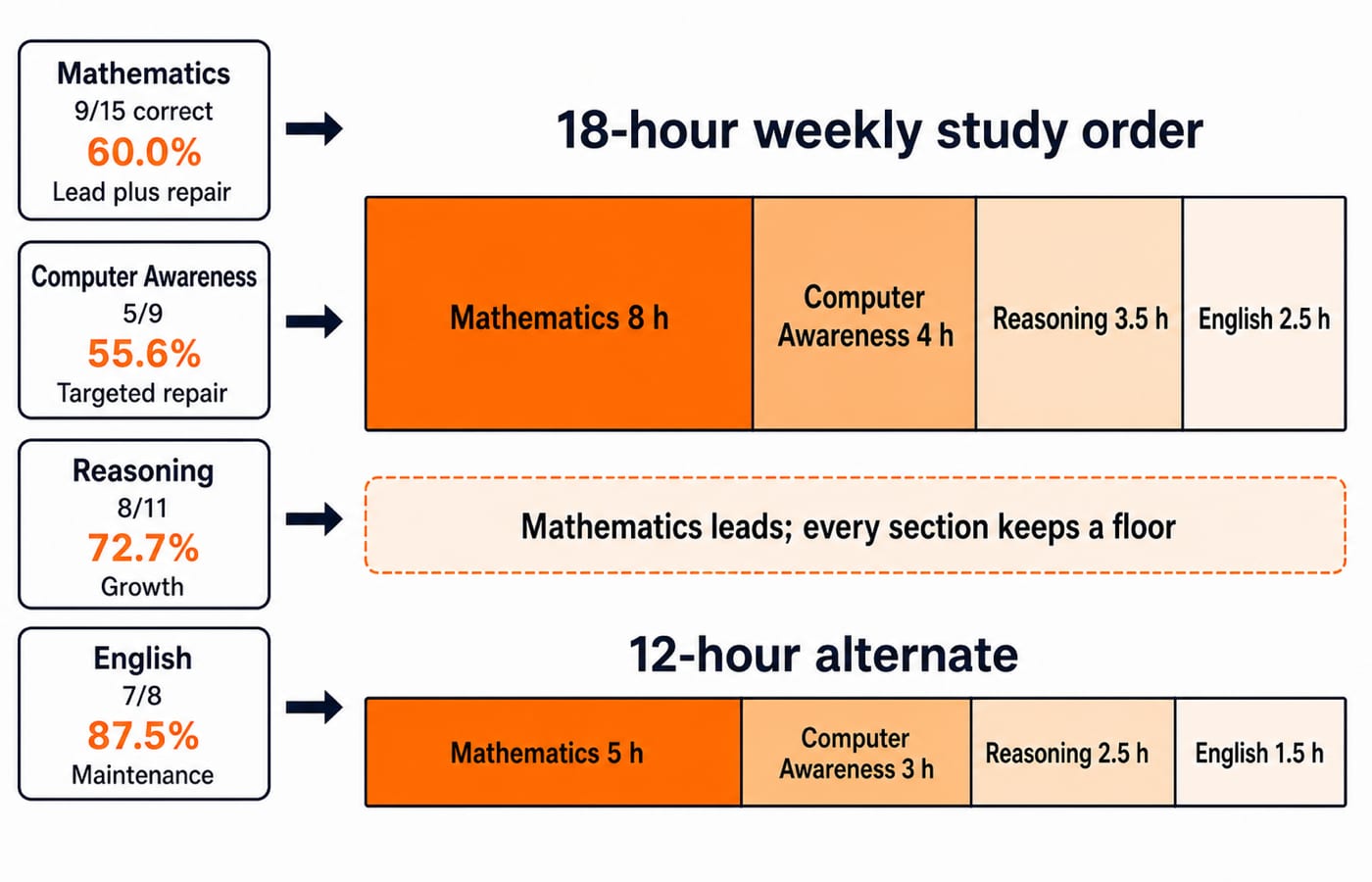
Mathematics | 18 | 15 | 9 | 6 | 3 | 38 min | 9/15 = 60.0% |
Reasoning | 12 | 11 | 8 | 3 | 1 | 19 min | 8/11 = 72.7% |
Computer awareness | 10 | 9 | 5 | 4 | 1 | 11 min | 5/9 = 55.6% |
English | 8 | 8 | 7 | 1 | 0 | 8 min | 7/8 = 87.5% |
Cause tags are: Mathematics, three concept gaps, two method-selection errors and one sign slip; Reasoning, two representation errors and one unsupported assumption; Computer Awareness, three recall confusions and one close-option error; English, one inference error. Six, three, four and one: the tags account for every wrong answer in the table.
Set Mathematics to lead plus repair, Computer Awareness to targeted repair, Reasoning to growth, and English to maintenance. Computer Awareness, not Mathematics, is the weakest section here at 55.6%, and it still does not get the biggest block, because its repair work is recall rather than concept building. To rebuild that recall in order, the MCA Entrance Computer Science prep order sequences programming, data structures and DBMS.
Build an 18-hour week from the evidence
For two weeks, allocate Mathematics 8 hours, Computer Awareness 4, Reasoning 3.5 and English 2.5. Check: 8 + 4 + 3.5 + 2.5 = 18 hours. Weakest accuracy does not command most time. Mathematics anchors; Computer Awareness gets the largest secondary repair block.
Three floors hold the rest of the week in place: Computer Awareness never below 3 hours, Reasoning never below 2.5, English never below 1.5. At 18 hours you sit clear of all three. On a 12-hour week use 5, 3, 2.5 and 1.5, which lands exactly on the floors: three of the six lost hours come out of Mathematics, one out of each supporting section. Check: 5 + 3 + 2.5 + 1.5 = 12 hours.
Make each section's hours do the right work
Mathematics gets four 90-minute blocks: 35 minutes concept repair, a 40-minute 12-item drill and 15 minutes review, plus two 60-minute redos. Thus 4 × 90 = 360 minutes = 6 hours, and 2 × 60 = 120 minutes = 2 hours, totalling 8. Redos require the method without notes.
Computer Awareness gets two 90-minute concept-map and recall blocks plus two 30-minute closed-book quizzes: 4 hours. Reasoning gets two 75-minute timed sets plus two 30-minute reconstruction reviews: 3.5 hours. English gets five 30-minute passage and error-list sessions: 2.5 hours.
Put Mathematics in the freshest long slot, alternate Computer Awareness and Reasoning in the second slot, and keep English short and frequent rather than saved for one long sitting. Do not clear the whole Mathematics allocation before the other three sections get touched.
Practise question selection without an attempt target
In a 12-item mixed drill, scan for 2 minutes and label five green, four amber and three red. Pass 1 attempts five green in 10 minutes: four correct, one wrong. Pass 2 attempts three amber in 9 minutes: two correct, one wrong. Leaving one amber and three red gives 8 attempted, 6 correct, 2 incorrect and 4 unattempted.
The two misses matter more than another attempt would have. Tag the Mathematics sign error and the Reasoning assumption, redo both the same day, then classify the three red items as hard or simply unfamiliar, because unfamiliar is a syllabus gap and hard is a practice gap.
Green means the method is visible on sight; amber means the setup is visible but the execution is uncertain; red means the route is invisible. You assign the labels yourself in the two-minute scan, and they move as your accuracy moves.
Move from section drills to mixed mocks
Use a 14-day bridge. Days 1 to 6: two 40-minute Mathematics drills, plus 30 minutes Reasoning, 25 Computer Awareness and 20 English, with equal review after every drill. Days 7 to 12: two 60-minute mixed sets, Mathematics with Reasoning and Computer Awareness with English, then 75 minutes review each. Day 13 is one full-length mock in a single unbroken sitting. Day 14 is a 120-minute review and redo.
Keep a four-line mock ledger:
M07 | wrong | 4 min 20 sec | sign error | redo 10 sign-sensitive itemsR09 | skipped | 3 min 10 sec | poor set choice | classify 5 sets in their first minuteC04 | wrong | 45 sec | confused two terms | make one contrast card and answer 15 recall itemsE06 | correct | 2 min 40 sec | slow inference | complete 3 timed passages
The attempt, review and retest loop behind that ledger is set out at more length in the SSC CGL Mock Test Strategy; only the section mix changes for NIMCET.
Avoid the study-order traps the pattern creates
Equal hours feel fair, which is why they are the default, and they give English as much time as Mathematics even though English already returns 87.5% and Mathematics 60%. Mathematics-only weeks feel productive because the hardest section is visibly moving, but Computer Awareness recall decays fastest when left alone, and it was the weakest section at 55.6%. The fix for both is the same: four roles, three floors, and no change to the split until two full mocks are done. Section weight is identical for every candidate; your baseline is not, so weight cannot set your hours.
Count concept-drill-review-redo loops, not lessons or raw questions. Label errors concept, method, selection, recall or execution. Hold 8/4/3.5/2.5 for two full mocks or 14 days, then move at most two hours while retaining every floor.
The short version and the next step
Read the brochure for NIMCET's own numbers, diagnose all four sections, let Mathematics lead at 8 hours, hold the 3, 2.5 and 1.5 hour floors under the other three, then progress from sectional drills to mixed sets and one reviewed mock.
If you want a ready calendar to hang this on, Aptitude for Placements: A 30-Day Practice Routine gives the day grid; swap its daily blocks for your own 8/4/3.5/2.5 split. If you would rather not sequence the syllabus yourself, the MCA Entrance Exam 2026 Course already orders the Mathematics, Reasoning and Computer Awareness content that MCA entrances test.
Keep learning
CUET-PG CS vs NIMCET: One Shared-Core Plan for MCA Entrance Prep
Prepare for both MCA entrances with one shared core and two thin exam-specific wrappers: an overlap sheet built from the official documents, a coverage-and-accuracy diagnostic, and a twelve-hour week that survives missed days.
Updated 22 Aug 20266 min readMCA Entrance
CUET PG Computer Science Mock Analysis: Build a Study Plan From Every Error
A mock score cannot tell you what to revise next. Use an error log, timed re-solves, priority weights and fresh-question retests to build a practical seven-day repair plan.
Updated 20 Aug 20266 min readMCA Entrance
NIMCET vs CUET PG MCA: Choose One Exam or Prepare for Both
Compare the two MCA entrance routes, calculate mock scores correctly, and use a personal decision matrix plus a 168-hour bridge plan to choose one or both.
Updated 18 Aug 20265 min readMCA Entrance
CUET PG Computer Science Preparation: 12-Week BCA Bridge Plan
Turn familiar BCA subjects into an entrance-ready system with a baseline audit, two maths routes, mixed objective sets and a realistic recovery calendar.
Updated 16 Aug 20266 min readMCA Entrance