CUET PG Computer Science Revision Map: Study Subjects in Prerequisite Order
Build CUET PG Computer Science revision in dependency order, then practise each block with the right kind of trace. Keep DBMS and networks in a separate programme-level lane.
KnowledgeGate Team
Exam prep & CS education
Updated 5 Aug 20266 min read
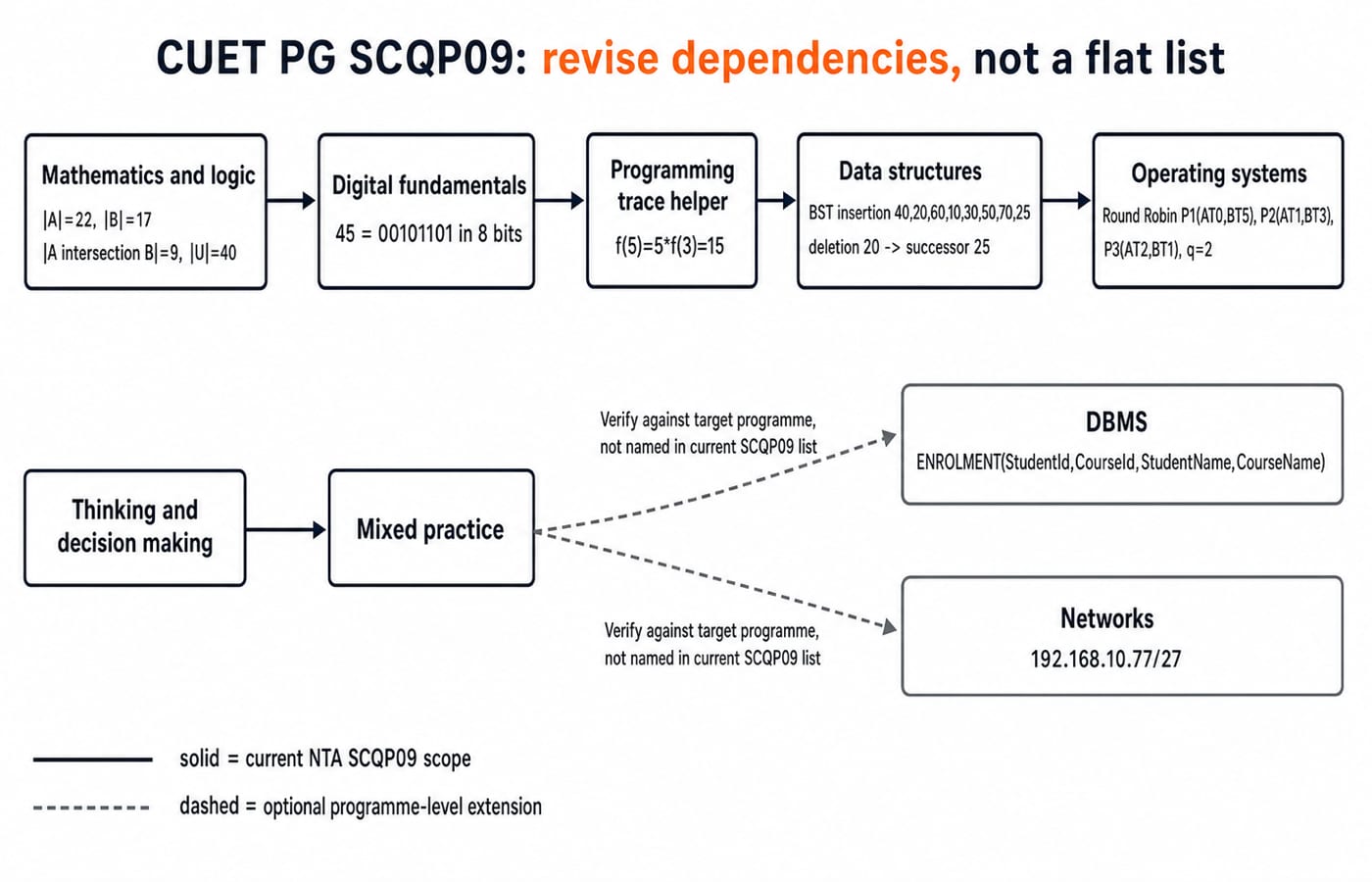
A flat syllabus encourages random switching between mathematics, code, trees, scheduling and digital logic. That wastes effort because later topics depend on notation and tracing habits built earlier. Order the work by the current official SCQP09 scope: thinking and decision making, mathematics, digital fundamentals, data structures and operating systems. DBMS and computer networks sit in an optional programme-level lane unless your target university or accepted paper mapping explicitly requires them.
1. Draw the official boundary before deciding what comes first
The current NTA science syllabus page names SCQP09 as Computer Science and Information Technology, and its syllabus lists thinking and decision making, mathematics, digital fundamentals, data structures and operating systems. It also lists functions, recursion and parameter passing, which justify a small programming-trace prerequisite, not a complete C, C++ or Java syllabus. For the full topic list under each of those headings, see CUET PG MCA Pattern: Mathematics, Reasoning and Computer Topic Map.
Official SCQP09 core | Check separately for the target programme |
|---|---|
Thinking and decision making | DBMS |
Mathematics | Computer networks |
Digital fundamentals | A named programming language |
Data structures, including relevant trace concepts | Any university-specific prerequisite |
Operating systems | Any different accepted paper mapping |
Revise a topic earlier when it supplies notation, calculations or state-tracing for the next one. The main chain is mathematics and logic, digital representation, programming traces, data structures, then operating systems. Reasoning runs beside it, while DBMS and networks are optional branches. The MCA Entrance Exam Preparation category collects the wider MCA entrance material, including the topics other entrances add on top of SCQP09.
2. Priority one: mathematics, logic and digital representation
Revise mathematics as derivation, not formula reading. Suppose |U| = 40, |A| = 22, |B| = 17 and |A intersection B| = 9.
|A union B| = 22 + 17 - 9 = 30
neither = |U| - |A union B| = 40 - 30 = 10
Subtract the intersection once because adding both set sizes counts the nine common elements twice. After each mathematics session, add one eight-minute reasoning set so the thinking and decision making group never goes cold.
For digital fundamentals, separate a value from its representation. Decimal 45 = 32 + 8 + 4 + 1, so its 8-bit form is 00101101. Because the leading bit is 0, that byte reads as 45 whether you take it as unsigned or as two's complement; flip it to 10101101 and the unsigned reading is 173 while the signed reading is -83. Check Boolean laws the same way, by substitution rather than recall: A + AB = A, because AB can only be 1 where A is already 1. This leads into data types, complements and memory units.
Use a closed-book rule sheet, three changed-value calculations, then label errors precisely: double-counted intersection, base conversion, signed interpretation or unit mismatch. The UGC NET Computer Science syllabus-area map groups these same CS areas for a wider paper, so it is a useful cross-check on how much a single area such as operating systems can be asked to cover.
3. Priority two: learn only the programming needed for traces
Keep this block narrow: types and values, arrays, functions, parameter passing and recursion. Dry-run with columns for call or statement, current values, pending work and returned value, then check.
For f(n) = 1 when n <= 1, otherwise f(n) = n * f(n - 2):
f(5) = 5 * f(3) = 5 * 3 * f(1) = 5 * 3 * 1 = 15
Unwind in reverse: f(1)=1, f(3)=3, f(5)=15. Now test the trap: f(4) = 4 * f(2) = 4 * 2 * f(0) = 8. The base condition accepts both 0 and 1, so copying the odd trace would fail. Label the first wrong row as base case, parameter value, pending multiplication or return order.
4. Priority three: revise data structures as state changes
Group structures by operation: arrays and linked lists for updates, stacks and queues for access policy, trees for ordered changes, graphs for traversal, sorting and searching for comparisons, and hashing for bucket state.
Insert 40, 20, 60, 10, 30, 50, 70, 25 into a binary search tree. The inorder traversal is 10, 20, 25, 30, 40, 50, 60, 70. Node 20 has two children. Delete it using its inorder successor 25, remove the old 25 below 30, and the new traversal becomes 10, 25, 30, 40, 50, 60, 70. It remains sorted because every left-subtree key is smaller and every right-subtree key is larger at each node.
Draw the tree after inserting 25 and deleting 20. For each family, record initial state, rule, state after each step, final invariant, and only then complexity. Complete four fresh operations before mixing families.
5. Priority four: operating systems follows state tracing
Revise process and thread vocabulary, CPU scheduling, concurrency, deadlock, memory, then file and I/O systems. Scheduling needs a timeline, deadlock needs resource state, and page replacement needs a frame table.
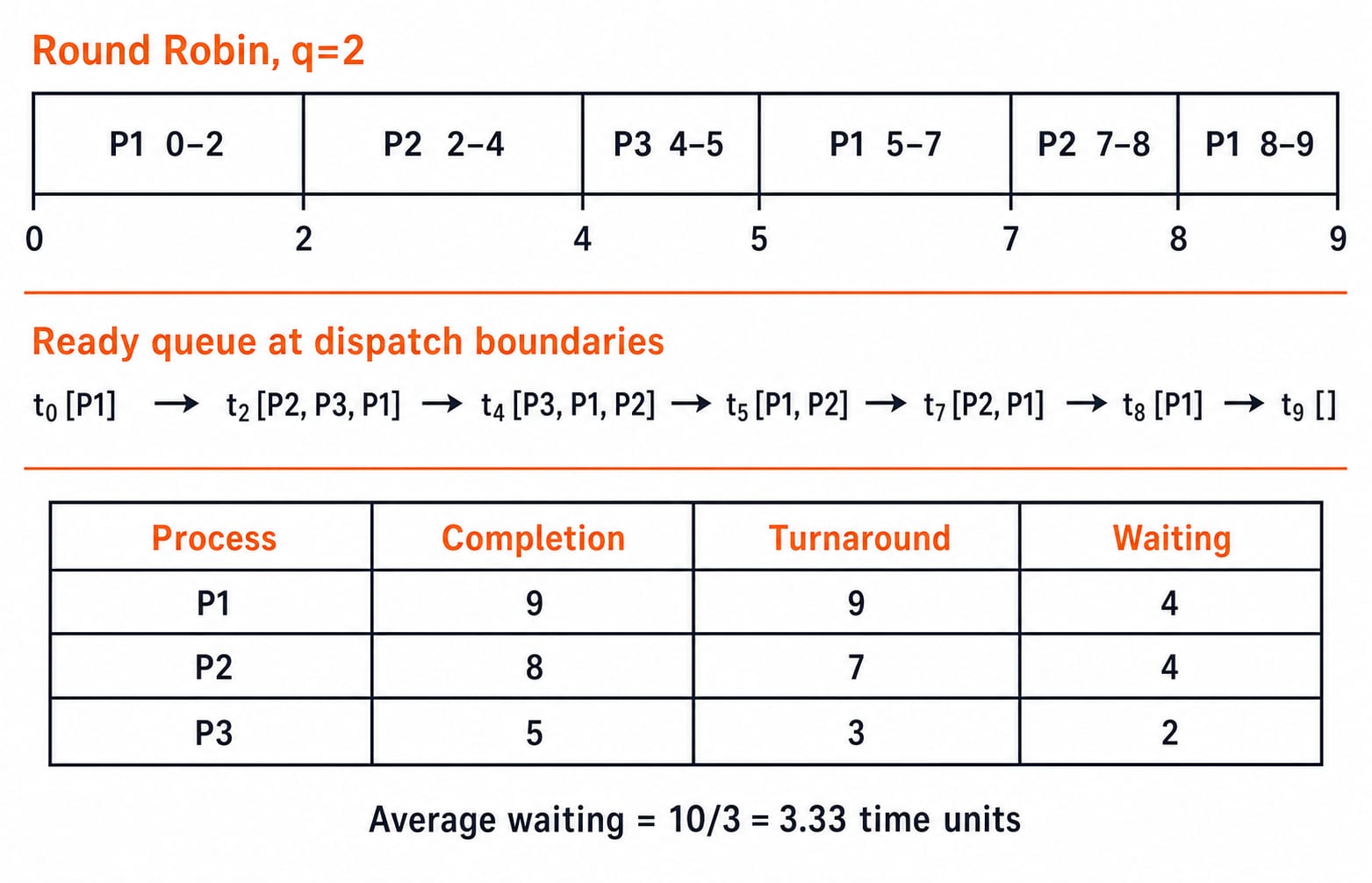
For Round Robin with quantum 2, take P1(AT=0,BT=5), P2(AT=1,BT=3) and P3(AT=2,BT=1). At t=2, place the newly arrived P3 before re-queuing the expired P1. The dispatch queues are t0 [P1], t2 [P2,P3,P1], t4 [P3,P1,P2], t5 [P1,P2], t7 [P2,P1], t8 [P1], t9 [].
The Gantt chart is P1 0-2 | P2 2-4 | P3 4-5 | P1 5-7 | P2 7-8 | P1 8-9.
Process | Completion | Turnaround = CT - AT | Waiting = TAT - BT |
|---|---|---|---|
P1 | 9 | 9 | 4 |
P2 | 8 | 7 | 4 |
P3 | 5 | 3 | 2 |
Average waiting time is (4 + 4 + 2) / 3 = 10/3 = 3.33 time units. The invariant is that an unfinished process returns to the ready-queue tail after using at most the quantum. Keep the queue, policy and time units visible.
6. Put DBMS and networks in an extension lane
The current NTA SCQP09 syllabus does not name DBMS or computer networks. Include them only when your target university, accepted paper code or wider MCA route requires them. Many MCA entrance courses teach both, because other entrances do ask for them.
For a DBMS repair drill, take ENROLMENT(StudentId, CourseId, StudentName, CourseName) with StudentId -> StudentName and CourseId -> CourseName. The candidate key is (StudentId, CourseId). Decompose it into STUDENT(StudentId, StudentName), COURSE(CourseId, CourseName) and ENROLMENT(StudentId, CourseId), so facts are not repeated in every enrolment.
For a network drill, host 192.168.10.77/27 has five host bits, so its block contains 2^5 = 32 addresses. Blocks advance by 32, and 77 lies in .64 to .95. Therefore the network is 192.168.10.64, the broadcast is 192.168.10.95, and the usual assignable range is .65 to .94, giving 32 - 2 = 30 addresses.
7. Turn the map into a current-cycle revision loop
For the completed 2026 cycle, NTA's SCQP09 syllabus specified 75 compulsory, subject-specific questions in English and Hindi. The 2026 information bulletin specified a 90-minute CBT, with +4 for a correct response and -1 for an incorrect response. Those figures describe that cycle, so recheck the current syllabus and information bulletin on NTA's CUET-PG pages before you plan around them. That syllabus carries no section-wise split, so there is no published weightage to order revision by, and dependency order is the substitute.
Use a 35-minute loop:
Spend 8 minutes recalling rules without notes.
Spend 17 minutes on 10 mixed questions.
Spend 7 minutes re-deriving each wrong or guessed answer.
Spend 3 minutes scheduling retries after 1, 3 and 7 days.
If you miss a day, do the oldest due retry and continue, because the gap since your last correct recall matters more than the calendar date the retry was due.
8. The short version and the next useful action
Verify the current official paper and your target programme mapping. Learn mathematics, representation and traces before tree or scheduling drills. Revise each technical area through visible state changes, and keep DBMS and networks only when your route requires them. Redraw the dependency map from memory, then solve the set, recursion, BST and Round Robin examples without notes.
If you would rather work from a route that is already sequenced, the MCA Entrance Exam 2026: Complete Course covers CUET PG alongside the other MCA entrances, so filter its lessons through the SCQP09 list. Your target university's programme page stays the last word on which paper mapping applies to you.
Keep learning
CUET-PG CS vs NIMCET: One Shared-Core Plan for MCA Entrance Prep
Prepare for both MCA entrances with one shared core and two thin exam-specific wrappers: an overlap sheet built from the official documents, a coverage-and-accuracy diagnostic, and a twelve-hour week that survives missed days.
Updated 22 Aug 20266 min readMCA Entrance
CUET PG Computer Science Mock Analysis: Build a Study Plan From Every Error
A mock score cannot tell you what to revise next. Use an error log, timed re-solves, priority weights and fresh-question retests to build a practical seven-day repair plan.
Updated 20 Aug 20266 min readMCA Entrance
NIMCET vs CUET PG MCA: Choose One Exam or Prepare for Both
Compare the two MCA entrance routes, calculate mock scores correctly, and use a personal decision matrix plus a 168-hour bridge plan to choose one or both.
Updated 18 Aug 20265 min readMCA Entrance
CUET PG Computer Science Preparation: 12-Week BCA Bridge Plan
Turn familiar BCA subjects into an entrance-ready system with a baseline audit, two maths routes, mixed objective sets and a realistic recovery calendar.
Updated 16 Aug 20266 min readMCA Entrance