NIMCET Computer Awareness Revision Map: From BCA Concepts to Fast Objective Recall
Convert familiar BCA subjects into six objective-recall buckets. Use a fully solved bridge drill and a repeatable 25-minute loop to find and repair weak rules.
KnowledgeGate Team
Exam prep & CS education
Updated 10 Aug 20266 min read
A BCA semester rewards explanation, derivation, and lab work. An entrance objective question may compress the same concept into an output, conversion, or almost-correct option. Computer Awareness is one of the four sections the NIMCET Information Brochure names, alongside Mathematics, Analytical Ability and Logical Reasoning, and General English, and it is the section a BCA graduate reaches with the content already learned and the speed still missing. Six BCA areas carry that load: programming basics, data representation, computer organisation, operating systems, databases, and networks. In every one of them the repair is the same, derive the answer from the notation instead of recognising it.
1. Turn the BCA syllabus into six objective-recall buckets
For each rule, answer one question without notes, explain it in one sentence, and record the rule behind a miss.
BCA area | entrance recall cue | first self-test | error to log |
|---|---|---|---|
Programming basics | Types, operators, control flow, output tracing | Trace five statements by hand | First rule applied wrongly |
Data representation | Base conversion, ranges, signed representation, units | Show one value in three bases | Value or representation confused |
Computer organisation | Memory, addressing, CPU, I/O | Label every number with a unit | Byte, word, or bit confused |
Operating systems | Process, scheduling, deadlock, memory | Simulate one state change | Policy or pointer missed |
Databases | Keys, functional dependencies, normal forms, SQL, transactions | Find one attribute closure | Dependency implication missed |
Networks | Layers, addressing, subnetting, protocols | Mark one subnet boundary | Prefix or block size missed |
Work the six buckets one at a time, using the MCA Entrance Exam Preparation hub for the teaching material behind each row.
2. Programming and representation need dry runs, not rereading
For a programming trace, write the declared type, substitute initial values, apply parentheses and operator precedence, respect integer division, then update a variable table after each statement. For int a = 7, b = 3; int r = a / b + a % b;, compute the quotient and the remainder as two separate values instead of jumping mentally to an option.
Apply the same discipline to representation. Decimal 45, hexadecimal 0x2D, and binary 00101101 are the same value in different forms. In an 8-bit signed question, the pattern for -45 is 11010011; read as unsigned, it is 211. The declared type matters.
3. Computer organisation and operating systems share resource accounting
In both subjects, name the resource, write its unit, and track state changes. Before calculating, separate memory bytes, words, addresses, and address bits. Before counting page replacement, separate each reference, hit, fault, frame state, and replacement pointer.
Keep two examples ready: byte-addressable 16 KiB memory with a 32-bit word, and FIFO with 3 empty frames for 0, 1, 2, 0, 3, 0, 4. A frame table is compulsory because guessing hides pointer movement. If the vocabulary is loose, rebuild it from Operating Systems before attempting the trace.
4. DBMS and networks become easier when every symbol gets a role
For DBMS, label the attributes, functional dependencies, closure, superkey, candidate key, prime attributes, and violated normal-form condition before choosing. Take R(A, B, C) with A -> B and B -> C.
For a network, write the prefix length, total address count, network address, broadcast address, and usual assignable-host range. Take 192.168.1.0/26. DBMS questions often hide a dependency implication; network questions often hide a boundary. Derive from the notation instead of trusting a slogan. Use Computer Networks for a deeper refresh on layers, addressing, or subnetting.
5. Worked example: solve one six-question bridge drill completely
First attempt these six prompts as a timed diagnostic, without notes.
Find
rforint a = 7, b = 3; int r = a / b + a % b;.Write decimal
45in 8-bit binary and hexadecimal, then encode-45in 8-bit two's complement.For byte-addressable
16 KiBmemory with32-bitwords, find the address bits and word count.Trace FIFO with
3empty frames for0, 1, 2, 0, 3, 0, 4.For
R(A, B, C),A -> B,B -> C, find the key, diagnose 3NF, and decompose.Diagnose the network, broadcast, and usual assignable-host range for
192.168.1.0/26.
Now solve in the same order.
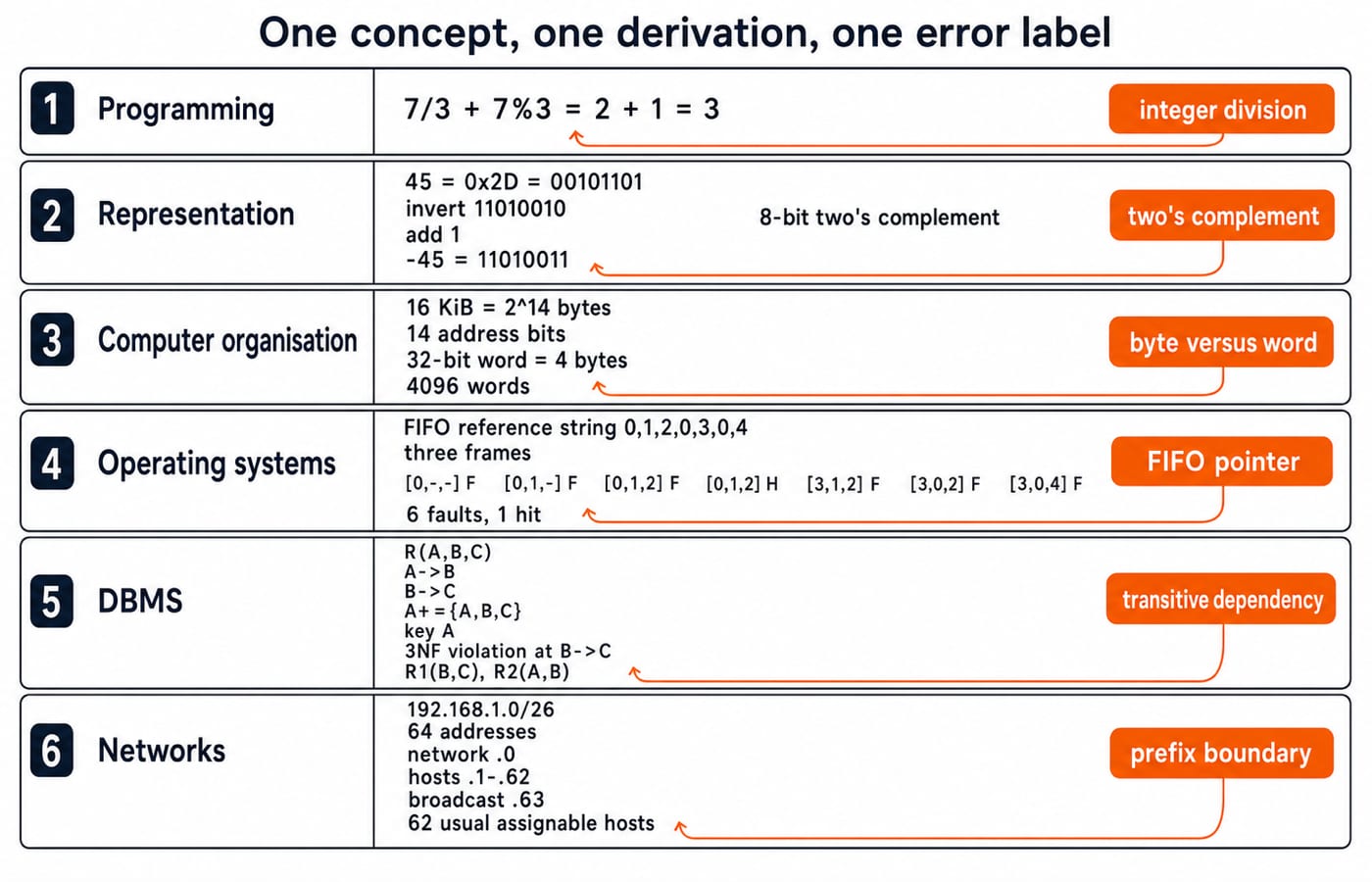
Programming: C integer division gives
7 / 3 = 2; the remainder is7 % 3 = 1. Thereforer = 2 + 1 = 3. Error log:integer division.Representation:
45 = 32 + 8 + 4 + 1, so its 8-bit form is00101101and its hexadecimal form is0x2D. Invert00101101to get11010010, then add1:11010010 + 1 = 11010011. Error log:two's complement.Computer organisation:
16 KiB = 16 * 1024 = 16,384 = 2^14bytes. Byte addressing therefore needs14address bits. A32-bitword is4bytes, so the memory contains16,384 / 4 = 4,096words. Error log:byte versus word.Operating systems: Trace every reference:
[0,-,-] F,[0,1,-] F,[0,1,2] F,[0,1,2] H,[3,1,2] F,[3,0,2] F,[3,0,4] F. The result is6faults and1hit. Error log:FIFO pointer.DBMS: Starting with
A, useA -> B, thenB -> C, soA+ = {A, B, C}. ThusAis a candidate key. The dependencyB -> Ccarries a transitive dependency from keyAthrough non-keyB. It violates 3NF becauseBis not a superkey andCis non-prime. A dependency-preserving decomposition isR1(B, C)andR2(A, B). Error log:transitive dependency.Networks: A
/26leaves6host bits, so the block contains2^6 = 64addresses, from192.168.1.0through192.168.1.63. The network is.0, the broadcast is.63, and the usual assignable range is.1through.62, giving62hosts. Error log:prefix boundary.
6. The traps are mostly translation errors
The first trap is answering from memory without checking the type, unit, policy, dependency, or prefix. Repair it with a five-second annotation: type, unit, policy, FD, or prefix.
The second is carrying a BCA-level essay into a one-line objective question. Reduce the idea to an invariant: positive integer division discards the fractional part, byte count differs from word count, FIFO evicts the oldest loaded page, closure tests key reachability, and /26 advances in blocks of 64.
The third is treating a correct guess as mastery. Give a one-sentence reason after every answer; if it is absent or wrong, log the item as weak.
7. Turn the map into an entrance revision loop
Use a 25-minute loop: 5 minutes of closed-book recall for six rules, 12 minutes for six mixed objective questions, 5 minutes to derive every wrong or guessed answer, and 3 minutes to schedule retries. Retry a miss after 1 day, 3 days, and 7 days. If you miss a day, continue with the next due item instead of doubling the session.
Practice by tracing an expression, converting a representation, computing memory, simulating replacement, testing a key or normal form, and finding a subnet boundary. Check current marks, weights, dates, question counts, and syllabus wording on the official NIMCET portal.
When one bucket keeps failing after two retries, the gap is the concept rather than the drill. Rebuild it from the lectures in CS Fundamentals for Placements by Sanchit Sir, then run that bucket through the loop again.
8. The short version and the next useful step
Translate each BCA subject into one recall cue. Derive before choosing, label the exact cause of every miss, and repeat misses on a short schedule. Redo the six-question drill without notes until all six answers and reasons are correct. For a structured path across MCA entrance areas, continue with the MCA Entrance Exam 2026 - Complete Course.
Keep learning
CUET-PG CS vs NIMCET: One Shared-Core Plan for MCA Entrance Prep
Prepare for both MCA entrances with one shared core and two thin exam-specific wrappers: an overlap sheet built from the official documents, a coverage-and-accuracy diagnostic, and a twelve-hour week that survives missed days.
Updated 22 Aug 20266 min readMCA Entrance

CUET PG Computer Science Mock Analysis: Build a Study Plan From Every Error
A mock score cannot tell you what to revise next. Use an error log, timed re-solves, priority weights and fresh-question retests to build a practical seven-day repair plan.
Updated 20 Aug 20266 min readMCA Entrance
NIMCET vs CUET PG MCA: Choose One Exam or Prepare for Both
Compare the two MCA entrance routes, calculate mock scores correctly, and use a personal decision matrix plus a 168-hour bridge plan to choose one or both.
Updated 18 Aug 20265 min readMCA Entrance
CUET PG Computer Science Preparation: 12-Week BCA Bridge Plan
Turn familiar BCA subjects into an entrance-ready system with a baseline audit, two maths routes, mixed objective sets and a realistic recovery calendar.
Updated 16 Aug 20266 min readMCA Entrance