

NCTE Functions, Powers and Structure: Act, Composition and Exam Traps
Separate NCTE's Act year from its establishment date, recognition from new-course permission, and expert places from total Council membership. Build a functional map, then test it with two worked questions.
KnowledgeGate Team
Exam prep & CS education
Updated 16 Nov 20266 min read
You may remember NCTE's full form yet confuse its Act year with its establishment date, or its standards role with teacher recruitment. NCTE and UGC can also look interchangeable when a question mentions a university. For your teaching recruitment preparation, build a functional map first, then use the two worked checks below to catch these errors.
What is NCTE? Keep the three dates separate
NCTE means National Council for Teacher Education. It is a statutory body, meaning it is established under legislation. Its remit centres on planned, coordinated teacher education and the maintenance of its norms and standards. Think teacher preparation, rather than staffing a particular school.
The statutory details below use the NCTE Act, NCTE's introduction, Council pages and statutory-function account; India Code supplies the Act dates, while UGC's official mandate and history support the comparison.
India Code and NCTE's introduction distinguish these milestones:
Event | Date |
|---|---|
Act enacted | 29 December 1993 |
Act enforced | 1 July 1995 |
Statutory body established | 17 August 1995 |
These are different events, not contradictory answers. “NCTE Act” asks for 1993; “statutory body came into existence” asks for 1995, specifically 17 August. Read the event before choosing the year.
NCTE functions: what the Council is trying to achieve
Learn the functions through four useful buckets. These organise revision; they are not an official four-part classification.
Planning and coordination: studying teacher-training needs and helping teacher education develop coherently.
Norms and standards: specifying what teacher-education programmes require, including suitable facilities.
Studies and research: examining training methods and evidence about teacher education.
Recommendations and academic improvement: advising on improvements that strengthen preparation and professional learning.
For example, identifying training needs is planning. Specifying required facilities is standard-setting. Investigating whether a training method improves classroom preparation is research. The same broad concern, better teacher education, can involve different functions.
Now separate purpose from enforcement. A standard explains what quality requires. Inspection and recognition powers help give that standard practical effect. A question asking about a function may describe the goal; a question asking about a power usually describes an action.
Powers: inspection, recognition, permission and appeal
Use the action in the question to locate the provision:
Section | Action |
|---|---|
13 | Inspection |
14 | Recognition of teacher-education institutions |
15 | Permission for a new course or training by a recognised institution |
17 | Withdrawal of recognition for contravention |
18 | Appeal |
Consider a fictional case: Institute A already runs a recognised B.Ed programme and proposes a new M.Ed programme. The tested provision is section 15. “Already recognised” gives the starting position; “new programme” identifies the requested permission. Choosing section 14 simply because an institution appears in the question misses this distinction. Permission is not automatic.
If a later case concerns withdrawal for contravention, identify section 17. An appeal against that order belongs under section 18, which covers appeals against Regional Committee orders under sections 14, 15 and 17.
Notice, opportunity to respond and the applicable procedure matter. A failed inspection does not mean instant closure. Also, NCTE recognition and affiliation to an examining body are distinct approvals, even though the statutory framework connects them.
Structure and composition: decode the numbers instead of cramming a total
The General Body or Council is NCTE's highest decision-making body. Its leadership roles include Chairperson, Vice-Chairperson and Member-Secretary. Distinguish the Council from its Executive Committee and Regional Committees. The four Regional Committees are Northern, Southern, Eastern and Western; they are not four independent NCTEs.
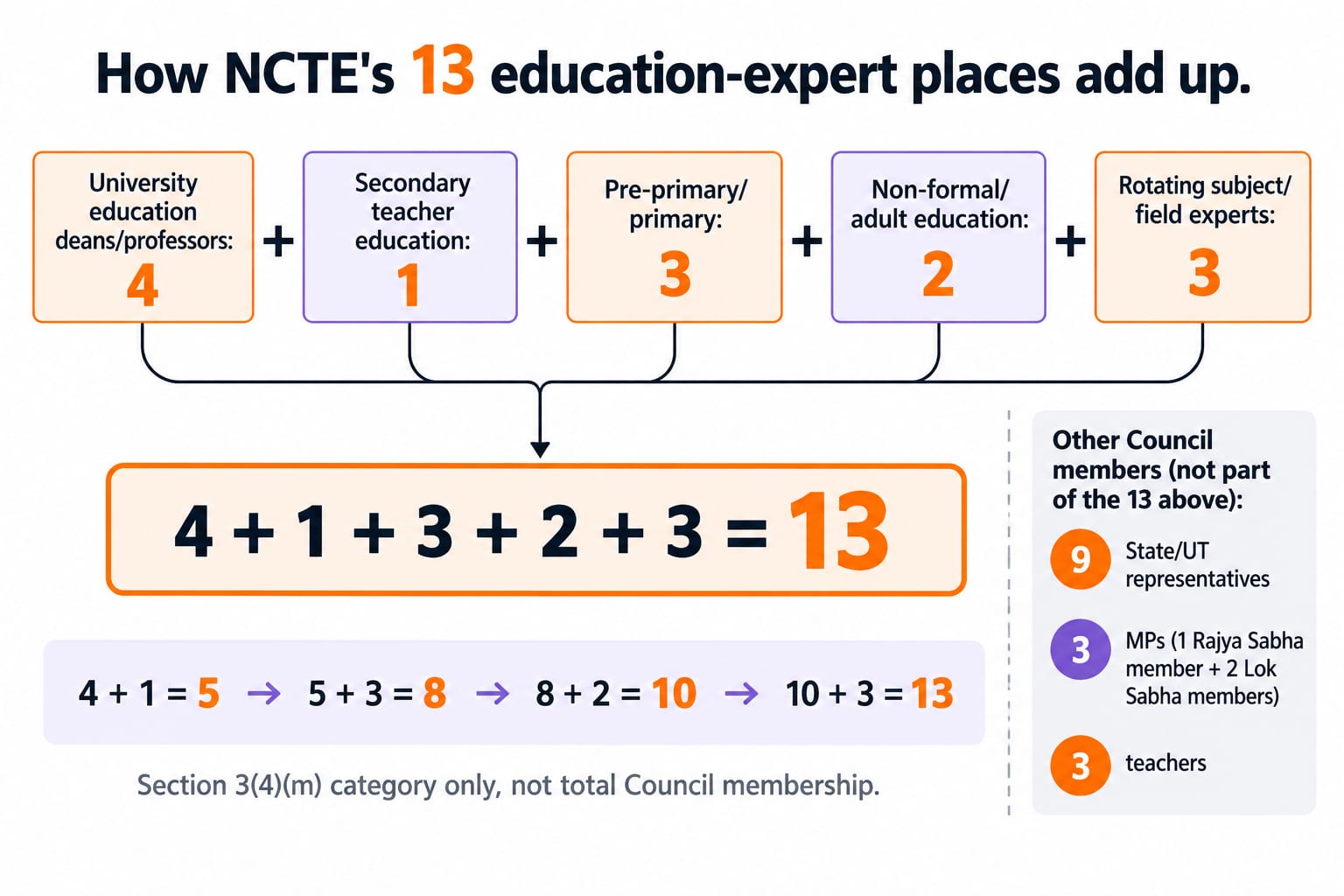
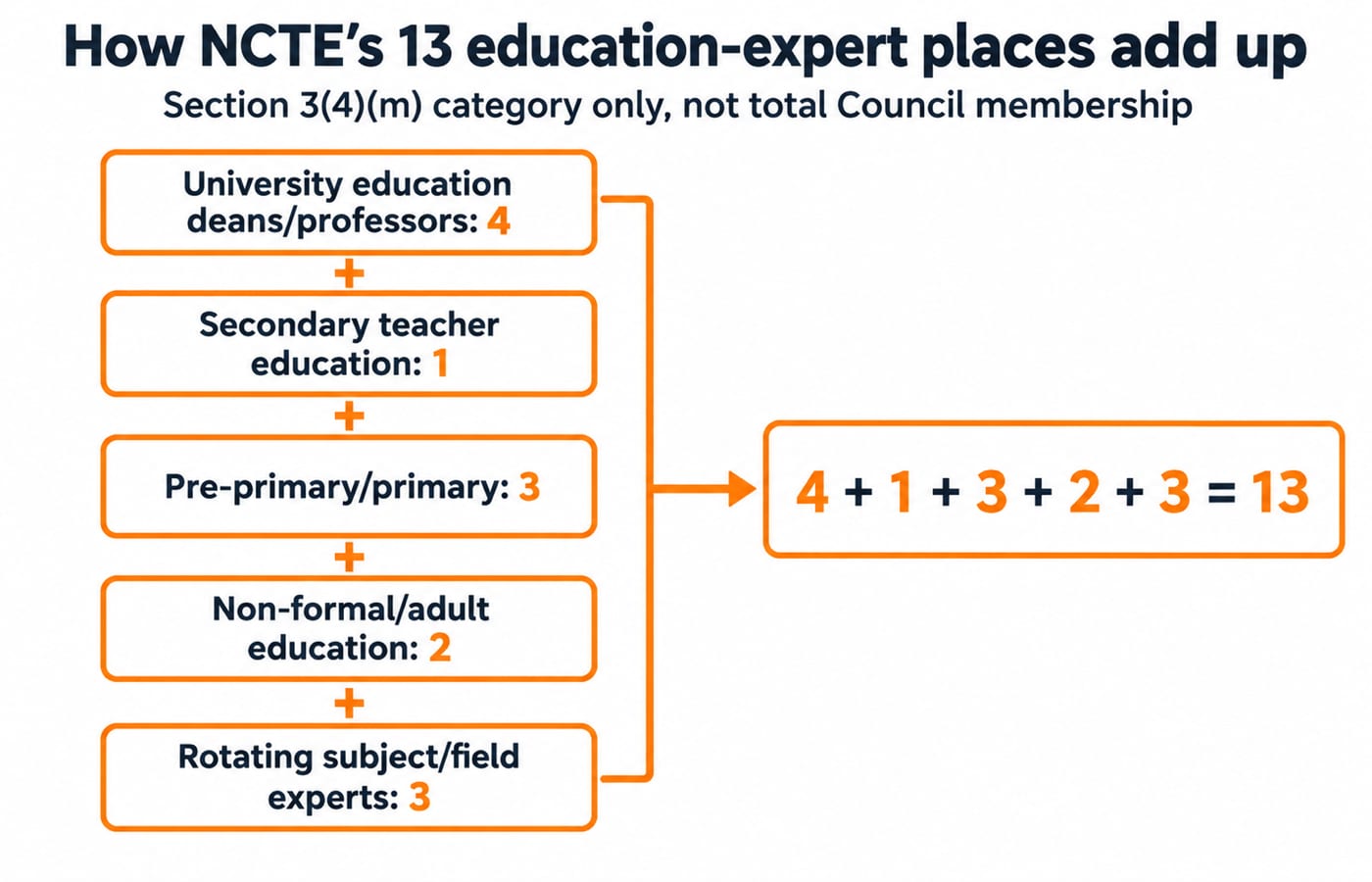
Under section 3(4)(m), the education-expert places add up as follows:
4 + 1 = 5; 5 + 3 = 8; 8 + 2 = 10; 10 + 3 = 13.
The 13 belongs to one membership category, not the whole Council. Separate clauses provide for 9 State/UT representatives, 3 MPs (1 Rajya Sabha member + 2 Lok Sabha members), and 3 teachers.
Ex-officio membership means membership arising from holding another office. The Act's UGC Chairperson or nominated member and NCERT Director illustrate this. Keep role-based membership separate from appointed expert groups; adding only the groups listed here would not establish total Council strength.
NCTE versus UGC: compare the remit, not just the acronyms
Ask what the body is being asked to do:
NCTE | UGC |
|---|---|
Focuses on teacher education | Coordinates university education |
Sets teacher-education norms and regulates recognition | Maintains university-education standards and provides grants |
NCTE Act, 1993 | UGC Act, 1956 |
Case A: A recognised teacher-training institution seeks permission for a new M.Ed programme. This points to the NCTE regulatory route, specifically the new-course distinction already discussed.
Case B: The question concerns UGC grants to eligible universities. This points to UGC, the University Grants Commission.
A university may engage with both bodies for different functions. A B.Ed reference does not make every associated university matter exclusively NCTE's business, and NCTE does not award every teacher-education degree. Identify the regulatory or academic action first. For the wider institutional picture, revise higher education bodies and accreditation.
Four traps that turn a familiar fact into a wrong answer
“1993 means statutory establishment.” Read which milestone is asked: the Act and the body's establishment have different dates.
“13 means the whole Council.” Read the membership clause: this is the education-expert category.
“Recognition is the same as affiliation.” They are different approvals with different roles.
“NCTE recruits KVS/DSSSB teachers.” Regulatory standards do not equal employer selection. NCTE is not the recruiting body for those appointments.
These mistakes happen when familiar acronyms prompt an answer before you read the operative noun. Underline Act, established, recognised institution, new course and appeal. Each word can change the correct response.
Extend this habit to education policies and Acts: a policy proposal and an enacted statutory change are different things.
How exam-style questions test this distinction
These are practice items, not past-paper questions. For the statutory wording, use the NCTE Act on ncte.gov.in.
Question 1: Match each item with its correct value.
Item | Value |
|---|---|
A = Act year | 1 = section 18 |
B = statutory establishment date | 2 = 17 August 1995 |
C = new-course permission for an already recognised institution | 3 = section 15 |
D = appeal | 4 = 1993 |
Answer: A-4, B-2, C-3, D-1. “Act year” gives 1993; “statutory establishment” gives 17 August 1995. C gives section 15 because recognition already exists: section 14 concerns the institution's recognition. “Appeal” gives section 18.
Question 2: Under section 3(4)(m), the five education-expert groups contain 4, 1, 3, 2 and 3 places. What is their total?
(a) 9
(b) 12
(c) 13
(d) 43
Answer: (c). Add step by step: 4 + 1 = 5; +3 = 8; +2 = 10; +3 = 13. Check by regrouping: (4 + 1 + 2) + (3 + 3) = 7 + 6 = 13.
Option (a) borrows the separate State/UT count. Option (b) omits the single secondary teacher-education place. Option (d) joins the first and last digits; it says nothing about total Council membership.
The short revision card and your next step
Recall: NCTE = teacher education; Act = 1993; statutory establishment = 17 August 1995; inspect/recognise/permit/withdraw/appeal = 13/14/15/17/18. Use this after understanding the distinctions.
Take a five-minute self-test: spend 2 minutes reconstructing the three-date table, 2 minutes solving the match exercise without looking, and 1 minute correcting the trigger word behind any mistake.
If you are preparing for DSSSB Section A, the DSSSB Section A course provides broader preparation, including general awareness. Use this NCTE revision card alongside that wider study plan.
Keep learning
Composition of Functions MCQs: 10 Solved Questions with Explanations
Solve 10 composition of functions MCQs step by step. Learn the right-to-left order, domain checks, associativity, and injective and onto implications.
Updated 3 Aug 20267 min read54 viewsDiscrete Mathematics MCQs
Hashing Data Structure: Hash Functions, Collision Resolution and Worked Examples
Trace the same eight keys through separate chaining and linear probing, then learn how tombstones, load factor and rehashing affect correctness and speed.
Updated 24 Sep 20266 min read109 viewsDSA & Algorithms
MP Cooperative Banking Structure: PACS, DCCBs and Apex Bank Functions
Learn how demand, finance and repayments move through PACS, DCCBs and MP Apex Bank. A principal-only example makes each tier's function easy to identify.
Updated 30 Oct 20266 min readMP Cooperative Bank

MP Cooperative Banking Structure and Functions: Three Tiers, Roles and Exam Traps
Build a clear village-to-state model of MP cooperative banking, then test it with tier, fund-flow, repayment and authority questions.
Updated 30 Oct 20266 min readMP Cooperative Bank