Policies, Acts and Contemporary Issues for Teaching Exams: Complete Notes with Examples
Learn to separate Acts, policies, guidelines and current education issues, then apply the right source to admission, inclusion and classroom questions.
KnowledgeGate Team
Exam prep & CS education
Updated 29 Aug 20265 min read
Aspirants often memorise RTE 2009, RPwD 2016 and NEP 2020 as year pairs, then miss a situation-based question because they cannot tell whether the stem needs an Act, policy, guideline or classroom principle. Use a worked admission case and a revision routine when preparing for CTET and TET, UGC NET Paper 1 and teaching-recruitment papers. These exams do not necessarily share a syllabus or weightage.
1. First classify the source
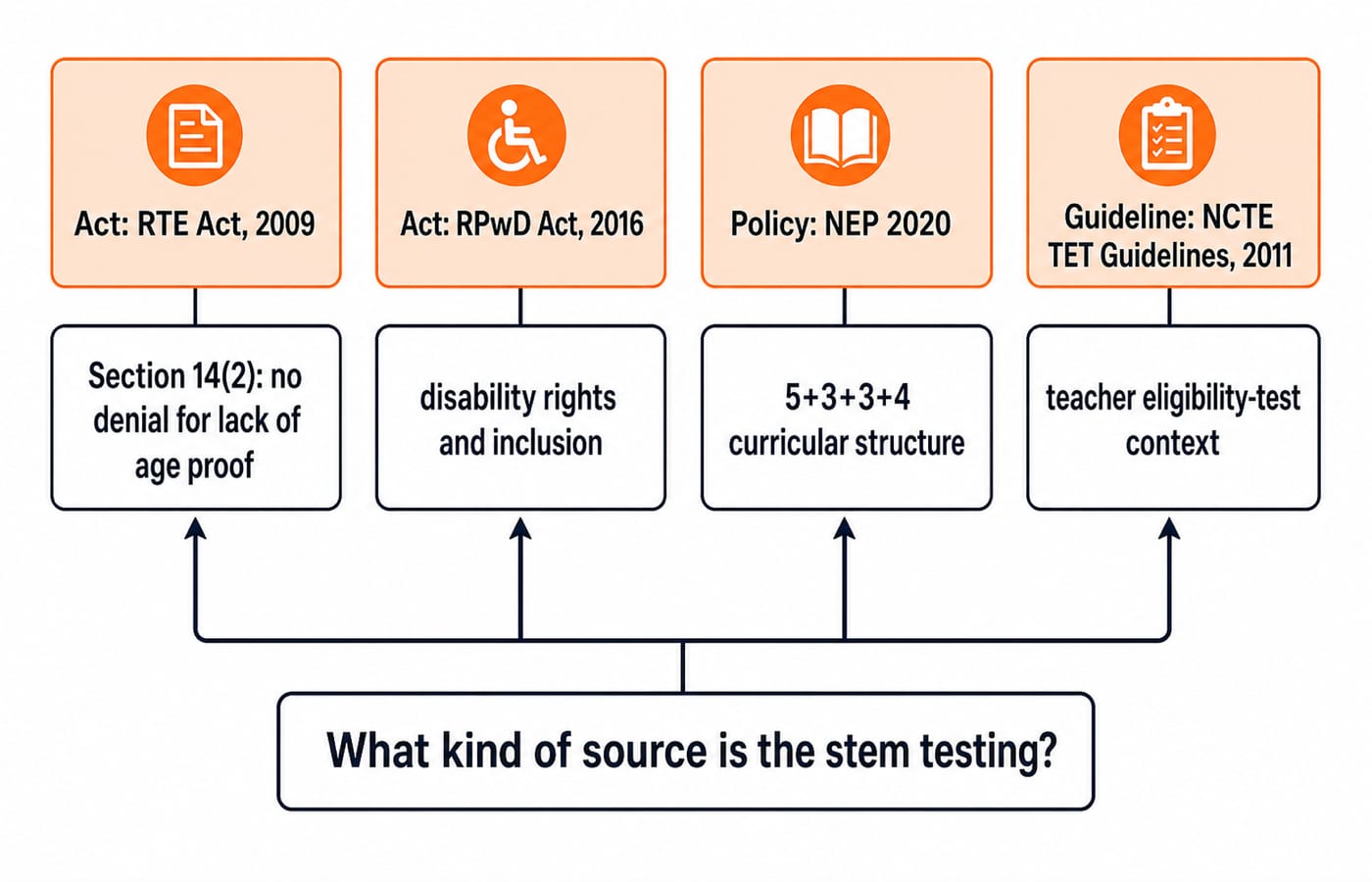
An Act is enacted law. A policy states direction and reform priorities. Rules, notifications and guidelines add operational detail within their authority. A scheme implements selected goals. A contemporary issue is a present challenge that may connect with several sources.
Use this classification as a study tool, not as a replacement for the official text.
Source | Type | Main study anchor | Authority |
|---|---|---|---|
RTE Act, 2009 | Act | Statutory rights and duties | India Code |
RPwD Act, 2016 | Act | Disability rights and inclusion | DEPwD |
NEP 2020 | Policy | Direction for education reform | Ministry of Education |
TET Guidelines, 2011 | Guidelines | Teacher eligibility-test context | NCTE |
The CTET and UPTET teaching eligibility category provides preparation context. It is not an authority for law or policy.
2. Build core notes from official sources
The India Code record for the RTE Act identifies the Right of Children to Free and Compulsory Education Act, 2009 as Act 35 of 2009, enforced from 1 April 2010, for ages 6 to 14. Keep five anchors:
Section 13 concerns capitation fee and screening for admission.
Section 14 concerns proof of age for admission.
Section 17 concerns physical punishment and mental harassment.
Section 24 covers teachers' duties.
Section 29 concerns curriculum and evaluation.
Recheck the current text before reproducing penalties or amendments.
The Ministry of Education's NEP 2020 page gives the policy's 5+3+3+4 curricular and pedagogical structure for ages 3 to 18. Its themes include foundational and experiential learning, multilingualism, inclusion and appropriate technology use. NEP 2020 is a policy, not a renamed RTE Act.
The DEPwD Acts page lists the RPwD Act, 2016 and its rules. Ask whether an action removes a barrier and enables participation. Do not invent a section or accommodation.
NCTE's TET guidance context says it developed TET guidelines in 2011 and CBSE conducts CTET based on them. Check the chosen exam's current syllabus and pattern on its conducting body's site.
3. Worked example: an 11-year-old without a birth certificate
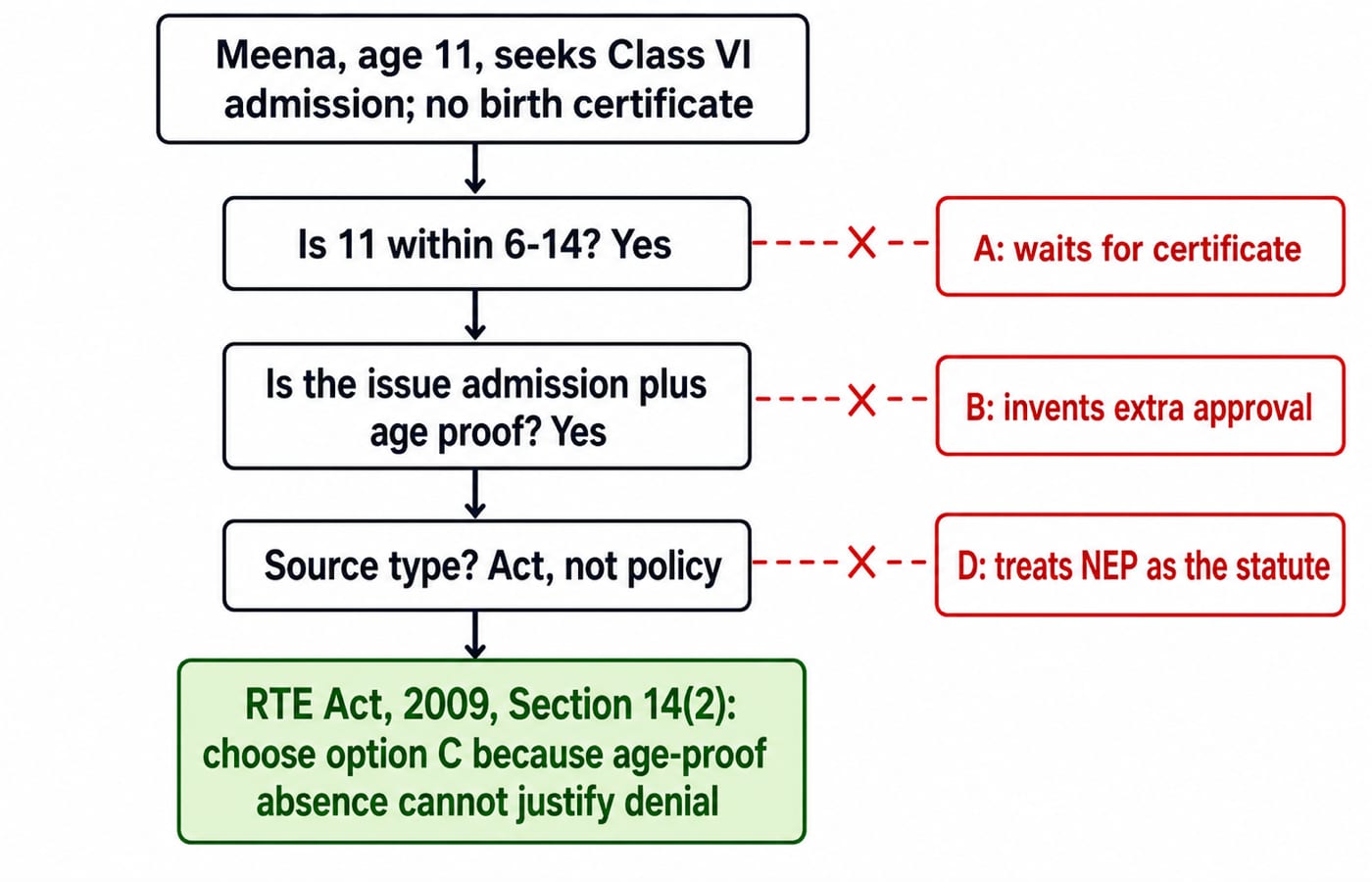
Stem: Meena, 11, seeks Class VI admission after moving. The school refuses because her parent cannot immediately produce a birth certificate. Which response fits the applicable official provision?
(A) Refuse admission until the birth certificate is produced.
(B) Admit only after a district officer grants an exception.
(C) Admit the child because lack of age proof cannot be a ground for denial.
(D) Treat NEP 2020 itself as the statutory admission provision.
Step 1: Age 11 is inside the RTE Act's 6 to 14 range.
Step 2: This is an admission and age-proof problem. Identify the Act and provision, not a broad policy.
Step 3: Section 14(2) says lack of age proof cannot deny admission. Therefore, (C) is correct. Options (A) and (B) add barriers. Option (D) confuses policy with the applicable Act.
If “birth certificate” becomes “missing transfer certificate”, do not reuse Section 14. Return to the RTE text and identify the transfer provision.
4. Turn contemporary issues into classroom decisions
Use five durable lenses instead of a weekly current-affairs list:
Problem lens | Affected learner | Principle | Workable response | Source to check |
|---|---|---|---|---|
Digital divide | Learner without device or connection | Equitable access | Offer an offline route | Programme authority |
Accessibility | Learner facing a format barrier | Participation | Supply accessible format | RPwD Act and rules |
Language and culture | Learner excluded by language | Inclusion | Add multilingual support | Current policy |
Assessment and well-being | Learner harmed by one measure | Fair assessment | Vary evidence and feedback | Syllabus or policy |
Data privacy and technology | Learner whose data is collected | Responsible use | Minimise and protect data | Current rules |
A class has 32 learners, 8 shared tablets and 1 screen-reader user. Since 32 ÷ 8 = 4, create 8 groups of 4, provide accessible text, retain an offline alternative and check participation. Equal tablet time does not remove every barrier. CTET CDP high-yield concepts connects this reasoning with learner development.
5. Recognise five objective-question patterns
Year-source match: 2009 → RTE Act.
Source-type classification: NEP 2020 → policy.
Statement pair: one statement on ages 6 to 14, another on Section 14.
Classroom situation: Meena's admission case.
Issue-to-principle: 32 learners, 8 tablets and 1 screen-reader user.
Answer five items with a one-line reason each: ages 6 to 14 link to RTE Act, 2009; NEP 2020 is a policy; the age-proof case uses Section 14(2); the disability-rights law is RPwD Act, 2016; the tablet plan is 8 groups of 4, plus accessibility.
UGC NET Paper 1 places teaching aptitude in the common paper. TETs and recruitments have their own scope. Read UGC NET Paper 1 vs Paper 2, then use the NTA UGC NET Paper 1 course for structured coverage. Confirm current patterns officially.
6. Common traps and their repairs
Every document becomes an Act: write the source type beside each title.
Only the year is memorised: attach one purpose and one scenario to it.
NEP answers an RTE admission case: decide whether the stem asks for a right, duty, implementation direction or reform goal.
Inclusion means identical treatment: identify the barrier in the 32-learner case.
One exam pattern is applied everywhere: check the current conducting-body syllabus.
A coaching note survives every amendment: recheck the relevant official authority before retaining section-level detail.
Never cite a future-dated notification, turn a proposal into a rule, or claim “always asked” or “fixed weightage” without official evidence.
7. Revise with a seven-day, 60-card loop
Build 20 source-and-year cards, 15 source-type cards, 15 statement or section-clue cards and 10 classroom-scenario cards. The total is 20 + 15 + 15 + 10 = 60 cards.
Day 1: Classify all 60.
Day 2: Revise RTE cards.
Day 3: Cover NEP.
Day 4: Cover RPwD and inclusion.
Day 5: Attempt 20 mixed cards.
Day 6: Rewrite every error with an official-source note.
Day 7: Retest 25 cards, including all errors and new mixed cards.
Suppose Day 5 produces 15 correct, 3 wrong and 2 unattempted. Attempted questions are 15 + 3 = 18, so attempted accuracy is 15 ÷ 18 × 100 = 83.3%. The unresolved set is 3 + 2 = 5 cards. Sort those five into source-type, fact or scenario-application errors, then repair the matching note before Day 7.
Keep the five lenses, but refresh examples from official releases as the news changes.
8. The short version and next step
Identify the source type, locate the official anchor, then apply it to the facts. RTE Act, 2009, RPwD Act, 2016 and NEP 2020 have different types and legal effects.
For a structured CTET route, use the CTET Paper 1 course. Then create the four-column source map, solve the Meena case without looking at the answer, and begin the 60-card seven-day loop.
Keep learning
Classroom Management and Communication for Teaching Exams: Complete Notes and Worked Scenarios
Connect classroom management, communication, feedback, discipline, and teacher immediacy, then practise an exam-style vignette with a step-by-step solution.
Updated 19 Oct 20266 min readCTET & UPTET

Teaching-Learning Aids and ICT Integration for Teaching Exams: Notes with Worked Classroom Examples
Learn how to select and sequence teaching-learning aids, recognise genuine ICT integration, and solve classroom scenarios with worked calculations.
Updated 15 Oct 20265 min readCTET & UPTET

Nature, Objectives and Characteristics of Teaching: Concept Notes for Teaching Exams
Learn to separate what teaching is, what change it seeks and how an effective teaching process operates. A worked fraction lesson connects every concept.
Updated 10 Oct 20265 min readCTET & UPTET
सामान्य अशुद्धियाँ (Samanya Ashuddhiyaan): Complete Hindi Grammar Notes for CTET and TET Exams
Learn to identify and correct Hindi word-form, agreement, pronoun and redundancy errors through exact examples, a worked MCQ and a scored diagnostic.
Updated 6 Oct 20266 min readCTET & UPTET