MP Cooperative Banking Structure: PACS, DCCBs and Apex Bank Functions
Learn how demand, finance and repayments move through PACS, DCCBs and MP Apex Bank. A principal-only example makes each tier's function easy to identify.
KnowledgeGate Team
Exam prep & CS education
Updated 12 Aug 20266 min read
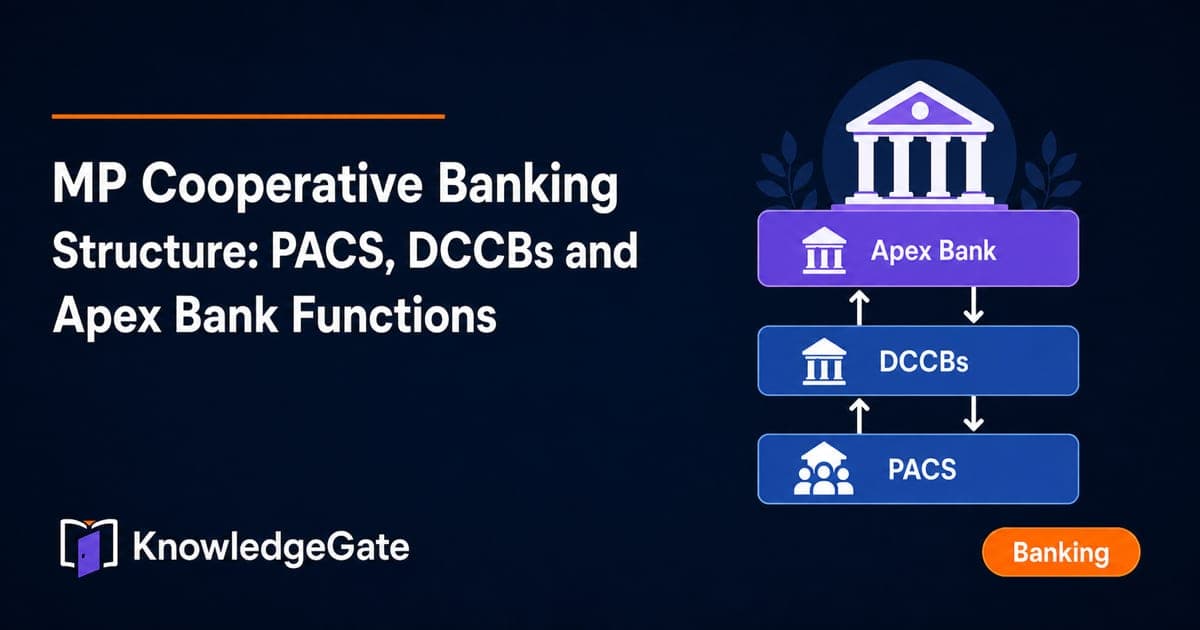
MP Cooperative Bank preparation often turns PACS, a district cooperative bank and the Apex Bank into one vague institution. Then a simple question about the direction of credit becomes guesswork. The three come apart cleanly on three counts: each faces a different counterparty, each does a different job in the credit chain, and each answers to a different authority. One loan of 10.00 lakh rupees, traced down to ten members and back up again, pins all three in place. Recruitment specifics such as dates, vacancies and eligibility change every cycle and live in MP Rajya Sahakari Bank's current official material.
MP cooperative banking means a three-tier short-term credit chain
NABARD's current guidance describes a federated short-term structure. Primary societies connect to district cooperative banks, then to the State Cooperative Bank. In Madhya Pradesh, MP Rajya Sahakari Bank is the state-level institution.
Demand and information aggregate upward as members -> PACS -> DCCB -> State Cooperative Bank/Apex Bank. Funds and institutional support generally move downward, while repayments move upward. A PACS is a cooperative society at the base, not a small branch of the Apex Bank.
This model differs from commercial-bank branches, urban cooperative banks, regional rural banks and the long-term cooperative credit structure. The Banking Exams guide provides the broader exam context.
PACS, DCCB and MP Apex Bank: the three tiers at a glance
Tier | Institution | Operating level | Core relationship |
|---|---|---|---|
1, base | Primary Agricultural Credit Society (PACS) | village or local member area | deals directly with members and consolidates eligible local credit demand |
2, middle | District Central Cooperative Bank (DCCB), also called a Central Cooperative Bank in some official material | district | finances and serves affiliated PACS, manages district-level funds and also performs banking functions |
3, apex | State Cooperative Bank (StCB), the MP Apex Bank in Madhya Pradesh | state | balances and coordinates the upper tier, supports DCCBs and connects the structure with state-level banking and refinance channels |
The table records functional relationships, not branch ownership. Not every service or loan passes through all three tiers, and a PACS keeps its own membership, rules and accounts even when the credit it lends comes from the tier above.
The MP Co-operative Bank Exam Preparation page collects the rest of this exam's preparation material. Dates, vacancies, marks and eligibility change with each recruitment cycle, and a tier question never turns on them.
PACS functions: member contact, local appraisal and recovery
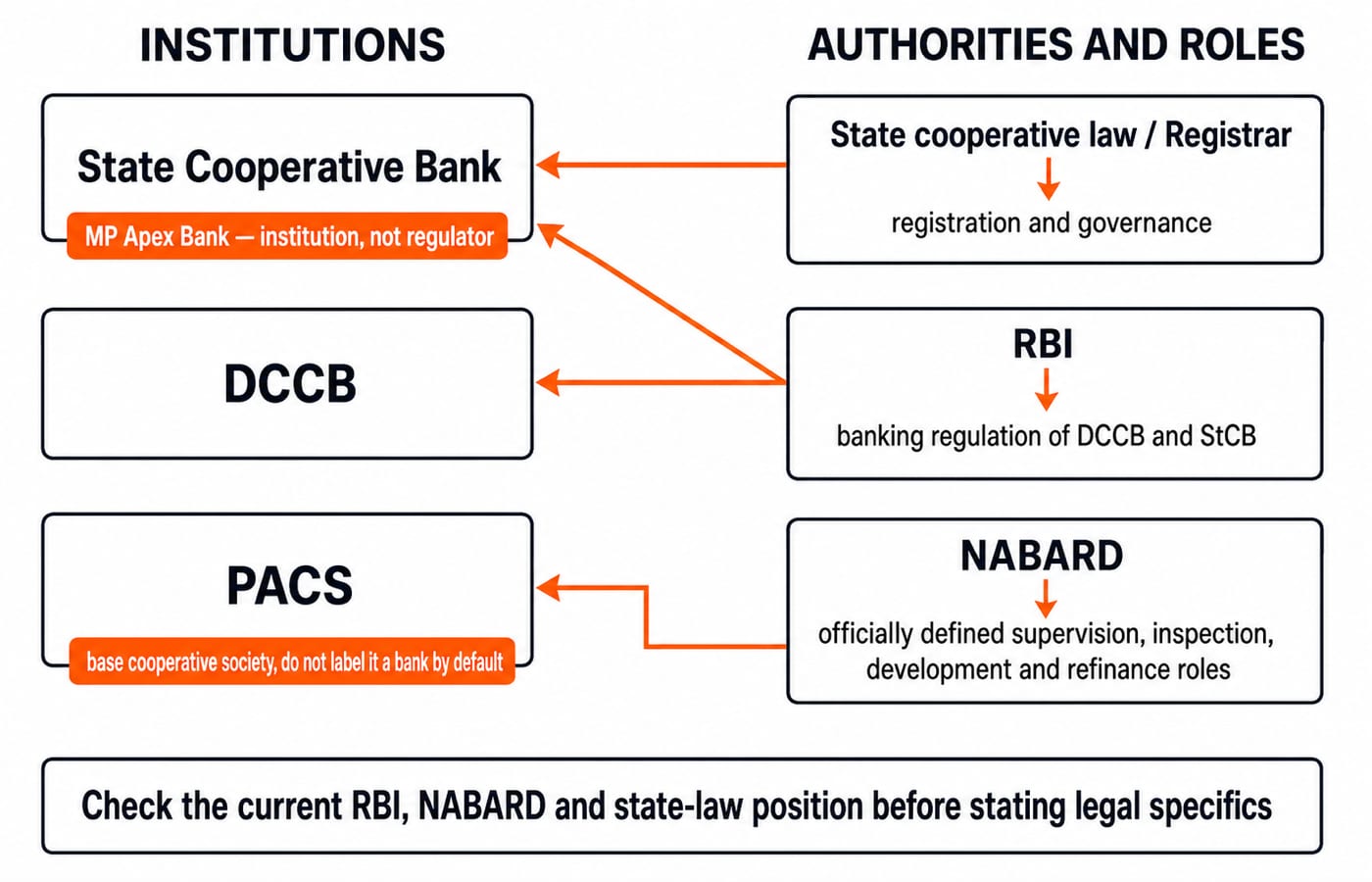
PACS is the member-facing base. It enrols eligible members under the society's rules, keeps share and member records, receives and assesses credit requests, disburses sanctioned credit, collects repayments and maintains borrower records. It may offer non-credit services or deposits where rules and permissions allow, but these are not universal features.
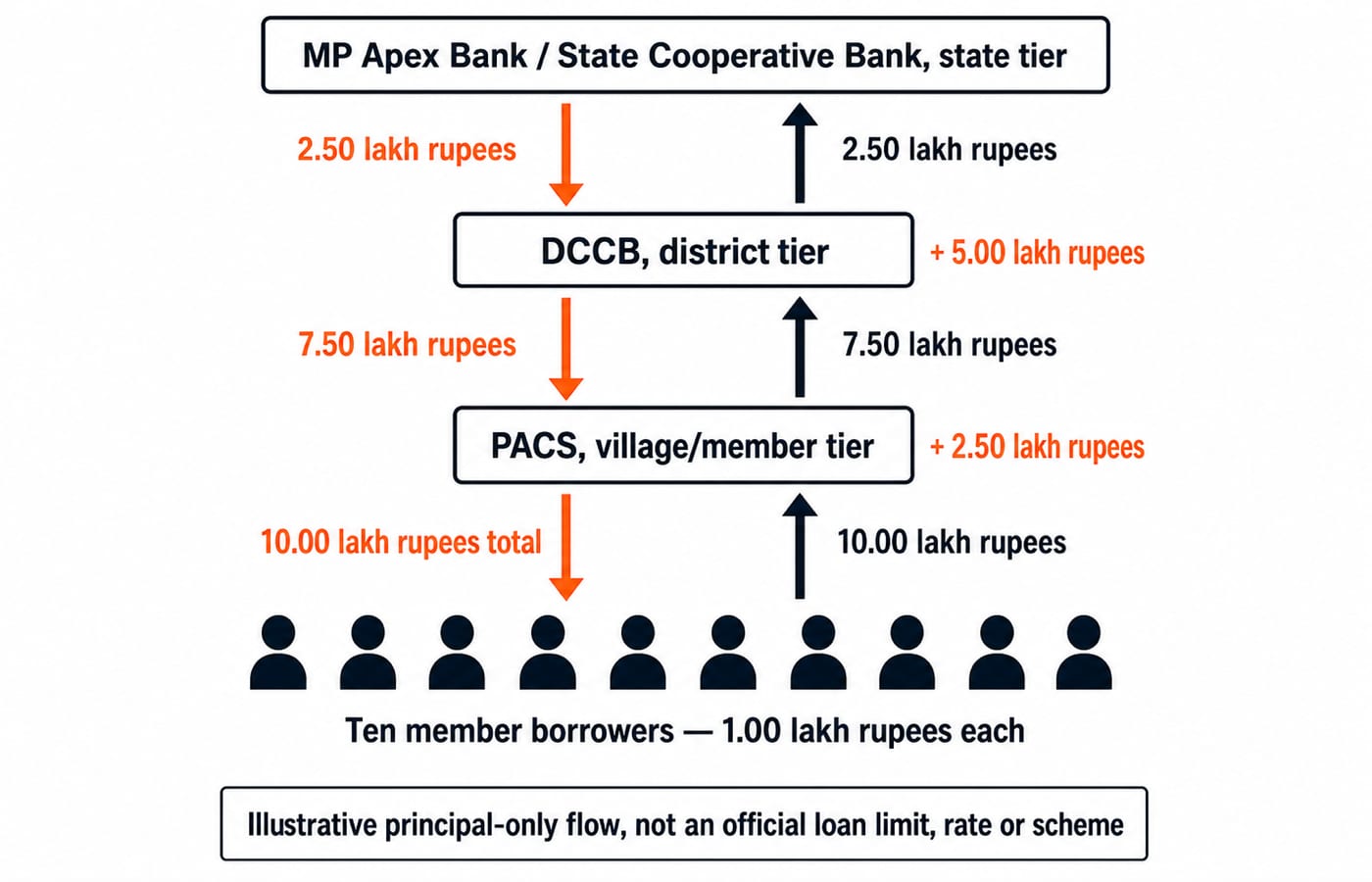
Suppose ten eligible members each request 1.00 lakh rupees for seasonal needs. The PACS consolidates 10 x 1.00 lakh rupees = 10.00 lakh rupees. It has 2.50 lakh rupees of available local resources, so its financing gap is 10.00 lakh rupees - 2.50 lakh rupees = 7.50 lakh rupees.
If the clue is direct contact with individual farmer-members, think PACS.
DCCB functions: the district financing and banking bridge
A DCCB aggregates affiliated societies' needs, manages finance under approved arrangements, handles district liquidity, maintains society accounts and payments, and conducts permitted banking business. It is not the regulator of PACS.
It also maintains district-level payment links among affiliated societies.
In the example, the DCCB must provide the PACS with 7.50 lakh rupees. It can deploy 5.00 lakh rupees from available district-level resources. Its remaining state-level liquidity need is therefore 7.50 lakh rupees - 5.00 lakh rupees = 2.50 lakh rupees.
Pooling several PACS requests, financing affiliated societies or managing district funds points to the DCCB. Official material may call this middle tier DCCB or CCB, so follow the question's terminology.
MP Apex Bank functions: state-level balance, coordination and linkage
The MP Apex Bank is the State Cooperative Bank at the top of this chain. It supports DCCB liquidity, coordinates the state network, provides permitted banking and treasury services, and connects the upper tiers with official refinance, development and policy channels. Its branch network, service list, programmes and recruitment notices change, so take those from the MP Apex Bank official site.
Here it supplies 2.50 lakh rupees to the DCCB. The DCCB combines that with 5.00 lakh rupees to make 7.50 lakh rupees. The PACS adds 2.50 lakh rupees and can disburse 10.00 lakh rupees in total.
The word apex means the top tier, not RBI, NABARD or a ministry. The Apex Bank is not a regulator merely because it is at the top.
MP cooperative credit flow: trace 10 lakh rupees down and back up
Now recompute the whole downward flow, using principal only:
Member demand:
10 borrowers x 1.00 lakh rupees = 10.00 lakh rupees.PACS contribution:
2.50 lakh rupees. PACS gap:10.00 lakh rupees - 2.50 lakh rupees = 7.50 lakh rupees.DCCB contribution:
5.00 lakh rupees. DCCB gap:7.50 lakh rupees - 5.00 lakh rupees = 2.50 lakh rupees.Apex support:
2.50 lakh rupees. DCCB funds available to the PACS:5.00 lakh rupees + 2.50 lakh rupees = 7.50 lakh rupees.PACS disbursement capacity:
2.50 lakh rupees + 7.50 lakh rupees = 10.00 lakh rupees.
The Apex amount fills the DCCB gap; it is not the full member disbursement. An option that routes the whole 10.00 lakh rupees from the Apex Bank fails on exactly this point, and so does one that has the PACS borrow its 2.50 lakh rupees share from above.
After all ten borrowers repay in full, the principal moves back up. The PACS receives 10.00 lakh rupees, replenishes its 2.50 lakh rupees contribution and returns 7.50 lakh rupees to the DCCB. The DCCB replenishes its 5.00 lakh rupees contribution and returns 2.50 lakh rupees to the Apex Bank. The check on both legs is 2.50 lakh rupees + 5.00 lakh rupees + 2.50 lakh rupees = 10.00 lakh rupees.
The figures are illustrative and track principal only. Interest, timing, defaults, security, eligibility and official lending limits would change the amount on every leg without reversing the direction any leg travels. No figure here is an MP Apex Bank scheme, rate or limit.
MP cooperative banking exam traps: terminology, regulation and fund direction
The amounts below are made up for practice. The tier each prompt points to is the part worth memorising.
Prompt clue | Correct tier | Reason |
|---|---|---|
12 member applications at 50,000 rupees each = 6.00 lakh rupees | PACS | direct member contact |
six PACS each seek 4.00 lakh rupees = 24.00 lakh rupees | DCCB | district pooling |
state-level balancing requirement of 9.00 lakh rupees across district institutions | Apex Bank | state balancing |
PACS is a society, not an Apex branch.
DCCB is middle, not state tier.
StCB and Apex Bank name the state tier.
Demand and repayment move upward; finance downward.
Short-term rural cooperatives are neither urban nor long-term cooperatives.
RBI banking regulation applies to StCBs and DCCBs. NABARD supervises and inspects those same two tiers and carries development and refinance roles across the structure. State cooperative law and the Registrar cover incorporation and governance, which is where PACS sit. So a PACS is not an RBI-regulated bank, and the MP Apex Bank is not a regulator at all: it is regulated, exactly like the DCCBs beneath it.
KnowledgeGate's Evolution of Indian Banking question set runs to more than 60 banking-awareness questions, only some of them MP-specific. Banking Awareness IBPS PO Mains: Static Core + Weekly Plan shows how to keep a static institutional topic like this one apart from the current-affairs layer. Practise all five forms this topic takes: tier identification, function matching, hierarchy ordering, fund direction and regulator distinctions.
MP cooperative banking: the short version and next study step
PACS knows the member and originates demand. DCCB pools and finances at district level. MP Apex Bank coordinates and balances at state level. Remember 2.50 lakh rupees Apex support + 5.00 lakh rupees DCCB resources + 2.50 lakh rupees PACS resources = 10.00 lakh rupees to members.
Continue with the MP Cooperative Bank 2026 Course to work through the rest of the syllabus in order. Current official MP Apex Bank material controls dates, eligibility, vacancies, pattern and other recruitment details.
Keep learning
Knowledge of ICT Explained: Digital Divide, Email Fields and MS Word Macros
Connect access, communication and automation through three worked ICT concepts. Practise denominator choice, Bcc visibility and a beginner Word macro trace.
Updated 16 Aug 20266 min readMP Cooperative Bank
MP Cooperative Bank Roles Compared: Clerk, Manager and Technical Work
Compare three broad work families without treating them as a current vacancy list. Use task routing, a role-fit calculation and a notification card to choose a preparation focus.
Updated 14 Aug 20266 min readMP Cooperative Bank
MP Cooperative Bank Mock Analysis: Turn Errors Into a Revision Loop
A mock score cannot show you what to fix next. Use this worked review system to reconcile your section data, identify root causes and retest each repair.
Updated 9 Aug 20268 min readMP Cooperative Bank
MP Cooperative Banking Structure and Functions: Three Tiers, Roles and Exam Traps
Build a clear village-to-state model of MP cooperative banking, then test it with tier, fund-flow, repayment and authority questions.
Updated 7 Aug 20266 min readMP Cooperative Bank