Higher Education Structure and Accreditation for Teaching Exams: UGC, NAAC, NBA and NIRF
Learn what UGC, NAAC, NBA and NIRF actually tell you through a role-first map and a fictional college case.
KnowledgeGate Team
Exam prep & CS education
Updated 5 Aug 20266 min read

UGC recognised, autonomous, NAAC accredited, NBA accredited and NIRF ranked can all sit beside one institution's name, and each of them answers a different question. UGC NET Paper 1 examines that system directly. Other teaching recruitment tests it only where the current official syllabus lists higher education.
Start with the five questions that organise the system
Before naming any body, ask:
Who creates or declares the institution?
Who may award the degree?
Who regulates or sets standards?
Who accredits quality?
Who ranks comparative performance?
One body need not answer all. A valid answer in one lane does not imply status in the others.
Term | What it means |
|---|---|
Recognition or legal status | Whether an institution or qualification sits within the applicable legal framework |
Affiliation | A college's academic and degree link to a university |
Autonomy | Specified academic or administrative freedom under applicable rules |
Accreditation | External quality-assurance judgement |
Ranking | Ordering under a published methodology |
Each term answers exactly one of those five questions, so a real institution has to be checked lane by lane, against the official record for that lane. Elimination questions live on these boundaries, which is why UGC NET preparation drills the five as one set.
Map degree-granting institutions and colleges
The UGC's current official FAQ gives five degree-granting institution labels and their establishment routes:
Institution type | Establishment or declaration route |
|---|---|
Central University | Act of Parliament |
Institution of National Importance | Established or declared by Act of Parliament |
State University | Act of the State Legislature |
Private University | Act of the State Legislature, and self-financing in the FAQ description |
Institution Deemed to be University | Central Government notification on UGC advice under Section 3 of the UGC Act, 1956 |
Affiliated, constituent and autonomous colleges sit below this layer. Under the UGC's 2023 autonomous-college regulations, an autonomous college remains within the applicable university framework. Autonomy is not university status or proof of independent degree-awarding power.
North State University was created by a State Legislature Act. River College is affiliated to it, then gains autonomy. That makes North State a State University and River College an affiliated autonomous college whose degrees are still awarded in the university's name. River College does not become a private university, and it does not step outside UGC or university rules.
Separate policy, regulation, accreditation and association
Body | What it does |
|---|---|
Ministry of Education | Handles Union-level policy and administration |
UGC | Promotes and coordinates university education, and determines and maintains standards |
AICTE, NCTE and other sector bodies | Set standards inside their own statutory remits, technical education for AICTE and teacher education for NCTE |
NAAC | Assesses and accredits institutions |
NBA | Accredits eligible technical programmes |
NIRF | Ranks through a published framework |
AIU | Acts as an association, not a national accreditor or universal regulator |
For elimination, standards point to a regulator or statutory body, institutional quality assessment to NAAC, a named technical programme to NBA, and a score plus rank to NIRF. Approval, recognition, accreditation and ranking may coexist, but cannot replace one another.
Inter-University Centres are shared university-system facilities associated with the UGC framework. They are neither a sixth degree-granting institution type nor an accrediting body.
NAAC and NBA show different levels of evidence
NAAC works at the institution level: it assesses and accredits the institution as a whole, not one department or one programme. Grade boundaries, cycle rules and process stages have all changed between cycles, so read them off the official NAAC assessment portal each time instead of memorising one number.
NBA works one level down. Its accreditation page states that NBA accredits selected technical programmes, not a whole institution or department. So if B.Tech Computer Science and Engineering is NBA accredited while B.Tech Civil Engineering is not listed, only the named programme is covered and nothing at all follows about Civil Engineering. Neither NAAC nor NBA proves degree authority.
NIRF ranks institutions but does not accredit them
The official NIRF site says the framework was launched in 2015 as a methodology for ranking institutions. Its current parameter page presents five broad families: Teaching, Learning & Resources; Research and Professional Practice; Graduation Outcomes; Outreach and Inclusivity; and Perception. The weights differ by category and by year, so never assume one universal split.
Take two illustrative institutions. A has NIRF Engineering score 54.20 and rank 76; B has 53.90 and rank 79. Since 54.20 - 53.90 = 0.30, A sits 0.30 ahead on score and ranks above B, 76 against 79. Nothing in those numbers speaks to a NAAC grade, NBA programme cover or degree authority. Rank movement is a Paper 1 concept, and UGC NET Paper 1 vs Paper 2 shows where it sits against the subject paper.
Fully worked example: classify one college
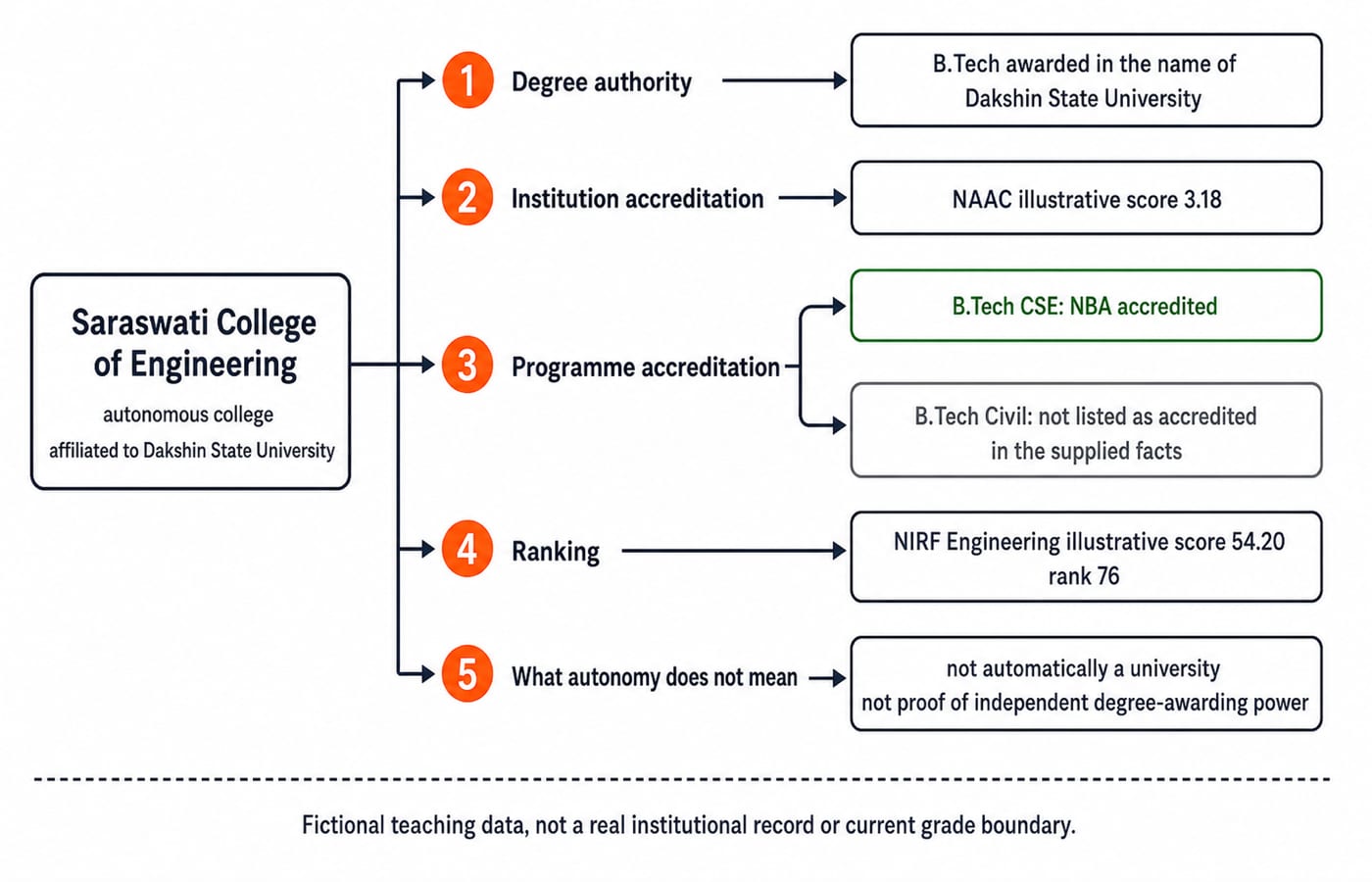
Saraswati College below is invented, and every value attached to it is illustrative rather than a real institutional record.
Saraswati College of Engineering is affiliated to Dakshin State University and is autonomous under the college framework. Its B.Tech degree is awarded in the name of Dakshin State University. Its illustrative NAAC score is 3.18. B.Tech Computer Science and Engineering is NBA accredited, while B.Tech Civil Engineering is not listed. Its illustrative NIRF Engineering score is 54.20, rank 76.
Classify the evidence in five steps:
Who awards the degree? Dakshin State University, the university named on the award record.
Did autonomy turn the college into a university? No.
What is the institution-level accreditation evidence? The NAAC score of 3.18.
What is the programme-level accreditation evidence? NBA status for B.Tech Computer Science and Engineering only. There is no basis to call Civil Engineering NBA accredited.
What is the comparative ranking evidence? NIRF score 54.20, rank 76.
If rank improves from 76 to 61 while the NAAC and NBA records stay unchanged, only the ranking has changed. If Civil Engineering later enters the current NBA database, that adds programme evidence for Civil Engineering alone. Neither event creates a university, and neither changes who issues the degree.
How objective papers test the topic
Question shapes include body-to-function matching, type-to-establishment-route matching, institution versus programme accreditation, accreditation versus ranking, and cases combining affiliation, autonomy and degree award. Practise them on mixed cases rather than single-body recall, because the trap is nearly always a swapped lane and not a forgotten name.
Practice question 1
An autonomous affiliated college has an NBA-accredited CSE programme and a NIRF rank of 76. Which conclusion is supported?
(A) The college is a university; (B) Every programme is NBA accredited; (C) CSE has programme-level NBA accreditation and NIRF 76 is ranking evidence; (D) NIRF awards the degree.
Answer: (C). Autonomy, programme accreditation, ranking and degree authority occupy separate lanes.
Practice question 2
Statement I: An Institution Deemed to be University is declared by Central Government notification on UGC advice under Section 3 of the UGC Act, 1956. Statement II: NBA accreditation of one programme means that the entire institution is NBA accredited.
(A) Both true; (B) I true, II false; (C) I false, II true; (D) Both false.
Answer: (B). Statement I follows the UGC FAQ. Statement II conflicts with NBA's programme-level boundary.
Marks, dates, question counts, weightage and syllabus wording differ by exam and by cycle. Take every one of those from the current notice of the body conducting the exam you are sitting.
Short version and the next study move
Recall the chain in order: creation or declaration, then degree authority, then affiliation or autonomy, then regulation or standards, then accreditation, then ranking. Dakshin State University awards the degree, NAAC 3.18 is institutional evidence, NBA covers only CSE, and NIRF 54.20 at rank 76 is ranking evidence.
Make 12 cards: 3 on institution types and routes, 3 on UGC and sector-body roles, 2 on NAAC versus NBA, 2 on NIRF, and 2 on Saraswati College. Score yourself, and at 9 out of 12 the 3 you missed will nearly always fall under legal status, accreditation level or ranking confusion. Sort them into those three buckets, then repeat only the weakest bucket.
Use the NTA UGC NET Paper 1 course for structured coverage and the UGC NET Paper 1 test series for later practice. UGC NET Computer Science syllabus areas helps distinguish the Paper 2 subject route from this Paper 1 concept. Now redraw the five-lane evidence map from memory and explain why none of its labels can replace another.
Keep learning

ICT in Education MCQs: 12 Solved Questions on Digital Learning Tools
Solve 12 ICT in Education MCQs, then use clear explanations and a five-layer model to separate files, tools, platforms and public initiatives.
Updated 3 Oct 20268 min readUGC NET Computer Science

Requirements Elicitation Techniques and Use Case Development: Worked Library Example
Follow a fictional library reservation from interviews and observation through testable requirements, a UML use-case model, UC-07, and acceptance checks.
Updated 28 Sep 20266 min readUGC NET Computer Science

Quality Factors: McCall’s and ISO 9126 Models with a Worked Scoring Example
Build both quality models around one maintainability audit. This guide maps their vocabulary, calculates McCall-style and ISO-style scores, and ends with exam-focused checks.
Updated 25 Sep 20265 min readUGC NET Computer Science

Cohesion and Coupling MCQs: 10 Solved Questions on Functional Independence
Practise 10 solved MCQs on cohesion, coupling, functional independence, module dependencies, and the distinctions that make closely matched options easier to separate.
Updated 24 Sep 20267 min readUGC NET Computer Science