MP Cooperative Banking Structure and Functions: Three Tiers, Roles and Exam Traps
Build a clear village-to-state model of MP cooperative banking, then test it with tier, fund-flow, repayment and authority questions.
KnowledgeGate Team
Exam prep & CS education
Updated 7 Aug 20266 min read
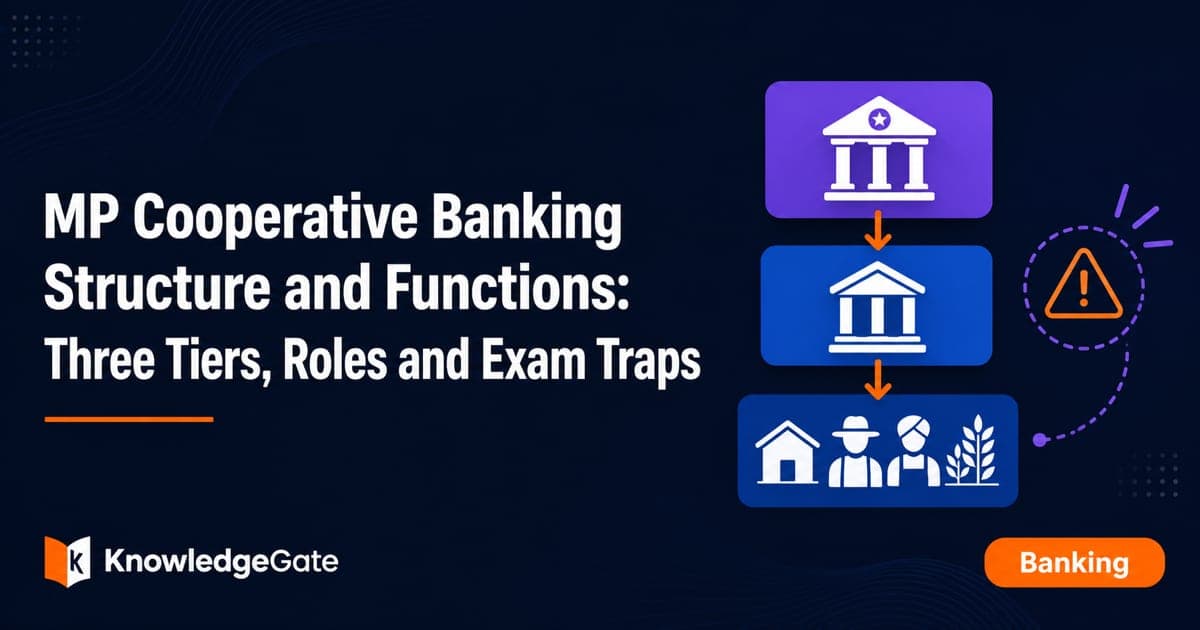
Apex Bank, State Co-operative Bank, DCCB and PACS are easy to memorise separately but just as easy to reverse in an exam question. The working model starts with village members at the base, moves through district financing in the middle, and ends at the state apex. Get that order right and the tier, function, fund-direction and authority questions all fall out of it, which is why the chain repays more revision time than any list of names. Recruitment specifics such as the marks split or the vacancy count sit in the applicable official notification, never in a structure question.
MP cooperative banking structure: read the three-tier chain from the borrower upwards
The short-term cooperative credit structure connects local member-facing societies with district-level financing institutions and a state-level apex institution.
Read it from the borrower upwards:
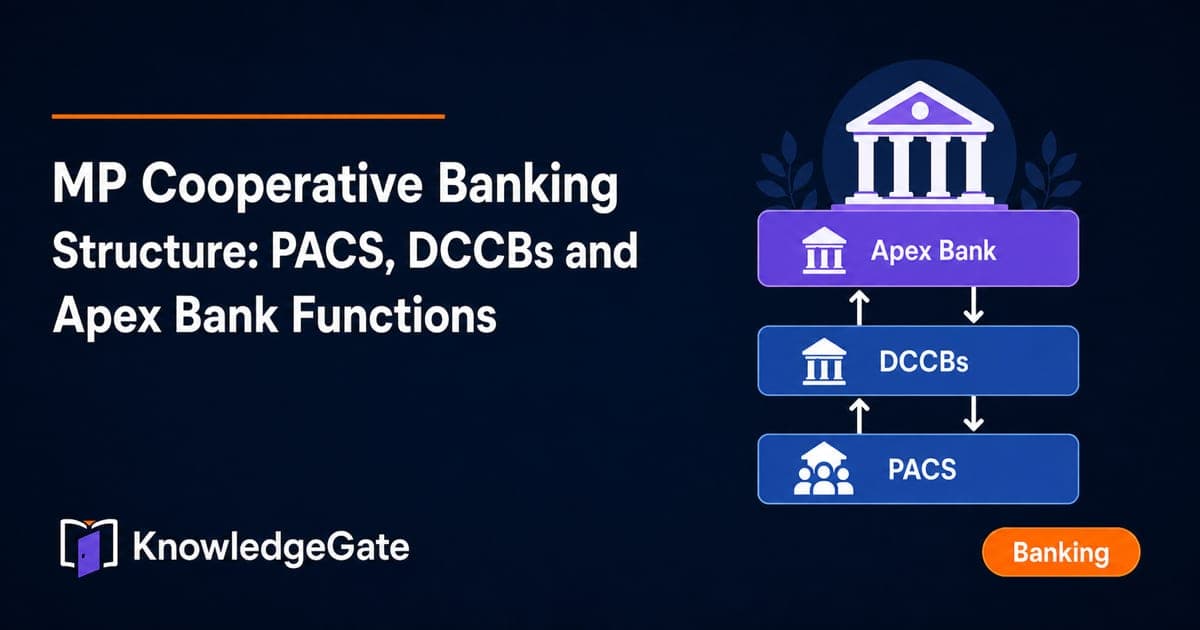
PACS -> DCCB -> State Co-operative Bank (MP Apex Bank)
“Primary” identifies the grassroots unit. “Central” in District Central Co-operative Bank identifies the district-level link, not a central government institution. “Apex” identifies the top of this structure within the state.
Level | Institution | Immediate interface | Core exam keyword |
|---|---|---|---|
Village/local | PACS | Member-borrowers | last-mile credit |
District | DCCB | Affiliated PACS and district customers | financing bridge |
State | State Co-operative Bank / MP Apex Bank | DCCBs and state-level institutions | apex and balancing centre |
The MP Co-operative Bank exam preparation page is the hub for this exam's other areas. For a structure question, though, begin with the three-tier chain rather than trying to recall unrelated facts.
MP Apex Bank: what the state-level tier does
At the state level, the State Co-operative Bank pools and deploys resources, supports liquidity moving towards the district tier, coordinates across DCCBs, and provides the upper cooperative-banking link for the state. It is the balancing centre of the state's structure: surplus at one district tier can be routed towards deficit at another. Questions test that role set, not branch counts or deposit figures.
In Madhya Pradesh, MP Rajya Sahakari Bank = State Co-operative Bank = MP Apex Bank. The different labels should not make you place them at different levels: all three name one institution occupying one tier, so an option that spreads them across two tiers is wrong on that ground alone.
Recognition prompt: Which institution is the apex of the three-tier structure within a state? The answer is the State Co-operative Bank, called MP Apex Bank in Madhya Pradesh.
DCCBs: the district financing and banking bridge
A District Central Co-operative Bank consolidates financing needs from affiliated PACS, provides the district-level banking link, and passes funds down to societies. It also carries repayment and demand information upwards through the structure.
A DCCB is not the village-level member society, and it is not the state apex. Its exam identity is simple: district + intermediary + PACS financing.
Consider a classification example. PACS A asks for 2 credit units, PACS B for 3, and PACS C for 5. The combined district demand recorded by the DCCB is:
2 + 3 + 5 = 10 credit units
“Credit unit” here is just a teaching unit for the arithmetic. The aggregation is the point: a DCCB's district demand is the sum of its affiliated societies' requests, which is why demand rises through the structure while funds come down it.
PACS: the member-facing base of the structure
PACS stands for Primary Agricultural Credit Society. It deals most directly with members at the local level by receiving credit requests, disbursing sanctioned credit, and collecting repayments. PACS is a cooperative credit society. It should not automatically be treated as a licensed cooperative bank.
Use a direction test when a question describes movement through the tiers:
Member applications and credit demand move from PACS upwards.
Sanctioned funds move from the upper tiers towards PACS and its members.
Repayments are collected at PACS and move back through the financing chain.
The common trap is that PACS is the member’s first contact but the lowest institutional tier. “Primary” does not mean apex, and PACS must not be expanded as “Primary Agricultural Cooperative Bank”.
MP cooperative banking credit flow: a fully worked three-tier example
The example below tracks principal only. Follow the quantities rather than the amounts, because each one has to balance in both directions.
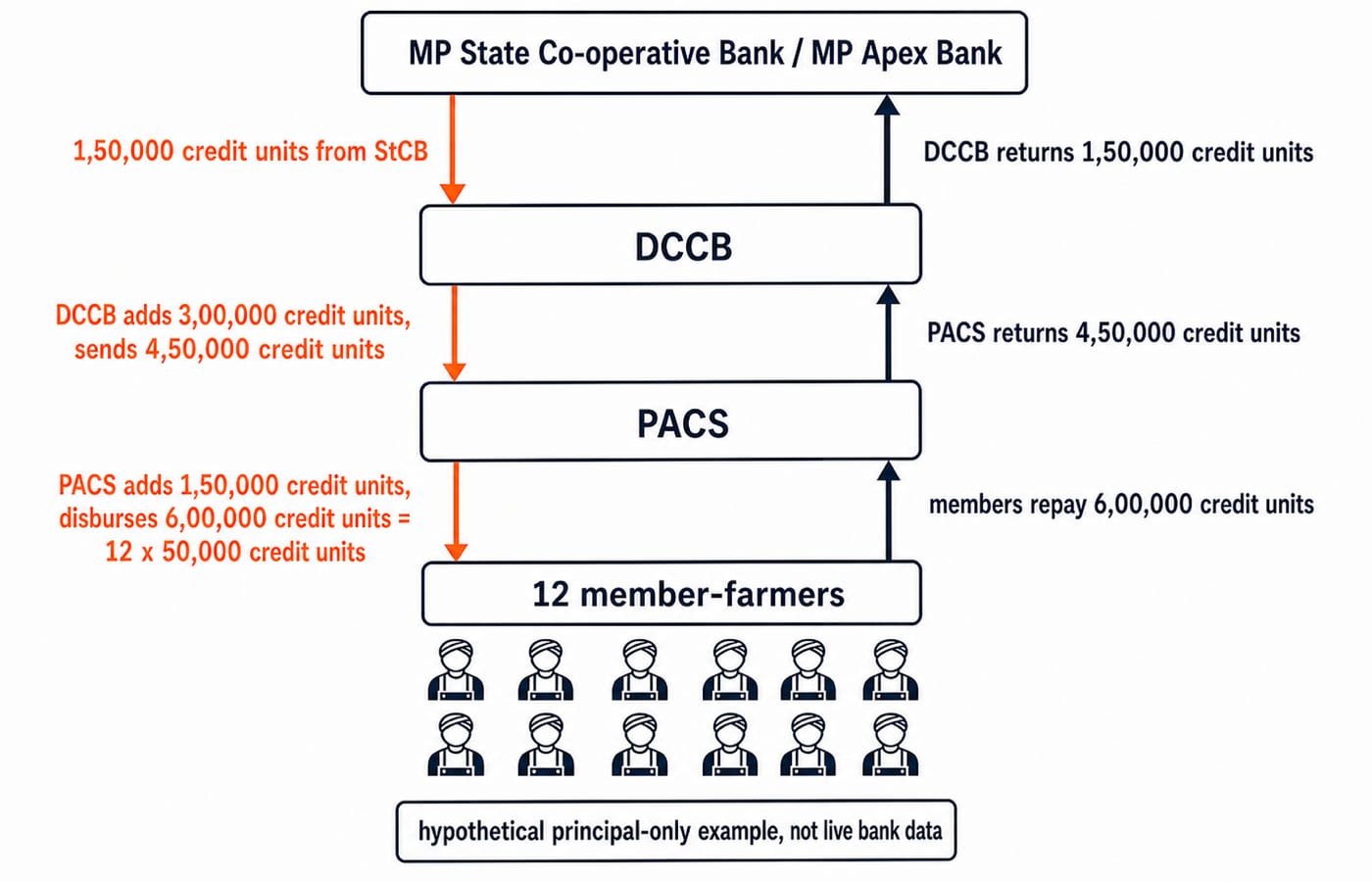
Twelve member-farmers each apply through one PACS for 50,000 credit units. Their total demand is:
12 x 50,000 credit units = 6,00,000 credit units
The PACS can meet 1,50,000 credit units from its own available pool. The district-financing gap is therefore:
6,00,000 credit units - 1,50,000 credit units = 4,50,000 credit units
The DCCB supplies that gap of 4,50,000 credit units. It uses 3,00,000 credit units from its own district pool and 1,50,000 credit units received from the State Co-operative Bank:
3,00,000 credit units + 1,50,000 credit units = 4,50,000 credit units
Now check the complete amount reaching the members through PACS:
1,50,000 credit units from PACS + 3,00,000 credit units from DCCB + 1,50,000 credit units from the State Co-operative Bank = 6,00,000 credit units
The reverse path uses the same principal quantities. If all 12 members repay principal, PACS collects 12 x 50,000 credit units = 6,00,000 credit units. It keeps 1,50,000 credit units to replenish the local pool and passes 4,50,000 credit units to the DCCB. The DCCB retains 3,00,000 credit units for its district pool and passes 1,50,000 credit units back upwards to the State Co-operative Bank.
The reverse check is 1,50,000 credit units + 3,00,000 credit units + 1,50,000 credit units = 6,00,000 credit units. Interest, due dates, security and sanction terms would sit on top of this principal skeleton without changing the direction of any arrow in it.
MP cooperative banking regulation: separate RBI, NABARD and the State Government
The Reserve Bank of India overview identifies State Co-operative Banks and DCCBs as regulated by RBI and supervised by NABARD. It explains that PACS are outside RBI’s Banking Regulation Act purview and are regulated and monitored by the respective State Governments.
Institution | Regulation | Supervision or framework |
|---|---|---|
StCB | RBI regulation | NABARD supervision |
DCCB | RBI regulation | NABARD supervision |
PACS | State Government / cooperative-society framework | not RBI regulation |
This authority split creates a high-value exam trap. An option can place an institution at the correct tier but attach the wrong authority. RBI should not be described as directly regulating PACS under the Banking Regulation Act. Also keep urban cooperative banks out of this chain: a UCB belongs to a different branch of cooperative banking.
MP cooperative banking exam questions: solve by tier, function and authority
Most questions reduce to four forms:
Sequence: arrange the tiers as PACS -> DCCB -> StCB.
Role matching: member-facing means PACS, district bridge means DCCB, and state apex means StCB.
Flow direction: funds move down, while demand, repayment and related information move up.
Authority matching: RBI regulates StCB and DCCB, NABARD supervises them, and PACS answer to the State Government.
Try three checkpoints:
A society receives village members’ crop-credit applications. Answer: PACS.
An institution finances affiliated societies across a district. Answer: DCCB.
A statement says NABARD regulates PACS under the Banking Regulation Act. Answer: false. NABARD supervises StCBs and DCCBs, and PACS sit outside the Banking Regulation Act with the State Governments.
Keep this trap box beside your revision notes:
Apex is state, not national.
Central in DCCB is district, not Union Government.
PACS is the base, not the top.
PACS is a society, not automatically a bank.
Fund flow and repayment flow run in opposite directions.
Regulation and supervision are not synonyms.
This three-tier topic is static banking awareness. The Banking Awareness IBPS PO Mains: Static Core + Weekly Plan guide sets out how to keep such institutional concepts separate from the changing current-affairs layer.
MP cooperative banking structure: the short version and next step
Use three memory lines:
Village: PACS | District: DCCB | State: MP Apex Bank
Member interface | financing bridge | state apex
RBI regulates StCB and DCCB | NABARD supervises them | State Governments handle PACS
If you need help turning static topics and changing events into a repeatable routine, use the Banking Exam Prep Plan: 3 Phases, 10-12 Hours a Week. For a structured Computer Operator and Society Manager preparation path, MP Cooperative Bank 2026 is the next step.
Keep learning
Knowledge of ICT Explained: Digital Divide, Email Fields and MS Word Macros
Connect access, communication and automation through three worked ICT concepts. Practise denominator choice, Bcc visibility and a beginner Word macro trace.
Updated 16 Aug 20266 min readMP Cooperative Bank
MP Cooperative Bank Roles Compared: Clerk, Manager and Technical Work
Compare three broad work families without treating them as a current vacancy list. Use task routing, a role-fit calculation and a notification card to choose a preparation focus.
Updated 14 Aug 20266 min readMP Cooperative Bank
MP Cooperative Banking Structure: PACS, DCCBs and Apex Bank Functions
Learn how demand, finance and repayments move through PACS, DCCBs and MP Apex Bank. A principal-only example makes each tier's function easy to identify.
Updated 12 Aug 20266 min readMP Cooperative Bank
MP Cooperative Bank Mock Analysis: Turn Errors Into a Revision Loop
A mock score cannot show you what to fix next. Use this worked review system to reconcile your section data, identify root causes and retest each repair.
Updated 9 Aug 20268 min readMP Cooperative Bank