Composition of Functions MCQs: 10 Solved Questions with Explanations
Solve 10 composition of functions MCQs step by step. Learn the right-to-left order, domain checks, associativity, and injective and onto implications.
KnowledgeGate Team
Exam prep & CS education
Updated 3 Aug 20267 min read
Composition questions rarely fail because of arithmetic. They go wrong when you reverse the order, ignore whether the inner output fits the outer domain, or overgeneralise a one-to-one or onto property.
Write the inside function first, simplify fully, and only then compare with the options. All ten questions here sit in the Composition of Functions practice set, which holds more than 15 questions on the topic, and Discrete Mathematics MCQs covers the neighbouring chapters.
Two habits decide most of these attempts. Where a stem restricts the domain, carry the restriction into the final answer, because a factor you cancel still bans the value that made it zero. And when an option claims a property always transfers, reach for a two-element counterexample before you accept it.
1. Composition order: the inner function acts first
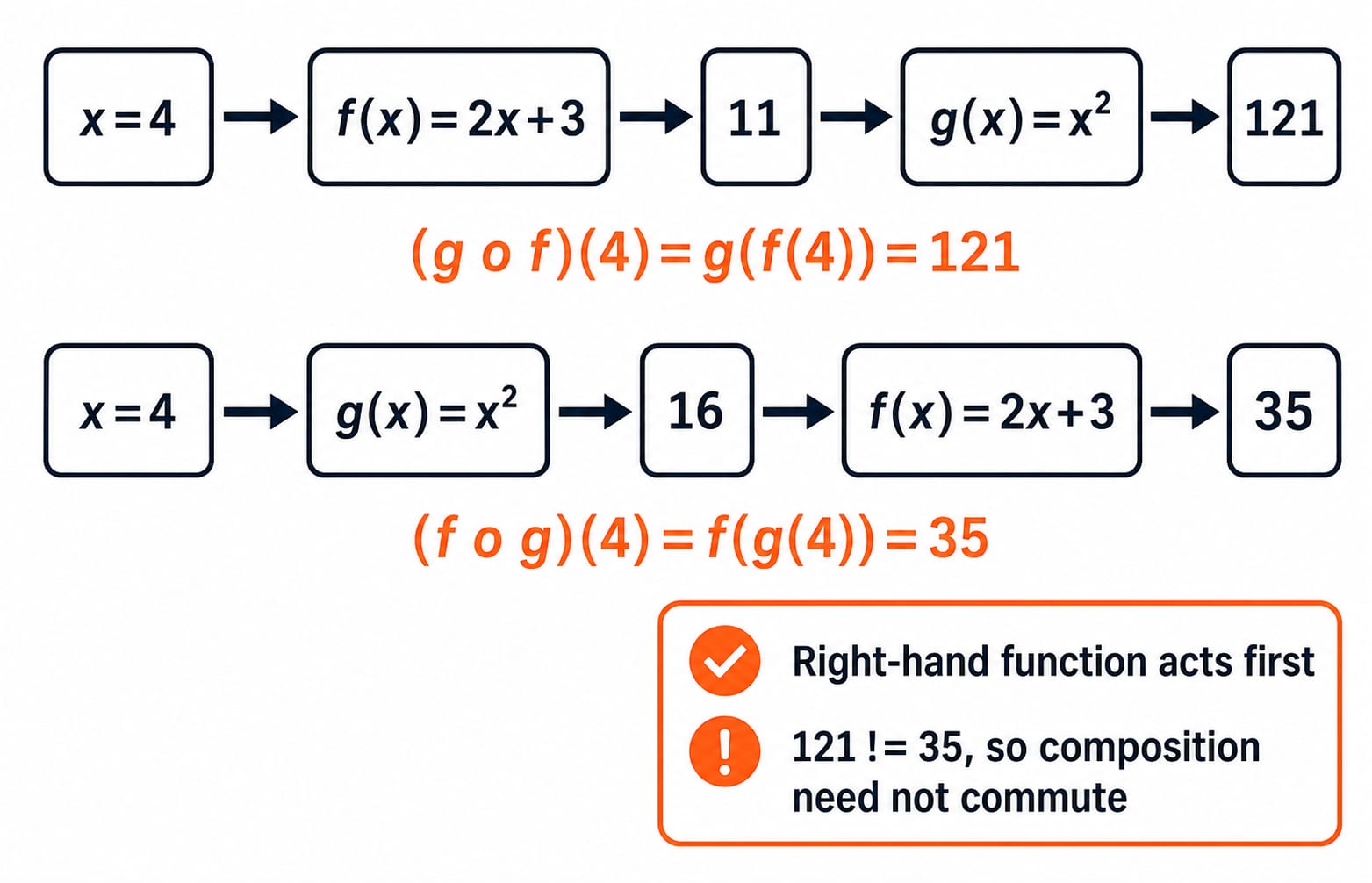
If f: A -> B and g: B -> C, then (g o f)(x) = g(f(x)). The right-hand function acts first, and g must accept every output of f.
For f(x)=2x+3, g(x)=x^2, and x=4, calculate f(4)=11, then g(11)=121, so (g o f)(4)=121. Reversing the order gives g(4)=16, then f(16)=35, so (f o g)(4)=35. Since 121 != 35, composition need not commute.
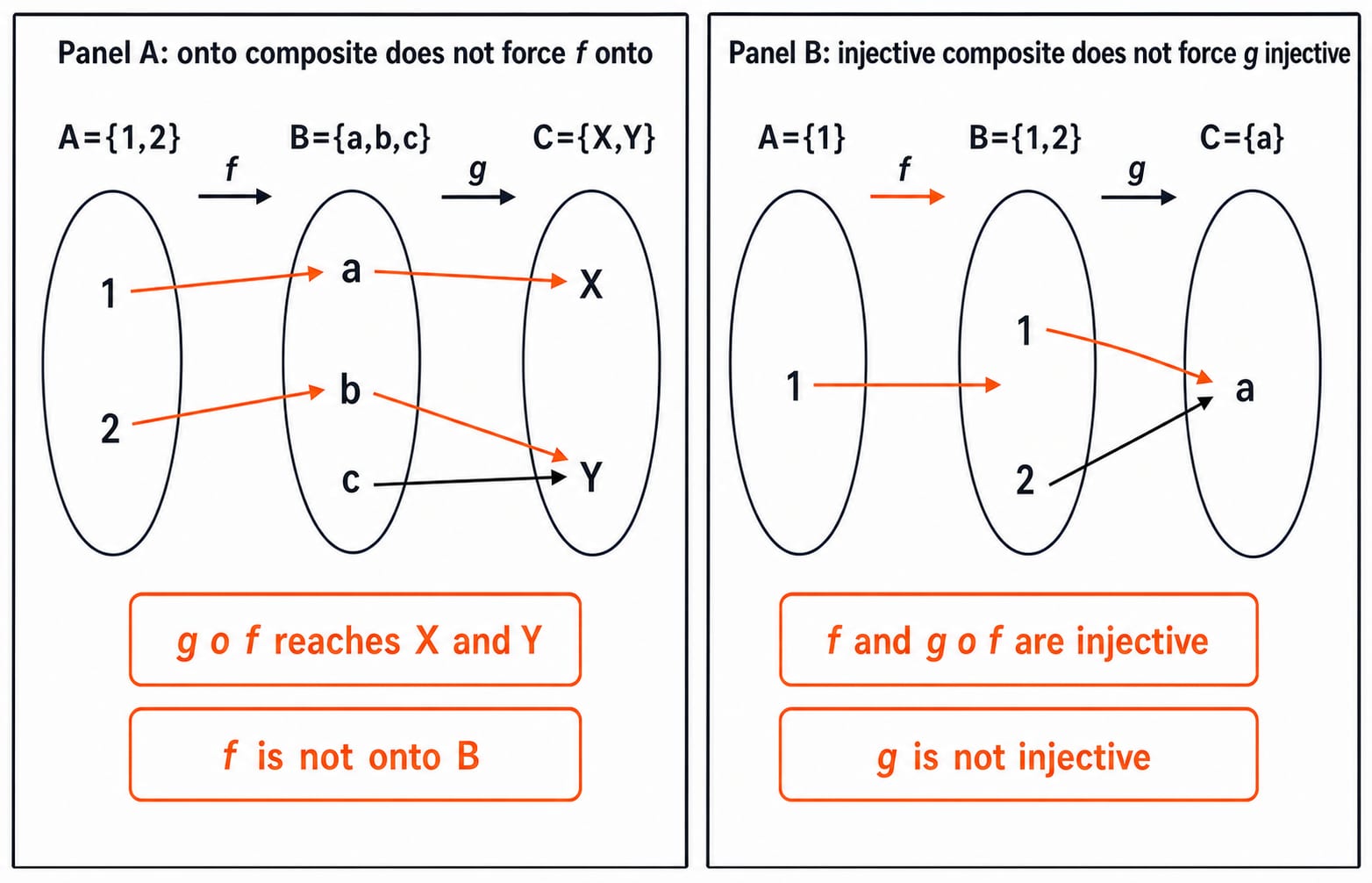
Composition is associative. Injective after injective stays injective; onto after onto stays onto. If g o f is onto, g must be onto, but f need not be. If g o f is injective, f must be injective, but g need not be one-to-one outside the image of f. Review Set Theory and Relations for GATE for the terminology.
2. Questions 1-2: definition and a direct numerical composition
Question 1. Identify what composition means
What is the composition of functions?
A. A function that applies one function after the other
B. A function that applies two functions at the same time
C. A function that reverses the application of another function
D. A function that undoes the application of another function
Answer: A. Composition feeds the output of one function into the next, so the applications are sequential. For example, if f(3)=7 and g(7)=49, then (g o f)(3)=49. Option B wrongly suggests simultaneous action. Options C and D describe ideas associated with an inverse function, not composition.
Question 2. Apply the inside function first
If f:Z->Z is defined as f(n)=11n and g:Z->Z is defined as g(n)=nmod7, then (gof)(4) is,
A. 4
B. 7
C. 44
D. 2
Answer: D. 2. Apply the right-hand function first: f(4)=11x4=44, then g(44)=44 mod 7=2. The traps are stopping at 44, reversing the order, or treating 7 as the remainder.
3. Questions 3-4: composition order and non-commutativity
Question 3. Compare both orders for a square and a shift
Let two functions f: R->R, g: R->R are defined as
f(a) = a^2
g(a) = a+1
then choose the correct option.
A. Composition of f(a), g(a) is commutative
B. Composition of f(a), g(a) is not commutative
C. Composition of f(a), g(a) is commutative and equivalent to f(a^2 + 1)
D. Composition of f(a), g(a) is commutative and equivalent to (a^2 + 1)
Answer: B. (f o g)(a)=f(a+1)=(a+1)^2=a^2+2a+1, while (g o f)(a)=g(a^2)=a^2+1. At a=2, the values are 9 and 5, so the functions do not commute. One unequal input disproves the general claim.
Question 4. Keep the ordered pair of affine compositions straight
UGC NET 2013, Computer Science, Paper 2 (December).
Let f and g be the functions from the set of integers to the set integers defined by
f(x) = 2x + 3 and g(x) = 3x + 2
Then the composition of f and g and g and f is given as
A. 6x + 7, 6x + 11
B. 6x + 11, 6x + 7
C. 5x + 5, 5x + 5
D. None of the above
Answer: A. f(g(x))=2(3x+2)+3=6x+7; then g(f(x))=3(2x+3)+2=6x+11. At x=1, the outputs are 13 and 17. Option B reverses them. See the solved page.
4. Questions 5-6: rational and three-function compositions
Question 5. Simplify both rational compositions before dividing
GATE 2015, Computer Science, Set 1.
If g(x) = 1 - x and h(x) = x/(x - 1), then g(h(x))/h(g(x)) is:
A. h(x)/g(x)
B. -1/x
C. g(x)/h(x)
D. x/(1 - x)²
Answer: A. g(h(x))=1-[x/(x-1)]=-1/(x-1) and h(g(x))=(1-x)/((1-x)-1)=(x-1)/x, so their ratio is -x/(x-1)^2. Also, h(x)/g(x)=x/[(x-1)(1-x)]=-x/(x-1)^2, matching A. Retain x!=0,1. See the solved page.
Question 6. Build a three-function composition from the inside out
UGC NET 2017, Computer Science, Paper 2 (January).
The functions mapping R into R are defined as :
f(x) = x³ - 4x, g(x) = 1/(x² + 1), h(x) = x⁴
Then find the value of the following composite functions :
(h ∘ g)(x) and (h ∘ g ∘ f)(x)
A. (x² + 1)⁴ and [(x³ - 4x)² + 1]⁴
B. (x² + 1)⁴ and [(x³ - 4x)² + 1]⁻⁴
C. (x² + 1)⁻⁴ and [(x² - 4x)² + 1]⁴
D. (x² + 1)⁻⁴ and [(x³ - 4x)² + 1]⁻⁴
Answer: D. h(g(x))=[1/(x^2+1)]^4=(x^2+1)^(-4). Set u=f(x)=x^3-4x; then g(u)=1/(u^2+1) and h(g(u))=(u^2+1)^(-4). Substitution gives [(x^3-4x)^2+1]^(-4). Option C writes x^2 for x^3 inside the bracket and leaves the outer exponent at +4 instead of -4. See the solved page.
5. Questions 7-8: associativity, domain, and range
Question 7. Verify associativity with actual formulas
UGC NET 2014, Computer Science, Paper 2 (December).
If we define the functions f, g and h that map R into R by :
f(x) = x⁴, g(x) = √(x² + 1), h(x) = x² + 72, then the value of the composite functions ho(gof) and (hog)of are given as
A. x⁸ - 71 and x⁸ - 71
B. x⁸ - 73 and x⁸ - 73
C. x⁸ + 71 and x⁸ + 71
D. x⁸ + 73 and x⁸ + 73
Answer: D. g(f(x))=sqrt(x^8+1), so h(g(f(x)))=x^8+1+72=x^8+73. Also, h(g(t))=(sqrt(t^2+1))^2+72=t^2+73; putting t=x^4 gives x^8+73. This verifies associativity, not commutativity. See the solved page.
Question 8. Track the composite function before its range
Let f(x) = 2x and g(x) = sin x. The domain and range of the composite function gof are:
A. Domain is all real x and range is -1 <= y <= 1
B. Domain is all real x and range is -2 <= y <= 2
C. Domain is -1 <= x <= 1 and range is -1 <= y <= 1
D. Domain is all positive real values and range is -1/2 <= y <= 1/2
Answer: A. (g o f)(x)=sin(2x). Both functions accept the needed real inputs, so the domain is all real numbers. The factor 2 changes frequency, not amplitude, so the range remains [-1,1]. At x=pi/4, the value is 1.
6. Questions 9-10: onto and one-to-one implications
Question 9. Infer what must be onto
If gof is onto then,
A. f and g must be onto
B. f must be and g maybe onto
C. f may be and g must be onto
D. Neither is onto
Answer: C. Every final value has the form g(f(a)), so g must be onto. But take A={1,2}, B={a,b,c}, C={X,Y}, with f(1)=a, f(2)=b, g(a)=X, g(b)=Y, and g(c)=Y. The composite reaches X and Y although f misses c.
Question 10. Find the false injectivity claim
Let g be a function from B to C and f be a function from A to B, then which property of function composition is INCORRECT?
A. If f and gof are onto, then g is also onto.
B. If f and gof both are one to one function, then g is also one to one.
C. If f and g both are onto function, then gof is also onto.
D. If f and g both are one to one function, then gof is also one to one.
Answer: B. Take A={1}, B={1,2}, C={a}; let f(1)=1, g(1)=a, and g(2)=a. Both f and g o f are one-to-one on A, but g is not. A holds because onto g o f makes g onto. C holds because onto f reaches B and onto g reaches C. D holds because g(f(x))=g(f(y)) forces f(x)=f(y) through injective g, and that forces x=y through injective f.
7. The short version and the next practice step
Answer key: 1-A, 2-D, 3-B, 4-A, 5-A, 6-D, 7-D, 8-A, 9-C, 10-B.
Mistake | What went wrong | Repair |
|---|---|---|
Reversed | Applied | Write |
Stopped after the inner function | Accepted 44 as final | Feed 44 into |
Assumed composition commutes | Expected both orders to match | Question 3 gives 9 versus 5 at |
Ignored domain restrictions | Cancelled without checking existence | Retain |
Extended a property beyond the inner image | Judged all of | Question 10 has |
For a 15-minute redo, answer all 10 in 7 minutes, rewrite every miss as nested parentheses in 5, and prove or disprove one property with a finite-set mapping in 3. Retest only the misses the next day.
Evaluate right to left, check domains, retain restrictions, and test strong one-to-one or onto claims with a counterexample. Continue with Set Theory and Relations MCQs. Work through the Discrete Mathematics module for structured revision and GATE Guidance by Sanchit Sir for broader preparation.
Keep learning
Graph Traversal MCQs: 12 Solved Questions on Walks, Paths, Trails, Circuits and Connectivity
Attempt 12 graph traversal and connectivity questions, then check each answer through definitions, reachability, degree conditions and edge-count arguments.
Updated 3 Oct 20267 min readDiscrete Mathematics MCQs
Planar Graphs MCQs: 12 Solved Questions on Kuratowski’s Theorem, Homeomorphism and Edge Bounds
Solve 12 planar graph questions, then check each answer through a forbidden-subdivision argument, a crossing-free redraw, or a short calculation.
Updated 28 Sep 20268 min readDiscrete Mathematics MCQs
Power Set and Cardinality MCQs: 12 Solved Questions with Explanations
Solve 12 power set questions, from direct enumeration and nested sets to inclusion chains, ordered pairs and recurrence-based counting.
25 Sep 20267 min readDiscrete Mathematics MCQs
Null Set, Universal Set, Subset and Proper Subset MCQs: 12 Solved Questions
Practise 12 MCQs on null sets, universal sets, subsets, proper subsets, complements and nested inclusion, with clear reasoning for every answer.
Updated 24 Sep 20267 min readDiscrete Mathematics MCQs