

Basic Requirements of Effective Teaching MCQs: 12 Solved Questions
Solve 12 teaching aptitude questions by separating subject knowledge, classroom processes and learner outcomes. Each answer explains the distinction that rules out tempting alternatives.
KnowledgeGate Team
Exam prep & CS education
Updated 15 Nov 20267 min read
Several options sound like desirable teacher qualities, but the stem may ask about subject mastery, actual learning, ability or a named behaviour category. This set gives 12 exact bank questions with answers and short elimination explanations; attempt each before reading its solution. The College Teaching question bank groups these questions under Basic Requirements of Effective Teaching. These are bank practice questions, not an official answer key.
How to attempt this effective-teaching MCQ set
Choose a 12-minute first pass, approximately 60 seconds per question, followed by 8 minutes reviewing uncertain answers. Record both your option and one reason for choosing it. Mark an answer as uncertain if you cannot reject a tempting alternative.
Keep three layers separate: subject knowledge is an input; clear explanation and responsive teaching are processes; learner understanding is an outcome. Interpret "most important" within the particular stem and options, rather than memorising one universal hierarchy. For broader revision, use Teaching Aptitude for CS Recruitment Exams: How to Score, then return to the distinctions tested below.
Subject mastery versus explaining ideas clearly
Q1
Effectiveness of teaching depends primarily on:
(a) Qualification of teacher
(b) Handwriting of teacher
(c) Personality of teacher
(d) Ability of teachers to explain the concept to the learners
Answer: (d). Explaining a concept connects what the teacher knows with what learners understand. Qualification is a credential; it does not establish that an explanation works. Handwriting and personality alone cannot establish understanding either.
Q2
The most important quality of a good teacher is
(a) Sound knowledge of subject matter
(b) Good communication skills
(c) Concern for students' welfare
(d) Effective leadership qualities
Answer: (a). For this question, sound subject knowledge is the foundation for accurate explanation and correction. Good communication helps convey content, but cannot replace knowing it. Read Q1 and Q2 together: mastery supplies the content; explanation makes it accessible.
Identify the complete set of teaching requirements
In combination questions, judge every statement before checking the options. A choice containing subject knowledge still fails if it also includes rigidity.
Q3
Which of the following are the basic requirements for effective teaching?
The letters A-E identify the statements below.
A. Teaching only what is included in the curriculum
B. Good communication skills
C. Using a rigid teaching approach
D. Excellent subject knowledge
E. Ability to connect with students
Choose the correct answer from the options given below:
(a) A & C only
(b) C & E only
(c) B, D & E only
(d) A, C & D only
Answer: (c). Test the statements separately: B enables clear communication, D supplies accurate content, and E helps the teacher connect with learners. C introduces rigidity, while A restricts teaching to only prescribed content.
UGC NET 2023: practice this question
Q4
Which of the following skills are needed for present day teacher to adjust effectively with the classroom teaching?
Knowledge of technology
Use of technology in teaching learning
Knowledge of students' needs
Content mastery
(a) 1 & 3
(b) 2 & 3
(c) 2, 3 & 4
(d) 2 & 4
Answer: (c). The required statements are 2, 3 and 4: applied technology use, knowledge of students' needs and content mastery. Knowing about technology is different from using it appropriately.
Diagnose difficulties and respond during teaching
Q5
Which of the following are required for good teaching?
(a) Diagnosis
(b) Remedy
(c) Direction
(d) Feedback
Select the correct answer from the codes given below:
(1) (a), (b), (c) and (d)
(2) (a) and (b)
(3) (b), (c) and (d)
(4) (c) and (d)
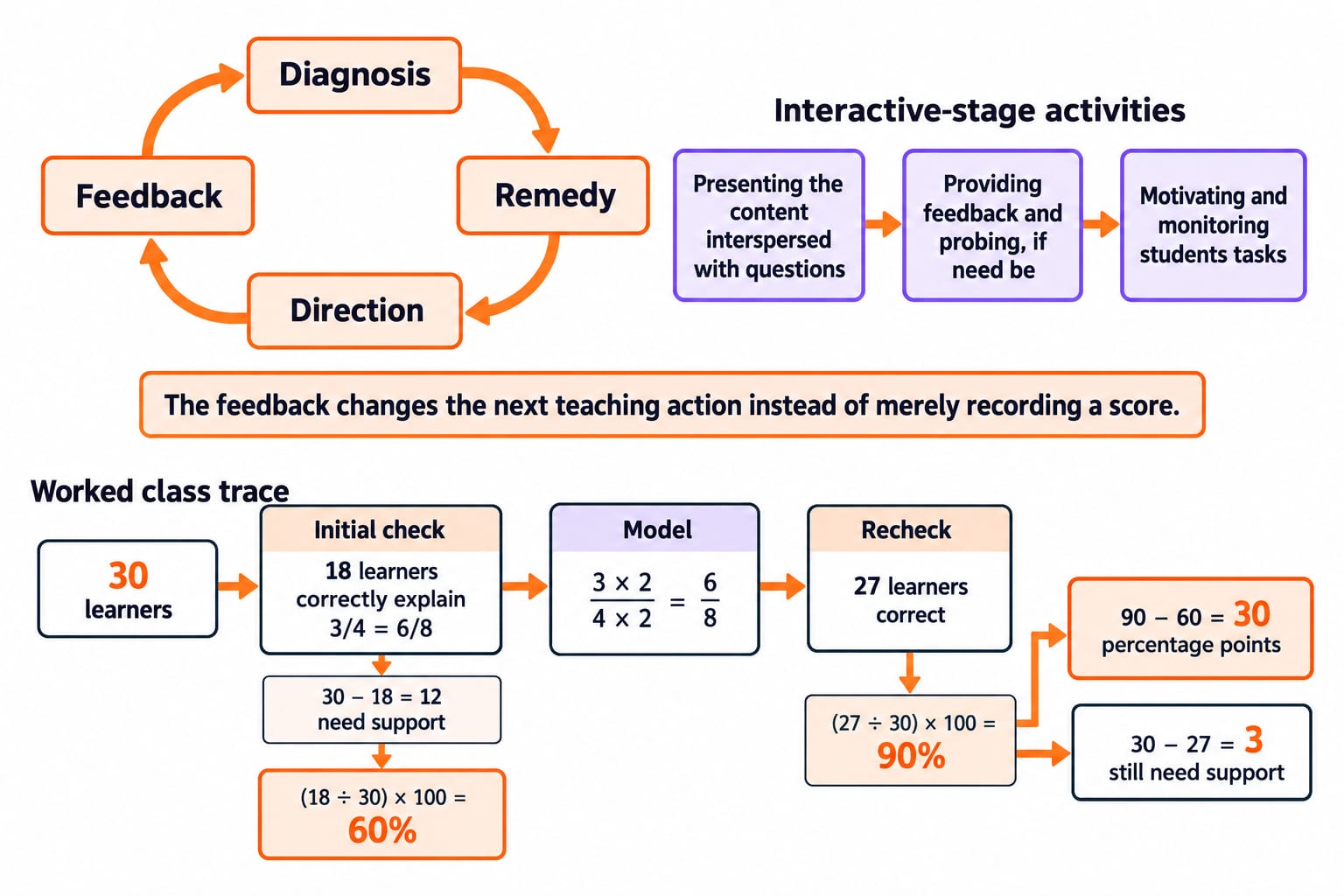
Answer: (1). All four functions belong: diagnosis finds the difficulty, remedy addresses it, direction guides the next step, and feedback informs adjustment. Option (2) omits direction and feedback.
UGC NET 2015: practice this question
Q6
What are the activities of teaching associated with its interactive stage?
(A) Planning of lesson
(B) Determining learning outcomes
(C) Presenting the content interspersed with questions
(D) Providing feedback and probing, if need be
(E) Motivating and monitoring students tasks
Choose the correct answer from the options given below :
(a) (A), (B) and (C) only
(b) (B), (C) and (D) only
(c) (A), (C) and (D) only
(d) (C), (D) and (E) only
Answer: (d). Statements C, D and E describe classroom interaction: presenting and questioning, providing feedback and probing, and motivating and monitoring. Planning lessons and determining outcomes belong to preparation. Options containing A or B therefore fail the stage distinction.
In an illustrative class of 30, 18 learners correctly explain 3/4 = 6/8 on an initial check, so 30 - 18 = 12 need support and accuracy is (18 / 30) * 100 = 60%. Model (3 * 2)/(4 * 2) = 6/8, guide those 12 through a visual fraction comparison, and check again. If 27 now answer correctly, accuracy is (27 / 30) * 100 = 90%, an increase of 90 - 60 = 30 percentage points, while 30 - 27 = 3 still need support.
The feedback changes the next teaching action instead of merely recording a score. Assessment and Evaluation Notes with Worked Examples develops this distinction.
Separate key behaviours from helping behaviours
The next pair distinguishes key behaviours from helping behaviours.
Q7
Which of the following have been identified as key behaviours contributing to effective teaching?
(A) Lesson clarity
(B) Instructional variety
(C) Using student ideas and contribution
(D) Engagement in learning process
(E) Structuring
Choose the correct answer from the options given below :
(a) (A), (B) and (D) only
(b) (A), (B) and (C) only
(c) (B), (C) and (D) only
(d) (C), (D) and (E) only
Answer: (a). The key behaviours here are lesson clarity, instructional variety and engagement, statements A, B and D. Using student ideas and structuring belong to helping behaviours in this classification.
Q8
From the following, identify those characteristics which go within the category 'helping behaviour' for becoming an effective teacher :
(A) Structuring
(B) Student success rate
(C) Using student ideas
(D) Probing
(E) Instructional variety
Choose the correct answer from the options given below :
(a) (A), (B) and (C) only
(b) (B), (C) and (D) only
(c) (C), (D) and (E) only
(d) (A), (C) and (D) only
Answer: (d). Structuring, using student ideas and probing form the helping set, statements A, C and D. Student success rate and instructional variety do not belong to the requested category. Probing means asking further questions to uncover or develop the learner's reasoning.
UGC NET 2020: practice this question
Read statement labels afresh: Q7's A, B and D mean different things from Q8's A, C and D. Memorise the behaviour names, not their temporary letters.
Distinguish ability from willingness to learn
Q9
Which of the following constitutes the 'ability' (can do) component for describing the competence of a teacher?
A. Confidence in performing teaching task
B. Knowledge of the subject being taught
C. Skill in analysing the learning tasks
D. Experience in handling learning task related situations
E. Commitment to organizing teaching-learning tasks
Choose the correct answer from the options given below:
(a) B, C and D only
(b) A, B and C only
(c) A, C and D only
(d) C, D and E only
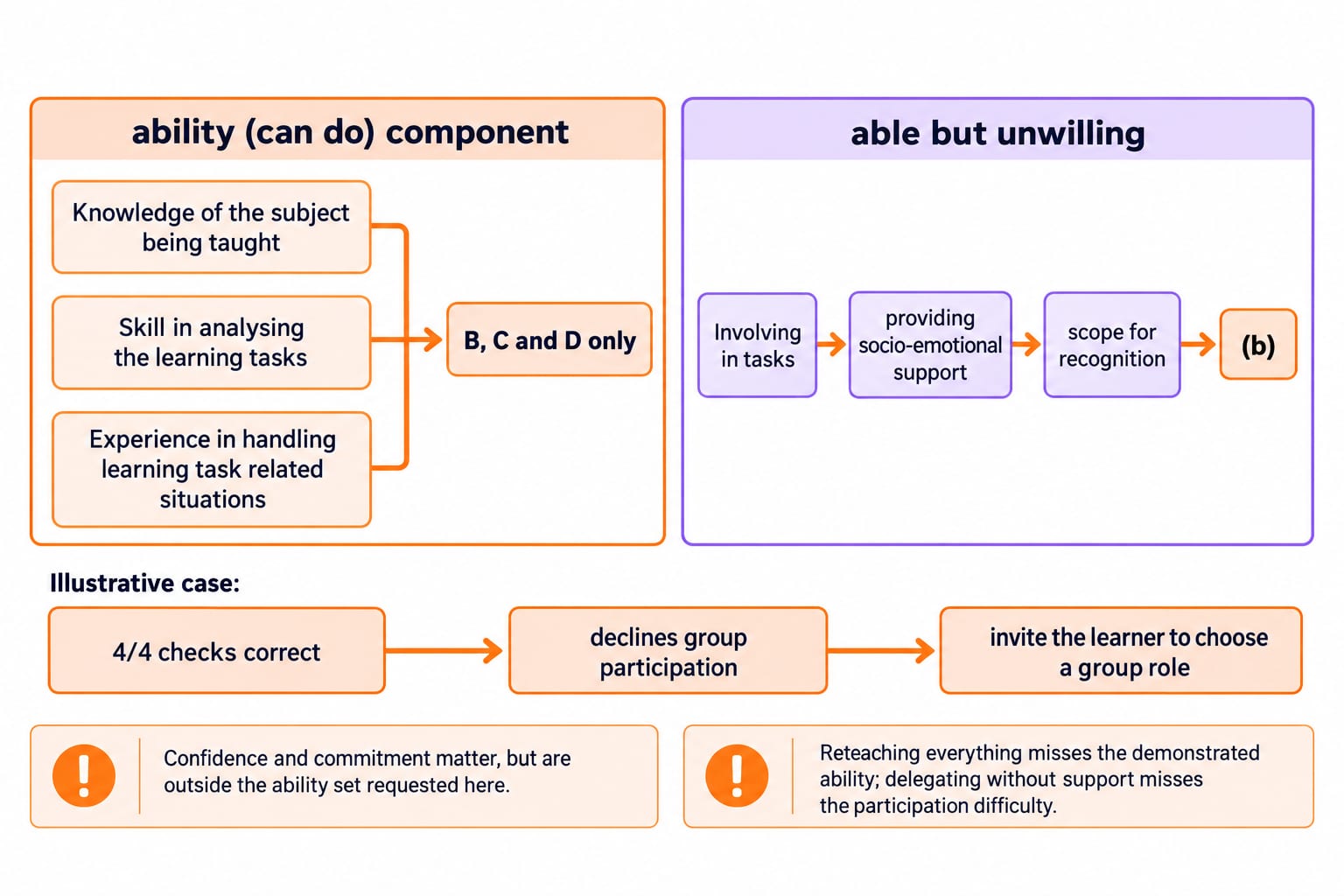
Answer: (a). Knowledge, skill in analysing learning tasks and relevant experience supply the can-do component, statements B, C and D. Confidence and commitment matter, but are outside the ability set requested here. A confident teacher still needs the knowledge and skill to perform the task.
Q10
The teaching strategy best suited to deal with students who in terms of performance readiness level are in the category of 'able but unwilling', will be,
(a) Assigning challenging tasks and delegation of roles
(b) Involving in tasks and providing socio-emotional support with scope for recognition
(c) Mentoring and guiding with close supervision
(d) Keeping the tasks specific and soft
Answer: (b). The learner has ability but needs involvement, socio-emotional support and recognition. Delegation alone overlooks the willingness barrier. Close supervision of skills also misses the main need when the learner has already demonstrated competence.
UGC NET 2020: practice this question
For illustration, a learner gets 4/4 checks correct but declines group participation. Acknowledge the demonstrated skill, invite the learner to choose a group role, and provide encouragement and recognition. Here, 4/4 is only an example, not a formal diagnostic cutoff. Reteaching everything misses the demonstrated ability; delegating without support misses the participation difficulty.
Participation and learning outcomes decide the final pair
Q11
A good teacher must be
(a) resourceful and autocratic
(b) resourceful and participative
(c) resourceful and authoritative
(d) resourceful and dominant
Answer: (b). Resourceful appears in every option, so it cannot distinguish the answer. Compare the second word: participative teaching involves learners while retaining teacher guidance. The control-centred alternatives do not provide that same emphasis on participation.
Q12
Effective teaching is a function of
(a) Teacher's satisfaction.
(b) Teacher's honesty and commitment.
(c) Teacher's making students learn and understand.
(d) Teacher's liking for professional excellence.
Answer: (c). Learners learning and understanding is the outcome criterion. Teacher satisfaction, commitment and professional ambition can support instruction but do not prove that learning occurred. This agrees with Q2: content mastery supports teaching, while learner understanding shows its result.
Review your errors and choose the next practice step
Answer key: Q1 (d); Q2 (a); Q3 (c); Q4 (c); Q5 (1); Q6 (d); Q7 (a); Q8 (d); Q9 (a); Q10 (b); Q11 (b); Q12 (c).
Group errors into knowledge versus outcome, statement combinations, behaviour classification, and ability versus willingness. Re-attempt missed or uncertain questions the next day. Use GATE, PSU, Engineering & Technical Exams to choose your relevant exam track.
For DSSSB Computer Science aspirants, the DSSSB TGT CS 2026 Section B Course - Knowledge Gate AI is an optional broader preparation route. Before counting an answer as revised, explain why one distractor is wrong.
Keep learning

Demand Paging Basics MCQs: 12 Solved GATE Questions on Page Faults and Effective Access Time
Attempt 12 GATE previous-year questions on demand paging, then check clear solutions for page-table calculations, page-fault probability, TLB cost and unit conversion.
Updated 29 Oct 20268 min readOperating System MCQs
Complex and Relative Addressing Modes: Effective Address Examples for GATE
Learn to separate address arithmetic, memory dereferences, PC-relative offsets, and register side effects. The worked examples use one 32-bit machine state throughout.
Updated 31 Oct 20265 min readComputer Organization & Architecture
Basic Addressing Modes in Computer Architecture: Worked Effective-Address Examples and Exam Traps
Stop mixing up the instruction field, effective address, and operand. Reuse one machine state to calculate each basic addressing mode step by step.
Updated 20 Sep 20266 min read63 viewsComputer Organization & Architecture
Requirements Elicitation Techniques and Use Case Development: Worked Library Example
Follow a fictional library reservation from interviews and observation through testable requirements, a UML use-case model, UC-07, and acceptance checks.
Updated 30 Oct 20266 min readUGC NET Computer Science