Multiple Job Offers: Compare Role, Learning, Location and Pay with a Weighted Scorecard
Use a repeatable scorecard to compare offers without letting headline pay decide everything. Gate red flags first, then test how priorities change the result.
KnowledgeGate Team
Exam prep & CS education
Updated 12 Aug 20266 min read

For a fresher, the offer with the strongest headline pay can still mean weaker work, limited manager access, a difficult commute, or restrictions that slow the first two years of a career. Deadline pressure makes those trade-offs harder to see.
A scorecard fixes that. Rule out anything that fails a hard gate, rate six dimensions from 1 to 5 against written evidence, then weight those dimensions to 100 points, with role fit, learning runway and manager access holding 60 of the 100 between them. Winning margins are small, often 0.10, which is why the last step is testing whether one changed priority reverses the result.
1. Set non-negotiable gates before scoring any offer
A gate cannot be repaired by a high score elsewhere. Three worth setting: substantial software work in the daily role, a service bond no longer than 12 months, and a one-way commute of at most 60 minutes unless hybrid work is confirmed in writing.
Keep gates separate from preferences. A 50-minute commute passes the commute gate but may still earn a low location rating. A 24-month bond fails outright and cannot be balanced by better compensation.
For each offer, keep a one-page evidence folder containing the job description, written offer, recruiter email, and notes from a manager or team-member call. An unconfirmed verbal statement is unknown, not evidence.
2. Turn six vague concerns into answerable questions
For role fit, ask about the first 90 days, the weekly split among coding, testing, support, and client implementation, and the outcome you own. For learning runway, record the confirmed stack, training, review process, and project exposure. For manager access, note team size, reporting line, review cadence, and whether you spoke to the actual manager.
For location, check office days, commute, relocation, shifts, and written hybrid terms. For risk, inspect probation, notice, bond, variable conditions, payroll entity, reassignment, and gaps between projects. For compensation quality, compare fixed, variable, one-time, benefits, and review timing like for like. An offer whose fixed component and first review date are both in writing rates higher than one of the same headline value that leans on an unguaranteed variable share or a joining bonus carrying a clawback.
Use fixed anchors: 1 means serious concern, 2 weak, 3 workable, 4 strong, and 5 excellent fit. Mark missing evidence U, for unknown. Never turn U into 3. Unknowns cluster on role fit, because one employer can hire freshers through several routes that lead to very different day-one work, a split set out in Wipro Interview Experience Patterns: Fresher Routes Compared.
3. Weight the decision before seeing which offer wins
Use this base model: role fit 25, learning runway 20, manager access 15, location 15, risk 10, and compensation quality 15. The weights total 100. The first three receive 60 points together because they shape early practice and feedback.
Calculate each contribution as weight x rating / 100, then add all six for a maximum of 5.00. An offer rated 5 on role fit therefore contributes 25 x 5 / 100 = 1.25, and a 2 on location contributes 15 x 2 / 100 = 0.30.
Change weights only for real priorities such as caregiving, health, commute tolerance, or urgent income stability, never because a favourite offer is losing.
4. Worked example: three offers, one result
Atlas, Beacon and Crest are invented offers, not market benchmarks. Atlas is a backend API role with weekly pull-request reviews, a fortnightly 30-minute manager one-to-one, five office days, and a 50-minute commute each way. The role is written and there is no service bond.
Beacon is a QA automation role with structured automation and cloud training, a weekly manager one-to-one in a six-person team, two office days, and a 25-minute commute. A development move is possible after 12 months but is not guaranteed. Crest is an implementation engineer role with generic four-week training, no confirmed manager cadence, a 15-minute same-city commute, the strongest compensation score, and a 24-month bond.
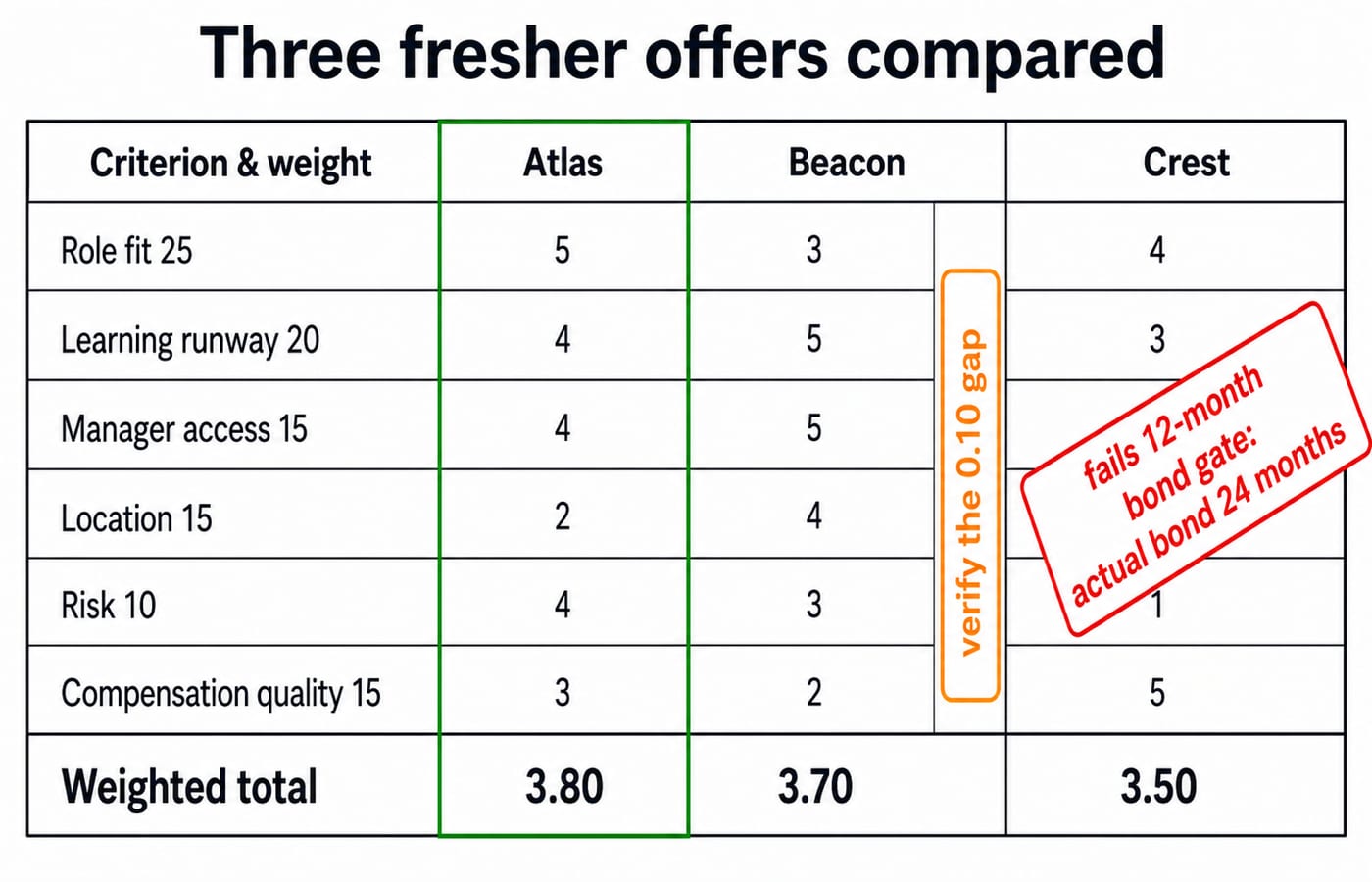
Dimension (weight) | Atlas | Beacon | Crest |
|---|---|---|---|
Role fit (25) | 5 -> 1.25 | 3 -> 0.75 | 4 -> 1.00 |
Learning runway (20) | 4 -> 0.80 | 5 -> 1.00 | 3 -> 0.60 |
Manager access (15) | 4 -> 0.60 | 5 -> 0.75 | 2 -> 0.30 |
Location (15) | 2 -> 0.30 | 4 -> 0.60 | 5 -> 0.75 |
Risk (10) | 4 -> 0.40 | 3 -> 0.30 | 1 -> 0.10 |
Compensation quality (15) | 3 -> 0.45 | 2 -> 0.30 | 5 -> 0.75 |
Total out of 5.00 | 3.80 | 3.70 | 3.50 |
Atlas leads Beacon by 0.10. Crest's 3.50 remains useful for comparison, but Crest is disqualified because its 24-month bond exceeds the 12-month gate. The highest compensation rating does not win because compensation is one dimension, not the whole decision.
5. Stress-test a close result
Treat a gap of 0.15 or less as a practical tie that needs another question, not as mathematical certainty. Atlas and Beacon differ by 0.10, so verify the precise role boundary and whether Beacon's possible development move is documented.
If location is a genuine constraint, reduce role fit from 25 to 15 and raise location from 15 to 25. Keep every other weight unchanged so the six still total 100 and the maximum stays 5.00. The recalculated totals are Atlas 3.50, Beacon 3.80, and Crest 3.60. Beacon now leads, while Crest still fails the bond gate.
The flip exposes what the candidate is actually optimising for. A result that survives only one weighting is not a robust result, so when a single defensible reweighting reverses it, gather better evidence or settle it with a harder question: "Which manager would I choose to learn from for 18 months?"
6. Complete a 3.5-hour decision week
On Day 1, spend 15 minutes on each of three written offers, then 30 minutes listing unanswered questions. On Day 2, schedule three 20-minute clarification calls, one per employer, then spend 15 minutes updating the evidence. On Day 3, use 10 minutes to set weights, 20 to score, 15 for the sensitivity check, and 15 for a decision rationale.
Write five lines: chosen offer, two strongest reasons, biggest accepted downside, failed alternatives, and the condition that would reopen the decision. If Day 2 slips, request a 24-hour extension. If none is available, keep unanswered fields as U and choose the most reversible option that passes every gate.
7. Verify and negotiate only decision-changing terms
After choosing provisionally, send a written checklist covering role, team, manager, office days, joining conditions, fixed and variable structure, probation, notice, and bond. Re-score only after written clarification.
For Atlas, ask whether five office days can become three after onboarding and be documented. If five remain, location stays at 2. If three are confirmed and materially reduce the burden, raise it to 3 and recalculate. A verbal possibility earns no point.
Never bluff about another offer or share confidential documents. HR Interview Questions for Freshers: How to Answer Honestly helps with the wording of a clarification call, and 7 Placement Preparation Mistakes to Avoid names the wider habit of treating a cleared round as the end of the work.
8. The short version and the next action
Set gates, gather written evidence, score from 1 to 5, weight the dimensions to 100, calculate, stress-test, and confirm deciding terms in writing. A scorecard structures judgement. It does not outsource the choice.
For interview preparation or help presenting experience, start with the Resume & Interview Preparation category. The Interview & Resume Preparation Course adds a one-to-one resume review and a one-to-one mock interview to the same preparation.
Tonight, duplicate the six-row table and enter your own gates and evidence. Do not accept or reject an offer until every red-flag U has either been answered or consciously accepted.
Keep learning
Placement Mock Analysis: One Error Ledger Across Every Test Round
Use one error ledger without flattening unlike round results. This worked example shows how to find the first wrong step, prioritise repairs and close errors only after fresh retests.
Updated 4 Oct 20265 min readInterview Corner
Internship to PPO: Build a Weekly Evidence Trail Before the Final Review
Use a weekly outcome ledger to make your internship work visible before the final review. This practice model shows how to record delivery, feedback, effect and handoff honestly.
Updated 28 Sep 20265 min readInterview Corner

DSA Mock Interview Rubric: A 100-Point Scorecard for Reasoning, Code and Communication
A practical six-part scorecard for running comparable DSA mocks, grading visible evidence and turning weak areas into the next week's practice.
Updated 25 Sep 20265 min readInterview Corner

Campus Recruitment Timeline: Stage by Stage from Pre-Placement Talk to Written Offer
Follow a campus drive without guessing. Build an evidence sheet, verify eligibility, plan each preparation window and check the written offer before responding.
Updated 24 Sep 20265 min readInterview Corner