Wipro Interview Experience Patterns: Fresher Routes Compared
Compare seven candidate-reported Wipro fresher experiences without mistaking any one route for the rule. Build a focused plan for technical, project, communication and fit questions.
KnowledgeGate Team
Exam prep & CS education
Updated 23 Jul 20265 min read
One Wipro interview experience describes separate technical and HR interviews. Another describes one business discussion, while a third adds a communication stage. The reports are not necessarily conflicting: they come from candidates who applied through different fresher routes and at different periods. No single one of them is the Wipro pattern. What repeats across all of them is the preparation signal worth acting on, and the round counts, durations, platforms, eligibility rules and question sets stay route-specific until your own invite confirms them.
How to read Wipro interview evidence without forcing one pattern
Seven reports sit behind the counts below: two campus, two off-campus, two WILP and one Elite. Seven is enough to rank what to prepare first and far too few to establish a frequency.
Record the route, report period, screening, stage label, technical topics, project or resume follow-up, and fit questions. Count only an explicitly described event. An omitted stage is not proof that it never occurred.
In this sample:
7 of 7 mention a self-introduction.
5 of 7 explicitly describe project or resume follow-up.
5 of 7 describe separate technical and HR stages. Two WILP reports instead describe one technical or merged business discussion.
5 of 7 include coding or debugging in screening.
4 of 7 explicitly include writing or a communication stage.
Rank your preparation by the rows that repeat, not by the one report whose stage list you happened to read first.
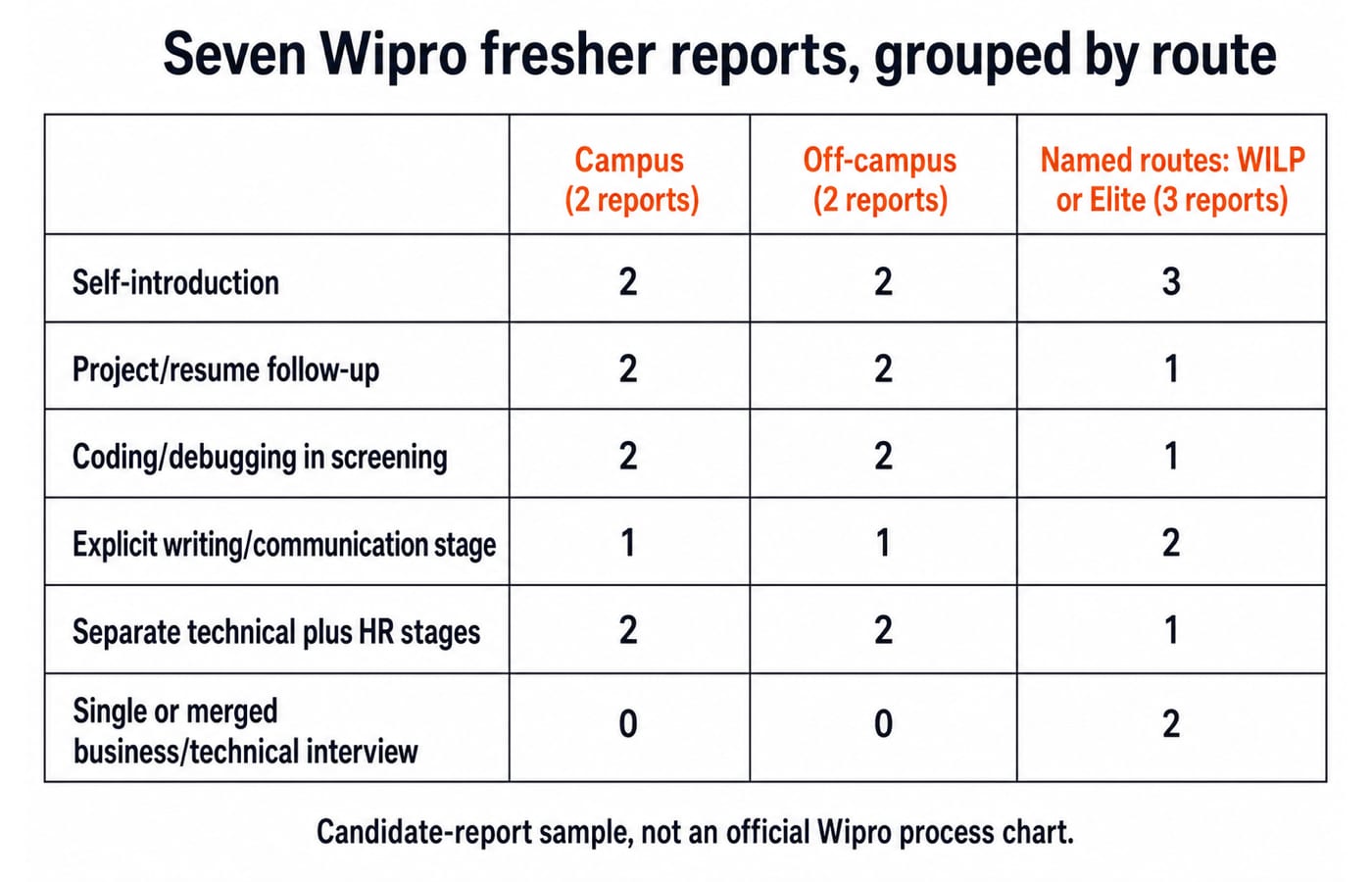
The recurring preparation core across fresher routes
Repetition raises priority, not certainty. Prepare a concise introduction; resume and project ownership; one language with OOP and coding fundamentals; and fit answers about relocation, shifts, teamwork, goals and learning readiness.
Reported material includes language basics, data types, OOP, SQL or DBMS, data structures, operating systems and small coding tasks. Use Technical Interview: OS, DBMS, CN & OOP Prep to organise the wider map.
Where campus, off-campus, WILP and Elite evidence diverge
Both campus reports move from an assessment to separate technical and HR interviews. One reports 70 questions in 70 minutes across logical, C/C++ output and operating-systems content. The other reports a 128-minute test with quantitative, verbal, logical, essay and coding components. Read your invite instead of memorising either set of numbers.
Both off-campus reports describe aptitude or language screening, coding, technical and HR interviews. Only one explicitly includes essay writing. Topics range from projects, SQL and Django to Java OOP.
Named routes vary further. One WILP report describes an 80-minute aptitude stage then a technical interview. Another describes verbal, analytical, quantitative and written communication followed by a merged business discussion. The Elite report adds a communication round before separate technical and HR stages. Explore Company-Specific Placement Courses to build the aptitude, coding and communication base every one of these routes drew on.
A four-week, 48-hour route-aware preparation plan
Use 12 hours weekly:
Week | Allocation | Total |
|---|---|---|
1 | Resume and project 4h; language and OOP 4h; SQL 2h; introduction and fit 2h | 12h |
2 | Coding or debugging 4h; OS/DBMS/CN 3h; aptitude and verbal 3h; communication 2h | 12h |
3 | Timed coding 4h; technical Q&A 3h; project follow-ups 3h; fit scenarios 2h | 12h |
4 | Three 60-minute mocks 3h; gap repair 3h; route practice 3h; invite check 2h; buffer 1h | 12h |
The arithmetic is 12 + 12 + 12 + 12 = 48 hours. If a two-hour weekday block is lost, move 90 core minutes to Saturday and take 30 minutes from the Week 4 buffer. Do not force four hours into the next day. At 10 hours weekly, protect language/OOP, project, coding and mocks first. Four weeks give 10 x 4 = 40 hours.
Use the Wipro Preparation course for aptitude, logical reasoning, English, written communication, coding, topic-wise videos and tests.
Wipro coding screening: work balanced brackets all the way through
Five of the seven reports put coding or debugging in screening, so one problem family worked end to end beats ten skimmed. For balanced brackets, scan {[()]} from left to right:
Character | Action | Stack after action |
|---|---|---|
| Push |
|
| Push |
|
| Push |
|
| Pop matching |
|
| Pop matching |
|
| Pop matching | Empty |
Stack heights rise to 1, 2 and 3, then fall to zero, so the result is true. For {[(])}, the fourth character ] expects [ but finds (, so return false. Scanning takes O(n) time and O(n) worst-case auxiliary space.
Explain why the last-opened bracket closes first, why an empty string is balanced, and why a closing bracket with an empty stack fails. For nested HTML-like tags, keep the rule but store tag names.
Prepare the project, introduction and fit answers as one chain
Build a 90-second introduction: 20 seconds for degree and focus, 40 for one project and your contribution, 20 for your primary language plus SQL or another supporting skill, and 10 connecting that evidence to the role. The check is 20 + 40 + 20 + 10 = 90 seconds. Every claim in those 90 seconds is a hook: the technical round pulls one and asks you to defend it, and the fit round asks what you intend to do with it next. That is what makes the three answers one chain rather than three rehearsed speeches.
A library-loan API has users(id, name), books(id, title) and loans(user_id, book_id, returned_at). Counts are Asha = 3, Bharat = 1 and Chen = 2. Group by user and apply HAVING COUNT(*) > 2; only Asha | 3 remains because only 3 exceeds 2. For your project, explain one endpoint, schema choice, bug and trade-off precisely. Do not borrow this as a fake story.
A bounded fit answer is stronger: "I can relocate to Bengaluru, Hyderabad, or Pune and would need 14 days after a written joining instruction. I am open to scheduled shifts once transport and roster expectations are clear." Practise with HR Interview Questions for Freshers & Answers and the Interview & Resume Preparation Course.
The final 24-hour check
Run a 20-minute audit: spend 5 minutes identifying the route and stage, 5 verifying three project facts, 5 rehearsing one language/OOP answer and one SQL answer, and 5 confirming a truthful fit response plus one interviewer question. The total is 5 + 5 + 5 + 5 = 20 minutes.
Your official invite, recruiter communication and application portal instructions are definitive for your drive. Do not import eligibility, cutoff, duration, platform, compensation, bond or round-count details from another candidate's report.
The short version
Prepare the recurring core, add route-specific work after reading the invite, and spend the final week explaining choices under follow-up pressure. Use the Wipro course for screening and the interview course for resume and mock work. Every report in this sample opened with a self-introduction, and most went straight from there into the project on the resume. Prepare for that first, whatever your route turns out to be.
Keep learning
Accenture Coding Questions: 4 Patterns with Solved Dry Runs
Stop memorising company-question lists. Learn four reusable coding patterns through precise examples involving strings, arrays, digits, and matrices.
Updated 2 Oct 20265 min readCompany-Specific Prep
Accenture Placement Preparation: 4-Week, 56-Hour Study Plan
Turn four preparation lanes into a practical weekly calendar. Start with a baseline, move hours towards your errors, and recover missed sessions without cramming.
Updated 27 Sep 20265 min readCompany-Specific Prep
Capgemini Interview Questions: Technical and HR Rounds with Model Answers
Practise clear technical and HR answers through Java, SQL, a coding trace and one consistent project story. Each example shows what to say and how to support it.
Updated 25 Sep 20265 min readCompany-Specific Prep
Capgemini Drive Mistakes: Stage-by-Stage Rejection Risks and Fixes
Diagnose the controllable evidence gaps behind common Capgemini drive risks. Repair your CV, timed practice, code traces, project proof and behavioural stories with worked drills.
Updated 24 Sep 20266 min readCompany-Specific Prep