MP Cooperative Bank Preparation Strategy: A 12-Week Plan for Working Candidates
A practical 12-week study system for working candidates, with fixed weekly blocks, diagnostic gates, review-led mock practice and a controlled recovery rule.
KnowledgeGate Team
Exam prep & CS education
Updated 25 Jul 20266 min read
A working candidate usually has enough material. The real shortage is usable energy after a full day at work. Eleven protected hours a week, spent in the order a diagnostic dictates, beat twenty unplanned ones. The MP Rajya Sahakari Bank (Apex Bank) online examination for Computer Operator and Society Manager asks one candidate to hold reasoning ability, quantitative aptitude, English language, general and banking awareness and computer knowledge at once, which is why sequencing those five decides more than the hour count. The KnowledgeGate MP Cooperative Bank course teaches all five for both posts at self-paced speed.
1. Fix an 11-hour weekly budget before choosing topics
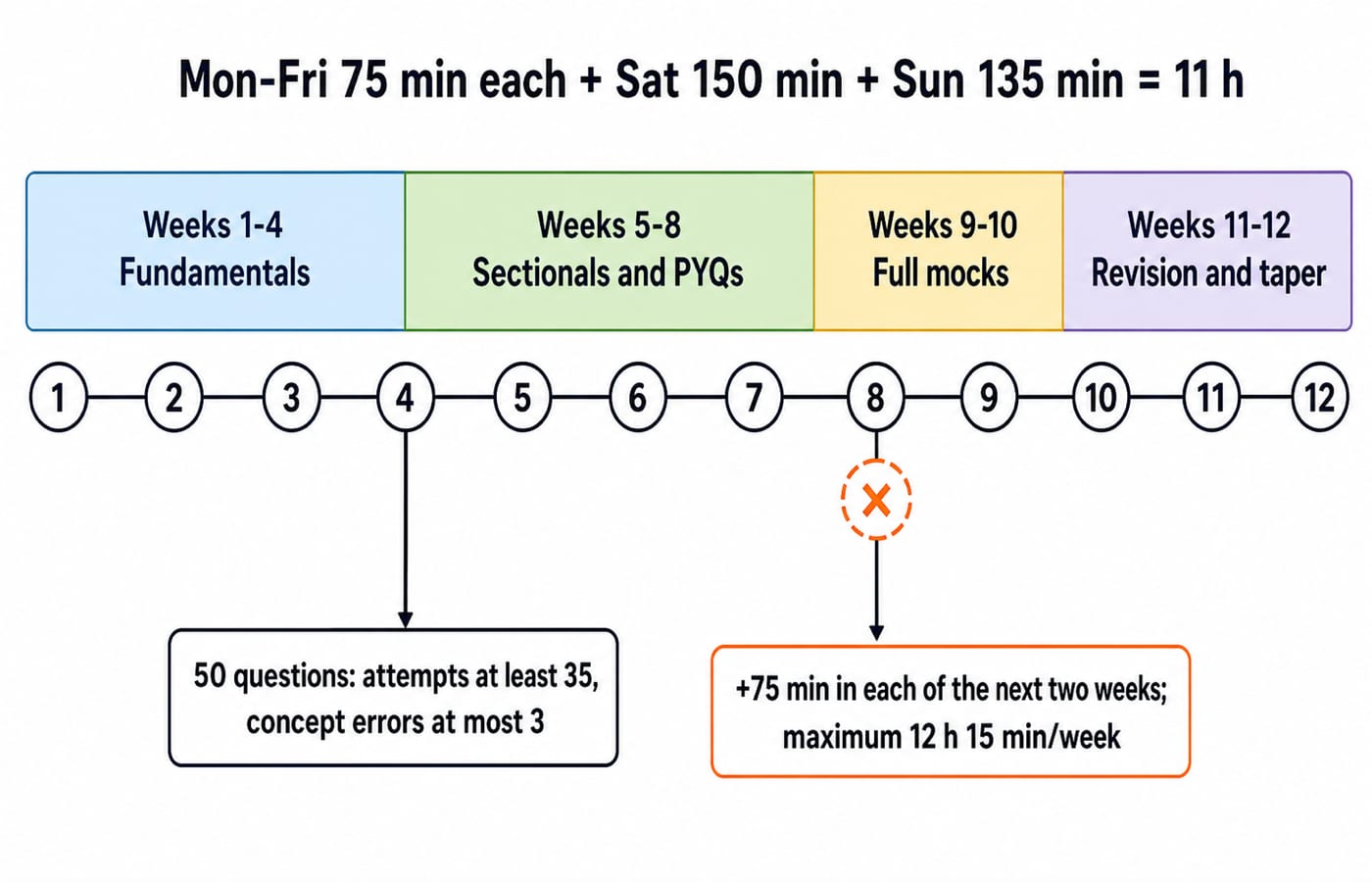
Set aside 75 minutes Monday to Friday, 150 on Saturday and 135 on Sunday: 11 hours in total.
Weekdays: 35 minutes learning, 30 solving and 10 updating the error log. Saturday: 60 timed practice, 60 review and 30 backlog repair. Sunday: a 75-minute mixed set, 45-minute review and 15-minute plan.
Protect them around work, perhaps 7:15 to 8:30 am weekdays plus a weekend slot. Then fit subjects. Repeatable 75-minute sessions beat all-day aspirations.
2. Use Week 0 to set priorities
Open the current notice on the official Apex Bank website. Copy its subjects, duration and marking rule into a one-page tracker.
Take a 50-question diagnostic and record the result.
Section | Correct | Wrong | Unattempted |
|---|---|---|---|
Quantitative Aptitude | 4 | 4 | 2 |
Reasoning Ability | 6 | 2 | 2 |
English Language | 3 | 2 | 5 |
Computer Knowledge | 2 | 3 | 5 |
General and Banking Awareness | 3 | 1 | 6 |
Total | 18 | 12 | 20 |
Attempts are 18 + 12 = 30, giving an accuracy of 18 / 30 x 100 = 60%. Rank Computer Knowledge first, Quantitative Aptitude second and English Language third, because low accuracy and high blank counts both cost you. Twenty blanks is the larger leak, and computer and awareness blanks are the cheapest to convert, since both reward recall rather than working speed. Turn any of this into a mark estimate only once the notice's marking rule is in your tracker.
3. Weeks 1-4: build and test fundamentals
Do not divide your time equally. Use this Week 1 allocation:
Week 1 block | Minutes |
|---|---|
Computer Knowledge | 180 |
Quantitative Aptitude | 120 |
English Language | 60 |
Reasoning Ability | 45 |
General and Banking Awareness | 45 |
Practice | 120 |
Review | 90 |
Total | 660 |
In Week 2, shift 180 minutes to Quantitative Aptitude and 120 to English Language. In Week 3, give 180 to English Language and 120 to Computer Knowledge.
Spend those blocks on named topics, not on chapters at large. Computer Knowledge here means MS Office applications, keyboard shortcuts and the terms-and-abbreviations list, a body of work short enough to finish once and then only revise. Quantitative Aptitude concentrates in percentage, ratio and proportion, averages, profit and loss, simple and compound interest, time and work, speed time and distance, mixture and alligation, and data interpretation. Awareness leans on the evolution of Indian banking as much as on polity, the economy and current affairs.
Use recorded lessons for concepts, then practise PYQs. End every 60-minute subject block with 10 questions or an equivalent set, instead of stopping at passive notes.
Week 4 consolidates the work: 60 minutes for each of the five sections, 210 minutes of mixed practice and 150 minutes of review. Finish with another 50-question diagnostic. Advance if attempts rise from 30 to at least 35 and concept errors fall to 3 or fewer. Otherwise, replace the first two Week 5 sessions with 150 minutes of foundation repair.
4. Weeks 5-8: turn concepts into sectional speed
A 25-question sectional yields 17 correct, 5 wrong and 3 unattempted. Accuracy is 17 / 22 x 100 = 77.3%. Classify the errors as 2 concept gaps, 2 rushed reads and 1 guess. After 48 hours, an equivalent set yields 22 correct, 2 wrong and 1 unattempted: 22 / 24 x 100 = 91.7%. Review changed the next attempt; score collection did not.
For the weekly schedule, use four 30-minute sectionals, four 45-minute reviews, two 75-minute repair blocks, 60 minutes of PYQ grouping, a 90-minute mixed set and a 60-minute weekly review. Twenty-five questions in 30 minutes is 72 seconds each, so set a two-minute abandon rule: a question still open at two minutes is costing you two others.
Use the grouping method in Why PYQs Beat Buying Another Question Bank. Run the same sectional cycle on English Language, where reading comprehension, cloze tests, sentence correction, active-passive voice and para jumbles repay timed drilling more than fresh vocabulary lists. For a section-by-section view of where these blocks sit, see MP Cooperative Bank Exam Pattern: Build a Section-by-Section Study Map.
5. Weeks 9-10: use full mocks as diagnosis
Take two full mocks a week, each set to the duration the notice states. Budget them at 120 minutes apiece until you have that figure, alongside two 90-minute reviews and 120 minutes of repair, with the remaining time on flash recall and error-log retests.
Mock A has 52 attempts, 34 correct and 18 wrong: 34 / 52 x 100 = 65.4%. Split its errors into 7 concept, 6 rushed and 5 guesses. Mock B has 54 attempts, 42 correct and 12 wrong: 42 / 54 x 100 = 77.8%.
Review concept errors first, followed by process errors, time sinks and blind guesses. Raise attempts only after achieving at least 75% accuracy across two consecutive timed sets. Borrow the review method from SSC CGL Mock Test Strategy: Turn Mocks Into Marks and run it on your own section list.
6. Weeks 11-12: revise and taper
In Week 11, complete three 60-minute error-log passes, two 60-minute mixed sets, one official-duration mock, a 90-minute review and 150 minutes of repair.
In Week 12, take one early official-duration mock, complete a 90-minute review, then use two 75-minute repairs, three 60-minute recall sessions and a 60-minute official-site and logistics check. Keep whatever time remains for rest or spillover. Add no new chapter after mid-Week 11 unless errors repeat.
Build revision cards from the concept errors in your error log, not from raw scores. If Mock B exposed a gap in percentage-to-fraction conversions, the front carries one such question in your own words and the back carries the one-line rule with the correct working. Pair each card with a fresh question to test recall.
7. Apply the missed-week rule
For one or two missed sessions, move at most one 75-minute block into each of the next two weeks. After a fully missed week, triage for 15 minutes and carry forward only 60 minutes essential concept repair + 60 minutes timed practice + 30 minutes error-log review = 150 minutes. Add 75 minutes to each next week, capped at 11 hours + 75 minutes = 12 hours 15 minutes. Drop duplicate lectures and decorative notes.
At a phase boundary, repeat a 25-question gate. More than 5 concept errors sends the next two 75-minute sessions to repair. Otherwise continue, using the 150-minute recovery rule.
The short version
Verify the notice, protect 11 hours, diagnose first, then work through fundamentals, sectionals, PYQs, mocks and revision, recovering only phase-critical work when a week goes. Keep the Apex Bank notice as your source for recruitment particulars and the MP Cooperative Bank course as your source for the five sections. If you are writing other banking papers this cycle too, the Banking & Insurance catalog lists them.
Keep learning
Knowledge of ICT Explained: Digital Divide, Email Fields and MS Word Macros
Connect access, communication and automation through three worked ICT concepts. Practise denominator choice, Bcc visibility and a beginner Word macro trace.
Updated 16 Aug 20266 min readMP Cooperative Bank
MP Cooperative Bank Roles Compared: Clerk, Manager and Technical Work
Compare three broad work families without treating them as a current vacancy list. Use task routing, a role-fit calculation and a notification card to choose a preparation focus.
Updated 14 Aug 20266 min readMP Cooperative Bank
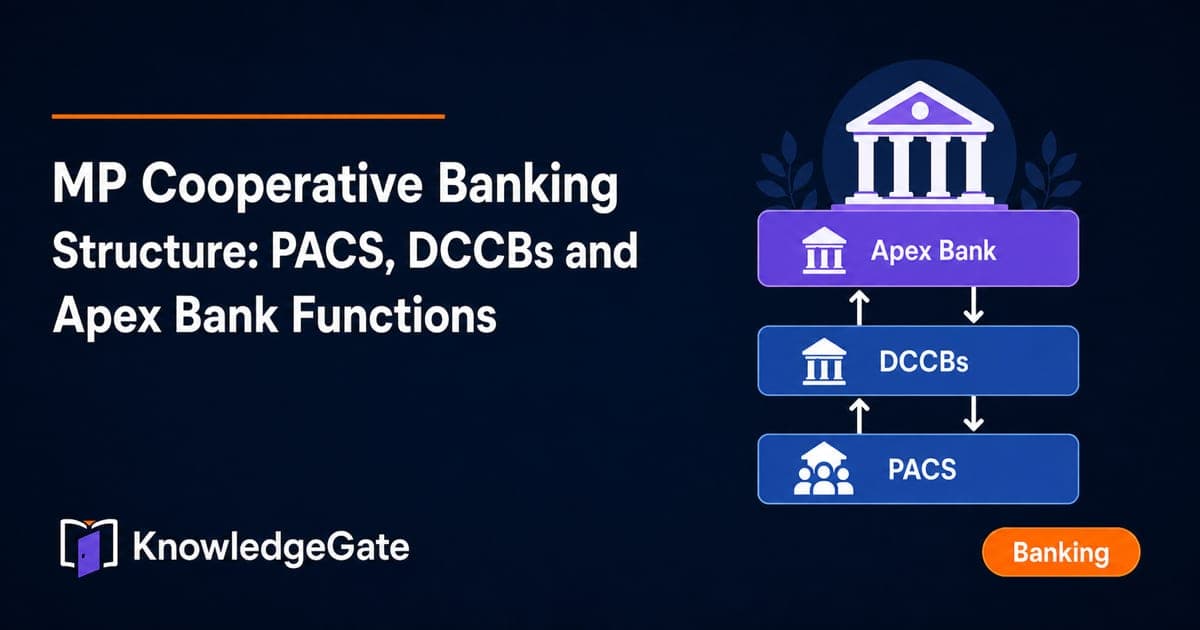
MP Cooperative Banking Structure: PACS, DCCBs and Apex Bank Functions
Learn how demand, finance and repayments move through PACS, DCCBs and MP Apex Bank. A principal-only example makes each tier's function easy to identify.
Updated 12 Aug 20266 min readMP Cooperative Bank
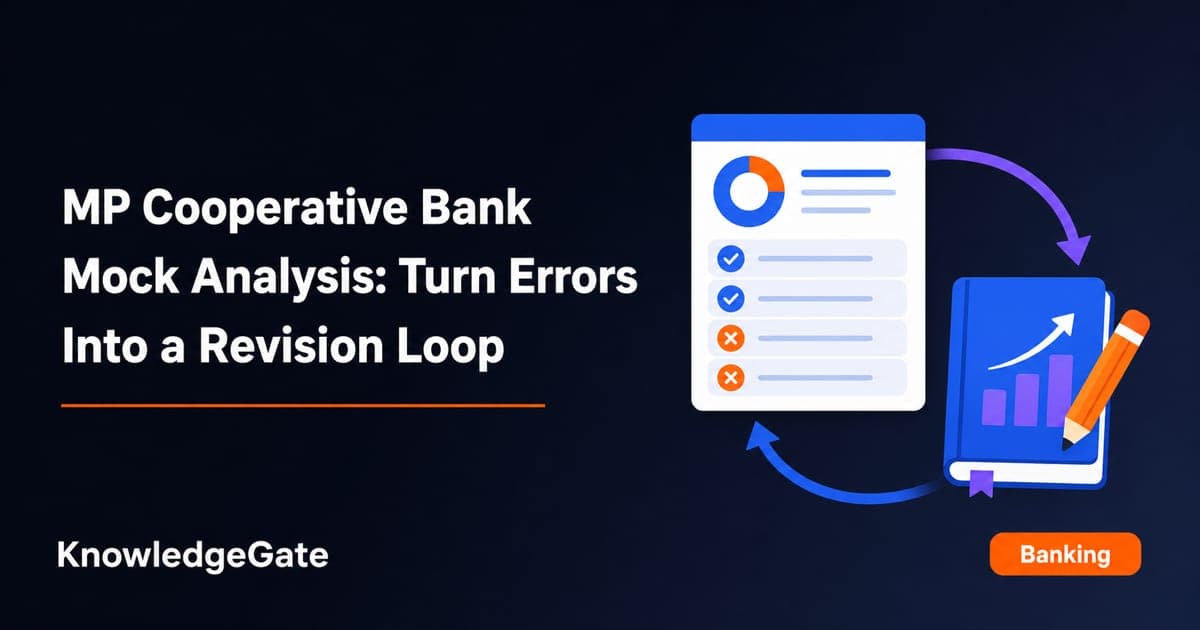
MP Cooperative Bank Mock Analysis: Turn Errors Into a Revision Loop
A mock score cannot show you what to fix next. Use this worked review system to reconcile your section data, identify root causes and retest each repair.
Updated 9 Aug 20268 min readMP Cooperative Bank