MP Cooperative Bank Roles Compared: Clerk, Manager and Technical Work
Compare three broad work families without treating them as a current vacancy list. Use task routing, a role-fit calculation and a notification card to choose a preparation focus.
KnowledgeGate Team
Exam prep & CS education
Updated 14 Aug 20266 min read
Computer Operator, Society Manager, clerk, assistant: those labels sit close enough together that MP cooperative banking candidates spend months preparing for the wrong working day. The families underneath are not close at all. Clerk and support work turns a request into an accurate record, manager and society-manager work decides what happens to the items that refuse to fit the routine, and technical and computer work keeps the processing reliable. Which family you aim at decides what you practise.
1. MP Cooperative Bank roles: three work families behind the labels
Cooperative credit in Madhya Pradesh runs on three levels: primary agricultural credit societies facing members at the village level, district central cooperative banks above them, and MP Rajya Sahakari Bank, the Apex Bank, at the state level. That is why Society Manager sits alongside ordinary branch labels. A society-facing job, a district branch counter and a state-level processing desk are different working days, even when one advertisement lists them together.
The three work families cut across all three levels. Clerk and support work covers front-line service and transaction records. Manager and supervisory work covers prioritisation and controlled decisions. Technical and computer work covers system-based processing, data quality and first-line support. One notified post often carries two families, because a small office cannot staff them separately.
KnowledgeGate's MP Co-operative Bank Exam Preparation category is built around Computer Operator and Society Manager preparation, mapping to the technical and the manager family.
2. Clerk or support work: service first, with accuracy underneath
The stable work shape is a sequence: receive a request, identify the account or record, check documents, enter or retrieve information, complete an allowed routine action, and escalate exceptions. The work objects are forms, transaction references, service requests, registers and customer acknowledgements.
Speed is visible, but one wrong name, account digit, date or reference creates more work than a slower correct entry. The strengths that pay are calm communication, arithmetic comfort, careful reading and knowing when not to improvise. Counter authority varies by designation: some hold cash, some handle records only. The habit that transfers everywhere is exception recognition, spotting the item you cannot close and passing it on with the reference attached.
3. Manager or society-manager work: decisions, exceptions and coordination
Manager-style work changes the level of attention. Rather than processing the next item, the role prioritises a queue, reviews exceptions, coordinates people, monitors records and looks for evidence before deciding. The artefacts are an exception note, an overdue-item list, a reconciliation summary, an approval trail and a daily status sheet.
Use the loop facts -> rule or delegated authority -> decision -> recorded reason -> follow-up. A fast approval without evidence is risky, while endless escalation blocks service. A society-level manager and a branch supervisor share that loop but not the counterparty: the society side works against member records, crop-loan documentation and recovery follow-up, the branch supervisor against branch registers and account-side exceptions.
4. Technical or computer work: reliable processing, not automatic software engineering
Computer-intensive operations are not automatically a specialist IT career. A Computer Operator-type role involves digital records, reports, office tools, authorised system use, data checks, peripheral faults and first-line troubleshooting. None of that on its own means writing code, administering servers or owning cyber security.
Spreadsheet fluency supports reports, computer fundamentals support diagnosis, keyboard accuracy supports clean records, and access-control awareness supports safe handling. The most useful habit is a reproducible incident note: what you did, what you expected, what appeared, and the exact time. If you want the boundary drawn sharply, IBPS SO IT Officer vs IBPS PO sets a specialist technical post against a generalist one.
5. Worked branch scenario: route 30 items without confusing authority
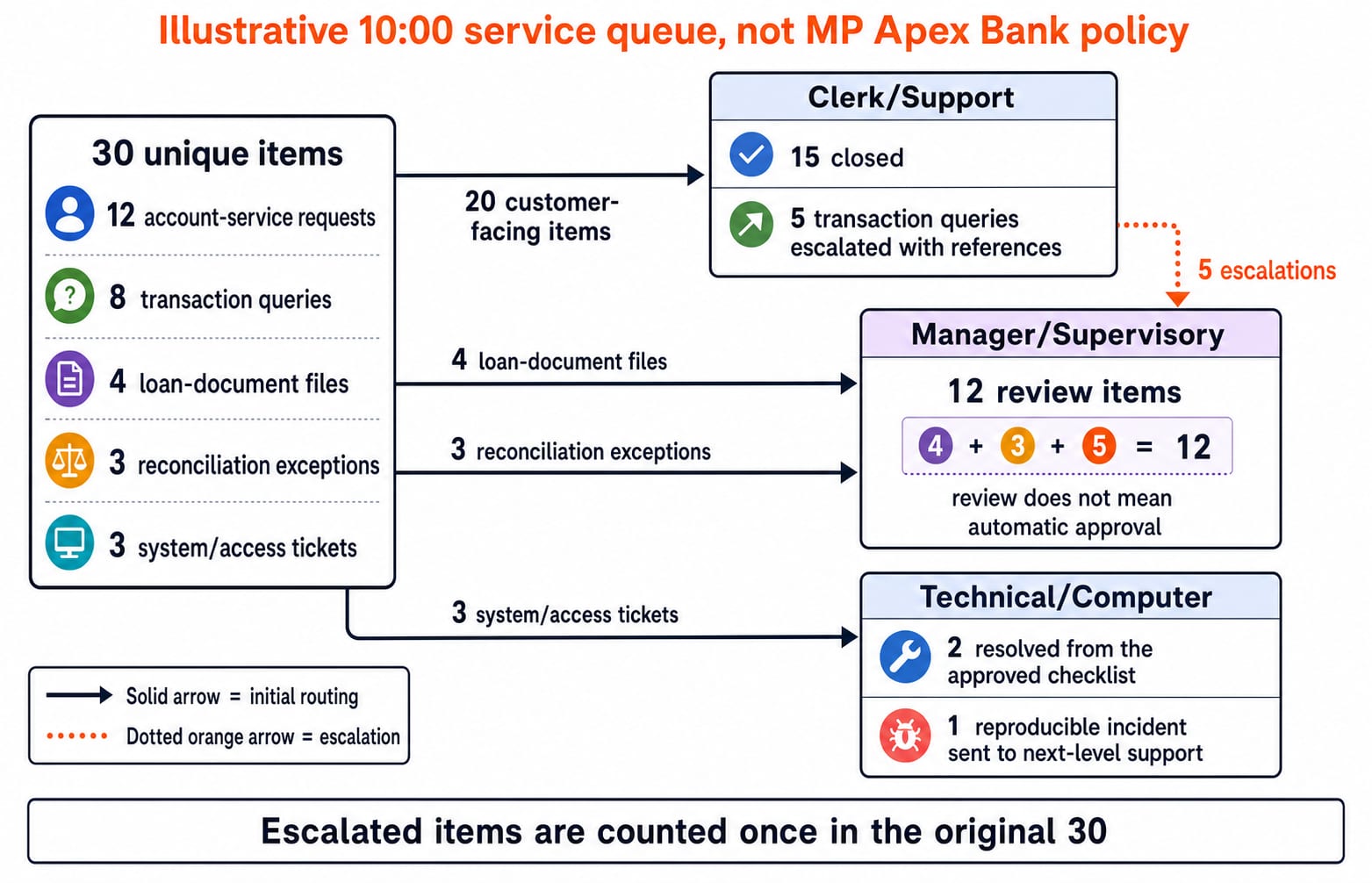
Take an invented branch morning. At 10:00 one queue holds 30 unique items: 12 account-service requests, 8 transaction queries, 4 loan-document files, 3 reconciliation exceptions and 3 system or access tickets.
The total is 12 + 8 + 4 + 3 + 3 = 30.
Clerk/support: initially handles the 20 customer-facing items because
12 + 8 = 20. It closes all 12 account-service requests and 3 routine transaction queries, so12 + 3 = 15close. It escalates the other 5 transaction queries with references attached.Manager/supervisory: reviews 4 loan-document files, 3 reconciliation exceptions and the 5 escalated queries. That gives
4 + 3 + 5 = 12review items. Review does not mean automatic approval.Technical/computer: handles 3 system or access tickets, resolves 2 through the approved checklist, and sends 1 reproducible incident to next-level support. Here,
2 + 1 = 3.
The 5 escalations are not new items, so the total stays 30. Notice what the technical desk does with the ticket it cannot close: it records a reproducible incident instead of working around the access control.
6. Worked role-fit score: compare preferences, not eligibility
Rate yourself out of 10 on four things, then weight them differently for each family. Candidate A scores customer interaction 8, record accuracy 7, people coordination 5 and technical troubleshooting 3. The weights below are a starting set; change them once a real notice gives you a duty list.
Clerk/support:
8 x 0.40 + 7 x 0.35 + 5 x 0.15 + 3 x 0.10 = 3.20 + 2.45 + 0.75 + 0.30 = 6.70.Manager/supervisory:
8 x 0.20 + 7 x 0.25 + 5 x 0.45 + 3 x 0.10 = 1.60 + 1.75 + 2.25 + 0.30 = 5.90.Technical/computer:
8 x 0.10 + 7 x 0.25 + 5 x 0.15 + 3 x 0.50 = 0.80 + 1.75 + 0.75 + 1.50 = 4.80.
Candidate A explores clerk and support work first, and tests manager-style work through coordination scenarios. The low technical score says build and sample that skill, not that the door is shut. A fit score is a preference tool, never an eligibility test: qualification, age and documents are a separate hard gate that the MP Cooperative Bank Eligibility Checklist works through post by post.
7. Verify the notification before choosing a preparation track
Build a seven-field verification card using only the applicable official notice:
Exact post title
Employer or participating bank
Essential qualification
Age and relaxation reference
Selection stages
Post-wise syllabus or skill requirement
Service or posting conditions
If a field is absent, write not stated in the notice rather than filling it from memory. Customer-service duties then point your preparation at aptitude, accuracy and communication. Manager-style duties add decision and exception scenarios. Computer-intensive duties add office tools, fundamentals, data accuracy and fault documentation.
One notice, one card. Lifting a pattern from another bank's advertisement is the most common way candidates end up practising for a paper they are not sitting.
8. MP Cooperative Bank roles: the short version and next step
Clerk and support work keeps routine service accurate. Manager and supervisory work handles priorities and exceptions. Technical and computer work keeps digital processing reliable. Real posts often combine two of them, and the notice you are applying against decides the actual title and scope.
Fill the card first, then run the routing exercise again on duties from your own target notice. The MP Cooperative Bank Prep: 12-Week Plan for Working Aspirants turns the family you pick into a weekly schedule. If your verified target matches its Computer Operator and Society Manager focus, the MP Cooperative Bank 2026 Course carries that plan already built.
Keep learning
Knowledge of ICT Explained: Digital Divide, Email Fields and MS Word Macros
Connect access, communication and automation through three worked ICT concepts. Practise denominator choice, Bcc visibility and a beginner Word macro trace.
Updated 16 Aug 20266 min readMP Cooperative Bank
MP Cooperative Banking Structure: PACS, DCCBs and Apex Bank Functions
Learn how demand, finance and repayments move through PACS, DCCBs and MP Apex Bank. A principal-only example makes each tier's function easy to identify.
Updated 12 Aug 20266 min readMP Cooperative Bank
MP Cooperative Bank Mock Analysis: Turn Errors Into a Revision Loop
A mock score cannot show you what to fix next. Use this worked review system to reconcile your section data, identify root causes and retest each repair.
Updated 9 Aug 20268 min readMP Cooperative Bank
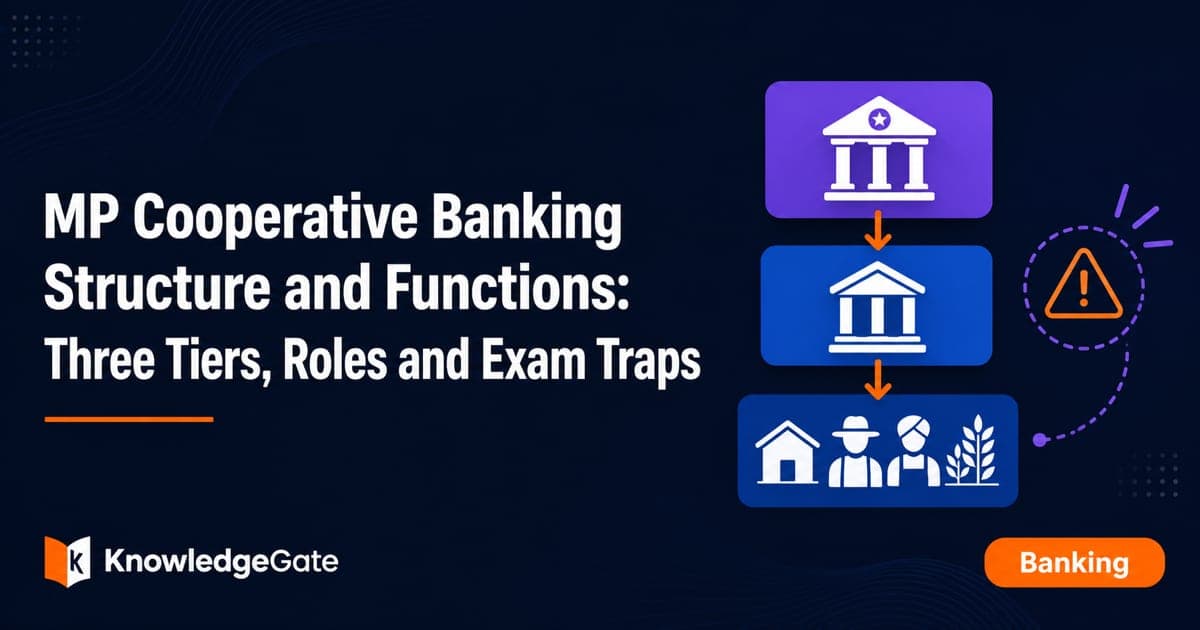
MP Cooperative Banking Structure and Functions: Three Tiers, Roles and Exam Traps
Build a clear village-to-state model of MP cooperative banking, then test it with tier, fund-flow, repayment and authority questions.
Updated 7 Aug 20266 min readMP Cooperative Bank