MP Cooperative Bank Mock Analysis: Turn Errors Into a Revision Loop
A mock score cannot show you what to fix next. Use this worked review system to reconcile your section data, identify root causes and retest each repair.
KnowledgeGate Team
Exam prep & CS education
Updated 9 Aug 20268 min read
A mock score alone cannot tell you whether a Computer Operator, a Society Manager or another Apex Bank post needs a different repair this week. The work is mechanical: copy the applicable post's section map from its official notice, tag every wrong answer and every solvable skip by section and cause, rank the repairs, then book the retest that proves each one held. Asha's 50-question practice paper runs the whole method through, and her counts and timings are hers rather than an exam pattern. The Banking & Insurance Exam Preparation category collects the courses behind this kind of preparation.
1. Build the post card before analysing the mock
Start with a six-field card:
post applied for | official notice URL and issue date | exact section names | notified language or medium | notified timing/navigation rules | notified marking rule
Fill every field from the applicable already-issued notice on MP Rajya Sahakari Bank's official site, the state's apex cooperative bank. Where the notice is silent, write check official notice rather than guessing. Because the posts differ, every dashboard row has to map back to this card.
The MP Cooperative Bank 2026 Course is built around the Computer Operator and Society Manager syllabus, so it is a reasonable place to draw practice sets from once the card is filled.
Asha's five diagnostic buckets are Reasoning, Numerical Ability, Computer Knowledge, Language, and MP/cooperative awareness, the awareness slice these posts lean on rather than general current affairs. If your notice names the sections differently, Quantitative Aptitude for Numerical Ability or English Language for Language, rename the rows before tagging anything. The labels are what make the analysis post-specific.
2. Reconcile the section dashboard before interpreting it
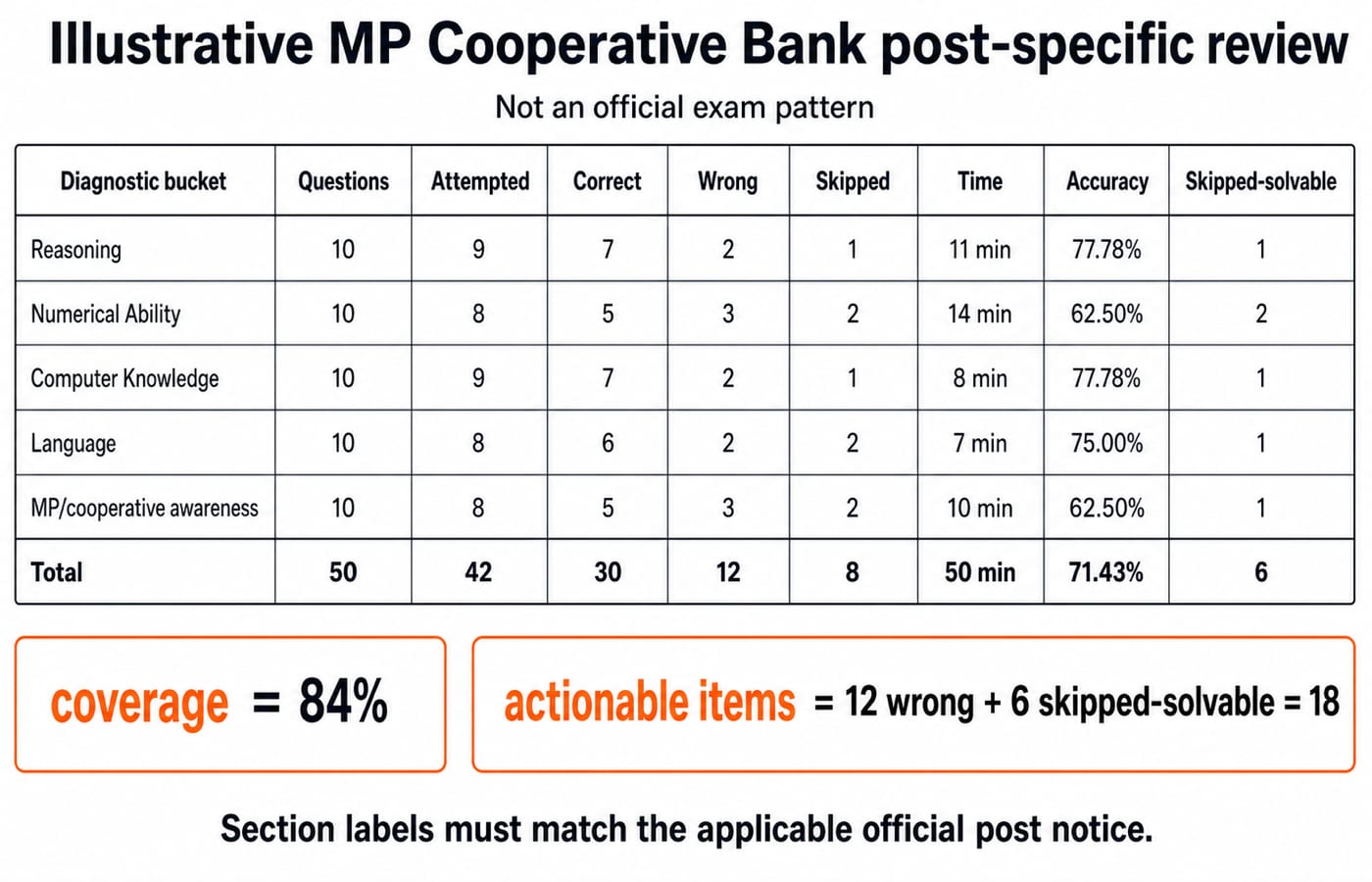
Asha's dashboard after a 50-question, 50-minute practice paper:
Diagnostic bucket | Questions | Attempted | Correct | Wrong | Skipped | Time | Accuracy | Skipped-solvable |
|---|---|---|---|---|---|---|---|---|
Reasoning | 10 | 9 | 7 | 2 | 1 | 11 min | 77.78% | 1 |
Numerical Ability | 10 | 8 | 5 | 3 | 2 | 14 min | 62.50% | 2 |
Computer Knowledge | 10 | 9 | 7 | 2 | 1 | 8 min | 77.78% | 1 |
Language | 10 | 8 | 6 | 2 | 2 | 7 min | 75.00% | 1 |
MP/cooperative awareness | 10 | 8 | 5 | 3 | 2 | 10 min | 62.50% | 1 |
Total | 50 | 42 | 30 | 12 | 8 | 50 min | 71.43% | 6 |
Reconcile before you interpret. In each row, correct plus wrong must equal attempted and attempted plus skipped must equal the question count: Reasoning gives 7 + 2 = 9 and 9 + 1 = 10, and the other four close the same way. The columns close too, at 42 attempted, 30 correct, 12 wrong, 8 skipped and 11 + 14 + 8 + 7 + 10 = 50 minutes. Only then read the derived figures: attempted accuracy 7/9 = 77.78%, 5/8 = 62.50%, 7/9 = 77.78%, 6/8 = 75.00% and 5/8 = 62.50%, overall 30/42 = 71.43%, coverage 42/50 = 84%. Convert none of it into marks until you have copied the marking rule, negative marking included, from the applicable notice.
Numerical Ability and MP/cooperative awareness tie at 62.50%, and the tie is the trap: one is a method fault you fix by re-deriving a rule, the other a recall fault only spaced retrieval from a named source will move. Reasoning looks healthy at 77.78% but ate 11 minutes, so a time sink hides there. Language ran quicker at 7 minutes yet lost 2 of 8 attempts, which points at reading. To weight the same five buckets by the post you applied for, MP Cooperative Bank Mock Analysis: Build a Post-Specific Weekly Preparation Loop works that split for Computer Operator and Society Manager.
3. Give every actionable item a section tag and one root cause
The repair queue is 12 wrong + 6 skipped-solvable = 18 items. All eight skips stay visible, but the two you can honestly defend are excluded from repair work, which is why the queue counts 6 and not 8. Give each item exactly one primary cause. Asha's split is concept gap 5, method error 3, speed and selection error 4, reading error 3 and MP/cooperative recall gap 3, checked by 5 + 3 + 4 + 3 + 3 = 18.
Item | Evidence | Primary cause | Repair note |
|---|---|---|---|
Numerical Q14 | 84 sec; 480 to 600; used | concept/base error |
|
Reasoning Q8 | 185 sec; no stable arrangement | speed/selection | A 90-second exit releases 95 seconds |
Computer Q27 | 46 sec; chose | concept | Locking row and column needs |
Language Q34 | 31 sec; missed incorrect | reading error | Circle the qualifier before checking options |
Awareness Q46 | 28 sec; low-confidence choice without a named source | MP/cooperative recall | Make an official-source card |
Name the first thing that went wrong, never silly mistake, a label that carries no repair. Where two causes fit, record the earlier one: a misread qualifier that then cost 40 seconds is a reading error, not a speed error.
4. Rank the next repairs by frequency, recurrence and time lost
Asha ranks families by how often each appeared in this mock and in how many of her last three mocks: priority = actionable items in this mock x mocks affected among the last three.
Error family | Priority | Time lost |
|---|---|---|
Percentage/ratio bases |
| 260 sec |
MP/cooperative source facts |
| 105 sec |
Long reasoning sets |
| 275 sec |
Language qualifiers |
| 60 sec |
Spreadsheet absolute references |
| 80 sec |
Those five families cover 3 + 3 + 2 + 3 + 2 = 13 of the 18; the other five are one-offs that go in the log without a card. Two pairs tie, so break ties by time lost: percentage/ratio (260 seconds) before MP/cooperative facts (105 seconds), long reasoning sets (275 seconds) before language qualifiers (60 seconds). The working order is percentage/ratio, MP/cooperative facts, long reasoning sets, language qualifiers, spreadsheet references. Rank families, not sections, because one section can hold two unrelated faults. For the same habit on a different paper, see SSC CGL Mock Test Strategy.
5. Turn each priority family into a measurable repair card
Every card carries five fields: faulty rule | corrected rule/source | three worked or retrieved examples | fresh set | delayed exit gate.
Percentage/ratio bases go first. The faulty rule divided the change by the new value; the corrected rule divides by the original. Three worked examples:
240 to 300:
(300 - 240)/240 x 100 = 60/240 x 100 = 25%increase.500 to 425:
(500 - 425)/500 x 100 = 75/500 x 100 = 15%decrease.360 to 450:
(450 - 360)/360 x 100 = 90/360 x 100 = 25%increase.
The fresh set is six items and the exit gate is 5/6, once immediately and again after 48 hours. The other four cards:
MP/cooperative facts: 12 retrieval prompts, each stored with its source URL and date. Aim them at the structure Asha kept guessing at: where the Apex Bank sits in the state's three-tier short-term cooperative credit system, how many district central cooperative banks Madhya Pradesh has, and what a primary agricultural credit society does at village level. Gate:
10/12now and after 72 hours.Long reasoning sets: four fresh sets under Asha's rule of leaving any set without a stable diagram at 90 seconds. Gate:
3/4correct with at most one set past 150 seconds.Language qualifiers: mark the qualifier,
not,except,incorrector its equivalent, before reading a single option, across 10 items. Gate:9/10now and after 48 hours. Bank PO English: RC-First Strategy for IBPS and SBI supplies fresh reading sets for this card.Spreadsheet references: six items including
=B2*$F$1copied down a column, where$F$1stays put whileB2moves. Gate:5/6now and after 48 hours.
Only the delayed result closes a card. The immediate re-attempt shows recognition; the one 48 or 72 hours later shows retention.
6. Schedule a seven-day error-to-revision loop
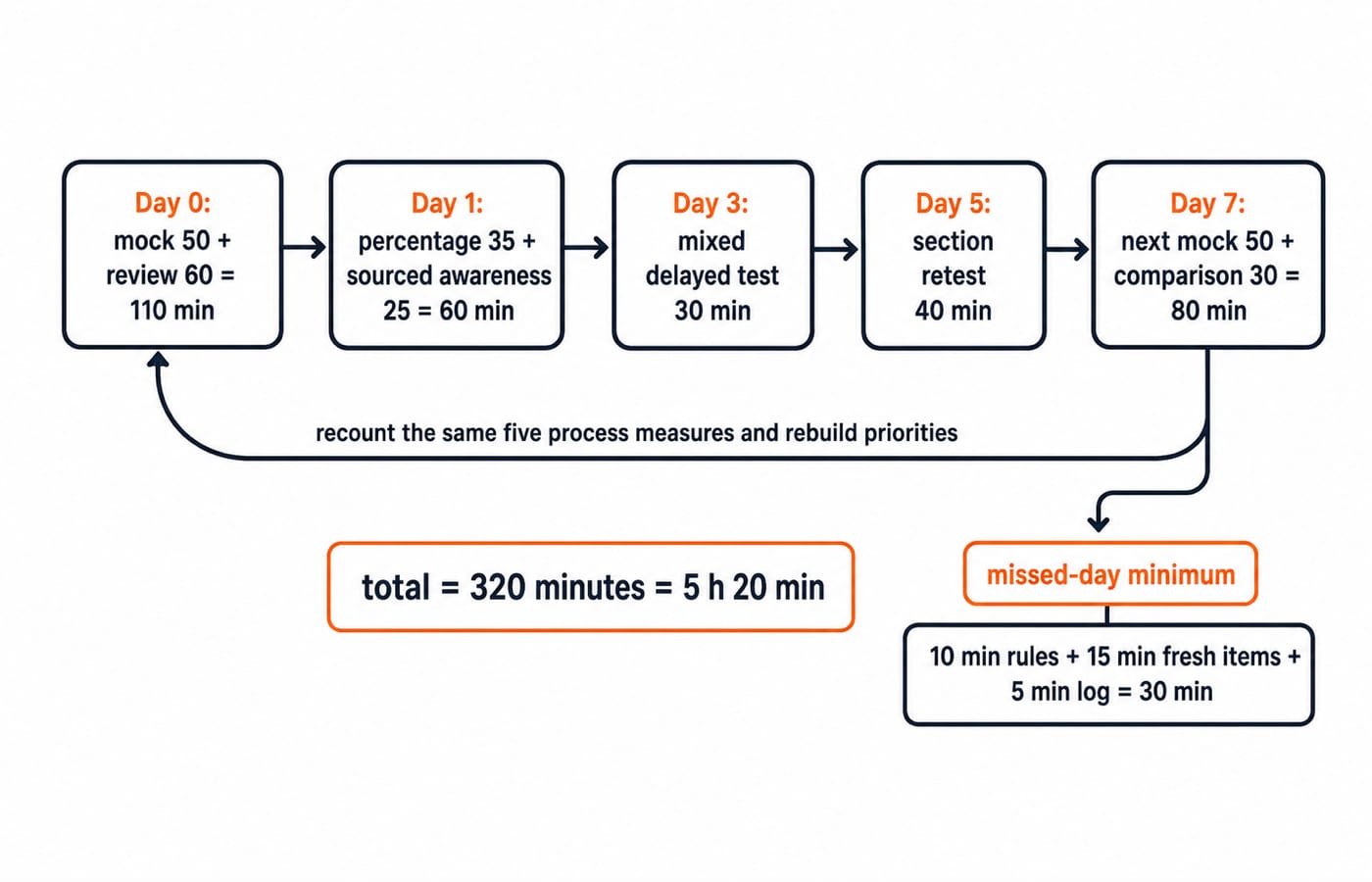
Asha's cycle, on her own timings:
Day | Work | Time |
|---|---|---|
0 | 50-minute mock + 60-minute review | 110 min |
1 | Percentage/ratio repair 35 + sourced awareness retrieval 25 | 60 min |
3 | Mixed delayed test | 30 min |
5 | Section retest | 40 min |
7 | Next mock 50 + comparison 30 | 80 min |
The week totals 110 + 60 + 30 + 40 + 80 = 320 minutes, or 5 hours 20 minutes. Every card takes its immediate attempt inside the Day 0 review, so Day 3 clears the 48-hour and 72-hour gates together: six percentage/ratio items, 12 awareness prompts, six spreadsheet items. Day 5 takes the rest, two reasoning sets and 10 qualifier items.
On Day 7, read five process measures before the score: attempted accuracy, skipped-solvable count, items past 150 seconds, source-free awareness attempts, and qualifier errors. The score moves last and slowest, so in week one it tells you least.
Days 0 and 7 are the ones to protect, because they are the measurement points. If Day 1 goes, fold a 30-minute minimum into Day 3: 10 minutes corrected rules + 15 minutes fresh items + 5 minutes log update = 30 minutes. Carry at most two priorities into a shortened week, and never start a new mock while the last one still has untagged items.
7. Close with five rules for the next post-specific mock
Asha's five rules, one per family:
Percentage: original base before division.
Reasoning: exit at 90 seconds without a stable diagram.
Language: mark the qualifier before options.
Awareness: no low-confidence attempt without a source or elimination basis.
Spreadsheet: decide which of the row and the column must stay fixed before writing a single
$.
Her targets for the next mock are all process measures she controls: skipped-solvable down from 6 to at most 3, items above 150 seconds down to at most 1, source-free awareness attempts at 0, and qualifier errors down from 3 to at most 1.
Match the post, reconcile the dashboard, tag each item once, rank the families, build the cards and retest on a delay. The loop survives a change of paper. For practice sets already built to the Computer Operator and Society Manager syllabus, start with the MP Cooperative Bank 2026 Course. For the marking rule, sectional timing and exact section names, the applicable notice on the Apex Bank site is the only authority.
Keep learning

Knowledge of ICT Explained: Digital Divide, Email Fields and MS Word Macros
Connect access, communication and automation through three worked ICT concepts. Practise denominator choice, Bcc visibility and a beginner Word macro trace.
Updated 16 Aug 20266 min readMP Cooperative Bank
MP Cooperative Bank Roles Compared: Clerk, Manager and Technical Work
Compare three broad work families without treating them as a current vacancy list. Use task routing, a role-fit calculation and a notification card to choose a preparation focus.
Updated 14 Aug 20266 min readMP Cooperative Bank
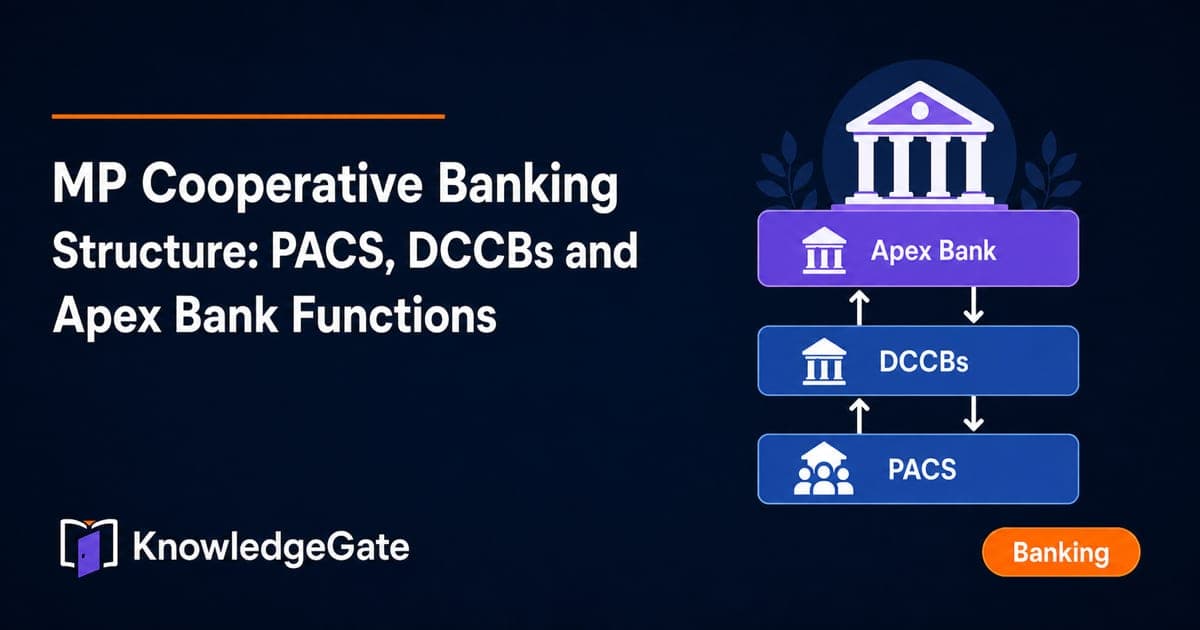
MP Cooperative Banking Structure: PACS, DCCBs and Apex Bank Functions
Learn how demand, finance and repayments move through PACS, DCCBs and MP Apex Bank. A principal-only example makes each tier's function easy to identify.
Updated 12 Aug 20266 min readMP Cooperative Bank
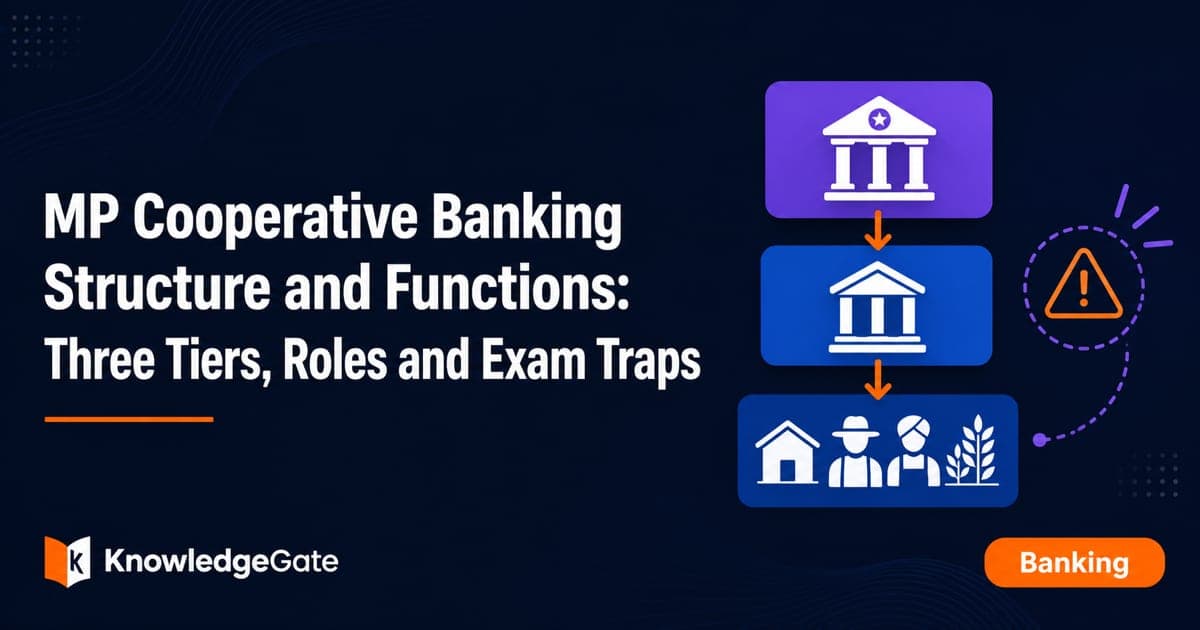
MP Cooperative Banking Structure and Functions: Three Tiers, Roles and Exam Traps
Build a clear village-to-state model of MP cooperative banking, then test it with tier, fund-flow, repayment and authority questions.
Updated 7 Aug 20266 min readMP Cooperative Bank