Channel Capacity Limits MCQs: 12 Solved PYQs on Nyquist, Shannon and Throughput
Solve 12 published-bank channel capacity PYQs covering formula selection, substitutions and unit traps. Each answer includes a concise worked explanation.
KnowledgeGate Team
Exam prep & CS education
25 Aug 20267 min read66 views
Nyquist and Shannon look familiar until a question changes the channel assumption or hides a unit conversion. Nyquist sets the noiseless signalling limit, while Shannon sets noisy-channel capacity. Applied-rate problems add sampling, throughput, overhead and mutual-information traps. Identify the condition first, then write the unit beside every substitution.
Channel capacity limits: the four formulas to keep beside you
Situation | Formula | Units | Typical trap |
|---|---|---|---|
Noiseless channel with |
| bps | Treating |
Noisy channel |
| bps | Using dB when |
Sampling and encoding |
| bps | Forgetting the factor of 2 |
Aggregate web throughput |
| bps | Forgetting that one byte is 8 bits |
Using the four rows above: 2 x 5000 x log2(2) = 10,000 bps, 6000 log2(17) = 24,524.78 bps, 2 x 8 kHz x 8 = 128 kbps, and 20,000/120 x 3 kB x 8 = 4 Mb/s under the decimal kB convention. For the larger subject pathway, use GATE CS Exam Preparation.
Channel capacity fundamentals and aggregate bandwidth, Questions 1-3
Questions 1 and 2 separate channel vocabulary from rate limits: bandwidth names the channel resource, while baud counts signal elements transmitted per second.
Question 1: UP Police 2017
What is used to measure the capacity of a communication channel?
A. Server Speed
B. Density
C. Bandwidth
D. Bus width
Answer: C. Bandwidth. Among these choices, bandwidth is the relevant channel resource. Data rate is expressed in bps, but Shannon's noisy-channel calculation also uses signal-to-noise ratio.
Question 2: UGC NET 2010
The baud rate is
A. always equal to the bit transfer rate
B. equal to twice the bandwidth of an ideal channel
C. not equal to the signalling rate
D. equal to half of the bandwidth of an ideal channel
Answer: B. equal to twice the bandwidth of an ideal channel. In the standard Nyquist ideal-channel model, the maximum signalling rate is 2B baud for bandwidth B Hz. Baud counts signal elements per second; bit rate equals baud x log2(M), so the two rates are equal only for two-level signalling.
Question 3: ISRO 2011
One SAN switch has 24 ports. All 24 supports 8 Gbps Fiber Channel technology. What is the aggregate bandwidth of that SAN switch?
A. 96 Gbps
B. 192 Mbps
C. 512 Gbps
D. 192 Gbps
Answer: D. 192 Gbps. Compute 24 ports x 8 Gbps per port = 192 Gbps. The unit stays Gbps, making 192 Mbps three orders of magnitude smaller.
Nyquist limit for a noiseless channel, Questions 4-7
When the channel is noiseless and has M discrete levels, use Nyquist: R_max = 2B log2(M). Here 2B is the maximum symbol rate, while log2(M) is the number of bits carried by each symbol.
Question 4: UGC NET June 2020
Given below are two statements: Statement 𝐼: The laws of nature put two fundamental limits on data rate of a channel. The H.Nyquist limit restricts the number of independent samples per second to twice the band-width in a Noiseless channel Statement 𝐼𝐼: Shannon’s major result about noised channel is that maximum data rate of a channel whose band width is Hz, and whose signal-to-noise ratio is is given by: Maximum number of bits/sec = In the light of the above statements, choose the correct answer from the options given below
A. Both Statement 𝐼 and Statement 𝐼𝐼 are true
B. Both Statement 𝐼 and Statement 𝐼𝐼 are false
C. Statement 𝐼 is correct but Statement 𝐼𝐼 is false
D. Statement 𝐼 is incorrect but Statement 𝐼𝐼 is true
Answer: A. Both Statement 𝐼 and Statement 𝐼𝐼 are true. Nyquist gives the noiseless symbol-rate limit 2H. Shannon gives noisy capacity as H log2(1 + S/N); the formulas address different assumptions.
Question 5: UPLT 2026
Nyquist theorem to calculate the data rate is:
A. H log 2 (1 + S/N) bits/sec
B. 2H log 2 (1 + S/N) bits/sec
C. H log 2 V bits/sec
D. 2 H log 2 V bits/sec
Answer: D. 2 H log 2 V bits/sec. This matches 2B log2(M), with H as bandwidth and V as signal levels. The 1 + S/N options belong to Shannon.
Question 6: UGC NET January 2025
Consider a noiseless channel with a bandwidth of 5000 Hz transmitting a signal with two signal levels. The maximum bit rate is
A. 2500 bps
B. 10000 bps
C. 5000 bps
D. 20000 bps
Answer: B. 10000 bps. Since log2(2) = 1, calculate 2 x 5000 x 1 = 10,000 bps. Reaching 20,000 bps would require log2(M) = 2, or four levels.
Question 7: UPPSC Polytechnic Lecturer 2022
Consider a noiseless channel with a bandwidth of 1000 Hz transmitting a signal with two signal levels. The maximum bit rate will be?
A. 2000 bps
B. 2000 kbps
C. 1000 bps
D. 1000 kbps
Answer: A. 2000 bps. Calculate 2 x 1000 x log2(2) = 2000 bps. No step converts bps to kbps, the trap in options B and D.
Next, try Subnetting MCQs: 12 Solved IP Addressing Questions as a separate numerical set.
Shannon capacity for a noisy channel, Question 8
The signal-to-noise ratio here is the linear value 16, not 16 dB. No dB conversion is needed.
Question 8: RSSB 2022, SCI - Paper 2
If the channel band is limited to 6 kHz and signal to noise ratio is 16, what would be the capacity of channel?
A. 15.15 kbps
B. 24.74 kbps
C. 30.12 kbps
D. 52.18 kbps
Answer: B. 24.74 kbps, the closest listed option. Use B = 6000 Hz, 1 + S/N = 17, and log2(17) = 4.087462841. Thus C = 6000 x 4.087462841 = 24,524.78 bps = 24.52 kbps; it is not exactly 24.74 kbps, but B is nearest.
Sampling rate, web throughput and overhead, Questions 9-11
Write the unit after every intermediate line. These three questions are arithmetic tests disguised as networking prose.
Question 9: UGC NET June 2015
Suppose a digitazed voice channel is made by digitizing 8 kHz bandwidth analog voice signal. It is required to sample the signal at twice the highest frequency (two samples per hertz). What is the bit rate required, if it is assumed that each sample required 8 bits ?
A. 32 kbps
B. 64 kbps
C. 128 kbps
D. 256 kbps
Answer: C. 128 kbps. The sampling rate is 2 x 8 kHz = 16,000 samples/s. Encoding each sample with 8 bits gives 16,000 x 8 = 128,000 bps = 128 kbps.
Question 10: UGC NET June 2023, Paper I
Consider a popular sports news site. At a given moment, 20,000 concurrent users submit a request (a transaction, T) once every 2 minutes on average. Each transaction requires the web app to download a new article that on average has 3 k bytes in length. What is the throughput?
A. 8 megabits per second
B. 4 megabits per second
C. 6 megabits per second
D. 2 megabits per second
Answer: B. 4 megabits per second. Under the options' decimal convention, 20,000/120 = 166.67 requests/s, then 166.67 x 3 kB = 500 kB/s. Since one byte is 8 bits, 500 x 8 = 4000 kb/s = 4 Mb/s.
For separate transport-layer practice, use TCP and UDP MCQs: 12 Solved Transport Layer Questions.
Question 11: ISRO 2018
Assuming that for a given network layer implementation, connection establishment overhead is 100 bytes and disconnection overhead is 28 bytes. What would be the minimum size of the packet the transport layer needs to keep up, if it wishes to implement a datagram service above the network needs to keep its overhead to a minimum of 12.5%. (Ignore transport layer overhead)
A. 512 bytes
B. 768 bytes
C. 1152 bytes
D. 1024 bytes
Answer: D. 1024 bytes. Total overhead is 100 + 28 = 128 bytes. Enforcing 128 / packet size = 0.125 gives packet size = 128 / 0.125 = 1024 bytes.
Discrete memoryless channel capacity, Question 12
Use I(X;Y) = H(Y) - H(Y|X) = H(X) - H(X|Y). Capacity maximises this mutual information over the input distribution.
Question 12: UGC NET June 2016
Consider a discrete memoryless channel and assume that H(x) is the amount of information per symbol at the input of the channel; H(y) is the amount of information per symbol at the output of the channel; H(x|y) is the amount of uncertainty remaining on x knowing y; and I (x; y) is the information transmission. Which of the following does not define the channel capacity of a discrete memoryless channel ?
A. max I(x;y); p(x)
B. max [H(y)-H(y ∣ x)]; p(x)
C. max [H(x)-H(x ∣ y)]; p(x)
D. max H(x ∣y); p(x)
Answer: D. max H(x ∣y); p(x). A, B and C are equivalent mutual-information forms when maximised over p(x). H(X|Y) is residual uncertainty, so maximising it does not maximise reliably transmitted information.
Channel capacity limits: what these PYQs are really checking
Apply the following decision rules:
Noiseless channel plus signal levels: use Nyquist.
Noise plus
S/N: use Shannon.Analogue frequency plus bits per sample: calculate the sampling bit rate.
Users plus payload: calculate throughput.
Entropy expressions: maximise mutual information.
The recurring traps are confusing symbol rate with bit rate, treating a linear S/N as dB, missing 1 + S/N, mixing bytes and bits, and choosing a kbps distractor when the calculation stays in bps.
For a wider subject plan, continue with GATE Guidance by Sanchit Sir. For focused practice, solve more Channel Capacity Limits PYQs.
Keep learning
Repeater, Hub, Bridge & Switch MCQs: 12 Solved Questions with Explanations
Solve 12 exam questions on device layers, MAC forwarding, VLANs, collision and broadcast domains, port mirroring, bridges and crosspoint counting.
Updated 20 Oct 20267 min readComputer Networks MCQs
Ethernet IEEE 802.3 MCQs: 12 Solved Questions with Explanations
Solve 12 Ethernet questions on IEEE 802.3, speed generations, hubs, MAC addresses, multicast, CSMA/CD and the first binary backoff race.
Updated 16 Oct 20267 min readComputer Networks MCQs
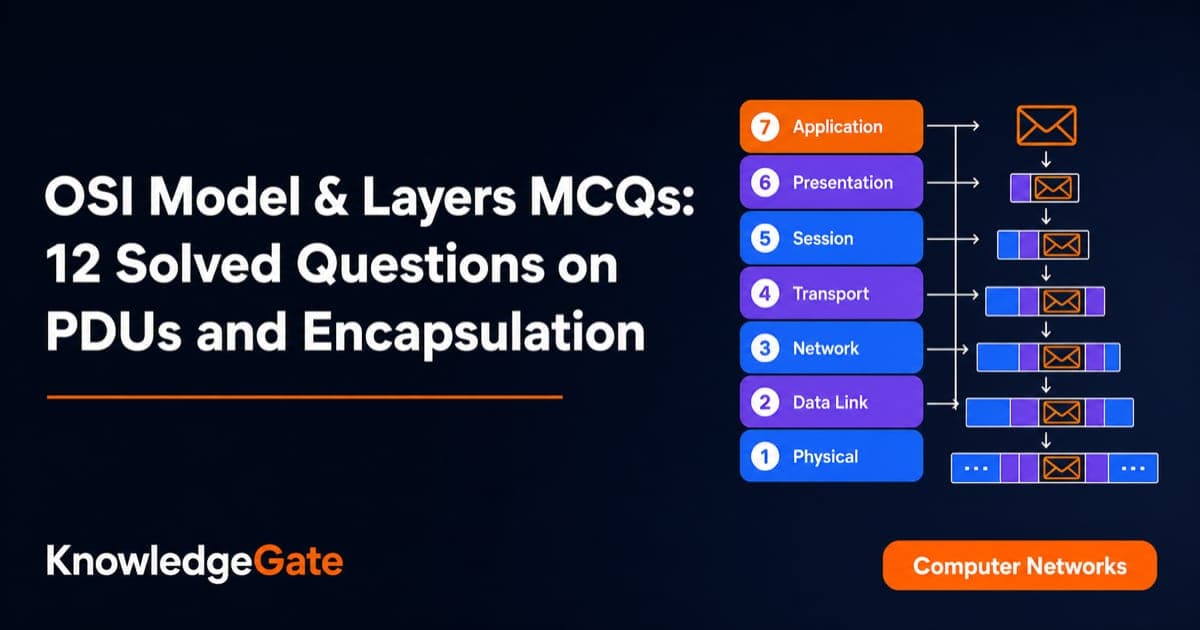
OSI Model & Layers MCQs: 12 Solved Questions on PDUs and Encapsulation
Test OSI layers, PDUs, encapsulation and router traversal through solved MCQs, with explanations, a byte-by-byte frame trace and a layer-visit method.
12 Oct 20267 min readComputer Networks MCQs

Mobile Computing MCQs: Solved Questions on Concepts, Features and Applications
Work through 10 solved questions covering portability, cellular standards, Bluetooth, CDMA, Android, mobile cloud, and device constraints. Each answer has a concise explanation.
7 Oct 20267 min readComputer Networks MCQs