Assessment and Evaluation for Teaching Exams: Complete Notes with Worked Examples
Build one connected framework from learning outcome to evidence, feedback and judgment, then apply it to classroom cases and original practice items.
KnowledgeGate Team
Exam prep & CS education
Updated 17 Sep 20265 min read
Aspirants memorise formative versus summative and assessment versus evaluation, yet miss scenarios by overlooking the evidence, purpose and decision. Start with the learning outcome, collect evidence that matches it, give feedback, and then judge performance against a criterion. Confirm exam-specific marks, question counts and topic weightage in the current notification.
1. Measurement, assessment and evaluation are not synonyms
Term | Meaning | Example |
|---|---|---|
Measurement | Assigns a quantity by rule |
|
Assessment | Interprets evidence | Quiz, explanation, observation |
Evaluation | Judges by criterion | Is |
Measurement quantifies evidence, assessment interprets it, and evaluation judges it. A test samples performance; an examination is formal. Neither is the whole process. Observations, questions, projects, portfolios, checklists and rubrics also provide evidence.
Two learners score 6/10. One reverses numerator and denominator four times; the other leaves four blanks after time expires. Equal measurement, but different support.
2. Classify assessment by purpose, timing and learner role
Diagnostic assessment finds gaps before or during teaching. Formative evidence changes the next move. Summative evidence records later attainment. One five-item quiz can diagnose, guide reteaching, or report.
Relationship | Main use | Exact cue |
|---|---|---|
Assessment for learning | Improve next step | Reteach after |
Assessment as learning | Learner self-monitors | Annotate with a four-point rubric |
Assessment of learning | Report attainment | Record |
Placement locates an entry level. Prognostic use estimates future difficulty or success, but cannot replace later evidence.
3. Match the tool to the learning outcome
Evidence needed | Suitable tool | Strength | Limitation |
|---|---|---|---|
Recognition | MCQ | Efficient | Weak on explanation |
Explanation | Short response | Shows reasoning | Slow scoring |
Process | Checklist | Captures steps | Not quality |
Product quality | Analytic rubric | Criterion detail | Needs descriptors |
Growth | Portfolio | Shows change | Selection varies |
Attitude | Rating scale | Records degree | Response bias |
Convenience must not choose the tool. For “compare unlike fractions and justify”, score comparison 0-2 and explanation by equivalent fractions or number line 0-2. A correct comparison with an incomplete reason earns 2 + 1 = 3/4. The pattern shows that explanation needs work.
A checklist records presence (labels equal intervals: yes/no), a rating scale records degree (1-5), and a rubric describes quality levels. Learners and Learning Process for Teaching Exams: Concepts, Examples and Traps focuses on readiness, scaffolding and transfer across four learner profiles. Learning and Motivation Notes for Teaching Exams: Concepts, Theories and Classroom Examples uses Riya's fraction trail to separate retained learning from motivation. The task here is different: match evidence to one outcome, interpret a misconception, and judge performance against a criterion.
4. Fully worked example: from a diagnostic error to an evaluation decision
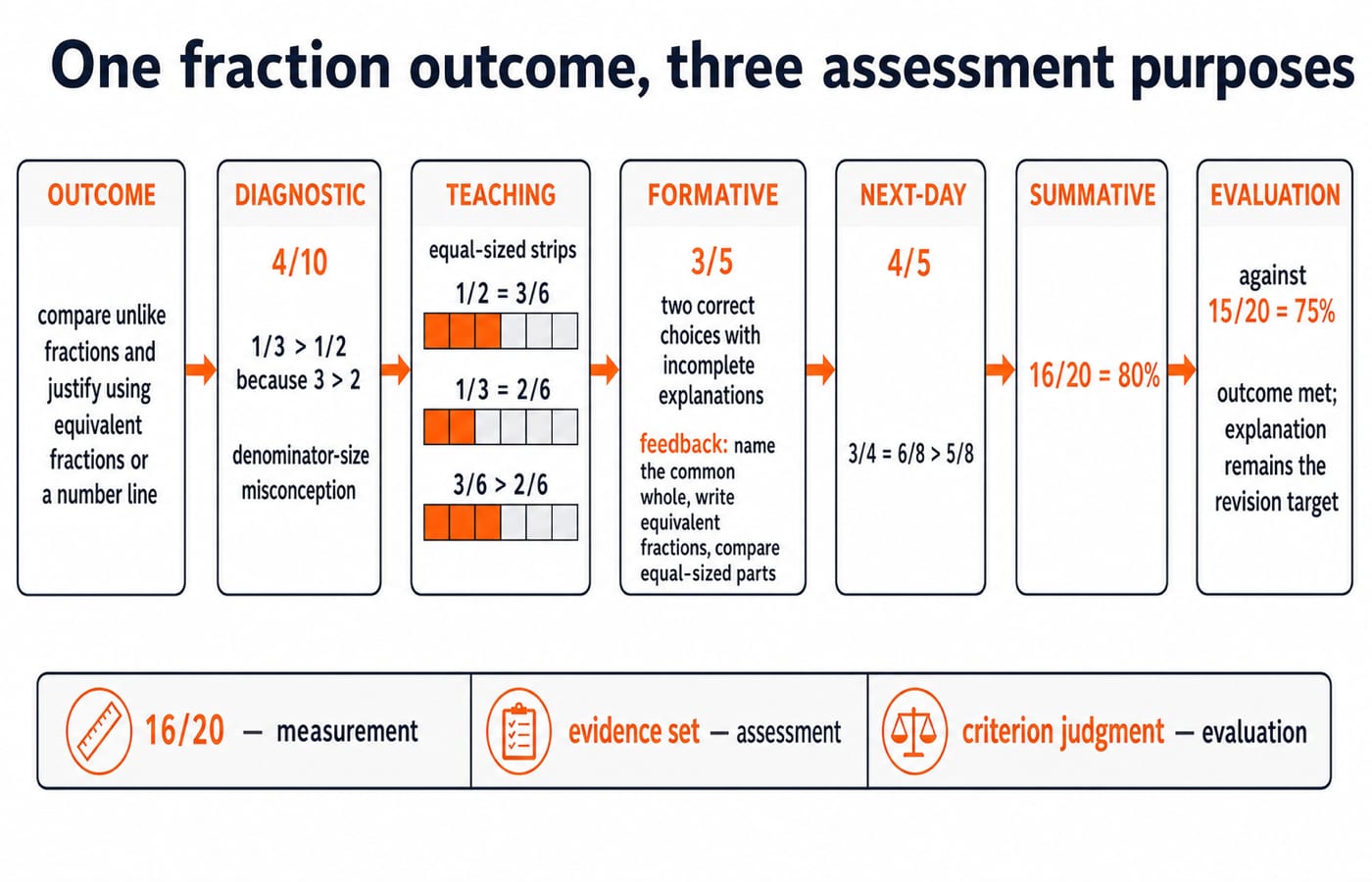
Grade VI outcome: “Compare two unlike fractions and justify using equivalent fractions or a number line.” Riya scores 4/10 and writes 1/3 > 1/2 because 3 > 2. This reveals a denominator-size misconception, not merely six errors.
Using equal-sized fraction strips, Riya completes 1/2 = 3/6 and 1/3 = 2/6, so 3/6 > 2/6. She scores 3/5 on an exit ticket; both missed items have correct choices but incomplete reasons. Feedback says, “Name the common whole, write equivalent fractions, then compare equal-sized parts.” Next day she scores 4/5: 3/4 = 6/8 > 5/8.
Riya then scores 16/20 = 80%; the pre-set criterion is 15/20 = 75%. Evaluation: “Outcome met; explanation remains the revision target.” 16/20 is measurement, the evidence set is assessment, and judgment against 15/20 is evaluation.
5. What makes an assessment trustworthy and useful
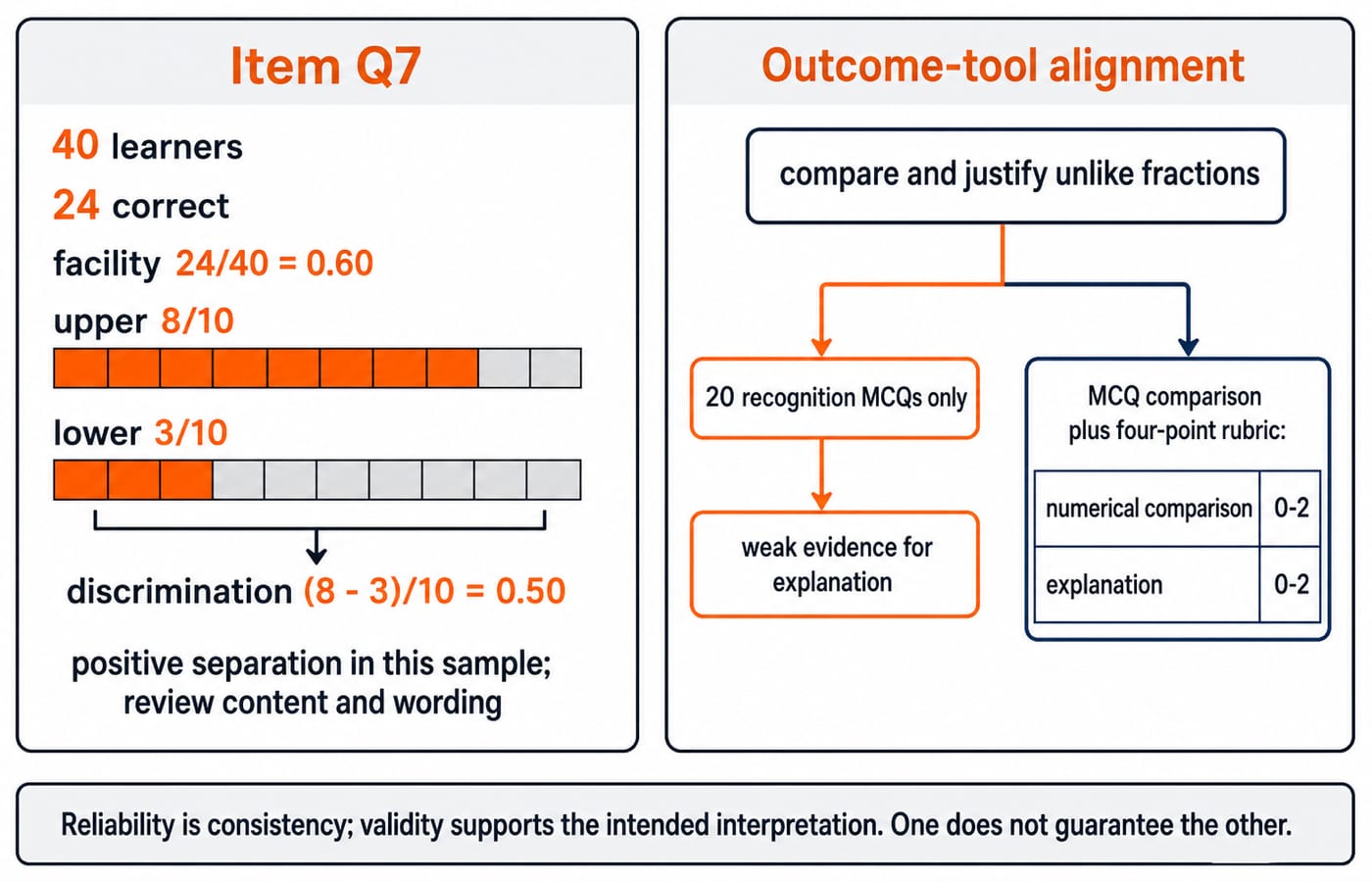
Use six failure tests: validity for interpretation, reliability for consistency, objectivity for scorer dependence, fairness for irrelevant barriers, comprehensiveness for coverage, and practicality for workable resources. Reliability does not guarantee validity.
On Q7, facility is 24/40 = 0.60. Upper-group correct is 8/10; lower-group correct is 3/10; discrimination is (8 - 3)/10 = 5/10 = 0.50. This shows 60% correct and positive separation in this sample, not automatic quality. Review content and wording.
For an oral-explanation outcome, 20 recognition MCQs are misaligned. Add an explanation scored 0-2 + 0-2. Two teachers agree on 8/10 responses, discuss two differences, and sharpen the rubric.
6. How teaching exams turn the concept into questions
For each scenario, identify the purpose, ask whether feedback changes the next step, match tool to outcome, and separate score from judgment. Expect pairs such as formative or summative, criterion-referenced or norm-referenced, validity or reliability, and checklist or rubric.
Original practice item A: After a five-item exit ticket, a teacher groups the two most common errors and changes the next lesson. What is the main use of this assessment? (A) Certification (B) Assessment for learning (C) Norm-referenced ranking (D) Placement. Answer: B, because the evidence changes the next teaching move.
Original practice item B: A learner scores 18/25, ranks 5th of 40, and the pre-set mastery criterion is 20/25. Which conclusion is justified? (A) Mastery is met because the rank is high (B) Mastery is not yet met even though the norm comparison is favourable (C) Reliability is proved (D) The test is diagnostic only. Answer: B, because 18/25 < 20/25; rank and mastery answer different questions.
Check the current conducting-body notification for exam-specific syllabus, marks, dates, counts, cutoffs and pattern.
7. High-frequency traps and the correction for each
Trap | Why it sounds plausible | What goes wrong | Do this instead |
|---|---|---|---|
Formative means ungraded | Often unmarked | Marks do not set purpose | Ask whether evidence changes teaching |
Diagnostic is only before teaching | Often starts first | Gaps also appear later | Diagnose from evidence |
Evaluation means marks | Marks seem final | A criterion is missing | State criterion and decision |
Summative cannot improve learning | Mainly reports | It can guide later teaching | Keep label, use evidence |
Reliable means valid | Both sound positive | Consistency may target the wrong outcome | Check consistency and alignment |
Objective means fair | Scoring is stable | Barriers may remain | Remove irrelevant barriers |
High rank means mastery | Rank looks favourable | Norm and criterion differ | Check mastery criterion |
| Number seems decisive | Context still matters | Review purpose, content and sample |
Continuous and comprehensive evaluation is not daily formal testing or unrelated marks. It gathers relevant evidence across time and the intended learning range. Label assessment by the purpose and use of evidence, not by marks.
8. Short version and the next study move
Begin with an observable outcome.
Choose evidence that matches it.
Measurement gives a quantity.
Assessment interprets an evidence set.
Evaluation judges against a criterion.
Formative use changes the next move.
Validity and reliability answer different quality questions.
For school teaching eligibility, use the Govt Teaching Eligibility Tests category and CTET Paper 1 course. For UGC NET teaching aptitude, use the NTA UGC NET Paper 1 course.
Reconstruct Riya's 4/10 -> 3/5 -> 4/5 -> 16/20 trail. Explain which part is measurement, assessment and evaluation, then attempt ten mixed scenarios.
Keep learning

सामान्य अशुद्धियाँ (Samanya Ashuddhiyaan): Complete Hindi Grammar Notes for CTET and TET Exams
Learn to identify and correct Hindi word-form, agreement, pronoun and redundancy errors through exact examples, a worked MCQ and a scored diagnostic.
Updated 6 Oct 20266 min readCTET & UPTET

Universities and Learning Programmes for Teaching Exams: Types, Modes and Solved Examples
Separate university status, delivery mode and programme purpose with a repeatable method, then test it on five UGC NET-style classification cases.
Updated 2 Oct 20265 min readCTET & UPTET

National Education Policy (NEP) 2020 Notes for Teaching Exams: 5+3+3+4, Reforms and MCQ Traps
Build an exam-ready map of NEP 2020, from the age-stage structure to pedagogy, language, PARAKH, B.Ed. routes and reliable distractor elimination.
Updated 26 Sep 20265 min readCTET & UPTET

Miscellaneous Pedagogy Topics for Teaching Exams: Complete Notes and Worked Examples
Turn a loose syllabus label into a five-part concept map, then use classroom evidence to distinguish sound pedagogy from attractive but incomplete options.
Updated 25 Sep 20266 min readCTET & UPTET