Internet of Things (IoT) MCQs: 10 Solved Questions on Architecture, ZigBee, WSN and MQTT
Solve 10 previous-year IoT questions using a four-stage architecture map, a ZigBee topology and direct option elimination. Recheck the key traps around wireless links, layers and MQTT.
KnowledgeGate Team
Exam prep & CS education
Updated 14 Aug 20267 min read
IoT MCQs are difficult because one set can jump from device architecture to low-power radio, sensor-network roles, industrial control and application messaging. Recognition without a system model creates avoidable errors, especially when two options describe technologies that can both appear in a real deployment. Work every question by naming the decisive phrase first, then eliminating the closest distractor. The safest model is the route the data itself takes: a physical sensor creates a reading, a local wireless link carries it, a gateway reaches an IP network, an MQTT broker distributes it, and an application or actuator uses it. Build that path once, then place every protocol and device role on it.
1. Build the IoT Architecture Map Before Attempting the MCQs
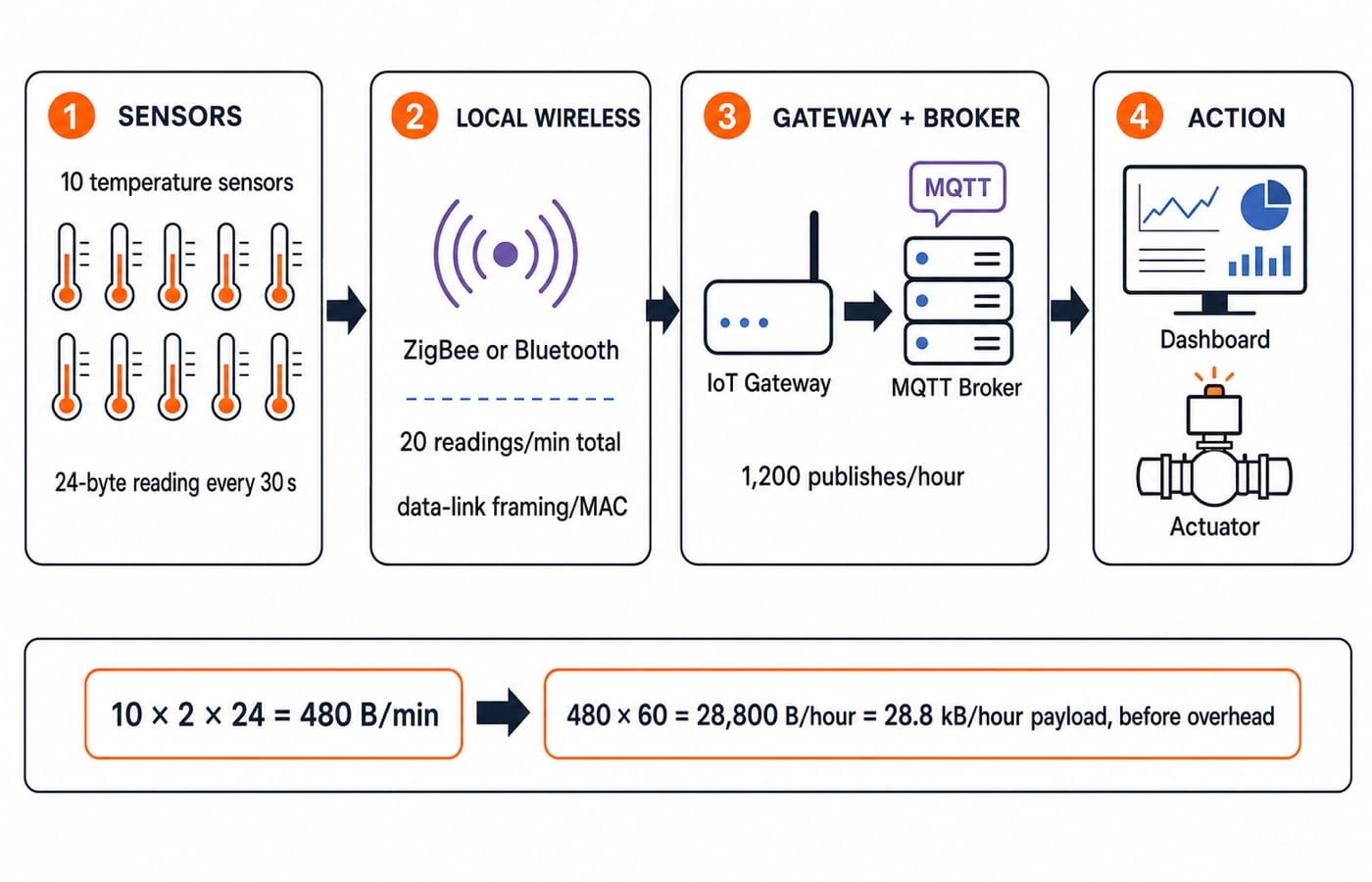
Use a four-part mental model:
A physical thing contains a sensor, an actuator, or both.
A local wireless link provides node-to-node communication, framing and medium access.
A gateway or IP network carries data beyond the local device network.
A broker or application consumes telemetry and may send a command back.
AI, blockchain, 5G and cloud platforms can be added to this path, but none is required by the core definition of IoT.
Now take 10 temperature sensors, each sending a 24-byte payload every 30 seconds.
Each sensor sends
60 / 30 = 2readings per minute.The site sends
10 x 2 = 20readings per minute.Payload per minute is
20 x 24 = 480 bytes.Payload per hour is
480 x 60 = 28,800 bytes, or28.8 kBin decimal units.Message count per hour is
20 x 60 = 1,200readings or publishes.
These are payload figures before overhead. Real traffic is higher after link, IP, transport and MQTT headers are added.
Use the Computer Networks MCQs collection when you want the wider subject practice route.
2. IoT Meaning and Distributed-Computing MCQs
Question 1, IBPS 2025
What does the term Internet of Things (IoT) primarily refer to?
A. A globally distributed ecosystem of AI-enabled embedded systems that autonomously interact with big data engines in real-time through federated learning models.
B. A dynamic framework where cyber-physical systems utilize blockchain protocols and AI agents to perform autonomous decision-making in fog computing layers.
C. An interconnected network of physical objects integrated with sensors, actuators, and communication protocols, designed to collect, exchange, and act on real-world data over the internet.
D. A virtualized cloud infrastructure that supports containerized microservices interacting with machine learning algorithms for large-scale IoT deployment over 5G.
E. A secure hardware-software ecosystem focused on real-time threat detection and intrusion prevention in smart connected devices using biometric sensors and cryptographic algorithms.
Answer: C. Connected physical objects, sensing or actuation, and communication are the defining pieces. AI, blockchain, fog, 5G and security can support a deployment, but an option that makes any of them compulsory does not give the core definition. Open the solved question.
Question 2, DSSSB 2021
Which of the following is not an example of Distributive computing?
A. LAN network
B. Mobile network
C. Parallel computing
D. Internet
Answer: C. LAN, a mobile network and the Internet are each a collection of separate machines linked so they can work together, which is what distributed computing describes. Parallel computing splits one job across processors that usually sit inside a single machine and share memory, so it is the odd one out. Practise it on the topic hub.
3. Wireless Connectivity and Layer MCQs
Keep the decision rule narrow. Zigbee is the expected low-power sensor-mesh answer, Bluetooth is a common short-range personal-area link, and the data-link layer handles framing and MAC over a wireless medium. No radio is always best because range, data rate and duty cycle change the engineering choice.
Question 3, UGC NET 2017
Which of the given wireless technologies used in IoT, consumes the least amount of power ?
A. Zigbee
B. Bluetooth
C. Wi-Fi
D. GSM/CDMA
Answer: A. The decisive phrase is least power, and the four options fall into a clear order: Zigbee draws the least, then Bluetooth, then Wi-Fi, with GSM/CDMA highest because its radio has to reach a cell tower kilometres away. Zigbee is built for low data rates and a low duty cycle, so a battery node can sleep between readings. Bluetooth Low Energy comes close in short-range duty-cycled use, but Zigbee remains the sensor-mesh answer here.
Question 4, BPSC 2023
Which wireless communication technology is commonly used in IoT devices for short-range communication?
A. Bluetooth
B. Wi-Fi
C. 4G LTE
D. More than one of the above
E. None of the above
Answer: A. Bluetooth is designed for short-range device-to-device and personal-area links, which is why it is common in wearables and sensor pucks. Wi-Fi reaches further through an access point and 4G LTE reaches a cell tower, so neither is short-range in the sense meant here. Option D would need at least two of the first three to qualify, and only Bluetooth does.
Question 5, BPSC 2024
Which layer is used for wireless connection in IoT devices?
A. Application layer
B. Network layer
C. Data link layer
D. More than one of the above
E. None of the above
Answer: C. The physical layer carries the raw radio signal, but a usable wireless connection needs framing, MAC addressing and node-to-node medium access, and all three belong to the data-link layer. The network layer routes packets between networks, and the application layer serves the user, so neither is where the wireless link is established.
4. ZigBee Roles and Wireless Sensor Network MCQs
Use one topology for the next three questions: one coordinator forms the network, two routers relay traffic, and six battery-powered end devices sense temperature. There are 9 devices in total. Only the 2 routers extend paths, while the 6 end devices can sleep between readings.
Question 6, Bihar STET 2025
Which among the following is not a type of Zigbee Device?
A. Zigbee Coordinator device
B. Zigbee Router
C. Zigbee start device
D. Zigbee end device
Answer: C. Zigbee defines exactly three device roles: the coordinator that forms the network, the router that relays for others, and the end device that senses or actuates. “Zigbee start device” is not one of them; it is a coined term placed beside the real ones, and starting the network is the coordinator's job.
Question 7, Bihar STET 2025
WSN stands for?
A. Wireless Standard Protocol
B. Wireless Sensor Network
C. Wireless Serial Protocol
D. Wireless Single Protocol
Answer: B. WSN means Wireless Sensor Network. In the topology above, the six sensing end devices gather measurements and pass them through the two routers to the coordinator, which acts as the sink toward the gateway. The other three expansions are invented, and none of them even ends in Network.
Question 8, Bihar STET 2025
Which ZigBee device is used to transfer data between ZigBee devices?
A. ZigBee Coordinator device
B. ZigBee Router
C. ZigBee start device
D. ZigBee end device
Answer: B. A ZigBee router relays frames between devices and extends coverage past a single hop. In the topology above, the two routers are what let distant end devices reach the coordinator at all. The coordinator forms and manages the network, and an end device never routes traffic for anyone else, which is exactly why it can sleep.
5. Industrial IoT Architecture and SCADA MCQ
Question 9, Bihar STET 2025
A complex SCADA system has ______ levels?
A. 6
B. 5
C. 3
D. 4
Answer: D. The keyed four-level hierarchy is field level for sensors and actuators, control level for PLCs and RTUs, supervisory level for SCADA servers and HMI, and enterprise level for management and analysis. This field-to-enterprise movement resembles the earlier IoT map, but not every IoT system uses SCADA.
6. MQTT Messaging MCQ
Question 10, IBPS 2025
Which lightweight messaging protocol uses a publish/subscribe model for efficient data transfer in IoT environments with constrained devices?
A. HTTP
B. FTP
C. MQTT
D. TCP
E. SMTP
Answer: C. Each sensor can publish to plant/line1/temp; the broker receives 1,200 publishes per hour, and a dashboard plus an alert service can subscribe. MQTT is an application-layer messaging protocol, while TCP is a transport it commonly uses. HTTP, FTP and SMTP serve different interaction purposes. Open the solved question.
Continue with application-layer MCQs. If MQTT's messaging model still blurs with familiar web protocols, use the application-layer protocols guide for the contrast.
7. Answer Key and the Four Traps to Recheck
Question | 1 | 2 | 3 | 4 | 5 | 6 | 7 | 8 | 9 | 10 |
|---|---|---|---|---|---|---|---|---|---|---|
Answer | C | C | A | A | C | C | B | B | D | C |
Recheck four pairs before scoring yourself:
Core IoT definition versus optional advanced technology.
Zigbee as the keyed low-power mesh answer versus Bluetooth for common short-range use.
Data-link framing versus network-layer routing.
MQTT application messaging versus TCP transport.
Questions 1 and 10 have their own solution pages, linked with each answer above. The remaining eight, and the rest of this topic, are practised from the IoT topic hub.
8. How This IoT Set Is Tested and What to Study Next
Revise the set in five buckets: definitions in Questions 1 and 2, wireless and layers in Questions 3 to 5, ZigBee and WSN roles in Questions 6 to 8, industrial architecture in Question 9, and messaging in Question 10. On your second attempt, spend 10 minutes answering all 10, then 10 minutes explaining every wrong option aloud with the architecture map.
For structured coverage of the IT specialist syllabus these questions come from, continue with the NIACL AO IT Specialist course. If you first need to choose a suitable exam route, start from Banking & Insurance exam preparation. The short version is simple: rebuild the four-stage path, retry the set without notes, and explain every correction in terms of device, link, network or application.
Keep learning
Computer Networks Basics & Criteria MCQs: 12 Solved Questions with Explanations
Solve 12 Computer Networks questions, then use clear explanations and worked criteria checks to separate similar terms confidently.
3 Oct 20268 min readComputer Networks MCQs
TCP Timers, RTT Estimation & SWS: 10 Solved MCQs and NATs
Solve 10 TCP exam questions covering timer roles, Silly Window Syndrome, recursive RTT estimates, Jacobson/Karels RTO and Karn's rule.
Updated 28 Sep 20267 min readComputer Networks MCQs
RSA Algorithm MCQs: 12 Solved Questions with Step-by-Step Explanations
Practise RSA key generation, modular inverses, encryption, signatures and defining equations, with concise working for conceptual and numerical answers.
25 Sep 20268 min readComputer Networks MCQs
Firewall, VPN, IDS and IPS MCQs: 11 Network Security Questions Solved
Solve 11 previous-year questions on firewalls, VPNs, IDS and IPS. Learn rule filtering, connection state, DMZ design, IPsec modes, tunnels and signatures.
Updated 24 Sep 20267 min readComputer Networks MCQs