

Grid Computing and Blockchain Explained: Worked Scheduling, Hash Chains and Exam Traps
Separate grid computing from blockchain, then practise capacity-aware scheduling and trace how an altered block breaks a toy hash chain.
KnowledgeGate Team
Exam prep & CS education
Updated 30 Oct 20266 min read

Grid computing and blockchain distribute activity across networked computers for different ends. A grid federates processing capacity to complete computation, while a blockchain coordinates a shared hash-linked record among nodes that may not trust one another. A grid scheduler balances capacity and overhead; a blockchain protocol preserves links and agrees on accepted state.
Grid computing and blockchain: shared idea, different purpose
A distributed system uses distinct networked computers on a task or service. Grid computing coordinates heterogeneous resources across sites or domains for computational work. A blockchain is a replicated, append-oriented ledger whose hash-linked blocks and consensus protocol determine accepted state.
System | Primary thing coordinated | Typical output | Trust or control model |
|---|---|---|---|
Distributed computing | Machines and processes | A distributed service or result | Umbrella idea; models vary |
Grid computing | CPU, memory, storage or instruments | A completed computation | Federated resources and policies |
Blockchain | Proposed transactions and replicated state | An agreed ledger history | Protocol-based validation and consensus |
The earlier Emerging Technology Trends Explained: Concepts and a Worked IoT Example separates blockchain from IoT, edge, cloud, AI, 5G, big data and AR/VR by system role. Grid scheduling instead places computational tasks across unequal sites; blockchain hash-link mechanics expose an altered predecessor. A grid does not need a blockchain, and a blockchain does not pool idle compute automatically.
Grid computing architecture: follow the job
A portal or broker authenticates a submitted divisible job. Resource discovery reports available sites. The scheduler places tasks by capacity and policy. Middleware coordinates heterogeneous processors, operating systems, networks and ownership rules. Data is staged to workers, monitoring detects progress or failure, and partial outputs are collected.
The scheduler decides placement, discovery reports availability, middleware provides common coordination, and local resource managers retain site control. Geographical separation alone does not create a grid.
A cluster is commonly tightly coupled and locally managed. A grid federates resources across sites or domains. A cloud exposes elastic, managed resources or services. These can overlap, so classify stated characteristics, not product labels.
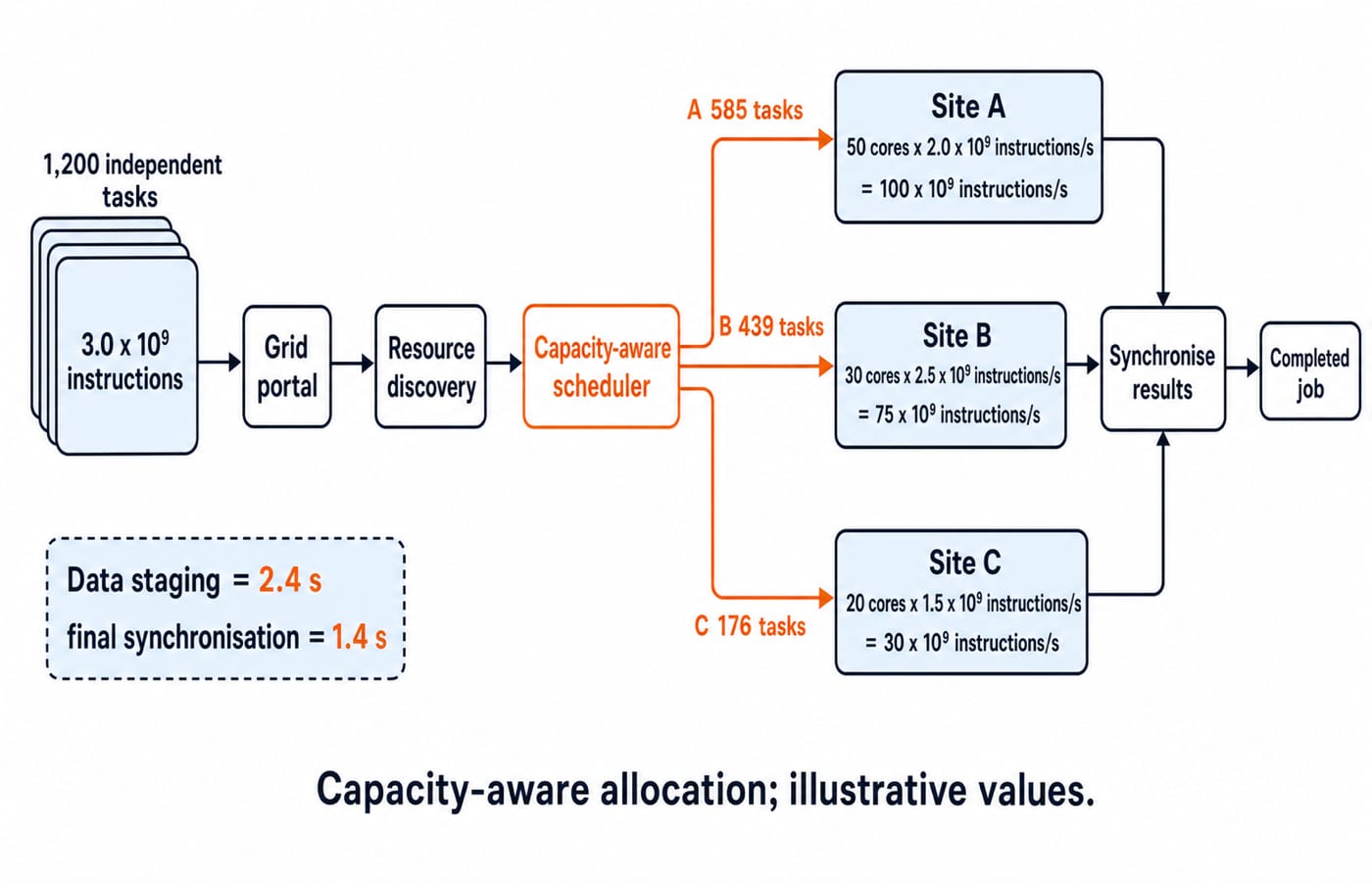
Grid computing worked example: schedule 1,200 tasks
Each of 1,200 independent equal tasks needs 3.0 x 10^9 instructions. Site A supplies 50 x 2.0 x 10^9 = 100 x 10^9 instructions/s; B supplies 30 x 2.5 x 10^9 = 75 x 10^9; C supplies 20 x 1.5 x 10^9 = 30 x 10^9. Combined throughput is 205 x 10^9 instructions/s.
Total work is 1,200 x 3.0 x 10^9 = 3.6 x 10^12 instructions. The divisible-work lower bound is (3.6 x 10^12) / (205 x 10^9) = 17.56 s.
Allocate in ratio 100:75:30: A gets 1,200 x 100 / 205 = 585.37, so 585 tasks; B gets 1,200 x 75 / 205 = 439.02, so 439; C gets the remainder, 176.
Finish times are A 585 x 3 / 100 = 17.55 s, B 439 x 3 / 75 = 17.56 s, and C 176 x 3 / 30 = 17.60 s. Makespan is the maximum, not the sum. With 2.4 s staging and 1.4 s synchronisation, total is 17.6 + 2.4 + 1.4 = 21.4 s.
Site A alone needs (3.6 x 10^12) / (100 x 10^9) = 36.0 s. Speed-up is 36.0 / 21.4 = 1.68x; the 14.6 s saving is 14.6 / 36.0 x 100 = 40.56%.
With 400 tasks each, A takes 12 s, B 16 s and C 40 s. The 3.8 s overhead makes 43.8 s, worse than A alone. Dependencies, failures or contention would change this fixed-rate result.
Blockchain architecture: four separate jobs
A block can contain transactions or records, metadata, the previous block's hash, a nonce or protocol-specific field, and its current hash. Changing an earlier block changes its digest, so the next block's stored reference no longer matches.
Hash linkage makes alteration detectable. Digital signatures can authenticate authorisation. Consensus determines which valid proposed history participating nodes accept. A hash is a one-way digest, not encryption or a signature, and a match alone does not prove network acceptance.
Access concerns who can read, submit and validate. Public networks allow broad participation; permissioned networks restrict roles; private or consortium deployments control governance. Permissioned is not unencrypted, and public need not expose readable personal data.
Blockchain worked example: trace a toy hash chain
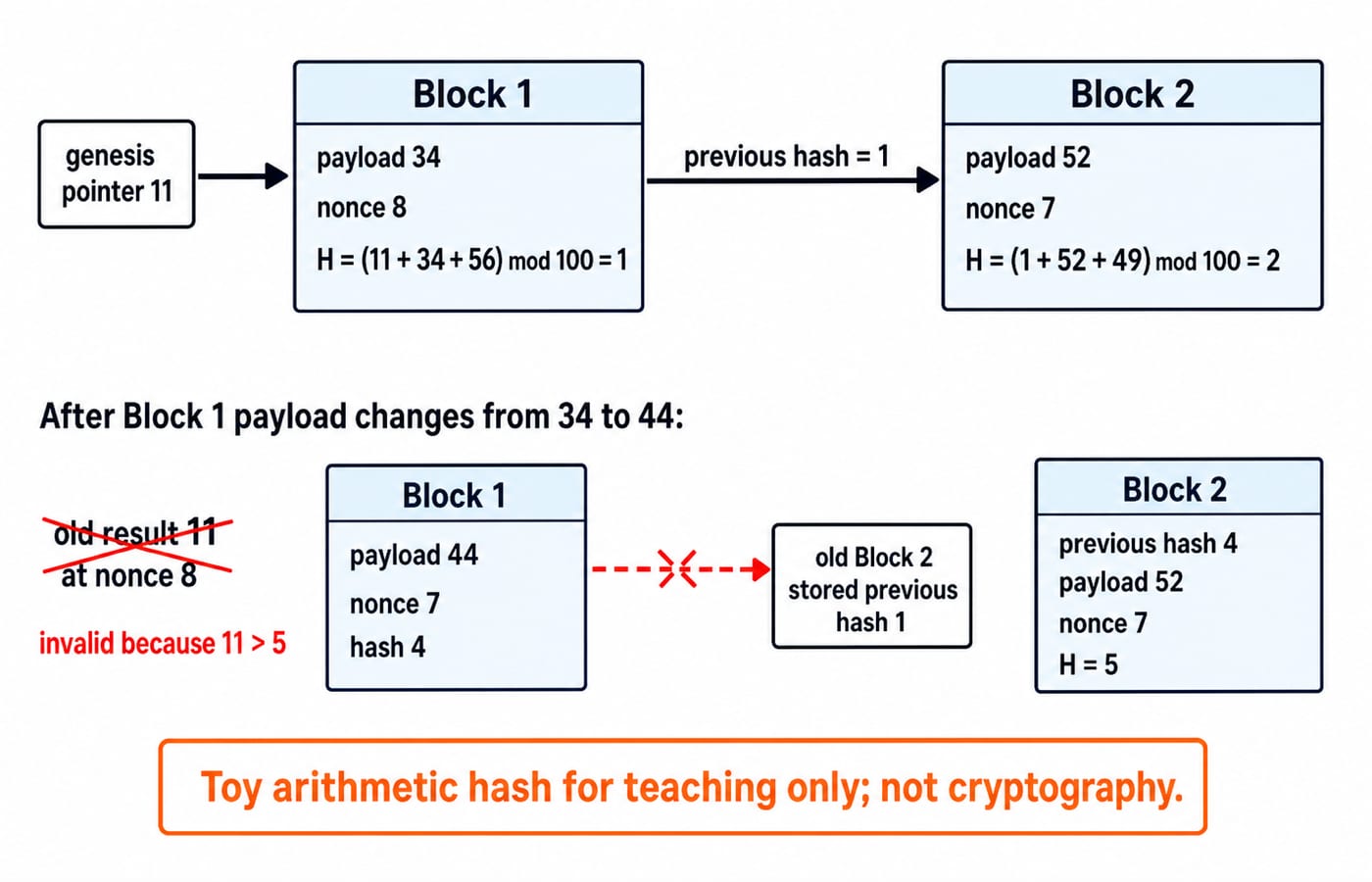
Use the hand-checkable toy rule H(previous, payload, nonce) = (previous + payload + 7 x nonce) mod 100. Accept a nonce when H <= 5. Its small linear output models link dependency, not cryptographic strength.
For Block 1, previous hash 11 and payload 34 give 0 -> 45, 1 -> 52, 2 -> 59, 3 -> 66, 4 -> 73, 5 -> 80, 6 -> 87, 7 -> 94, 8 -> 1. Nonce 8 is first accepted, so the hash is 1.
Block 2 uses previous hash 1 and payload 52. Nonce 0 gives 53, nonce 6 gives (1 + 52 + 42) mod 100 = 95, and nonce 7, the first accepted, gives (1 + 52 + 49) mod 100 = 2. It stores 1, 7 and 2 respectively.
Alter Block 1's payload from 34 to 44. Old nonce 8 gives (11 + 44 + 56) mod 100 = 11, which fails. Nonce 7 is first accepted and gives (11 + 44 + 49) mod 100 = 4. Block 2 still stores 1, so the link breaks. After changing that field to 4, Block 2 recomputes as (4 + 52 + 49) mod 100 = 5.
Real hashes have an avalanche effect and consensus rules are protocol-specific. This linear function only makes the dependency hand-checkable.
Grid computing versus blockchain: classify the evidence
Basis | Grid computing | Blockchain |
|---|---|---|
Primary aim | Execute computational work | Agree on ledger state |
Unit distributed | Tasks and resources | Transactions and ledger replicas |
Coordination mechanism | Brokers, schedulers and middleware | Validation and consensus |
Typical control boundary | Federated sites or domains | Protocol participants and governance |
Failure concern | Slow or failed workers, data transfer | Conflicting histories, invalid changes |
Result | Collected computation | Accepted hash-linked history |
Scheduler placement is not consensus; ledger replicas are not pooled processors:
Six university labs donate idle processors to render 9,000 frames: grid.
Banks maintain authorised hash-linked settlement-ledger replicas: permissioned blockchain.
Twenty servers in one data centre run a simulation under one administrator: cluster.
A provider provisions virtual machines for a spike, then releases them: cloud.
A grid might record resource-use attestations on a blockchain. Its compute federation remains the grid and its audit ledger remains the blockchain. Name components by function.
Exam patterns: solve, classify and reject traps
Question shapes include definition or feature selection, system comparison, makespan calculation and tamper detection. Retain 21.4 s, 1.68x and 43.8 s. In the chain, Block 2 stores 1 while revised Block 1 hashes to 4. Practise the decision rule behind each value rather than memorising a label.
Reject these recurring wrong ideas:
Adding parallel site times. Take the maximum, then add overhead.
Splitting tasks equally across unequal resources. Allocate by capacity.
Calling every distributed system a grid. Inspect purpose and control.
Calling a hash encryption or a blockchain absolutely immutable. Hashes are digests; chains are tamper-evident, and revision depends on the protocol.
Assuming only proof of work is consensus or only cryptocurrency uses blockchain.
Assertion: changing Block 1 can invalidate its link into Block 2. Reason: Block 2 stores Block 1's earlier hash. Both are true; the reason explains the assertion. More sites need not help when slow resources or communication outweigh capacity. Use the Govt Teaching Jobs category to choose the relevant teaching-paper route.
Grid computing and blockchain: the short version
Grid computing federates resources to execute work. Blockchain replicates and agrees on hash-linked state. For a grid, add throughputs, allocate by capacity, take the slowest time, then add overhead. For a blockchain, recompute the changed block, compare the next pointer, and separate hashes, signatures and consensus.
Use two invariants as a final check. For the grid, assigned task counts must total 1,200 and makespan is the largest site time plus 3.8 s of overhead. For the chain, Block 2's stored previous hash must equal Block 1's recomputed hash; 1 versus 4 exposes the alteration.
For a structured teaching-paper sequence, use the DSSSB TGT Computer Science Section B Course if it matches your exam route.
Keep learning

Cyber Threats and Malware Attacks: Types, Attack Chains and a Worked Incident
Learn to separate vectors, techniques and payloads, classify mixed malware behaviour, calculate exposure, and map controls to each incident stage.
Updated 26 Jul 20266 min readDBMS

Emerging Technology Trends in ICT: AI, Cloud, IoT and Blockchain with Worked Examples
Learn what AI, cloud, IoT, blockchain and related ICT technologies actually do. One smart-classroom case connects the definitions to two worked calculations.
Updated 10 Nov 20265 min readGATE Strategy & Roadmap

Emerging Technologies in Web Technology: Cloud, IoT, Edge and Blockchain with Worked Examples
Follow 200 factory sensors from MQTT messages to edge decisions, cloud functions, a live dashboard and a toy blockchain. The worked numbers make each role concrete.
Updated 27 Oct 20265 min readGATE Strategy & Roadmap
Banking Exams Reasoning Puzzles: A Repeatable Grid Method
Learn a six-step puzzle method through one complete five-person day and city set. Build separate grids, control branches, finish the arrangement and verify every clue.
Updated 19 Aug 20266 min readBanking Exams