

Internet of Things (IoT) MCQs: 10 Solved Architecture and Applications Questions
Solve 10 published IoT MCQs on architecture, wireless links, Zigbee, MQTT, SCADA and distributed systems. Each answer includes a concise explanation.
KnowledgeGate Team
Exam prep & CS education
Updated 30 Oct 20267 min read
IoT questions switch quickly between the system definition, wireless choices, Zigbee roles, messaging and industrial control. If you memorise only expansions, you can still confuse a sensor network with an application protocol or a router with an end device. Choose an answer and write one reason before opening each worked explanation.
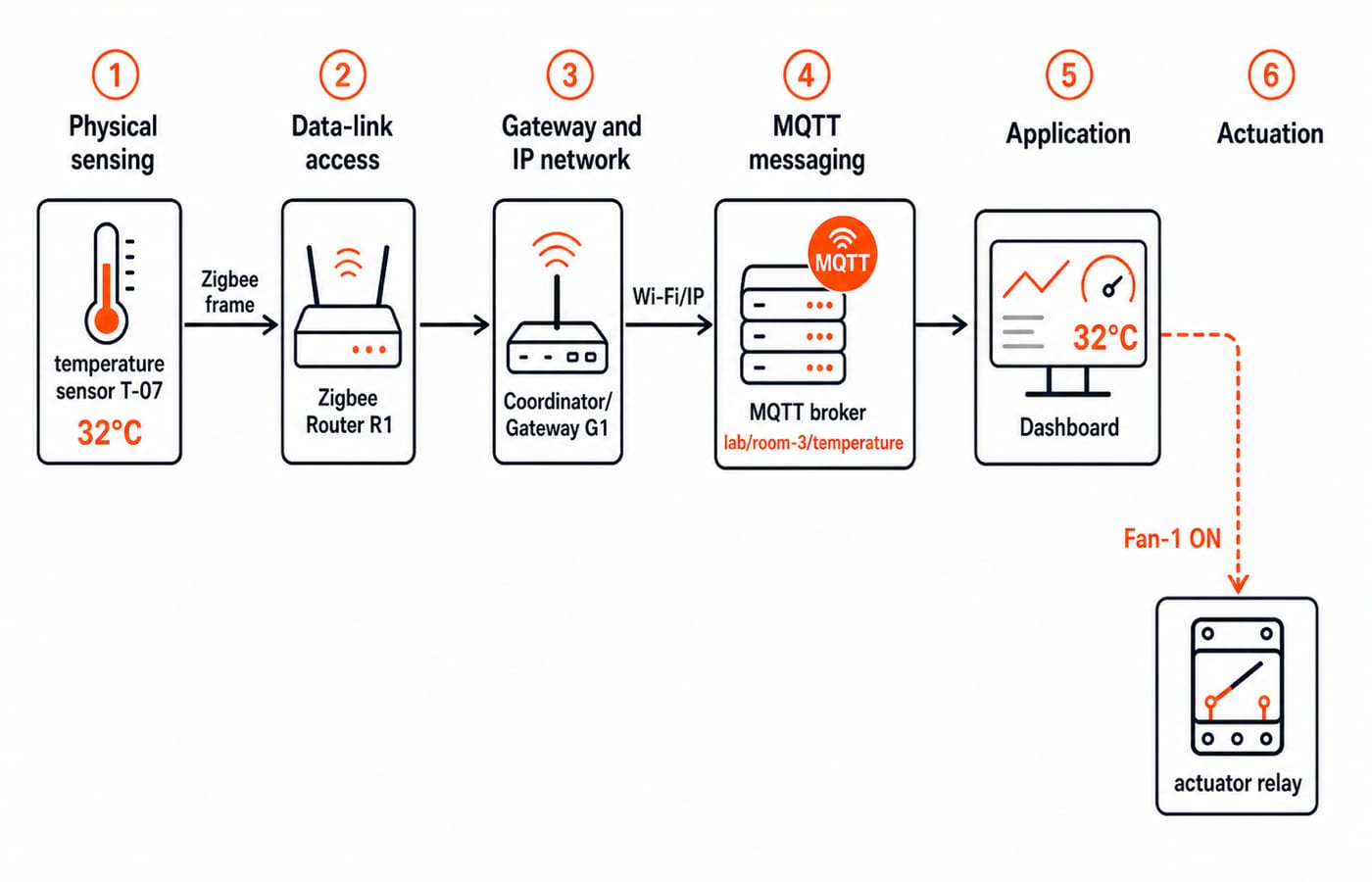
The earlier Internet of Things (IoT) MCQ set groups these same 10 questions as mixed practice and adds telemetry-volume arithmetic. For architecture-focused revision, trace every answer through one T-07 sensor-to-actuator path and two system diagrams; device roles, link layers, messaging and industrial control then stay connected.
Internet of Things concepts and architecture: the rule card
Term | Main job | Concrete example |
|---|---|---|
sensor | observes a physical quantity | T-07 measures 32°C |
actuator | changes the physical world | relay switches Fan-1 ON |
WSN | links sensor nodes wirelessly | T-07 sends through Zigbee Router R1 |
gateway | joins the local device network to IP services | Gateway G1 forwards the reading over Wi-Fi |
MQTT broker | routes published messages by topic |
|
application | presents data or issues a command | dashboard shows 32°C and requests Fan-1 ON |
The minimum architecture chain is physical object -> sensor or actuator -> local wireless link -> gateway or IP network -> processing or broker -> application. A sensor turns a physical condition into data, while an actuator takes a command back into the physical world. The local link moves frames among nearby devices, and the gateway joins that network to IP services. Local framing moves data across one link; IP routing carries it between networks; an application protocol defines the message exchange.
AI, blockchain, cloud and 5G can support an IoT design, but no one of them defines IoT. The defining feature is the connected physical-to-digital loop that senses or acts, communicates, processes and presents or controls.
IoT MCQs 1-2: definition and wireless sensor networks
Question 1: What does the term Internet of Things (IoT) primarily refer to?
IBPS 2025
What does the term Internet of Things (IoT) primarily refer to?
A. A globally distributed ecosystem of AI-enabled embedded systems that autonomously interact with big data engines in real-time through federated learning models.
B. A dynamic framework where cyber-physical systems utilize blockchain protocols and AI agents to perform autonomous decision-making in fog computing layers.
C. An interconnected network of physical objects integrated with sensors, actuators, and communication protocols, designed to collect, exchange, and act on real-world data over the internet.
D. A virtualized cloud infrastructure that supports containerized microservices interacting with machine learning algorithms for large-scale IoT deployment over 5G.
E. A secure hardware-software ecosystem focused on real-time threat detection and intrusion prevention in smart connected devices using biometric sensors and cryptographic algorithms.
Answer: C. An interconnected network of physical objects integrated with sensors, actuators, and communication protocols, designed to collect, exchange, and act on real-world data over the internet.
T-07 senses, G1 communicates and Fan-1 acts, completing the defining physical-to-digital loop. AI, blockchain, fog, cloud, 5G and security can support deployments, but none defines IoT.
Question 2: WSN stands for?
Bihar STET 2025, Computer Science
WSN stands for?
A. Wireless Standard Protocol
B. Wireless Sensor Network
C. Wireless Serial Protocol
D. Wireless Single Protocol
Answer: B. Wireless Sensor Network.
A WSN contains sensor nodes that observe conditions and exchange readings wirelessly through a sink or gateway. T-07 belongs to the sensing network, while G1 connects it to IP; the other choices invent protocol expansions.
IoT MCQs 3-4: short-range links and power choice
Question 3: Which wireless communication technology is commonly used in IoT devices for short-range communication? (module practice; question page unavailable)
BPSC 2023, Computer Science, PGT Tier-3
Which wireless communication technology is commonly used in IoT devices for short-range communication?
A. Bluetooth
B. Wi-Fi
C. 4G LTE
D. More than one of the above
E. None of the above
Answer: A. Bluetooth.
Bluetooth is intended here for nearby peripherals, wearables and sensors. Wi-Fi also covers local areas, but usually serves an IP LAN with higher throughput, while 4G LTE is wide-area cellular.
Question 4: Which of the given wireless technologies used in IoT, consumes the least amount of power ?
UGC NET 2017, Computer Science, November
Which of the given wireless technologies used in IoT, consumes the least amount of power ?
A. Zigbee
B. Bluetooth
C. Wi-Fi
D. GSM/CDMA
Answer: A. Zigbee.
Zigbee suits low-data-rate sensor networks whose nodes sleep for long periods and transmit briefly. Wi-Fi and cellular usually spend more energy; Bluetooth Low Energy can also be efficient, but the broad Bluetooth option does not change the answer to this question.
IoT MCQs 5-7: Zigbee roles and the link layer
Question 5: Which among the following is not a type of Zigbee Device?
Bihar STET 2025, Computer Science
Which among the following is not a type of Zigbee Device?
A. Zigbee Coordinator device
B. Zigbee Router
C. Zigbee start device
D. Zigbee end device
Answer: C. Zigbee start device.
The recognised roles are coordinator, router and end device. A coordinator forms the network, routers relay, and end devices are usually sleeping leaf nodes; start device is not a standard role.
Question 6: Which ZigBee device is used to transfer data between ZigBee devices? (module practice; question page unavailable)
Bihar STET 2025, Computer Science
Which ZigBee device is used to transfer data between ZigBee devices?
A. ZigBee Coordinator device
B. ZigBee Router
C. ZigBee start device
D. ZigBee end device
Answer: B. ZigBee Router.
A router forwards frames and extends a Zigbee network beyond one direct hop. The coordinator starts the network, while an end device communicates through its parent instead of relaying traffic; R1 is the concrete router.
Question 7: Which layer is used for wireless connection in IoT devices?
BPSC 2024, Computer Science
Which layer is used for wireless connection in IoT devices?
A. Application layer
B. Network layer
C. Data link layer
D. More than one of the above
E. None of the above
Answer: C. Data link layer.
Among these choices, the data link layer handles local frames and medium access for Wi-Fi, Bluetooth and Zigbee. The physical layer carries radio signals but is absent; the network layer routes between networks, while the application layer serves software.
IoT MCQs 8-9: MQTT messaging and SCADA hierarchy
Question 8: Which lightweight messaging protocol uses a publish/subscribe model for efficient data transfer in IoT environments with constrained devices?
IBPS 2025
Which lightweight messaging protocol uses a publish/subscribe model for efficient data transfer in IoT environments with constrained devices?
A. HTTP
B. FTP
C. MQTT
D. TCP
E. SMTP
Answer: C. MQTT.
MQTT separates senders and receivers through a broker and topics. G1 publishes 32°C to lab/room-3/temperature; TCP can carry MQTT, but HTTP is request-response, FTP transfers files and SMTP transfers email.
Question 9: A complex SCADA system has ______ levels? (module practice; question page unavailable)
Bihar STET 2025, Computer Science
A complex SCADA system has ______ levels?
A. 6
B. 5
C. 3
D. 4
Answer: D. 4.
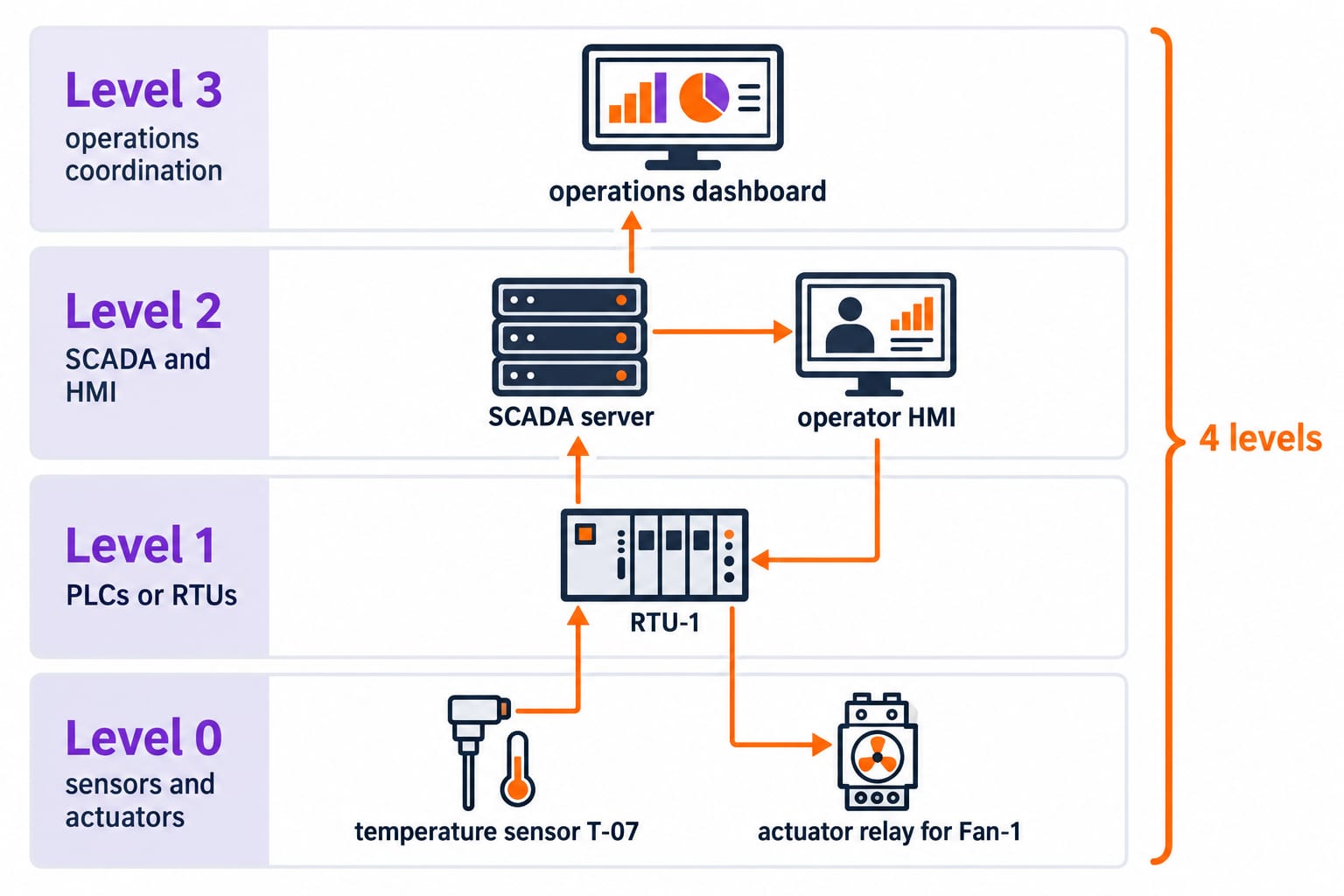
This model has Level 0 sensors and actuators, Level 1 PLCs or RTUs, Level 2 SCADA and HMI, and Level 3 operations coordination. A T-07 reading travels through an RTU and operator HMI to an operations dashboard. Labels vary by framework, so this question uses four levels rather than asserting a universal vendor count.
IoT MCQ 10 and the traps the set is testing
Question 10: Which of the following is not an example of Distributive computing?
DSSSB 2021, Computer Science
Which of the following is not an example of Distributive computing?
A. LAN network
B. Mobile network
C. Parallel computing
D. Internet
Answer: C. Parallel computing.
LAN, mobile networks and the Internet connect separate nodes that can do distributed work. Parallel operations may instead run on tightly coupled processors or cores inside one machine, so parallel computing need not be distributed.
Exam demand | Questions | Fast check |
|---|---|---|
definition and scope | 1-2 | look for physical objects, sensing or actuation, connectivity |
wireless selection | 3-4 | compare range, data rate and power |
device role and layer | 5-7 | coordinator starts, router relays, end device is a leaf, data link handles local access |
application messaging and control | 8-9 | MQTT publishes by topic, SCADA supervises a hierarchy |
architecture distinction | 10 | parallel does not automatically mean distributed |
Check five traps before you accept an option:
Optional technologies are not the IoT definition.
Bluetooth and Zigbee are not interchangeable answer words.
A Zigbee router relays, but an end device does not.
TCP transports MQTT, but does not provide MQTT's publish/subscribe semantics.
Parallel describes concurrency, while distributed describes placement across networked nodes.
Use Computer Networks MCQs as the next mixed practice set. If layers and protocol roles still blur together, revise Application Layer Protocols: DNS and HTTP Guide to separate application protocols from lower-layer transport and link functions.
Internet of Things MCQs: short version and next step
Recall the chain: sense or act -> connect locally -> route through a gateway -> publish or process -> present or control. Add two role cues, coordinator forms, router forwards, end device sleeps and MQTT publishes through a broker.
Redraw both figures from memory, then make a blind second attempt at Questions 1, 4, 6, 8 and 9. These test IoT definition, wireless power, Zigbee relay roles, MQTT messaging and SCADA hierarchy. Only then check the sequence: C, A, B, C, D.
For a structured core-CS exam route, use GATE Guidance by Sanchit Sir. For placement-focused fundamentals, use CS Fundamentals for Placements by Sanchit Sir. Whichever route you choose, return to the five questions above until you can justify every answer without looking at the options.
Keep learning

Internet of Things (IoT) MCQs: 10 Solved Questions on Architecture, ZigBee, WSN and MQTT
Solve 10 previous-year IoT questions using a four-stage architecture map, a ZigBee topology and direct option elimination. Recheck the key traps around wireless links, layers and MQTT.
Updated 30 Oct 20267 min readComputer Networks MCQs
Future Internet Explained: Architecture, a Worked IoT Example and Exam Traps
Learn how device, edge, network, cloud and application layers cooperate, then solve a smart-campus example for data reduction and control-loop latency.
Updated 16 Nov 20266 min readWeb Development
IoT, Sensors and Smart Cities Explained: Architecture, Numericals and Exam Traps
Learn the role of every IoT block, separate common sensor terms, and solve a 120-node streetlighting numerical covering data, energy and hysteresis.
Updated 31 Oct 20266 min readTeaching Recruitment (Computer Science)
Internet Fundamentals: Architecture, Connections, DNS, URLs and Worked Examples
Build a clean mental model of the Internet and Web, then trace a browser request and calculate transfer time, cache expiry and segment count.
Updated 6 Aug 20266 min readGATE Strategy & Roadmap