

Future Internet Explained: Architecture, a Worked IoT Example and Exam Traps
Learn how device, edge, network, cloud and application layers cooperate, then solve a smart-campus example for data reduction and control-loop latency.
KnowledgeGate Team
Exam prep & CS education
Updated 16 Nov 20266 min read
Future Internet sounds like a network that will switch on one day. That picture makes learners memorise IoT, cloud, 5G, IPv6, edge computing and the Semantic Web as an unrelated list. In fact, it is an umbrella for evolving designs and capabilities, not one protocol, product, fixed architecture or scheduled replacement for today's Internet. Future Internet combines a defined scope with layered architecture, while edge processing affects traffic volume and response time.
Future Internet: define the idea before naming technologies
Start by keeping three terms separate.
Term | Meaning |
|---|---|
Internet | The interconnected networking infrastructure and protocols that move data. |
Web | An information and application system that runs over the Internet. |
Future Internet | A broad design and research direction for improving how networks, services, data, devices and people interact. |
The idea groups five goals: connect many heterogeneous devices; distribute compute and storage across device, edge and cloud; make networks more programmable; make data interoperable and discoverable; and improve security, privacy, resilience and efficiency.
IPv6, IoT, wireless access, cloud and edge computing, SDN/NFV and semantic-data approaches can enable those goals. None is an alternative definition of Future Internet. Use CS Fundamentals for Exams & Placements to place these ideas beside the broader networking and computing concepts.
A layered Future Internet architecture
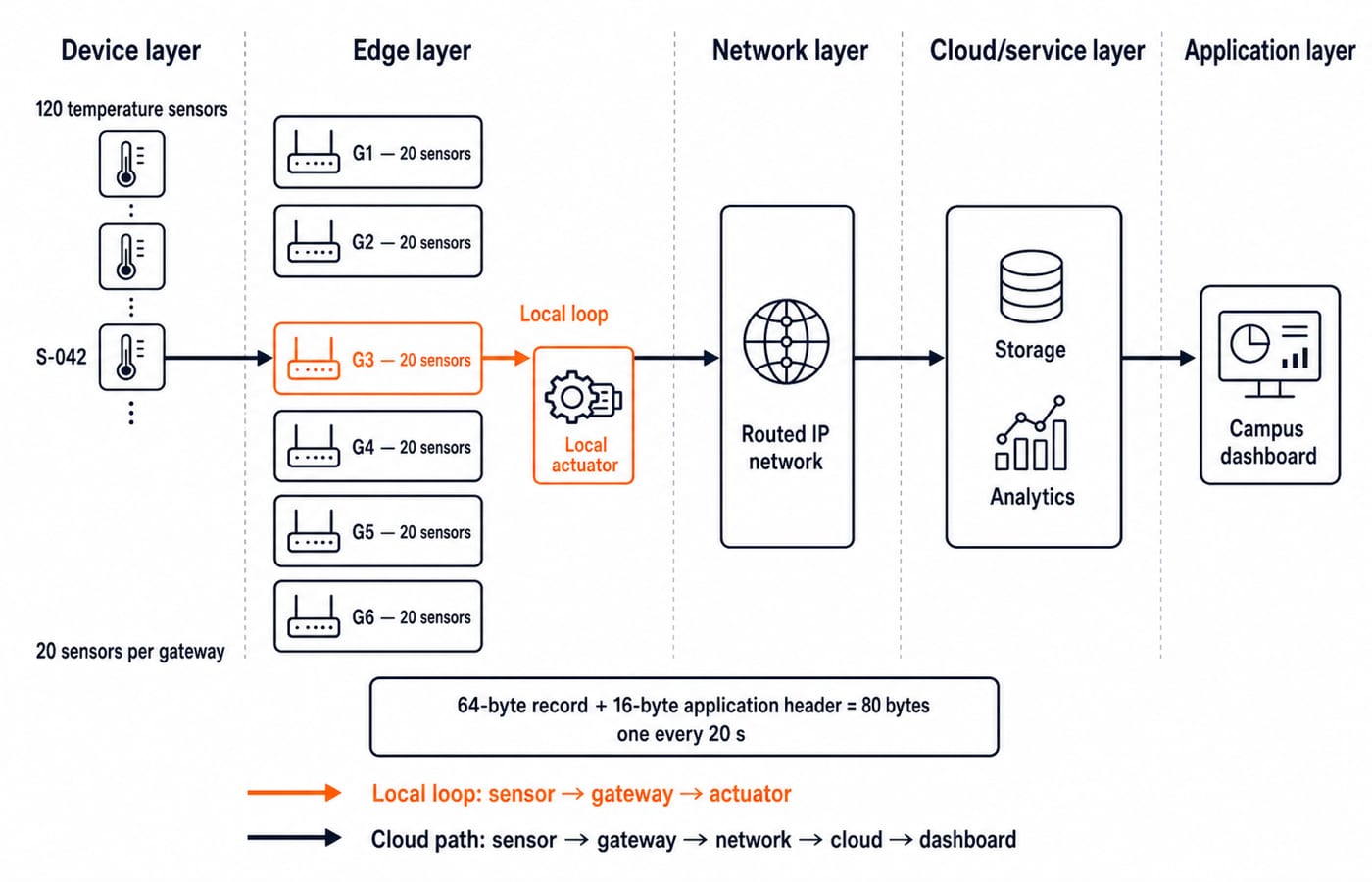
A useful teaching model has five layers:
Device or sensing layer: observes or acts on the physical world.
Edge or gateway layer: aggregates data, filters it and makes time-sensitive local decisions.
Network layer: provides addressing, routing and transport across heterogeneous links.
Cloud or service layer: stores longer histories, coordinates sites and runs heavier analysis.
Application layer: presents useful behaviour to students, staff or operators.
This is a reasoning model, not a mandated universal stack.
A smart-campus sensor network illustrates the traffic and latency calculations. A campus has 120 temperature sensors divided evenly across six edge gateways, so each gateway serves 20 sensors. Every sensor produces one 80-byte application message every 20 seconds. That message contains a 64-byte reading record and a 16-byte application header. Gateways send selected readings and summaries to a cloud service, while a local actuator can receive an edge decision. For a focused refresher on where Web and HTTP concepts fit, see Web Technologies for Teaching Exams: HTML, HTTP, DNS Guide.
Worked smart-campus example: reduction and response time
Calculate raw application data over 10 minutes, or 600 seconds.
Messages per sensor = 600 / 20 = 30 messages.
Messages from all sensors = 120 x 30 = 3,600 messages.
Raw volume = 3,600 x 80 = 288,000 bytes, or 0.288 MB in decimal units.
Average message rate = 3,600 / 600 = 6 messages/s.
Average application-data rate = 6 x 80 = 480 bytes/s = 3.84 kb/s.
These figures exclude transport, network and link overhead because only application sizes are supplied.
Apply the edge policy. It forwards every anomalous reading, assumed here to be 5% of readings, and each gateway sends one 120-byte summary per minute.
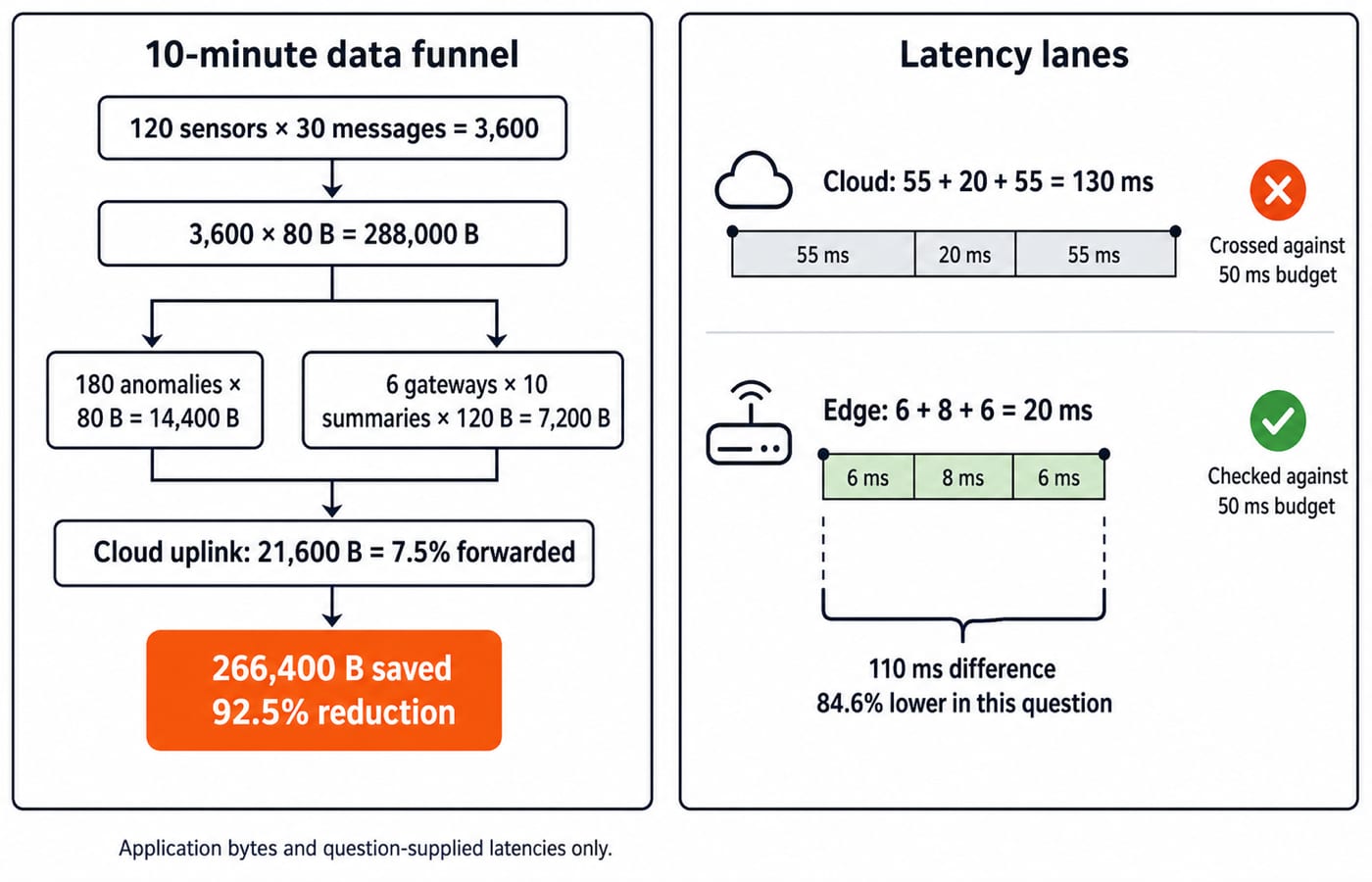
Anomalies = 0.05 x 3,600 = 180 messages.
Anomaly data = 180 x 80 = 14,400 bytes.
Summaries = 6 gateways x 10 minutes = 60 summaries.
Summary data = 60 x 120 = 7,200 bytes.
Total uplink data = 14,400 + 7,200 = 21,600 bytes.
The forwarded fraction is 21,600 / 288,000 = 7.5%. Therefore, the reduction is 100% - 7.5% = 92.5%, equal to 288,000 - 21,600 = 266,400 bytes saved.
Use only the scenario's latency values. The cloud loop takes 55 ms outward + 20 ms to decide + 55 ms back = 130 ms. The edge loop takes 6 ms outward + 8 ms to decide + 6 ms back = 20 ms. Against the stated 50 ms alarm budget, only the edge loop qualifies. It is 110 ms faster, or (110 / 130) x 100 = about 84.6% lower than the cloud loop in this question.
Identity, addressing and interoperable data
Identity, location and meaning answer different questions. For the same sensor, urn:campus:sensor:S-042 can be a stable classroom identifier. 2001:db8:42::42 is a documentation-only example of a locator, and it can change without changing the logical identity. DNS or another naming system can map human-usable names to reachable service locations. An IPv6 address alone does not provide semantics, trust or permanent identity.
The tuple (S-042, 31.5) is ambiguous. A self-describing record is clearer: sensorId=S-042, observedProperty=temperature, value=31.5, unit=degree Celsius, observedAt=09:30:00Z, location=Lab-B. A shared schema and vocabulary let the gateway, cloud service and dashboard interpret these fields consistently.
Semantic interoperability means shared, machine-processable meaning. It does not mean that the network has human intelligence. Semantic Web, IoT and Future Internet remain distinct ideas even when a system combines them. The Application Layer Protocols: DNS Walk-Through, HTTP covers the narrower naming and application-protocol foundation.
Security, privacy, resilience and design trade-offs
Every boundary in the architecture is a trust decision. A cloned S-042 reporting a false 45 degree Celsius value is not trustworthy because its identifier looks correct. The design needs device authentication, protected data in transit, replay protection, authorised and integrity-checked gateway configuration, least-privilege service access and useful audit logs. IPv6, edge placement or encryption alone cannot solve every security problem.
The 120-byte gateway summaries and the question's 5% exceptions can reduce central collection, but the system still needs a defined purpose, retention rule and access policy. Edge aggregation can lose raw detail unless the design deliberately retains it. Cloud analysis offers a wider view but adds dependency on the longer path.
If that path is temporarily unavailable, the gateway may keep the stated 20 ms local alarm loop and buffer permitted summaries for later synchronisation. That works only if local rules, storage limits and failure handling were designed and tested. Edge and cloud are complementary placements with explicit trade-offs.
How exam-style questions test Future Internet concepts
Future Internet questions commonly ask you to:
choose the correct Internet-versus-Web statement;
map a component to the device, edge, network, cloud or application layer;
distinguish an identifier from a locator;
classify IoT, SDN/NFV, edge computing and semantic data as enablers;
calculate messages, bytes, percentage reduction or latency;
evaluate a security or privacy conclusion.
Rapid check: Messages in 10 minutes = 3,600. Raw application data = 288,000 bytes. Edge-to-cloud data = 21,600 bytes. Reduction = 92.5%. Cloud loop = 130 ms. Edge loop = 20 ms. Only the edge loop meets the stated 50 ms budget.
S-042is the logical device identifier, while the example IPv6 address is a locator.
Practise the same distinction-and-calculation skills with the GATE Test Series: Mocks & Topic-wise Tests.
Traps that turn a broad concept into a wrong answer
Trap | Correction |
|---|---|
Future Internet is one protocol. | An umbrella of evolving designs. |
Internet equals Web. | The Web runs over Internet infrastructure. |
IoT equals Future Internet. | IoT is one domain. |
Everything belongs in the cloud. | Placement follows latency, bandwidth, privacy and analysis. |
Edge replaces cloud. | Different jobs. |
IPv6 guarantees security. | Addressing and security are separate. |
Semantic means intelligent. | Shared machine-processable meaning, not intelligence. |
Each sensor sends 600 / 20 = 30 readings; summaries are per gateway. Do not confuse 21,600 bytes forwarded with 266,400 bytes saved. The 92.5% reduction and 20 ms latency follow the supplied assumptions, not a universal rule.
The short version and the next study step
Recall the chain: heterogeneous devices, edge decisions, network connectivity, cloud coordination, useful application. Naming, interoperable data and explicit security controls hold it together. In this example, 288,000 raw bytes become 21,600 forwarded bytes, and the 20 ms edge loop meets the stated 50 ms budget.
Redraw both diagrams and explain where the five goals appear. Then explain the result without looking back. For a structured GATE-oriented next step, explore GATE Guidance by Sanchit Sir.
Keep learning
MongoDB Aggregation Pipeline: `$match` to `$group` with a Worked Example
Build one MongoDB aggregation pipeline step by step. Follow five fictional orders through filtering, array expansion, grouping, projection, and deterministic sorting.
Updated 17 Nov 20266 min readWeb Development

Testing React Components: A Runnable Vitest and Testing Library Tutorial
Build and test a small React progress component from its initial render through completion. The examples use accessible queries, awaited actions, and an exact mock assertion.
Updated 15 Nov 20266 min readWeb Development
React Performance Optimization Tutorial: Profiler, memo, useMemo, and useCallback Examples
Build one React lab, measure its render and calculation counts, then remove avoidable work while keeping typing responsive.
Updated 14 Nov 20266 min readWeb Development

Node.js Path and OS Modules: Build Portable Scripts with Runnable Examples
Learn how Path and OS remove hard-coded assumptions from Node.js scripts. Follow deterministic examples, memory maths, and a complete system-report build.
Updated 13 Nov 20265 min readWeb Development