

Integration Questions with Solutions: 12 Solved MCQs
Solve 12 integration MCQs step by step, then use your score to identify whether symmetry, substitution, integration by parts or limits need revision.
KnowledgeGate Team
Exam prep & CS education
Updated 29 Oct 20267 min read
Integration questions are rarely lost because you have never seen an antiderivative. They are lost when you miss symmetry, the sign inside an absolute value, a disguised derivative, the right substitution or a changing limit. This practice has 12 MCQs. Select an option and write the decisive transformation before opening each solution. The GATE CS & IT 2027 Guidance course places this practice in the wider route.
Integration questions: the five checks before you calculate
Use this five-line method card before doing algebra:
Test odd or even symmetry.
Resolve modulus signs from the stated interval.
Look for a reverse derivative pattern.
Choose substitution or integration by parts.
Split an area wherever the upper curve changes.
Here is a ten-second method demonstration, not a thirteenth bank question. In the integral from -2 to 2 of (3x^3 + 5) dx, the odd part 3x^3 contributes 0. The constant contributes 5 * 4=20, so the value is 20. For more structured calculus theory and practice, use the Engineering Mathematics course alongside this set.
Questions 1-3: symmetry and interval control
Question 1: odd powers on a symmetric interval
The value of integral from -2 to 2 of (a*x^5 + b*x^3 + c) dx depends on the value of:
(a) b
(b) c
(c) a
(d) a and b
Solution. By linearity, both x^5 and x^3 are odd, so their integrals from -2 to 2 are 0. The remaining term is
integral from -2 to 2 of c dx=c[2-(-2)]=4c.
The value depends only on c, so the correct option is (b). As a direct check, the x^6 and x^4 endpoint terms cancel, while cx gives 4c.
Question 2: remove absolute values before integrating
If a < b, then integral from a to b of (|x - a| + |x - b|) dx is equal to:
(a) (b - a)2 / 2
(b) (b^2 - a^2) / 2
(c) (b - a)
(d) (b - a)2
Solution. On [a,b], |x-a|=x-a and |x-b|=b-x. Their sum is the constant b-a, and the interval length is also b-a. Therefore the integral is (b-a)^2, so the correct option is (d). Check with a=1 and b=4: the integrand is 3 over a length of 3, giving 9.
Question 3: pair a function with its reflected copy
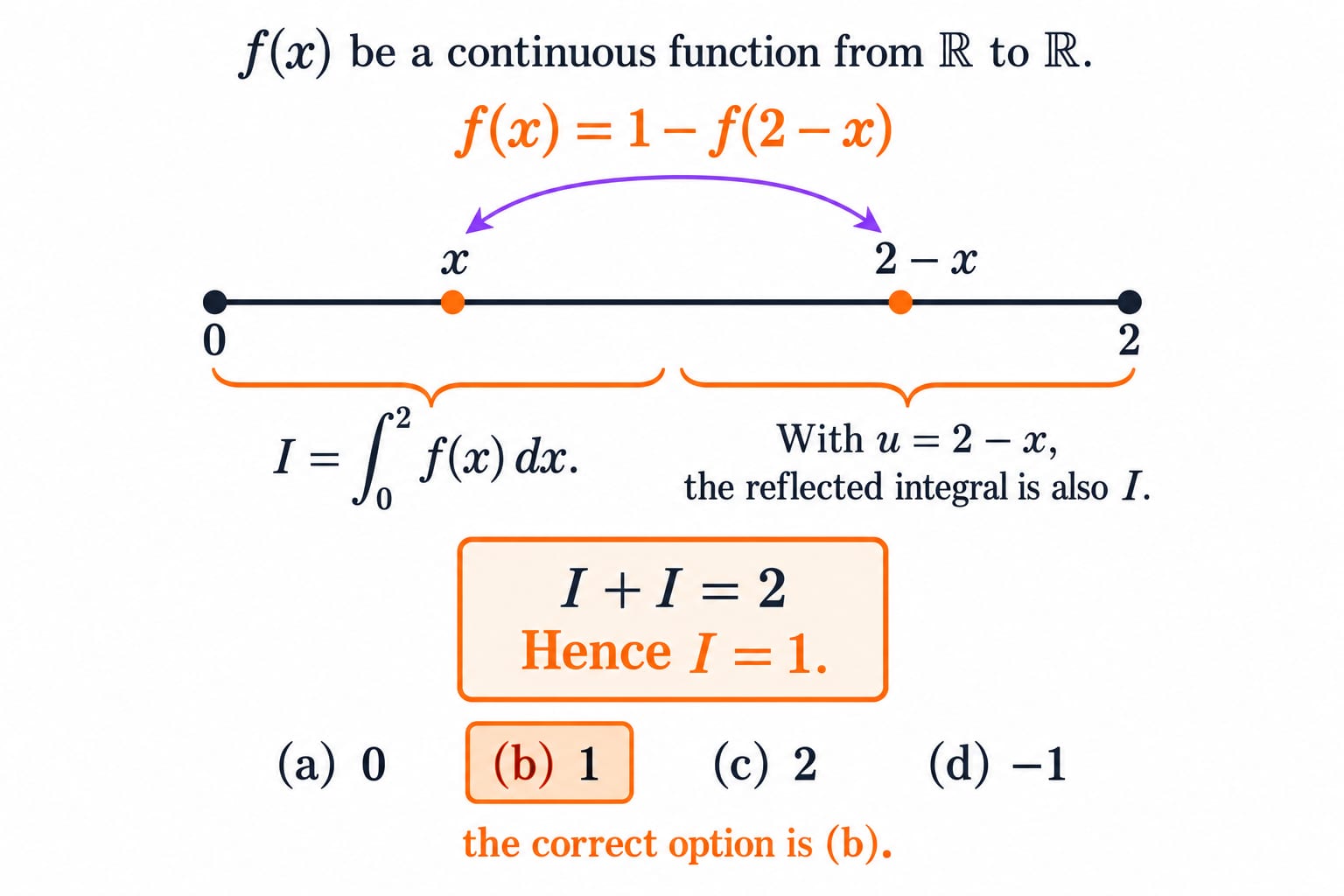
Let f(x) be a continuous function from R to R such that
f(x) = 1 - f(2 - x)
Which one of the following options is the CORRECT value of integral from 0 to 2 of f(x) dx?
(a) 0
(b) 1
(c) 2
(d) -1
Solution. Let I = integral from 0 to 2 of f(x) dx. Integrate f(x)+f(2-x)=1 over [0,2]. With u=2-x, the reflected integral is also I, so I+I=2. Hence I=1, and the correct option is (b). Source: GATE Computer Science, Set 2, 2024.
Questions 4-6: recognise the antiderivative and choose the substitution
Question 4: read the quotient rule backwards
The value of the integral from 0 to pi/2 of [(1 + 2 cos x) / (2 + cos x)^2] dx lies in the interval:
(a) (-1, 0)
(b) (0, 1)
(c) (-2, -1)
(d) (1, 2)
Solution. Read the quotient rule backwards:
(d)/(dx)((sin x)/(2+cos x))
=(cos x(2+cos x)+sin^2x)/((2+cos x)^2)
=(1+2cos x)/((2+cos x)^2).
The value is [sin x/(2+cos x)]_0^pi/2=1/2, which lies in (0,1). The correct option is (b). The MCA Entrance Mathematics study order gives a wider algebra-to-calculus route.
Question 5: simplify a tangent fraction
integral from 0 to pi/4 of (1 - tan x)/(1 + tan x)dx is equivalent to
(a) 0
(b) 1
(c) ln 2
(d) 1/2 ln 2
Solution. Use
(1-tan x)/(1+tan x)=tan((pi)/(4)-x).
With u=pi/4-x, the integral becomes
integral from 0 to pi/4 of tan(u) du=[-ln|cos u|]_0^pi/4=(1/2) ln 2.
The correct option is (d). Source: GATE Computer Science 2009.
Question 6: turn secant and cosecant powers into a polynomial
If integral sec^2 x csc^4 x dx = -(1/3) cot^3 x + k tan x - 2 cot x + C, then the value of k is
(a) 1
(b) 2
(c) 3
(d) 4
Solution. Put t=tan x. Then dt=sec^2xdx, and
csc^4x=((1+t^2)^2)/(t^4)=t^-4+2t^-2+1.
Thus the antiderivative is
-(1)/(3t^3)-2/t+t+C=-1/3cot^3x-2cot x+tan x+C.
Therefore k=1, so the correct option is (a). At x=pi/4, differentiating the result gives 2+4+2=8, matching sec^2xcsc^4x=2times4=8.
Questions 7-9: integration by parts and reduction formulas
Question 7: solve an integral equation after integrating by parts
The value of x such that x > 1, satisfying the equation integral from 1 to x of t ln t dt = 1/4 is
(a) sqrt(e)
(b) e
(c) e^2
(d) e - 1
Solution. Take u=ln t and dv=tdt. The antiderivative is
(t^2)/(2)ln t-(t^2)/(4).
Evaluation from 1 to x gives (x^2/2)ln x-x^2/4+1/4=1/4. Hence (x^2/4)(2ln x-1)=0. Since x>1, ln x=1/2, so x=sqrt e. The correct option is (a). Source: GATE Computer Science, Set 2, 2025.
Question 8: use integration by parts twice
The value of the integral given below is
integral from 0 to pi of x^2 cos xdx
(a) -2 pi
(b) pi
(c) -pi
(d) 2pi
Solution. First take u=x^2 and dv=cos xdx. The boundary term [x^2sin x]_0^pi is 0, leaving -2 integral from 0 to pi of x sin x dx. A second parts step gives
integral from 0 to pi of x sin x dx=[-x cos x+sin x]_0^pi=pi.
The answer is -2pi, so the correct option is (a). Its negative sign is sensible because x^2 gives more weight to the half where cos x<0.
Question 9: derive a recurrence rather than guessing its coefficients
If I_n = integral from 0 to a of (a^2 - x^2)^n dx, where n is a positive integer, then In expressed in terms of I_(n-1) equals:
(a) (2na^2 / (2n + 1)) I_(n-1)
(b) (2n^2a^2 / (2n + 1)) I_(n-1)
(c) (2na^2 / (2n - 1)) I_(n-1)
(d) (2n^2a^2 / (2n - 1)) I_(n-1)
Solution. Integrate by parts with u=(a^2-x^2)^n and dv=dx. The boundary term is 0, so
I_n = 2n integral from 0 to a of x^2(a^2-x^2)^(n-1)dx.
Replace x^2 by a^2-(a^2-x^2). Then I_n = 2n(a^2I_(n-1)-I_n), giving
(2n+1)I_n = 2na^2I_(n-1).
The correct option is (a). At n=1, it gives (2a^2/3)I_0=2a^3/3, equal to integral from 0 to a of (a^2-x^2) dx.
Questions 10-12: area, improper integrals and variable limits
Question 10: split the area where the curves cross
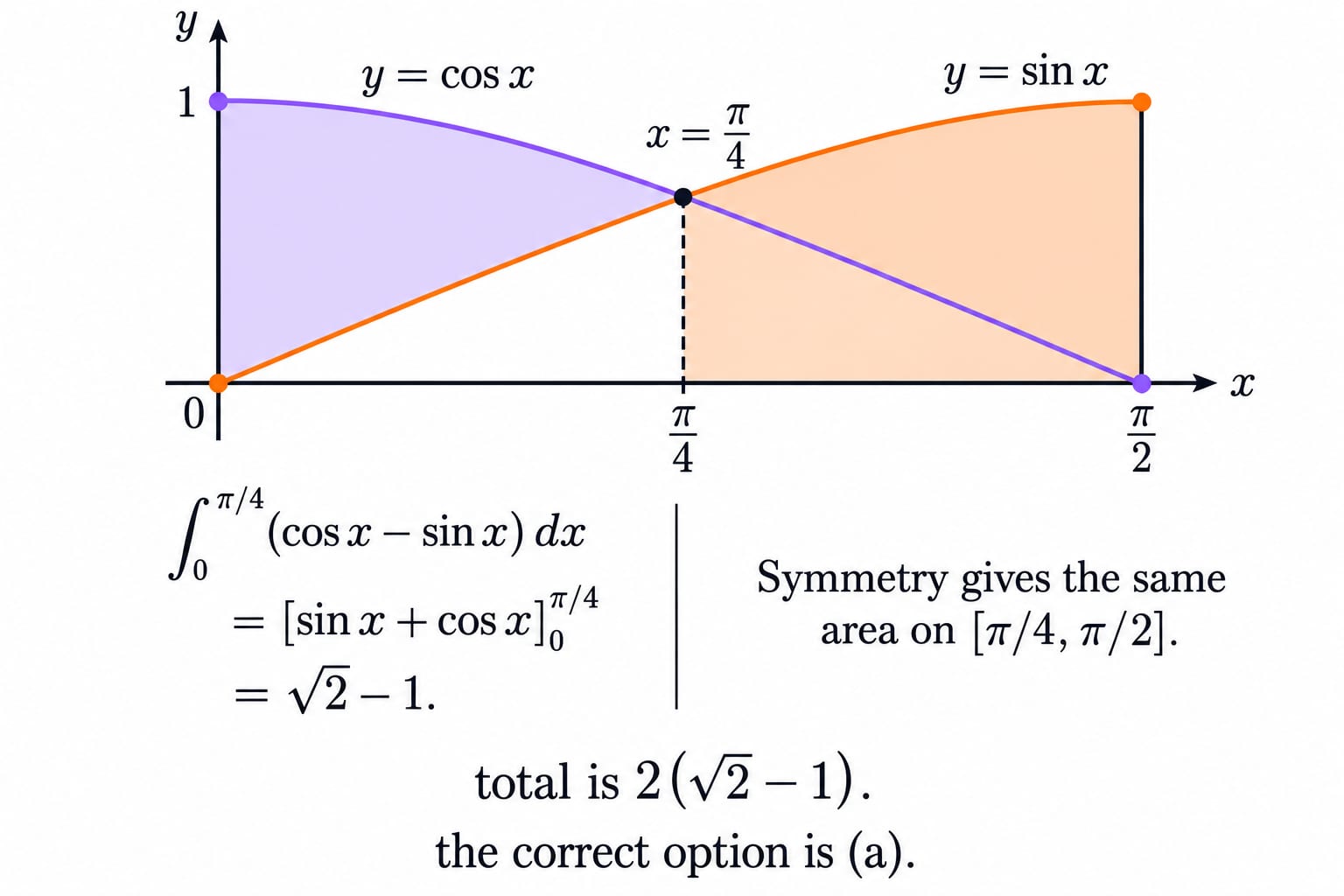
The area enclosed between the curves y = sin x and y = cos x for 0 <= x <= pi/2 is:
(a) 2(sqrt(2) - 1)
(b) 2(sqrt(2) + 1)
(c) sqrt(2) - 1
(d) sqrt(2) + 1
Solution. The curves meet at x=pi/4. On [0,pi/4],
integral from 0 to pi/4 of (cos x - sin x) dx=[sin x+cos x]_0^pi/4=sqrt(2)-1.
Symmetry gives the same area on [pi/4,pi/2], so the total is 2(sqrt(2)-1). The correct option is (a). Integrating sin x-cos x across the whole interval would cancel signed areas instead of measuring the enclosed area.
Question 11: separate boundedness from finite improper area
Let f(x) = x^-(1/3) and A denote the area of the region bounded by f(x) and the X-axis, when x varies from -1 to 1. Which of the following statements is/are TRUE?
I) f is continuous in [-1, 1]
II) f is not bounded in [-1, 1]
III) A is nonzero and finite
(a) II only
(b) III only
(c) II and III only
(d) I, II and III
Solution. At x=0, x^-1/3 is undefined and unbounded. Statement I is false and II is true. Geometric area uses the absolute value:
A=2 integral from 0 to 1 of x^(-1/3) dx = 2[3/2 x^(2/3)]_0^1 = 3.
The area is nonzero and finite, so III is true. The correct option is (c). An unbounded integrand need not produce a divergent improper integral. Source: GATE Computer Science, Set 2, 2015.
Question 12: differentiate an integral whose limits both move
The value of (d/dx) integral from (sin x)^2 to 2 sin x of e^(t^2) dt at x=pi is:
(a) 1
(b) -1
(c) 2
(d) -2
Solution. Leibniz's rule gives
F'(x) = e^((2 sin x)^2)(2 cos x) - e^(((sin x)^2)^2)(2 sin x cos x).
At x=pi, sin pi=0, cos pi=-1, and both exponential factors are e^0=1. Therefore F'(pi)=1(-2)-1(0)=-2, so the correct option is (d). No antiderivative of e^(t^2) is needed.
Score the set and revise the method that failed
Give yourself one point per correct answer. A score of 10 to 12 means you are ready for a mixed timed set. At 7 to 9, revise one weak method. At 4 to 6, rebuild symmetry and substitution recognition. At 0 to 3, return to the five-check card. These are editorial practice bands, not official cutoffs. Diagnose Q1 to Q3 for interval logic, Q4 to Q6 for reverse derivatives and substitution, Q7 to Q9 for parts and recurrence, and Q10 to Q12 for area, improper behaviour and Leibniz's rule. Next, try Linear Algebra for GATE CS for another calculation-heavy Engineering Mathematics drill.
Integration answer key and the next practice step
Answer key: Q1 (b) | Q2 (d) | Q3 (b) | Q4 (b) | Q5 (d) | Q6 (a) | Q7 (a) | Q8 (a) | Q9 (a) | Q10 (a) | Q11 (c) | Q12 (d)
For revision: inspect interval symmetry, resolve signs and boundaries, choose the method, carry the limits through every substitution, then verify sign and magnitude. If you want a sequenced route that places Engineering Mathematics beside the rest of GATE CS preparation, continue with GATE Guidance by Sanchit Sir. Solve the set again without opening the solutions, and write only the decisive transformation for each question.
Go deeper with the full courseDiscrete Mathematics
Keep learning

Levels of Testing MCQs: 12 Solved Questions on Unit, Integration, System and Acceptance Testing
Solve 12 testing-level MCQs while learning how scope, interfaces and the source of the expected result separate unit, integration, system and acceptance testing.
Updated 31 Oct 20268 min readMCQ Practice

Redux Toolkit Integration in React: Store, Slices, Async Thunks, and Runnable Examples
Build a Study Planner that traces each click through Redux Toolkit, calculates progress, filters tasks, loads deterministic async data and exposes failures.
Updated 4 Nov 20266 min readWeb Development

Teaching-Learning Aids and ICT Integration for Teaching Exams: Notes with Worked Classroom Examples
Learn how to select and sequence teaching-learning aids, recognise genuine ICT integration, and solve classroom scenarios with worked calculations.
Updated 30 Oct 20265 min readCTET & UPTET
Combinations With and Without Repetition: 12 Questions with Solutions
Choosing a combination formula starts with identifying what can repeat and what makes two selections different. Work through 12 MCQs covering ordinary selections, restrictions, bounded repeats and non-empty distributions.
Updated 7 Nov 20267 min readDiscrete Mathematics MCQs