

Combinations With and Without Repetition: 12 Questions with Solutions
Choosing a combination formula starts with identifying what can repeat and what makes two selections different. Work through 12 MCQs covering ordinary selections, restrictions, bounded repeats and non-empty distributions.
KnowledgeGate Team
Exam prep & CS education
Updated 7 Nov 20267 min read
The difficulty in combinations is recognising distinct items, repeatable types and minimum-per-group conditions before choosing a formula. These 12 questions have concise worked solutions; attempt each before reading its answer. Practise additional combinations questions in KnowledgeGate’s Placement Preparation question bank. The set moves from simple selections to distributions used in placement preparation, starting with simple selections and moving to distributions.
Decide what counts as a different selection
Order does not matter in a combination. Choosing pants P1, P2 and P3 gives the same selection as choosing P3, P1 and P2. For distinct items without replacement, choose r from n using C(n,r) = n!/[r!(n-r)!].
When n types can repeat without limit, selecting r items gives C(n+r-1,r). This is stars and bars: identical units are allocated among labelled types or recipients, with no upper capacity. If each of n recipients must receive at least one of r identical items, the count becomes C(r-1,n-1), provided r >= n.
Bounded repeats need a separate count, as Q9 shows. For conceptual revision, use the permutations and combinations counting method. First identify the objects and restrictions, then calculate.
Warm up with ordinary combinations
Q1. Choosing pants
Azhar wants to choose 3 pants out of 5 pants of his collection. How many ways are possible to make this selection?
(a) 15
(b) 10
(c) 8
(d) 20
Answer: (b), 10. The pants are distinct, but their selection order is irrelevant:
C(5,3) = 5!/(3!2!) = (5x4)/2 = 10.
Using 5P3 = 5x4x3 = 60 counts each selected set in 3! = 6 orders. Dividing 60 by 6 returns 10. See the worked three-pants selection.
Q2. Counting handshakes
23 people are there, they are shaking hands together, How many handshakes possible?
(a) 250
(b) 252
(c) 242
(d) 253
Answer: (d), 253. Count each pair of people shaking hands once, with no repeated handshakes. Each of 23 people has 22 possible partners, giving 23x22 = 506 person-to-person contacts. Each handshake appears twice, once from each end:
C(23,2) = 506/2 = 253.
The division removes duplicate counting; it does not remove any actual handshake.
Q3. Selecting toppings
A girl has to make a pizza with different toppings. There are 8 different toppings available. In how many ways can she choose 2 different toppings for the pizza?
(a) 16
(b) 56
(c) 112
(d) 28
Answer: (d), 28. Choose an unordered pair:
C(8,2) = 8x7/2 = 28.
Option (b), 56, counts both orders of every pair. Choosing topping X and then Y gives the same pair as choosing Y and then X. “Different toppings” also rules out taking the same topping twice.
Combine groups and use a complement
Q4. Selecting from two groups
In how many ways can a group of 5 members be formed by selecting 3 boys out of 6 and 2 girls out of 5 ?
(a) 567
(b) 789
(c) 200
(d) 498
Answer: (c), 200. Choose the boys in C(6,3) = (6x5x4)/(3x2x1) = 20 ways. Choose the girls in C(5,2) = 5x4/2 = 10 ways.
Every boys' selection can accompany every girls' selection, so multiply: 20x10 = 200. Adding 20+10 would count separate partial selections, not complete groups. Multiplication combines the choices needed for one outcome; addition combines mutually exclusive cases.
Q5. Requiring at least one boy
In a group of 6 boys and 4 girls, four children are to be selected. In how many different ways can they be selected such that at least one boy should be there?
(a) 210
(b) 209
(c) 202
(d) 250
Answer: (b), 209. Start with all selections:
C(10,4) = (10x9x8x7)/(4x3x2x1) = 210.
The forbidden selection contains no boys. That means choosing all four girls, possible in C(4,4) = 1 way. Therefore, valid selections = 210-1 = 209.
“At least one” includes one, two, three or four boys. Counting exactly one boy would answer a narrower question. Subtracting the single forbidden case is quicker than adding four valid cases.
Turn restrictions into disjoint cases
Q6. Allowing at most three men
In how many ways a team of 11 must be selected from 5 men and 11 women such that the team must comprise of not more than 3 men?
(a) 2009
(b) 2250
(c) 2256
(d) 2789
Answer: (c), 2256. “Not more than 3” permits zero, one, two or three men. Complete each team with women:
Men | Women | Number of teams |
|---|---|---|
0 | 11 | C(5,0)C(11,11) = 1x1 = 1 |
1 | 10 | C(5,1)C(11,10) = 5x11 = 55 |
2 | 9 | C(5,2)C(11,9) = 10x55 = 550 |
3 | 8 | C(5,3)C(11,8) = 10x165 = 1650 |
Add these disjoint cases: 1+55+550+1650 = 2256. The all-women team is allowed. Omitting it loses one valid selection. Revisit the at-most-three-men solution if that boundary case was easy to miss.
Q7. Meeting minimums in both parts
In an examination, 10 questions are to be answered, choosing at least 4 from each of Part A and Part B. If Part A and Part B each contain 6 questions, in how many ways can these 10 questions be answered?
(a) 44
(b) 55
(c) 66
(d) None
Answer: (c), 66. The legal splits (A,B) are (4,6), (5,5) and (6,4). Neither part can contribute more than six questions.
C(6,4)C(6,6) + C(6,5)C(6,5) + C(6,6)C(6,4)
= 15x1 + 6x6 + 1x15 = 15+36+15 = 66.
These are selections of questions, not orders of answering them. Each selection belongs to exactly one split, so adding the three counts creates no overlap.
Remove invalid pairs and respect bounded repeats
Q8. Counting diagonals
In a regular octagon, how many diagonals are possible?
(a) 31
(b) 11
(c) 20
(d) 68
Answer: (c), 20. Any two vertices define a segment, giving C(8,2) = 8x7/2 = 28 pairs. Eight adjacent pairs form sides. Removing them leaves 28-8 = 20 diagonals.
Check from each vertex: exclude itself and its two neighbours, leaving five diagonal endpoints. The count 8x5 counts each diagonal twice, so 8(8-3)/2 = 20 again.
Q9. Selecting repeated letters
Find the total number of combinations of 5 alphabets A, B, A, B, B taking some or all at a time.
(a) 10
(b) 11
(c) 12
(d) 13
Answer: (b), 11. Treat identical letters as indistinguishable. Choose 0, 1 or 2 As, and independently choose 0, 1, 2 or 3 Bs. Exclude the empty selection:
(2+1)(3+1)-1 = 12-1 = 11.
Check by selection size:
One letter: A, B.
Two letters: AA, AB, BB.
Three letters: AAB, ABB, BBB.
Four letters: AABB, ABBB.
Five letters: AABBB.
That gives 2+3+3+2+1 = 11. Unrestricted repetition would allow unavailable copies. Using 2^5-1 would distinguish the individual copies of A and B, overcounting the letter combinations. Here both the repeat limits and the exclusion of the empty selection matter.
Solve repetition and non-empty distributions
Q10. Selecting repeatable car types
A showroom contains 20 cars. In how many ways can 8 cars be selected if each car can be repeated any number of times?
(a) 20C7
(b) None of these
(c) 20C8
(d) 27C8
Answer: (d), 27C8. Since repetition is explicitly allowed, interpret the 20 cars as 20 selectable types with unlimited copies. They are not 20 unique physical vehicles removed once each.
Let x_i count selections of type i. Then x_1+...+x_2_0 = 8, with each x_i >= 0. Eight stars represent selections and 19 bars separate the 20 types. Choose the eight star positions among 27 positions:
C(20+8-1,8) = C(27,8) = 2,220,075.
Plain C(20,8) forbids repeated types. The selection with repetition solution uses the unlimited-copy interpretation.
Q11. Filling distinct boxes
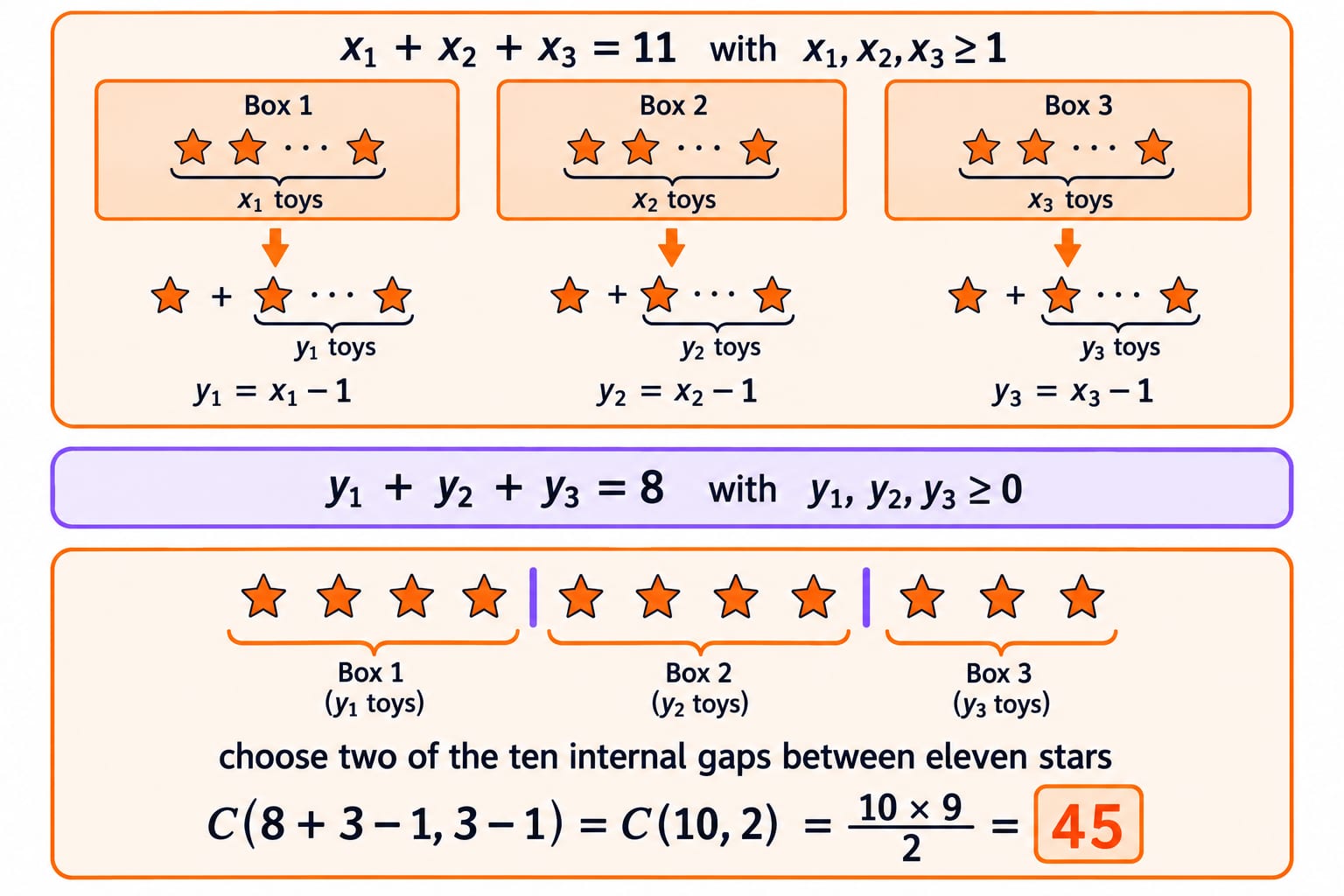
In how many ways can 11 identical toys be placed in 3 distinct boxes such that no box is empty?
(a) 72
(b) 54
(c) 45
(d) 36
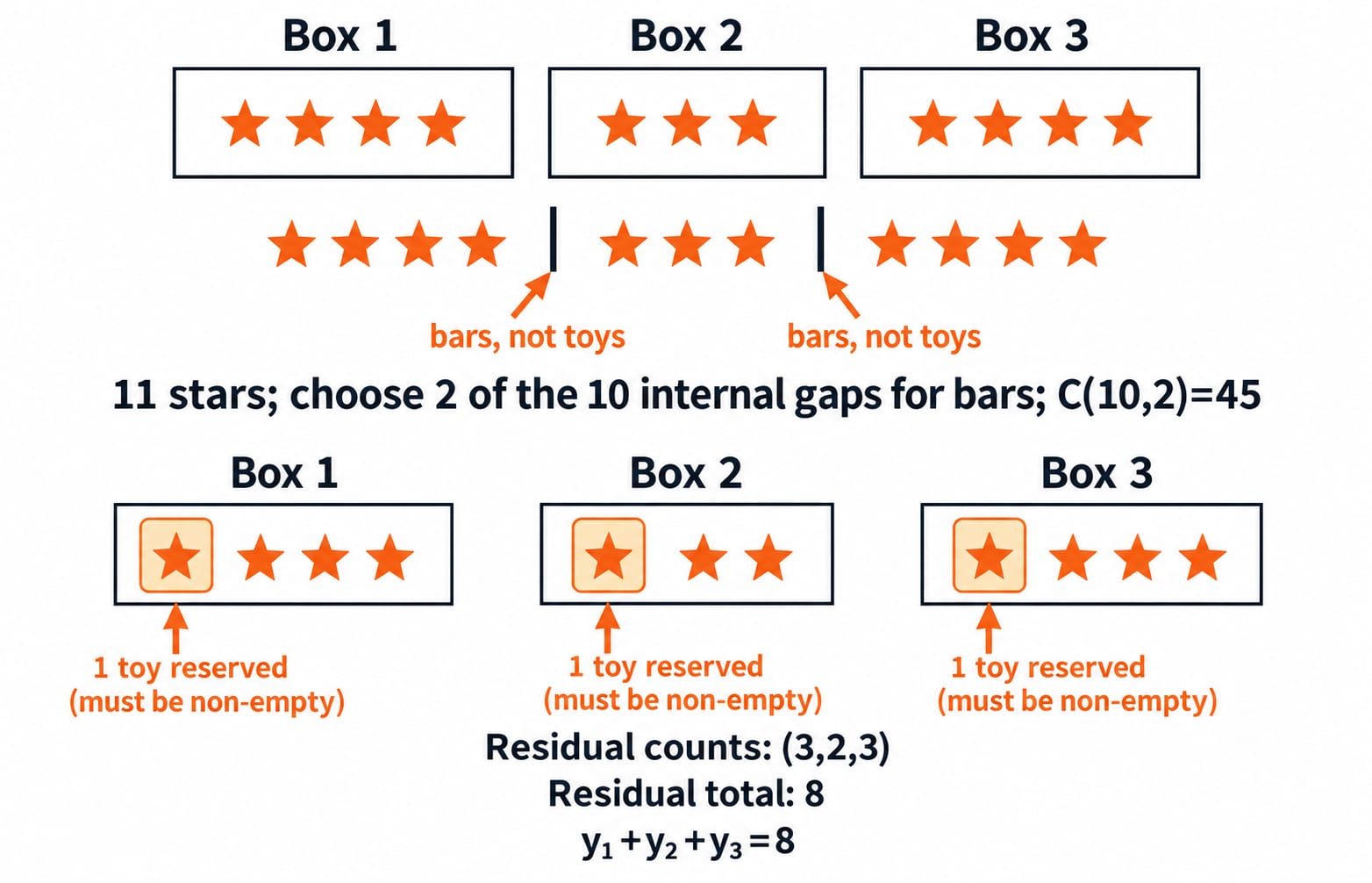
Answer: (c), 45. Write x_1+x_2+x_3 = 11, with every x_i >= 1. Reserve one toy per box, leaving 11-3 = 8 toys. Put y_i = x_i-1, so y_1+y_2+y_3 = 8 with every y_i >= 0.
Stars and bars gives C(8+3-1,3-1) = C(10,2) = 10x9/2 = 45. Equivalently, choose two of the ten internal gaps between eleven stars. Both methods enforce non-empty boxes; compare them in the non-empty-boxes solution.
Q12. Giving every student a pencil
In how many ways can we distribute 10 identical pencil into 4 students so that each student get at least 1 pencil ?
(a) 64
(b) 72
(c) 78
(d) 84
Answer: (d), 84. Reserve one pencil for each student: 10-4 = 6 remain. Count non-negative solutions of y_1+y_2+y_3+y_4 = 6:
C(6+4-1,4-1) = C(9,3) = 9x8x7/6 = 84.
Using C(13,3) would distribute all ten pencils without the initial reservation, allowing students to receive none.
Check the model before the arithmetic
Answer strip: 1 (b)/10; 2 (d)/253; 3 (d)/28; 4 (c)/200; 5 (b)/209; 6 (c)/2256; 7 (c)/66; 8 (c)/20; 9 (b)/11; 10 (d)/C(27,8); 11 (c)/45; 12 (d)/84.
Reattempt wrong answers after naming the error: counted order, missed a case, allowed an empty group or ignored a repeat limit. Write that diagnosis before substituting numbers. The formula becomes much easier to choose once the selection model is clear.
If you are preparing for that assessment, continue with the AMCAT preparation course.
Go deeper with the full courseDiscrete Mathematics
Keep learning
How to Use Practice Exams and Past Papers with Spaced Repetition
Turn practice exams and past papers into a spaced revision system. Learn how to analyse mistakes, schedule reattempts, and fit mocks into a weekly study plan.
Updated 29 Oct 20265 min read59 viewsGATE Strategy & Roadmap

Permutations and Combinations for GATE CS: Counting Questions Solved with a Repeatable Method
One repeatable method (choose, arrange, subtract) applied to 20 GATE-style counting problems, with the four-question decision procedure that replaces formula memorisation for permutations and combinations in GATE CS.
Updated 30 Oct 20266 min read282 viewsEngineering Mathematics
Range, Mean Deviation, Variance and Standard Deviation: 12 Questions with Solutions
Practise 12 questions on dispersion, from finding a range to recovering a missing number. Each solution shows the calculation and the trap to avoid.
Updated 2 Nov 20267 min readDiscrete Mathematics MCQs
Integration Questions with Solutions: 12 Solved MCQs
Solve 12 integration MCQs step by step, then use your score to identify whether symmetry, substitution, integration by parts or limits need revision.
Updated 29 Oct 20267 min readDiscrete Mathematics MCQs