Levels of Testing MCQs: 12 Solved Questions on Unit, Integration, System and Acceptance Testing
Solve 12 testing-level MCQs while learning how scope, interfaces and the source of the expected result separate unit, integration, system and acceptance testing.
KnowledgeGate Team
Exam prep & CS education
Updated 17 Aug 20268 min read

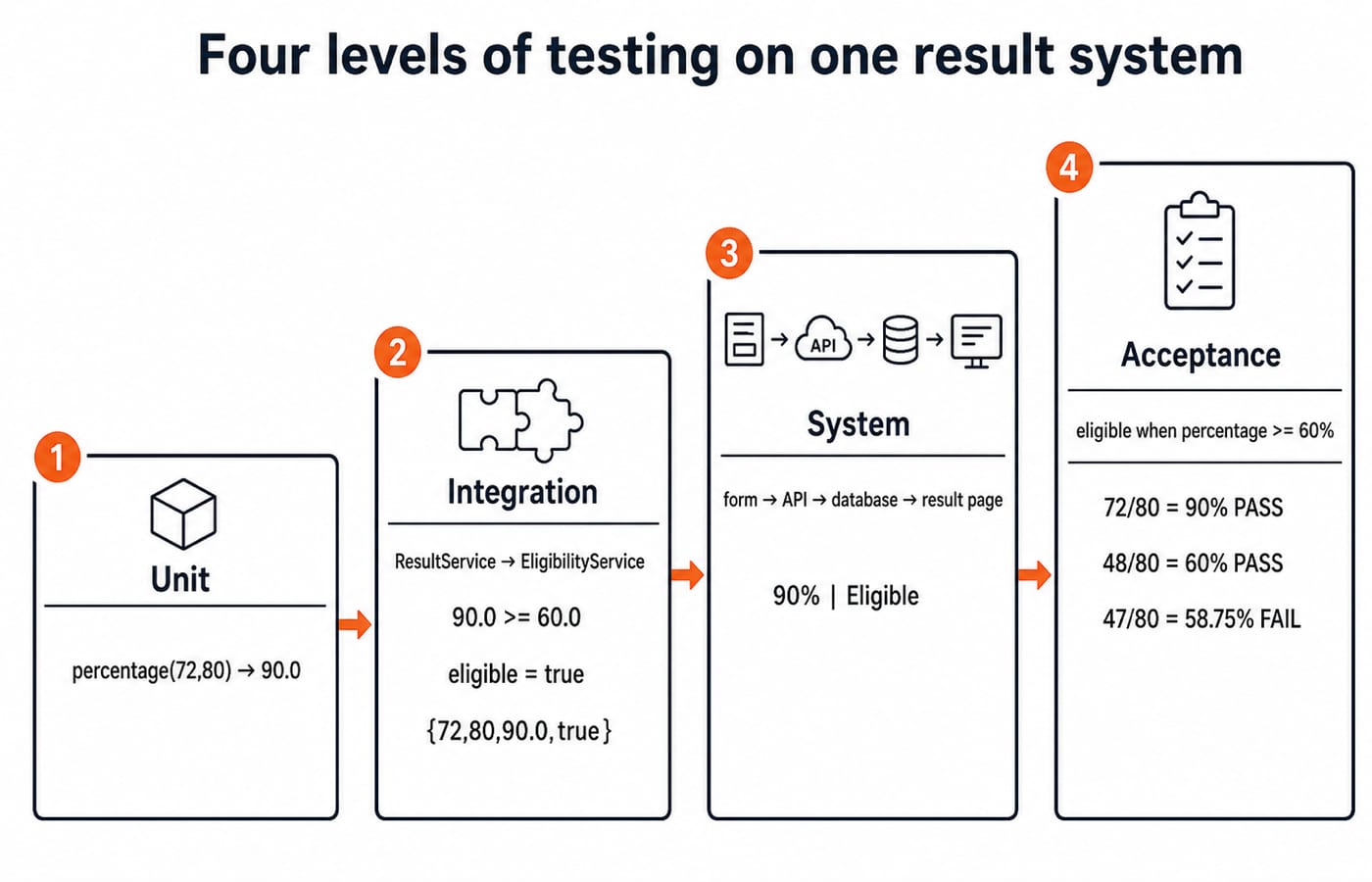
Unit, integration, system and acceptance testing sound obvious when each definition appears alone, but mixed options make them harder to separate. A question can combine a testing level with a technique, a user viewpoint, a stub, a complete-system check or an acceptance condition. One decision rule settles most of them: first identify what is under test, then ask which interfaces are real, and finally ask whose requirement supplies the expected result. One worked example carries the distinction throughout: a score of 72 out of 80, a percentage function that must return 90.0, and an agreed eligibility rule that accepts anything at 60% or above.
1. Unit, integration, system and acceptance testing at a glance
Scope separates the four levels. Unit checks one component, integration checks collaborating components, system checks the assembled product, and acceptance checks agreed user or business needs. Black-box, white-box, functional and regression describe techniques or purposes, not replacement levels.
The same 72-out-of-80 score produces a different check, and a different piece of evidence, at each of the four levels.
Level | Check on the 72/80 example | Result |
|---|---|---|
Unit |
|
|
Integration |
|
|
System |
| screen shows |
Acceptance | agreed rule |
|
The exam-safe normal progression is unit -> integration -> system -> acceptance. Delivery pipelines may overlap these activities, so "usually" matters.
2. Testing-level order and definition MCQs
Q1. Normal order of testing levels
Arrange the following types of testing in the order they are usually performed in the software development life cycle.
A. Integration testing
B. Unit testing
C. System Testing
D. Acceptance Testing
Choose the correct answer from the options given below
(A) B, C, A, D
(B) B, A, C, D
(C) C, B, A, D
(D) C, B, D, A
Answer: (B) B, A, C, D. Testing usually widens from units to interfaces, the complete system and acceptance needs. It is a classic sequence, not an inflexible project schedule. (UGC NET June 2025, see the solved page)
Q2. Match each level with its scope
Match List I (Testing Type) with List II (Description):
Testing Type | Description |
|---|---|
(A) Unit testing | (I) Testing individual components of the software. |
(B) Integration testing | (II) Testing the interaction between integrated components. |
(C) System testing | (III) Testing to verify the system meets business needs. |
(D) Acceptance testing | (IV) Testing the complete system to ensure it meets requirements. |
Choose the correct answer from the options given below:
(A) (A)-(I), (B)-(II), (C)-(III), (D)-(IV)
(B) (A)-(I), (B)-(II), (C)-(IV), (D)-(III)
(C) (A)-(I), (B)-(III), (C)-(II), (D)-(IV)
(D) (A)-(I), (B)-(IV), (C)-(II), (D)-(III)
Answer: (B). Unit maps to a component, integration to interactions, system to the complete product and acceptance to business needs. "Complete system" differs from the stakeholder's >= 60% acceptance rule. (UGC NET August 2024, see the solved page)
If the answer format itself is confusing, read MCQ, MSQ or NAT? GATE Question Types Explained to see how each response type is entered.
3. Unit and integration testing MCQs: coverage, stubs and missing modules
Q3. Unit-test coverage and reliability
In unit testing of a module, it is found that for a set of test data, at the maximum 90% of the code alone were tested with the probability of success 0.9. The reliability of the module is
(A) Greater than 0.9
(B) Equal to 0.9
(C) At most 0.81
(D) At least 0.81
Answer: (C) At most 0.81. In this question's model, the bound is 0.90 x 0.90 = 0.81. This is not a universal reliability formula, and coverage alone cannot expose unexecuted code or weak assertions. (ISRO 2018, see the solved page)
Q4. Top-down integration and test doubles
Which of the following are facts about a top-down software testing approach?
I. Top-down testing typically requires the tester to build method stubs.
II. Top-down testing typically requires the tester to build test drivers.
(A) only I
(B) Only II
(C) Both I and II
(D) Neither I nor II
Answer: (A) only I. Top-down integration uses stubs for unavailable lower modules. Bottom-up integration uses drivers to imitate missing higher-level callers. (UGC NET January 2017, see the solved page)
Q5. Purpose of a stub
What is the purpose of a "stub" in software testing?
(A) To simulate the behavior of a missing or incomplete module
(B) To generate test data for a module
(C) To analyze code coverage during testing
(D) To identify performance bottlenecks in a module
Answer: (A). A stub stands in for an absent dependency, such as EligibilityService returning eligible = true for 90.0. A driver instead calls an available EligibilityService directly with 90.0 and threshold 60.0. (Deloitte 2025, see the solved page)
4. System testing MCQs: the complete product and shared responsibility
Q6. Testing the entire system as a whole
Which testing technique focuses on testing the entire software system as a whole?
(A) Unit testing
(B) Integration testing
(C) System testing
(D) Acceptance testing
Answer: (C) System testing. Units and interfaces are narrower scopes. Acceptance judges agreed needs, while "entire software system as a whole" identifies system scope. (Deloitte 2024, see the solved page)
Q7. Overall system function and performance
Which of the following software testing verifies that all elements mesh properly and that overall system function/performance is achieved?
(A) Unit testing
(B) Integration testing
(C) Validation testing
(D) System testing
Answer: (D) System testing. "All elements mesh properly" suggests integration, but "overall system function/performance" widens the scope, so the answer is the level that exercises the assembled product rather than the interfaces between two of its parts. Validation testing checks the software against customer expectations, which is an acceptance concern, not a mesh-and-performance one. (RPSC 2024, see the solved page)
Q8. A classic system-testing problem
A classic system testing problem is
(A) software-pointing
(B) test-pointing
(C) data-pointing
(D) finger-pointing
Answer: (D) finger-pointing. Cross-layer failures tempt teams to shift blame. Input 72,80, stored record {72,80,90.0,true}, environment, observed output and expected output provide shared evidence for tracing the cause. (MPPSC 2025, see the solved page)
5. Acceptance testing MCQs: business needs, user perspective and functional checks
Q9. Business and compliance requirements
Which type of testing in the Software Development Life Cycle (SDLC) is primarily performed to verify that the software satisfies business and compliance requirements?
(A) Unit Testing
(B) Integration Testing
(C) Blackbox Testing
(D) Acceptance Testing
(E) Regression Testing
Answer: (D) Acceptance Testing. Business and compliance needs supply the acceptance criteria. Blackbox is a technique, regression checks changes, and lower levels do not prove stakeholder acceptance. (IBPS 2024, see the solved page)
Q10. Evaluating from the user's perspective
Which testing technique focuses on evaluating the software from the user's perspective?
(A) Unit testing
(B) Integration testing
(C) System testing
(D) Acceptance testing
Answer: (D) Acceptance testing. The user's perspective makes the agreed need the oracle. System testing can use the same path, but its defining scope is the complete product. (Deloitte 2025, see the solved page)
Q11. A method used for acceptance tests
Which of the following testing methods is normally used as the acceptance test for a software system?
(A) Regression testing
(B) Integration testing
(C) Unit testing
(D) Functional testing
Answer: (D) Functional testing. Acceptance scenarios commonly use functional checks. Acceptance is the level and decision context, while functional testing is a method, so the terms are not identical. (UPPSC 2022, see the solved page)
The boundary matters: percentage >= 60.0 accepts 48/80 = 60% and rejects 47/80 = 58.75%. Implementing percentage > 60.0 could pass lower-level tests yet fail acceptance.
6. Mixed classification MCQ: pair each level with a test style
Q12. Match levels with associated testing styles
In context of software testing match of Column-I and Column-II is:
Column-I | Column-II |
|---|---|
i. Integration Testing | a. Alpha Testing |
ii. Unit Testing | b. Usability Testing |
iii. Acceptance Testing | c. Data Flow Testing |
iv. System Testing | d. Black Box Testing |
(A) i-a, ii-b, iii-d, iv-c
(B) i-d, ii-c, iii-b, iv-a
(C) i-c, ii-d, iii-a, iv-b
(D) i-b, ii-d, iii-a, iv-c
Answer: (C) i-c, ii-d, iii-a, iv-b. The official key pairs integration with data flow, unit with black box, acceptance with alpha and system with usability. Alpha testing is the anchor: it is a pre-release trial run by users at the developer's site, which makes it an acceptance activity, so iii-a already rules out options (A) and (B). Between the two survivors, only (C) leaves usability with the assembled system; (D) would pair usability with integration, which tests interfaces a user never sees. The other three labels are techniques, and technique is independent of level, so a unit test written purely from a function's stated behaviour counts as black box at the unit level even though white-box is the usual default there. Treat these as this paper's associations, not exclusive identities, and classify scope and oracle before technique. (HTET 2022, see the solved page)
7. Testing-level revision checklist and next practice step
Level | Smallest useful question | Worked-example evidence | Common trap |
|---|---|---|---|
Unit | Does | function result | confusing coverage with reliability |
Integration | Does | interface contract | stub versus driver |
System | Does the full flow display | end-to-end outcome | stopping at interface checks |
Acceptance | Does | stakeholder criterion | calling every functional check acceptance |
Attempt all 12 questions without reading the explanations. When you miss one, label the miss as scope, oracle, technique or test-double, then re-attempt that category after 48 hours. Why PYQs Beat Buying Another Question Bank explains this practice approach, and DBMS Transaction MCQs provides the next solved set for applying it.
If you want a structured, ready-built plan, follow GATE Guidance by Sanchit Sir. If you only want to explore, browse the current GATE CS learning catalogue through GATE CS Exam Preparation.
The short version is component -> interfaces -> complete system -> accepted need. Identify that path first, and testing-level options become much easier to classify.
Keep learning

Ecosystem Fundamentals MCQs: 10 Solved Questions on Meaning and Ecological Organisation
Solve 10 ecosystem MCQs with clear explanations of ecological organisation, productivity, sustainability, environmental ethics, energy balance and conservation.
8 Sep 20268 min readMCQ Practice
Architectural and Component Design MCQs: 12 Solved Questions
Solve 12 bank MCQs on software architecture, component roles, repositories, MVC, DFDs, structure charts and UML, each with a direct worked explanation.
Updated 6 Sep 20268 min readMCQ Practice

C++ Constructors MCQs: 12 Solved Object-Initialization Questions
Solve 12 published C++ constructor questions by tracing object creation, copy semantics, arrays, access, virtual rules, and dynamic allocation.
Updated 5 Sep 20267 min readMCQ Practice

Clipping Algorithms MCQs: 11 Solved Cohen-Sutherland and Cyrus-Beck Questions
Solve 11 clipping questions with fresh explanations, checked outcodes, line classifications, boundary intersections and a practical revision routine.
Updated 3 Sep 20268 min readMCQ Practice