

Differentiability and Differentiation Questions with Solutions: 12 Solved MCQs
Work through 12 solved questions from the KnowledgeGate question bank on differentiability and differentiation. Each solution shows the decisive test, from one-sided derivatives to related rates.
KnowledgeGate Team
Exam prep & CS education
Updated 29 Oct 20267 min read
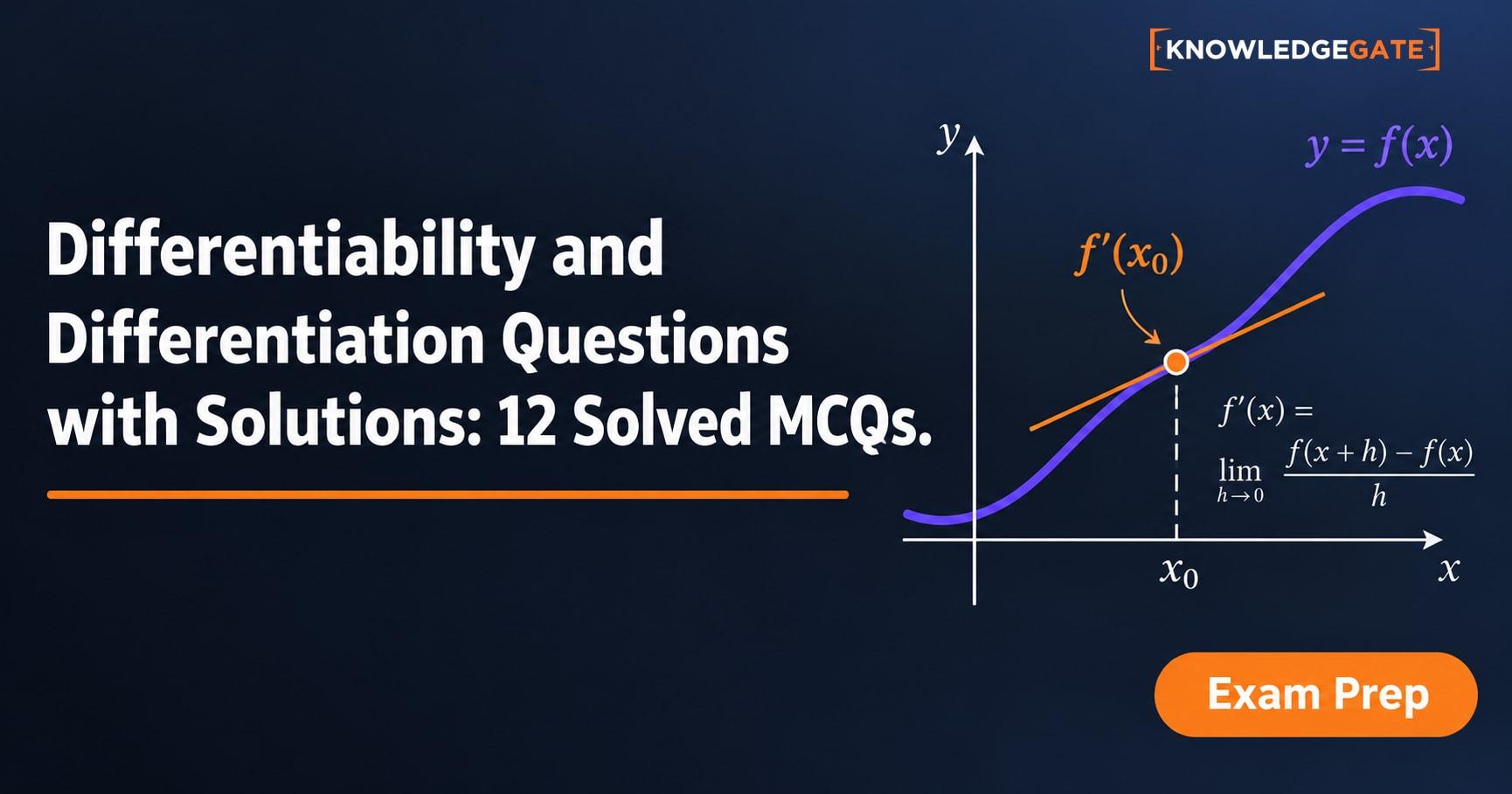
Knowing derivative formulas is often not the real problem. Students lose a question at a join point, a theorem condition, an interval restriction or one negative sign. Work through 12 solved questions from the KnowledgeGate question bank, with working after each answer. The wider GATE CS Exam Preparation resources.
Differentiability and differentiation: the test card to use
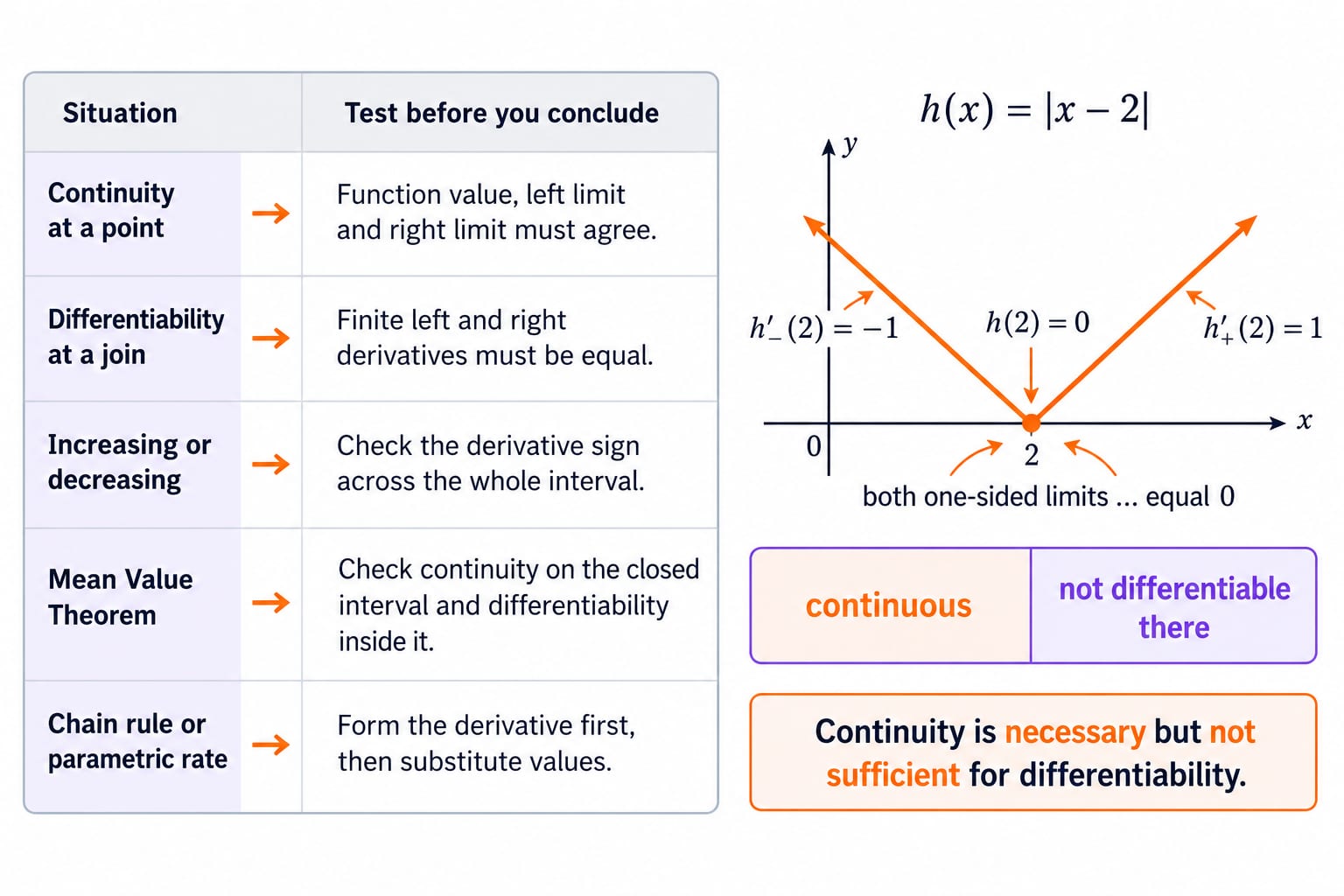
Situation | Test before you conclude |
|---|---|
Continuity at a point | Function value, left limit and right limit must agree. |
Differentiability at a join | Finite left and right derivatives must be equal. |
Increasing or decreasing | Check the derivative sign across the whole interval. |
Mean Value Theorem | Check continuity on the closed interval and differentiability inside it. |
Chain rule or parametric rate | Form the derivative first, then substitute values. |
Calibrate this card with h(x)=|x-2|. At x=2, both one-sided limits and h(2) equal 0, so h is continuous. However, h'_-(2)=-1 and h'_+(2)=1, so it is not differentiable there. Continuity is necessary but not sufficient for differentiability. For structured theory and practice in Engineering Mathematics for GATE Exam, keep this distinction visible while solving.
Questions 1-3: join points, piecewise conditions and the absolute-value cusp
Question 1: where the active maximum branch changes
Let f: R to R be a function such that f(x) = max{x, x^3}, x in R , where R is the set of all real numbers. The set of all points where f(x) is NOT differentiable is
(a) {-1, 1, 2}
(b) {-2, -1, 1}
(c) {0, 1}
(d) {-1, 0, 1}
Solution. A branch can change only where x=x^3. Thus x(x-1)(x+1)=0, giving candidates -1,0,1. The active branches are x for x<-1, x^3 for -1<x<0, x for 0<x<1, and x^3 for x>1. The left and right derivative pairs are (1,3), (0,1) and (1,3), respectively. Every pair differs. Answer: (d).
Question 2: make a three-piece function smooth at both joins
Let f: R to R be a function. Note: R denotes the set of real numbers. f(x) = -x, if x < -2; f(x) = a x^2 + b x + c, if x in [-2, 2]; f(x) = x, if x > 2. Which one of the following choices gives the values of a, b, c that make the function f continuous and differentiable?
(a) a = 1/4, b = 0, c = 1
(b) a = 1/2, b = 0, c = 0
(c) a = 0, b = 0, c = 0
(d) a = 1, b = 1, c = -4
Solution. Continuity at -2 and 2 gives
4a - 2b + c = 2; 4a + 2b + c = 2.
Matching derivatives gives
-4a + b = -1; 4a + b = 1.
Subtracting the continuity equations gives 4b=0, so b=0. The derivative equations then give 4a=1, hence a=1/4, and continuity gives 1+c=2, so c=1. Check: the four left sides become 2,2,-1,1, exactly their required values. Answer: (a).
Question 3: continuity does not guarantee differentiability
Consider the following two statements about the function f(x) = |x|: P. f(x) is continuous for all real values of x. Q. f(x) is differentiable for all real values of x. Which of the following is TRUE?
(a) P is true and Q is false.
(b) P is false and Q is true.
(c) Both P and Q are true.
(d) Both P and Q are false.
Solution. The function |x| is continuous for every real x, including 0. Its derivative is -1 for x<0 and 1 for x>0. At 0 the one-sided derivatives differ, so Q fails there while P remains true. Answer: (a).
Questions 4-6: derivative signs, the chain rule and a power-series coefficient
Question 4: identify the function increasing on the whole interval
Consider the functions: I. e^(-x), II. x^2 - sin(x), and III. sqrt(x^3 + 1). Which function or functions are increasing everywhere on [0, 1]?
(a) III only
(b) II only
(c) II and III only
(d) I and III only
Solution. For I, the derivative is -e^-x<0, so it decreases. For II, the derivative is 2x-cos x, which equals -1 at 0 and stays negative near 0. It is not increasing everywhere. For III, the derivative is 3x^2/(2sqrt(x^3+1)), non-negative on [0,1] and positive for x>0. The function is increasing across the interval. Answer: (a).
Question 5: differentiate the scaled sigmoid at zero
The value of the derivative of Sigmoid function given by f(x) = 1/(1 + e^(-2x)) at x = 0 is
(a) 0
(b) 1 / 2
(c) 1 / 4
(d) infinity
Solution. Write f(x)=(1+e^-2x)^-1. The chain rule gives
f'(x)=(2e^-2x)/((1+e^-2x)^2).
At 0, e^0=1, so f'(0)=2/(1+1)^2=2/4=1/2. As a check, f'(x)=2f(x)(1-f(x)); using f(0)=1/2 again gives 1/2. Answer: (b).
Question 6: differentiate the geometric series and reindex
Let G(x) = 1/(1 - x)^2 = sum[i=0..infinity] g(i)x^i, where |x| < 1. What is g(i)?
(a) i
(b) i+1
(c) 2i
(d) 2^i
Solution. For |x|<1,
1/(1 - x) = sum[n=0..infinity] x^n.
Differentiate term by term:
1/(1 - x)^2 = sum[n=1..infinity] n x^(n - 1) = sum[i=0..infinity] (i + 1)x^i.
Therefore g(i)=i+1. Answer: (b).
Questions 7-9: Mean Value Theorem checks and a parametric normal
Question 7: find both Mean Value Theorem points
Find a value of c such that the conclusion of the Mean Value Theorem is satisfied for f(x) = -2x^3 + 6x - 2 on the interval [-2, 2]
(a) 2sqrt(1/3) and -2sqrt(1/3)
(b) 4sqrt(1/3) and -4sqrt(1/3)
(c) sqrt(1/3) and -sqrt(1/3)
(d) 3sqrt(1/2) and -3sqrt(1/2)
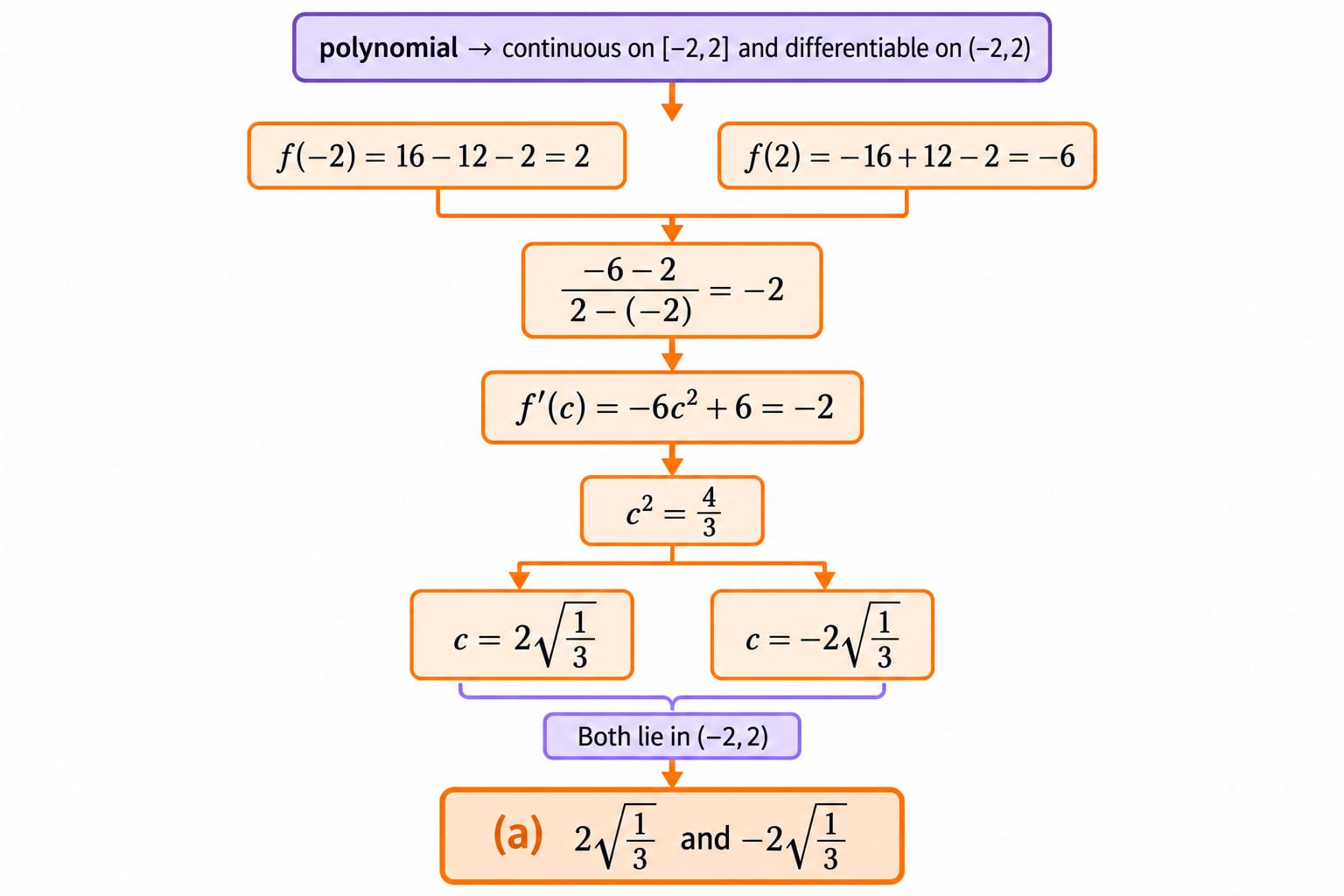
Solution. f(x)=-2x^3+6x-2 is a polynomial, so it is continuous on [-2,2] and differentiable on (-2,2). Now f(-2)=16-12-2=2 and f(2)=-16+12-2=-6. The secant slope is
(-6-2)/(2-(-2))=(-8)/(4)=-2.
Set f'(c)=-6c^2+6=-2. Then c^2=4/3, so c=+/-2sqrt(1/3), approximately +/-1.155. Both lie in (-2,2). Answer: (a).
Question 8: recognise when the theorem cannot be applied
What is the value of c as per the Mean Value Theorem for f(x) = |x| over the interval [-8, 6]?
(a) -1/7
(b) 0
(c) not determined
(d) 1
Solution. The secant slope is
(|6|-|-8|)/(6-(-8))=(6-8)/(14)= -1/7.
But |x| is not differentiable at 0, which lies inside (-8,6), so the Mean Value Theorem does not apply. Also, f'(x) is either -1 or 1 away from 0, never -1/7. No valid c exists. Answer: (c).
Question 9: move from a parametric tangent to the normal
The slope of the normal line to the curve x = t^2 + 3t - 8 and y = 2t^2 - 2t - 5 at the point (2, -1) is:
(a) 22/7
(b) -7/6
(c) -5
(d) -6/7
Solution. Solving t^2+3t-8=2 gives t=-5 or 2. Also, 2t^2-2t-5=-1 gives t=-1 or 2. The common parameter is t=2. Then dx/dt=2t+3=7 and dy/dt=4t-2=6. The tangent slope is 6/7, so the normal slope is -7/6. The product (6/7)(-7/6)=-1 checks the result. Answer: (b). The MCA Entrance Mathematics study order gives a wider algebra-to-calculus sequence.
Questions 10-12: inverse trigonometry, a hidden smooth join and related rates
Question 10: use the interval before undoing inverse tangent
If y = tan^(-1)((3x - x^3)/(1 - 3x^2)), where -1/sqrt3 < x < 1/sqrt3, then dy/dx is
(a) -1/(1 + x2)
(b) 3/(1 + x2)
(c) 3/sqrt(1 + x2)
(d) 1/sqrt(1 + x2)
Solution. Let x = tan(theta), so theta = tan^(-1)(x). The interval gives -pi/6<theta<pi/6, hence -pi/2<3theta<pi/2. Using tan 3theta=(3tan(theta)-tan^3(theta))/(1-3tan^2(theta)), the fraction is tan(3theta). The principal-range check permits
y=tan^-1(tan(3theta))=3theta=3tan^-1x.
Thus dy/dx=3/(1+x^2). At x=0, this equals 3, which checks the result. Answer: (b).
Question 11: an absolute value without a cusp
The set of points where the function f(x) = x / (1 + |x|) is differentiable, is:
(a) (-infinity, -1) union (1, infinity)
(b) (-infinity, infinity)
(c) (0, infinity)
(d) (-infinity, 0) union (0, infinity)
Solution. For x>=0, f(x)=x/(1+x) and f'(x)=1/(1+x)^2. For x<0, f(x)=x/(1-x) and f'(x)=1/(1-x)^2. At 0, the difference quotient is
limit as h -> 0 of (f(h) - f(0))/h = limit as h -> 0 of 1/(1 + |h|) = 1.
Both sides agree, so the function is differentiable for every real x. Answer: (b).
Question 12: related rates with sign and units
If the radius of a circle changes at the rate of -2/pi m/sec, at what rate does the circle's area change when the radius is 10 m?
(a) 40 m2/sec
(b) 30 m2/sec
(c) -30 m2/sec
(d) -40 m2/sec
Solution. From A=pi r^2, differentiate with respect to time:
dA/dt = 2pi r dr/dt.
With r=10 m and dr/dt=-2/pi m/sec,
dA/dt = 2pi(10)(-2/pi) = -40 m^2/sec.
The negative sign means the area is shrinking. Answer: (d).
Score the set and diagnose the exact method to revise
Score one point per correct answer. Use these practice bands, not official cutoffs: 10-12 means you are ready for a mixed timed set; 7-9 needs one-method revision; 4-6 calls for rebuilding join tests and derivative rules; 0-3 means restart with the test card. Revise Q1-Q3 for joins, Q4-Q6 for derivative rules, Q7-Q9 for theorem and parametric methods, and Q10-Q12 for domains, piecewise work and rates. Then try Linear Algebra for GATE CS as another calculation-heavy drill.
Answer key, short revision card and next practice step
Answer key: Q1 (d) | Q2 (a) | Q3 (a) | Q4 (a) | Q5 (b) | Q6 (b) | Q7 (a) | Q8 (c) | Q9 (b) | Q10 (b) | Q11 (b) | Q12 (d)
For every new question: identify the domain or join; check the theorem or rule conditions; differentiate before substituting values; verify the sign, interval and units. If you want a sequenced route that places Engineering Mathematics beside the rest of your preparation, use GATE Guidance by Sanchit Sir as the next step.
Go deeper with the full courseDiscrete Mathematics
Keep learning
Combinations With and Without Repetition: 12 Questions with Solutions
Choosing a combination formula starts with identifying what can repeat and what makes two selections different. Work through 12 MCQs covering ordinary selections, restrictions, bounded repeats and non-empty distributions.
Updated 7 Nov 20267 min readDiscrete Mathematics MCQs
Range, Mean Deviation, Variance and Standard Deviation: 12 Questions with Solutions
Practise 12 questions on dispersion, from finding a range to recovering a missing number. Each solution shows the calculation and the trap to avoid.
Updated 2 Nov 20267 min readDiscrete Mathematics MCQs
Integration Questions with Solutions: 12 Solved MCQs
Solve 12 integration MCQs step by step, then use your score to identify whether symmetry, substitution, integration by parts or limits need revision.
Updated 29 Oct 20267 min readDiscrete Mathematics MCQs
Quadratic Equations Questions with Solutions: 12 Solved MCQs
Attempt 12 quadratic-equation MCQs, then check complete solutions covering the formula, discriminants, graphs, Vieta's relations, modelling, and radix notation.
Updated 30 Oct 20268 min read57 viewsDiscrete Mathematics MCQs