

Hasse Diagram MCQs: 12 Solved Questions on Greatest, Least, Upper and Lower Bounds
Solve 12 Hasse diagram questions across MCQ, MSQ and NAT formats, with visible cover-pair counts, extremal-element checks, bounds and partition refinement.
KnowledgeGate Team
Exam prep & CS education
Updated 30 Oct 20268 min read

Hasse diagram questions become difficult when you confuse the order relation with its transitive reduction. A second trap is treating a greatest or least element as if it meant merely maximal or minimal, even though those words use different quantifiers. These 12 solved questions span MCQ, MSQ and NAT formats, with cover-relation counts, LUB and GLB calculations, diagram reading and partition refinement. For bounded, complemented, distributive and Boolean lattice tests, use Lattice and Boolean Algebra MCQs; this set focuses on cover edges, extremal elements, upper and lower bounds, and partition refinement. For the underlying topic, see the Hasse diagram, greatest and least element lesson.
Hasse diagram edges: count covers, not every comparable pair
Join and meet existence, sublattice closure and distributivity are handled in the earlier Lattice MCQs: Join, Meet and Hasse Diagrams; this set applies the cover rule to edge counts and follows it through extremal elements, bounds and partition refinement. In a Hasse diagram, x is joined to y only when x < y and no selected element z satisfies x < z < y. A Hasse diagram omits loops, arrowheads and edges already implied by transitivity.
Question 1, MCQ
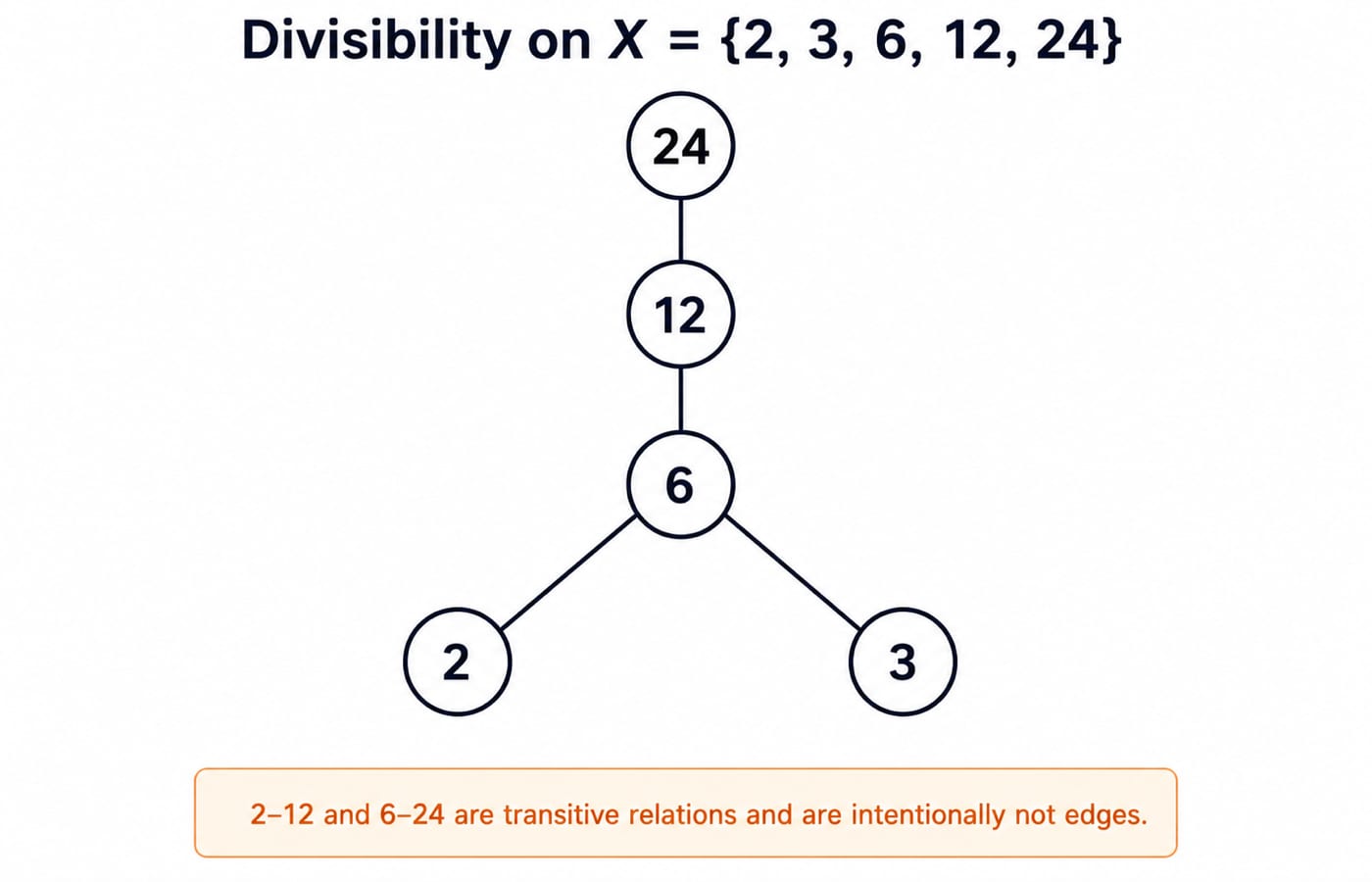
Let X = {2, 3, 6, 12, 24}. Define a partial order on X by x <= y if x divides y. The number of edges in the Hasse diagram of (X, <=) is
(a) 3
(b) 4
(c) 9
(d) None of the above
Answer: (b) 4. The covers are 2 < 6, 3 < 6, 6 < 12 and 12 < 24, so there are four edges. Relations 2 < 12, 2 < 24, 3 < 12, 3 < 24 and 6 < 24 all contain an intermediate selected element and are therefore transitive.
Question 2, NAT
The number of edges in the hasse diagram representation of the partial ordering {(a,b)|a divides b} on {1,2,3,4,6,16,24} is ________
Answer: 8. The covers are 1-2, 1-3, 2-4, 2-6, 3-6, 4-16, 4-24 and 6-24, giving 2 + 2 + 1 + 2 + 1 = 8. Do not add 1-4, 2-16, 2-24 or 3-24, because each has an intermediate divisor in the selected set.
Question 3, NAT
If A = {1, 2, 3, 6, 9, 18} is ordered by divisibility, how many edges does its Hasse diagram have?
Answer: 7. The covers are 1-2, 1-3, 2-6, 3-6, 3-9, 6-18 and 9-18. The chains 1 | 2 | 6 | 18 and 1 | 3 | 9 | 18, together with 3 | 6, remove direct edges such as 1-6, 1-9, 2-18 and 3-18.
Greatest and least versus maximal and minimal elements
A greatest element is above every element, while a least element is below every element. A maximal element only has nothing strictly above it, and a minimal element only has nothing strictly below it. Several maximal elements may exist, but a poset has at most one greatest element.
Question 4, MCQ
UGC NET 2019 greatest-and-least check
Consider the poset ({3, 5, 9, 15, 24, 45}, divisibility). Which statement is correct?
(a) There exist a greatest element and a least element
(b) There exist a greatest element but not a least element
(c) There exist a least element but not a greatest element
(d) There does not exist a greatest element and a least element
Answer: (d) There does not exist a greatest element and a least element. A least element would divide all six members, but no member divides both 3 and 5. A greatest element would be a listed common multiple, yet no listed member is divisible by both 24 and 45.
Question 5, NAT
Consider the given lattice:Assume W = no of minimal elements, X = no. of maximal elements, Y= no. of maximum elements and Z= no of minimum elements than W+X+Y+Z = ________
Lattice used to count minimal, maximal, maximum and minimum elements
Answer: 5. The unique bottom node gives W = 1 and Z = 1; the three separate top nodes give X = 3, but none is above the other two, so Y = 0. Therefore W + X + Y + Z = 1 + 3 + 0 + 1 = 5.
Question 6, NAT
Let P = ({1, 2, 3, ..., 20}, divisibility), the poset of integers from 1 to 20 ordered by divisibility. How many maximal elements does it have?
Answer: 10. The maximal elements are {11,12,13,14,15,16,17,18,19,20} because none has a distinct multiple within {1,...,20}. Every number from 1 through 10 does have a larger multiple in the set, including 10 | 20, so none is maximal.
Question 7, MSQ
Choose the correct statements based on the hasse diagram,
Hasse diagram for topological ordering
(a) g is the greatest element
(b) a is the least element
(c) a,b,d,c,e,f,g is a valid topological ordering
(d) a,b,c,d,e,f,g is a valid topological ordering
Answer: (b), (c) and (d). Node a lies below every other node, so it is least, while distinct maximal nodes f and g mean g is not greatest. Nodes c and d are incomparable, so either order shown respects every cover direction.
Upper and lower bounds in divisibility posets
For positive integers ordered by divisibility, the GLB of a finite set is its gcd and the LUB is its lcm, provided those values belong to the poset. Do not transfer this shortcut to a different order relation without checking its definition.
Question 8, MCQ
UGC NET 2019 GLB-and-LUB solution
What are the greatest lower bound (GLB) and the least upper bound (LUB) of A = {3, 9, 12} and B = {1, 2, 4, 5, 10}, if they exist in the positive-integer divisibility poset?
(a) A: GLB 3, LUB 36; B: GLB 1, LUB 20
(b) A: GLB 3, LUB 12; B: GLB 1, LUB 10
(c) A: GLB 1, LUB 36; B: GLB 2, LUB 20
(d) A: GLB 1, LUB 12; B: GLB 2, LUB 10
Answer: (a). For A, gcd(3,9,12) = 3 and lcm(3,9,12) = 36; for B, gcd(1,2,4,5,10) = 1 and lcm(1,2,4,5,10) = 20. Only option (a) contains all four values.
Question 9, MCQ
Let D36 = {1, 2, 3, 4, 6, 9, 12, 18, 36} with divisibility as the partial order. What is the least upper bound (LUB) of 2 and 3?
(a) 12
(b) 36
(c) 6
(d) 18
Answer: (c) 6. The common upper bounds of 2 and 3 within the divisors of 36 are 6, 12, 18 and 36. Since 6 divides all three other candidates, it is the least under divisibility.
Lattice and diagram-bound questions: test existence first
A lattice needs both a join and a meet for every pair. An upper bound of a subset must sit above every member of that subset, not merely some of them.
Question 10, MCQ
UGC NET 2010
A partially ordered set is said to be a lattice if every two elements in the set have:
(a) a unique least upper bound
(b) a unique greatest lower bound
(c) both (A) and (B)
(d) none of the above
Answer: (c) both (A) and (B). Every pair must have a unique join, its least upper bound, and a unique meet, its greatest lower bound. Either operation alone is insufficient.
Question 11, NAT
A hasse diagram of a poset given below: Then find the number of upper bounds of the set {a,b,d,e} is ________
Hasse diagram for upper bounds
Answer: 2. Node d is above a, b and e, and reflexivity puts it above itself; h is above d and hence above all four elements. No other node is above the complete set, so the upper-bound set is {d,h} and its count is 2.
Partition refinement: turn containment into a Hasse diagram
For partitions, pi_i P pi_j means every block of pi_i is contained in some block of pi_j. Apply that definition block by block before drawing an edge.
Question 12, MCQ
GATE 2007 partition-refinement diagram
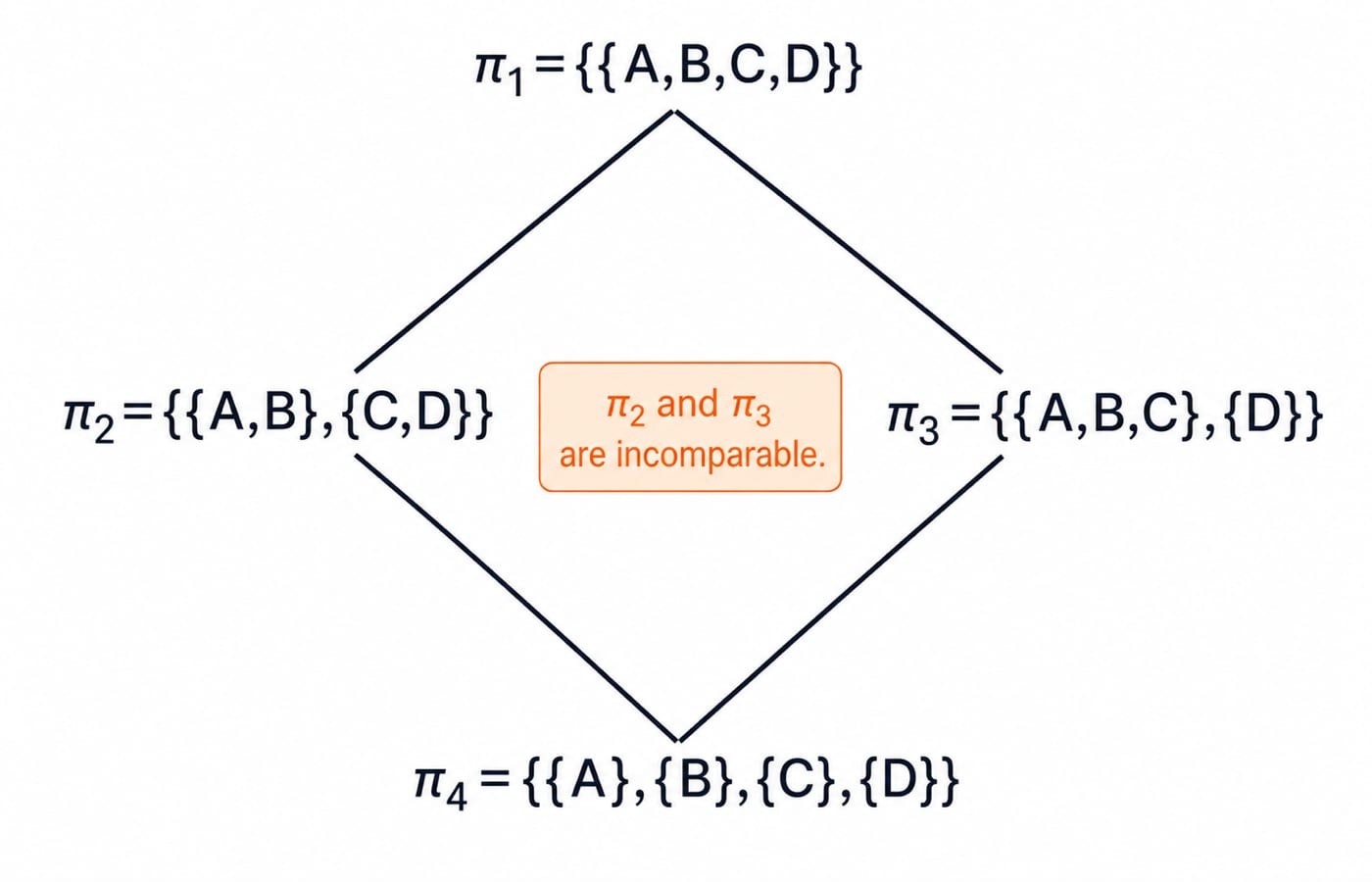
Consider the set S = (A, B, C, D}. Consider the following 4 partitions pi1, pi2, pi3, pi4 on S : pi1 = {ABCD}' , pi2 = {AB}' , {CD}' , pi3 = {ABC}' , {D}' , pi4 = A' , B' , C' , D'. Let P be the partial order on the set of partitions S' = {pi1, pi2, pi3, pi4} defined as follows : pi_i P pi_j if and only if pi_i refines pi_j. The poset diagram for (S', P ) is :
(a) !Option a diagram
(b) !Option b diagram
(c) !Option c diagram
(d) !Option d diagram
Answer: (c), the diamond. pi4 refines both pi2 and pi3, and both refine pi1; meanwhile pi2 and pi3 are incomparable because {C,D} is not contained in a block of pi3, while {A,B,C} is not contained in a block of pi2. Thus the covers are pi4-pi2, pi4-pi3, pi2-pi1 and pi3-pi1.
Hasse diagram exam traps: a four-check error table
Trap | Fast check | Questions to retry |
|---|---|---|
Counting every divisibility pair instead of covers | Name an intermediate selected element | Q1-Q3 |
Treating maximal as greatest | Ask whether it is above every node | Q4-Q7 |
Swapping gcd and lcm under divisibility | Use GLB = gcd and LUB = lcm | Q8-Q9 |
Declaring a lattice after checking one pair or bound | Verify both meet and join for every pair | Q10-Q12 |
For an accuracy routine under a minute, write the relation direction, cross out transitive pairs, circle the top and bottom candidates, then calculate common bounds.
Hasse diagram revision map and next step
Q1-Q3 test edge counting, Q4-Q7 extremal elements, Q8-Q11 bounds, and Q12 order construction. Re-attempt Q2, Q7, Q8 and Q12 without solutions to exercise four distinct reasoning modes.
For the full Discrete Mathematics sequence, use GATE Guidance by Sanchit Sir. For surrounding subjects and practice, browse the GATE preparation category.
Go deeper with the full courseDiscrete Mathematics
Keep learning

Hasse Diagram, Greatest and Least Elements: Upper and Lower Bounds with Worked Examples
Build one divisibility Hasse diagram, then use it to distinguish greatest from maximal and calculate bounds, LUB, and GLB step by step.
Updated 14 Nov 20266 min readEngineering Mathematics

Architectural and Component Design MCQs: 12 Solved Questions
Solve 12 bank MCQs on software architecture, component roles, repositories, MVC, DFDs, structure charts and UML, each with a direct worked explanation.
Updated 29 Oct 20268 min readMCQ Practice

Lattice MCQs: 12 Solved Questions on Join, Meet and Hasse Diagrams
Solve 12 lattice questions from basic definitions to divisor posets, complements, sublattices and the distributive law. Each answer names the decisive pair or identity.
Updated 30 Oct 20267 min read53 viewsDiscrete Mathematics MCQs

ER Diagram to Relational Model MCQs: 12 Solved Questions
Solve 12 ER mapping questions, then use a compact rule table and a five-relation worked example to check every table count and key placement.
16 Sep 20267 min read176 viewsDBMS MCQs