

Clock Reasoning for Competitive Exams: Concepts, Shortcuts and Solved Examples
Clock questions become easier when you treat both hands as moving objects. Derive the core formulas, solve angle and meeting problems, and handle mirrors and faulty clocks without guesswork.
KnowledgeGate Team
Exam prep & CS education
Updated 1 Nov 20266 min read
Clock questions become manageable when both hands are treated as moving objects on the same circle. Exact angle, meeting-time, mirror and faulty-clock calculations follow from their positions and relative speeds.
Turn the clock face into degrees and speeds
Measure every angle clockwise from 12. A complete circle is 360 degrees, so the 12 hour marks are 30 degrees apart.
The minute hand covers
360/60 = 6 degreesper minute.The hour hand covers
30/60 = 0.5 degreeper minute.
At H:M, reduce H to the 12-hour clock. The two absolute positions are:
Minute-hand angle:
6MHour-hand angle:
30H + 0.5M
Their raw separation is |6M - (30H + 0.5M)| = |30H - 5.5M|. If a question asks for the smaller angle, use min(raw separation, 360 - raw separation).
The 5.5 degrees per minute is not a separate fact to cram. It is the minute hand's speed minus the hour hand's speed: 6 - 0.5 = 5.5. That relative speed drives coincidence, right-angle and opposite-hand questions.
Solve a stated-time angle without freezing the hour hand
Find the smaller angle at 3:40.
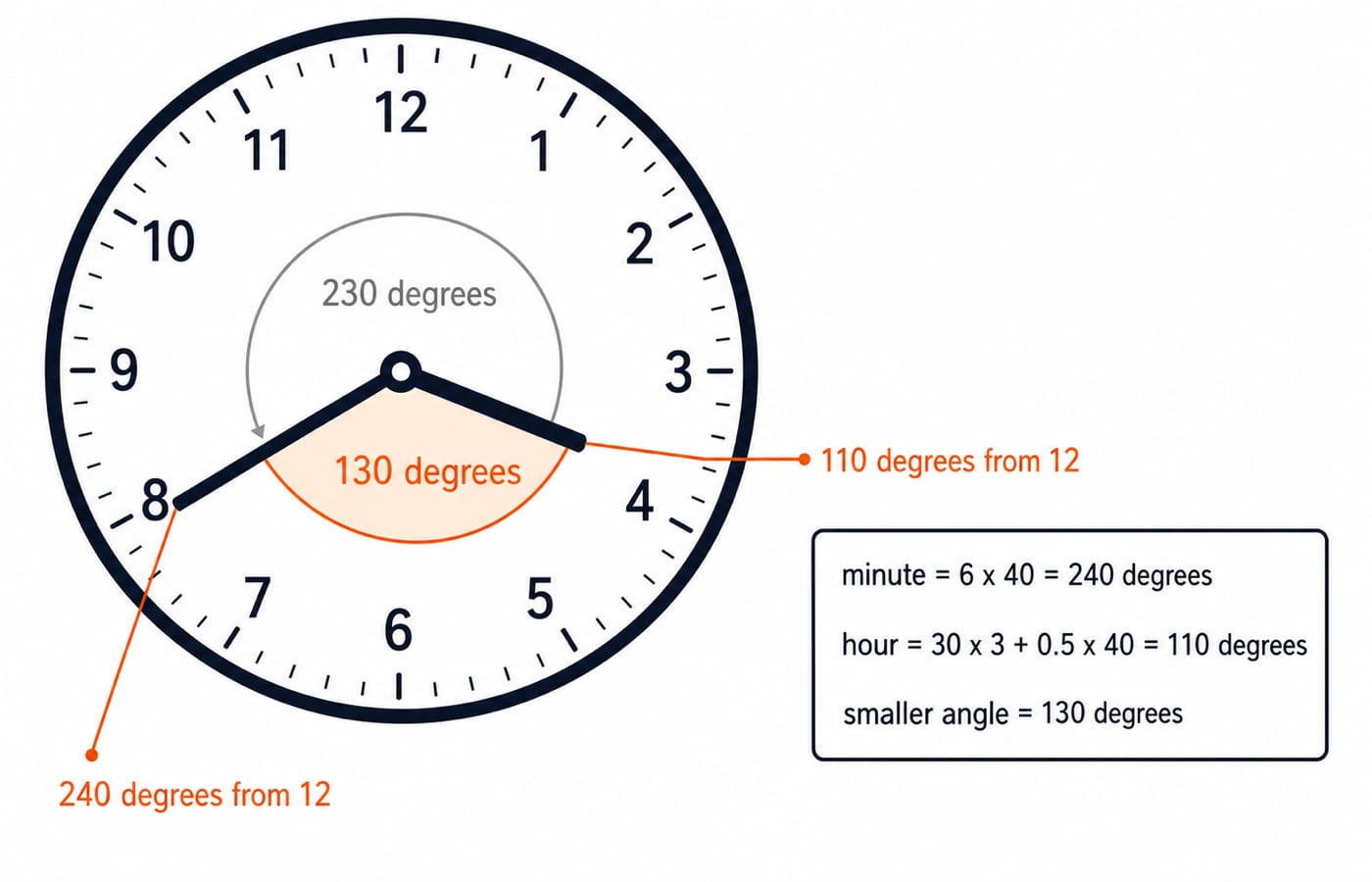
The minute hand is at 6 x 40 = 240 degrees, exactly on 8. The hour hand is at 30 x 3 + 0.5 x 40 = 90 + 20 = 110 degrees, two-thirds of the way from 3 to 4.
The raw difference is |240 - 110| = 130 degrees. Therefore, the smaller angle is 130 degrees and the reflex angle is 360 - 130 = 230 degrees.
The compact formula confirms it: |30 x 3 - 5.5 x 40| = |90 - 220| = 130 degrees. An answer of 150 degrees comes from using the fixed positions of 3 and 8. It is wrong because the hour hand advances 20 degrees during those 40 minutes.
Use relative speed to find when the hands meet
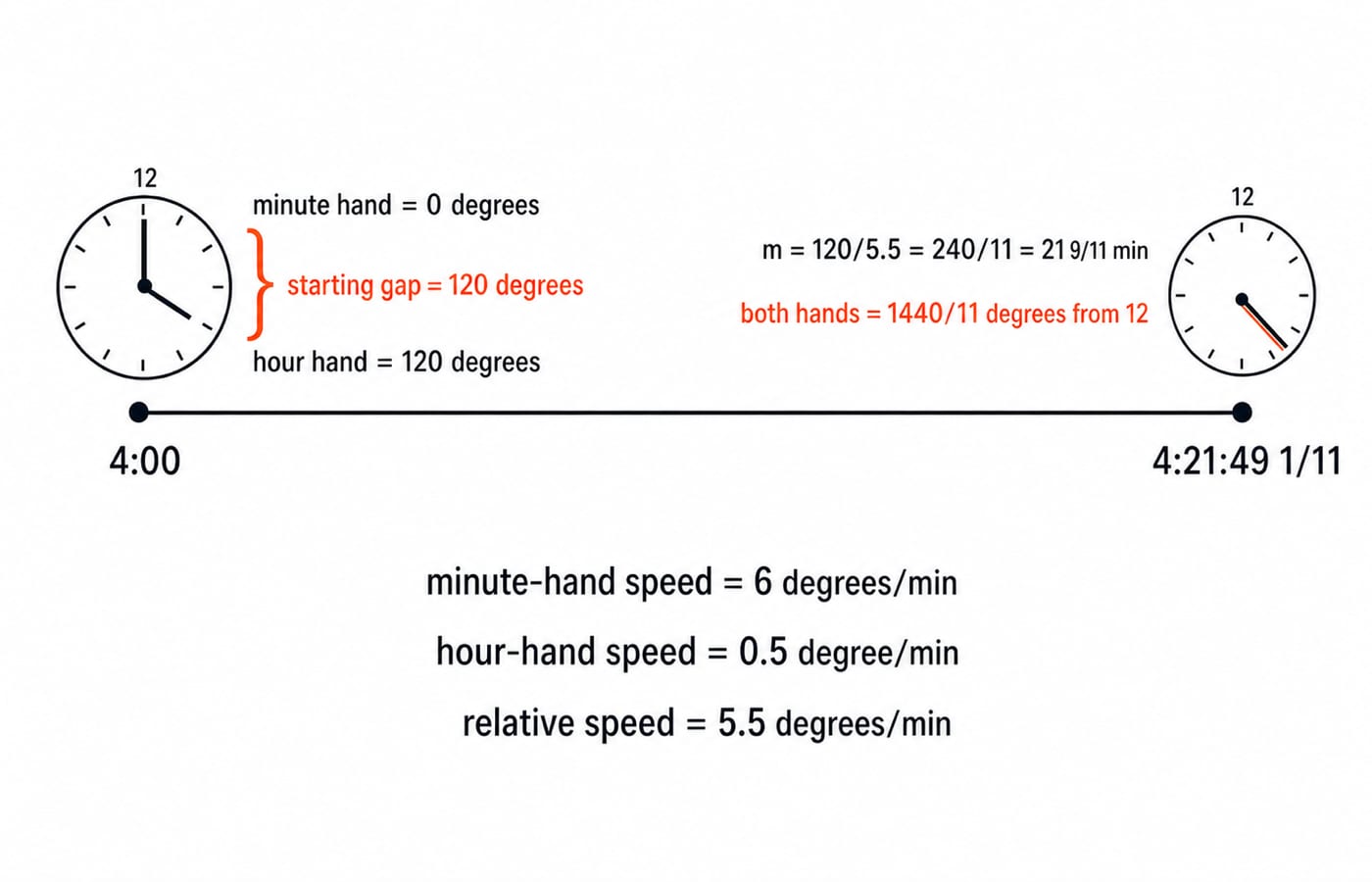
Consider the meeting between 4 and 5. At 4:00, the hour hand is 4 x 30 = 120 degrees ahead of the minute hand. The minute hand closes this gap at 6 - 0.5 = 5.5 degrees per minute.
So the catch-up time is 120/5.5 = 240/11 = 21 9/11 minutes. Convert only the fractional minute: (9/11) x 60 = 49 1/11 seconds. The hands meet at 4:21:49 1/11.
Substitution verifies the meeting. The minute hand is at 6 x 240/11 = 1440/11 degrees. The hour hand is at 120 + 0.5 x 240/11 = 120 + 120/11 = 1440/11 degrees. Their positions match exactly.
Between H and H+1, the first coincidence occurs at M = 60H/11 minutes after H:00, provided that value lies within the hour. Consecutive coincidences are 360/5.5 = 720/11 = 65 5/11 minutes apart. The relative-speed setup remains safer than memorising a list of meeting times.
Solve right-angle and straight-line positions with one equation
Use |30H - 5.5M| = theta, with theta = 90 degrees for a right angle and theta = 180 degrees for opposite hands. Test both signs, then retain only roots satisfying 0 <= M < 60. For a smaller right angle, a raw separation of 270 degrees also represents 90 degrees.
For a right angle between 2 and 3:
|60 - 5.5M| = 90
The branch 60 - 5.5M = 90 gives a negative minute value, so reject it. The other branch gives 60 - 5.5M = -90, hence M = 150/5.5 = 300/11 = 27 3/11 minutes. Since (3/11) x 60 = 16 4/11 seconds, the time is 2:27:16 4/11.
Check the positions. The hour hand is at 60 + 150/11 = 73 7/11 degrees, while the minute hand is at 1800/11 = 163 7/11 degrees. Their difference is exactly 90 degrees.
For opposite hands between 4 and 5, |120 - 5.5M| = 180. The valid root is M = 600/11 = 54 6/11 minutes, which gives 4:54:32 8/11. The other branch gives a negative minute value and must be discarded.
Treat mirror clocks and faulty clocks as transformations
For a standard vertical mirror, use actual time = 11:60 - mirror reading, treating 12 as 0 where needed. If the mirror reads 7:25, then 11:60 - 7:25 = 4:35. Visually, the minute hand on 5 at 25 minutes reflects to 7 at 35 minutes, and the hour hand reflects to the corresponding point between 4 and 5.
Do not apply this vertical-mirror rule to a water image. A vertical mirror reverses left and right. A horizontal reflection reverses top and bottom, so it needs its own dial-based reasoning.
Now take a clock that is correct at 8:00 a.m. and gains 5 minutes in every 60 true minutes. Its indicated-to-true elapsed-time ratio is 65:60 = 13:12. After 6 true hours, or 360 minutes, it gains 30 minutes. It reads 2:30 p.m. when the actual time is 2:00 p.m.. Reverse-checking gives 390 x 12/13 = 360 true minutes.
Choose the fastest safe route and audit the answer
Use absolute hand positions for an angle at a stated time. Use relative speed when the hands must meet or form a target angle. Use 11:60 subtraction for a vertical mirror, and a rate ratio for a clock that gains or loses time. The real shortcut is choosing the correct model before calculating.
Run four checks before accepting an answer:
The hour hand must move 0.5 degree for every minute after the hour.
A smaller angle cannot exceed 180 degrees.
A computed minute value must satisfy
0 <= M < 60.Convert a fractional minute to seconds only after obtaining the exact fraction.
For relative-motion work, keep a four-part scratch line: start gap, relative speed, target gap, time. For a stated-time angle, write two rows named hour position and minute position.
Recognise the question family and avoid its trap
Clock reasoning can ask for an angle at a stated time, a coincidence, a right-angle or opposite position, a mirror reading, or a gain or loss calculation. The Placement preparation and coding goals places this topic within the broader quantitative aptitude, logical reasoning and verbal-ability track.
The common mistakes now become easy to diagnose: freezing the hour hand on its numeral, using 6 instead of 5.5 as relative speed, returning the reflex angle when the smaller angle is required, retaining an invalid root, rounding 240/11 too early, or confusing a 5-minute gain with the clock's total displayed elapsed time.
For a wider section map and weekly plan, read Aptitude for Placements. Logical Reasoning for Placement Tests develops the same method-first habit for other reasoning families. Confirm topic inclusion and the current pattern in the official notification for your own exam.
The short version, then practice in layers
Remember these five lines:
Minute hand:
6 degrees/minHour hand:
0.5 degree/minRelative speed:
5.5 degrees/minSmaller stated-time angle:
min(|30H - 5.5M|, 360 - |30H - 5.5M|)Standard vertical mirror:
11:60 - mirror reading
Practise in three layers: start with 5 stated-time angles, then solve 5 coincidence or target-angle questions, followed by 5 mirror or faulty-clock questions. After each miss, label the cause as model choice, equation sign, fraction conversion or arithmetic.
For the broader aptitude, reasoning and verbal-ability learning path, continue with Aptitude for Placement. Derive the model, keep fractions exact and audit the result before moving to the next question.
Keep learning

Calendar Reasoning for Competitive Exams: Shortcuts and Solved Examples
Turn calendar questions into small remainder calculations. Learn the core rules, follow solved dates, and avoid the inclusion errors that spoil otherwise correct work.
Updated 31 Oct 20266 min readAptitude & Reasoning

Data Sufficiency: A 5-Step Method, Shortcuts and Solved Examples
Learn to test each statement independently, prove insufficiency with two valid cases, and stop as soon as the target becomes unique. Three worked problems make the method concrete.
Updated 15 Nov 20266 min readAptitude & Reasoning

Data Arrangement Questions: Concepts, Shortcuts and Solved Examples
Turn names, cities, roles and scores into a clean grid. This guide shows safe shortcuts and solves one complete arrangement from clues to answer.
Updated 11 Nov 20266 min readAptitude & Reasoning
Coding-Decoding Concepts and Shortcuts with Solved Examples
Identify, validate and reverse coding-decoding rules through letter shifts, rearrangements, number codes and sentence substitution.
Updated 9 Nov 20265 min readAptitude & Reasoning