IBPS SO IT Officer 2026: Eligibility and Exam Pattern, Stage by Stage
See how IBPS SO IT Officer eligibility works, what Prelims, Mains and Interview each do, and which details must be checked in the live notification.
KnowledgeGate Team
Exam prep & CS education
Updated 29 Jul 20264 min read62 views
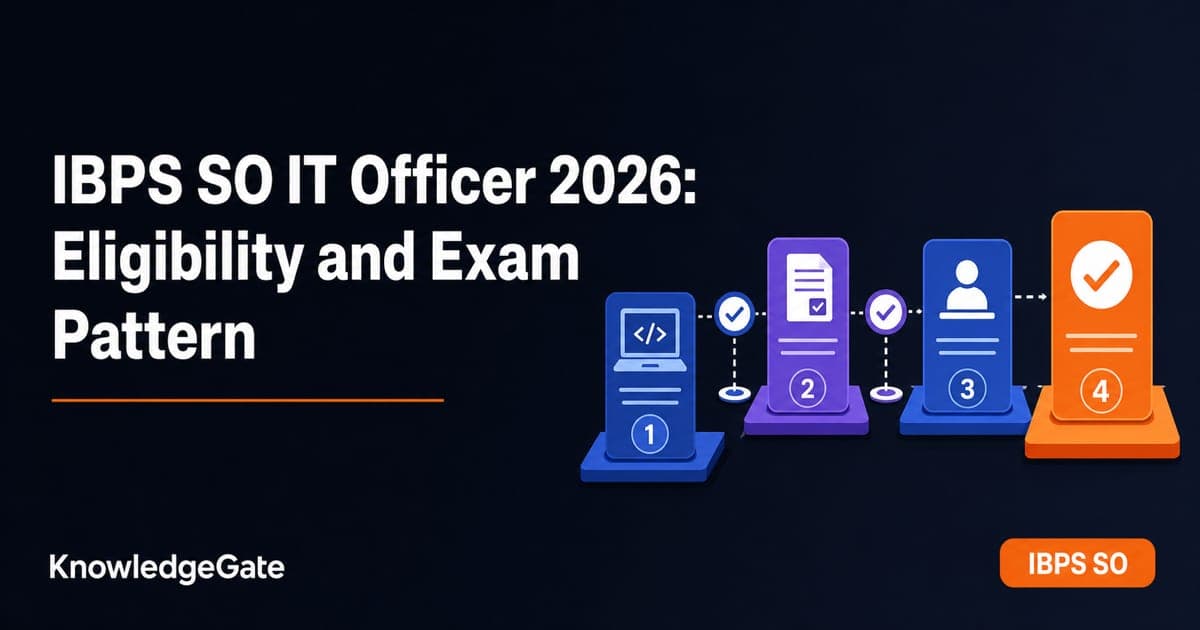
The IBPS SO IT Officer (Scale I) post confuses candidates on two fronts. Eligibility is tied to specified technical qualifications rather than being open to every graduate, and selection runs through three stages that do not all count in the same way.
Two questions decide the rest: can you apply, and how are you actually selected? The first turns on the exact degree wording in the current notice; the second turns on which stages carry marks into the final merit list.
Who the IBPS SO IT Officer route is for
The IT Officer is a specialist role in participating public-sector banks. The work is connected to technology and systems, which can include banking applications, networks, information security, databases, digital channels, and technical support. It is not the same generalist route as a Probationary Officer post.
That difference shapes both the eligibility and the assessment. IBPS expects candidates to arrive with a relevant technical background, then uses a Professional Knowledge paper to test the domain. Before planning preparation, establish that your exact qualification appears in the current notification.
Eligibility: read the degree wording carefully
Recent IBPS SO notifications have specified routes such as a four-year engineering or technology degree in named fields including Computer Science, Information Technology, and Electronics and Communication. They have also listed certain relevant postgraduate qualifications and the DOEACC B level route.
The wording matters more than a broad label such as "engineering graduate". A related branch that sounds suitable is not automatically eligible if it is absent from the notified list. Check the full degree name on your certificate against the qualification table in the current notice.
Age limits, category relaxations, nationality conditions, the cut-off date for holding the qualification, and documentary requirements are also official specifics. Use the official IBPS portal for the live notification and read those clauses before applying. Do not rely on a future-dated PDF, a coaching summary, or last year's age calculation.
The three stages of selection
The selection path has three distinct jobs:
Preliminary examination: an objective screening stage covering Reasoning, English Language, and Quantitative Aptitude.
Main examination: the IT Officer stream's Professional Knowledge paper, which tests the domain used for specialist selection.
Interview: a personality and domain discussion for candidates shortlisted after Mains.
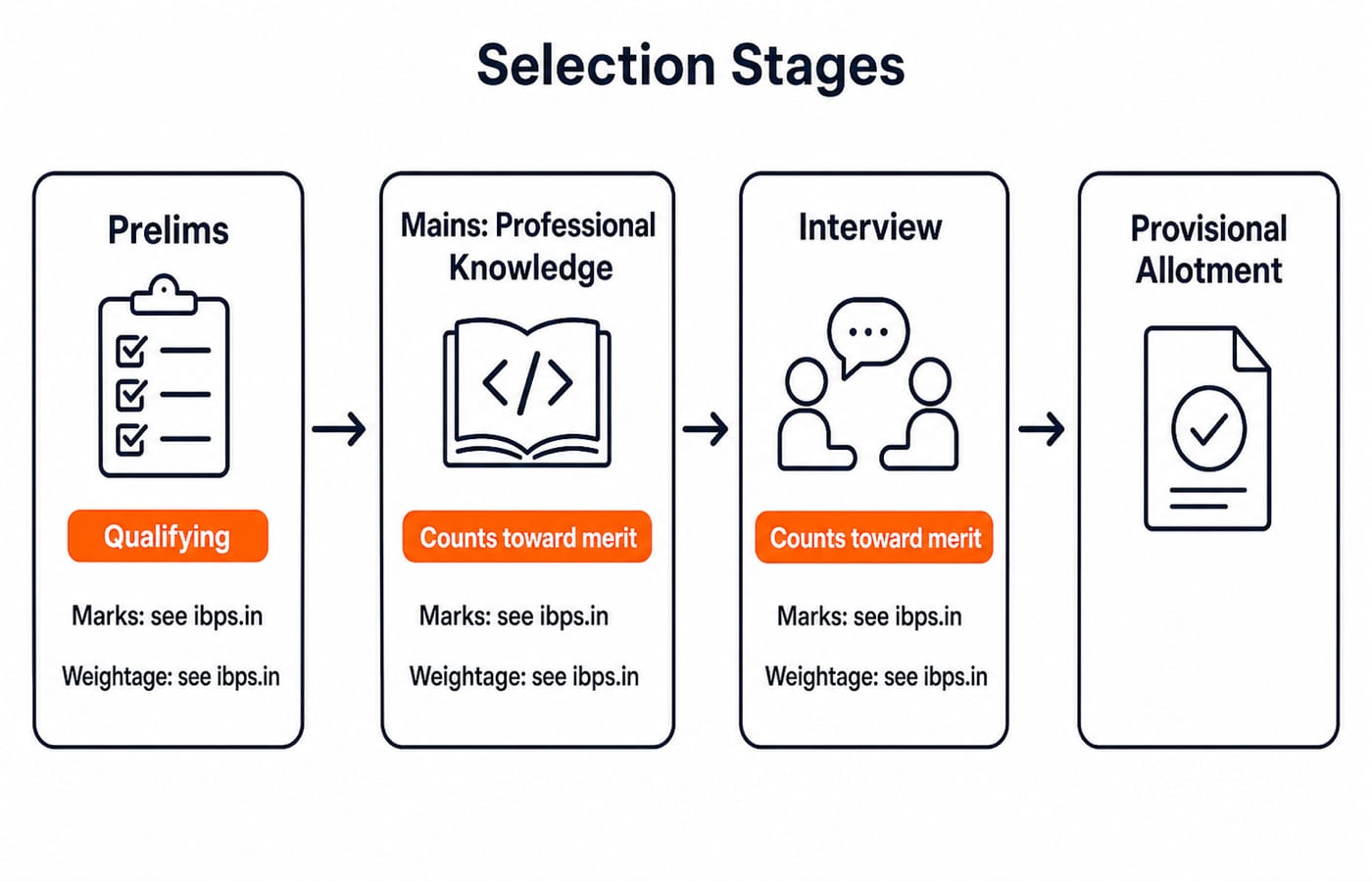
Prelims is the gate. Clear its qualifying thresholds and you move to Mains. Mains and Interview then supply the marks that build the final merit list, and allotment follows from that list together with your bank preferences and the vacancies declared for each participating bank.
How each stage is scored
Prelims is sectional and qualifying in nature. Recent selection structures have used it to shortlist candidates for Mains without carrying its score into final merit. That makes it important but different from the next two stages: you must clear the gate, yet extra Prelims marks do not necessarily improve the final ranking.
The Professional Knowledge score from Mains and the Interview score are combined for the final merit list using the weightage stated in the notification. Do not memorise a ratio from an older cycle. Exact marks, sectional timings, qualifying standards, the Interview weightage, and any penalty for wrong answers must be verified on ibps.in for the cycle in which you apply.
The scoring asymmetry decides how you split your time. Build enough speed and accuracy to clear each Prelims requirement, then give the bulk of your study hours to Professional Knowledge, because in the recent structure those are the marks that carry into the merit list. Interview preparation should begin before the Mains result, especially if you have not recently revised your own projects, the technologies on your CV, and how banks actually use them.
What Professional Knowledge covers
The technical preparation map includes DBMS, computer networks, operating systems, data structures, software engineering, and programming. These are not isolated college subjects in this exam. Questions can test definitions, outputs, protocols, normalisation, scheduling, complexity, development models, or how two nearby concepts differ.
Use IBPS SO IT Officer Professional Knowledge: a subject topic map for the full breakdown and a sensible order of study. KnowledgeGate's question bank carries about 1,700 IBPS previous-year questions, which take you from revision to exam-style retrieval.
A practical cycle is:
revise one compact concept block;
solve questions without notes;
mark errors as concept, recall, or misread;
revisit only the weak subtopic;
finish with a mixed set so that subject switching becomes normal.
The IBPS SO IT Prelims course covers the screening subjects, while the IBPS IT Officer Scale I bundle connects the wider preparation path. The Banking and Insurance catalogue is useful if you are comparing specialist and other bank-exam options.
IBPS SO IT Officer vs IBPS PO
The shortest distinction is eligibility, exam content, and role. SO IT is a specialist path with notified technical qualifications and a domain paper. PO is a generalist banking route with a broader eligibility base and no IT Professional Knowledge paper in the same sense. Inside the bank, one role begins from technology specialisation and the other from general banking responsibilities.
The best option therefore depends on your qualification and the work you want, not simply on which paper looks easier. IBPS SO IT Officer vs IBPS PO gives the full comparison.
Verify, then apply: the short version
First, match your exact qualification to the live notice. Second, remember the stage roles: Prelims screens, Professional Knowledge in Mains contributes to merit, and Interview also contributes to merit under the stated official formula. Third, verify every mark, timing, penalty, age condition, and weightage on ibps.in for the 2026 cycle before submitting the form.
Once eligibility is settled, prepare the aptitude gate and the domain merit paper as two different jobs. That distinction prevents a common mistake: spending all your time clearing Prelims while leaving the specialist paper, the part meant to distinguish an IT Officer, until too late.
Keep learning
NABARD Grade A Finance Preparation: Resources and an 8-Week Plan
Build a Finance specialist study plan around accounting, calculations and management applications. Use a 12-hour weekly schedule, a worked project appraisal and an error-based review routine.
5 Oct 20265 min readBanking Exams
LIC AAO Preparation for Repeat Attempts: A Six-Week Reset Plan
Familiar chapters need a sharper review method. Use your previous attempt and recent errors to plan six weeks of focused repair, protected mains work and manageable retests.
30 Sep 20265 min readBanking Exams
RBI Grade B Preparation Strategy: A 16-Week Phase-by-Phase Plan
A working aspirant must build early-stage speed without leaving economics, finance, management and writing cold. This plan turns 15 hours a week into foundations, timed practice, mock repair and a post-Phase-I bridge.
Updated 27 Aug 20265 min readBanking Exams
RBI Grade B Syllabus 2026: Phase 1 and Phase 2 Decoded
Separate RBI's official General Cadre syllabus from practical study buckets, then use diagnostics and worked examples to build a balanced weekly plan.
Updated 26 Aug 20265 min read56 viewsBanking Exams