Odisha Police Constable Exam Pattern and Eligibility: Written Test, Physical Standards and PET
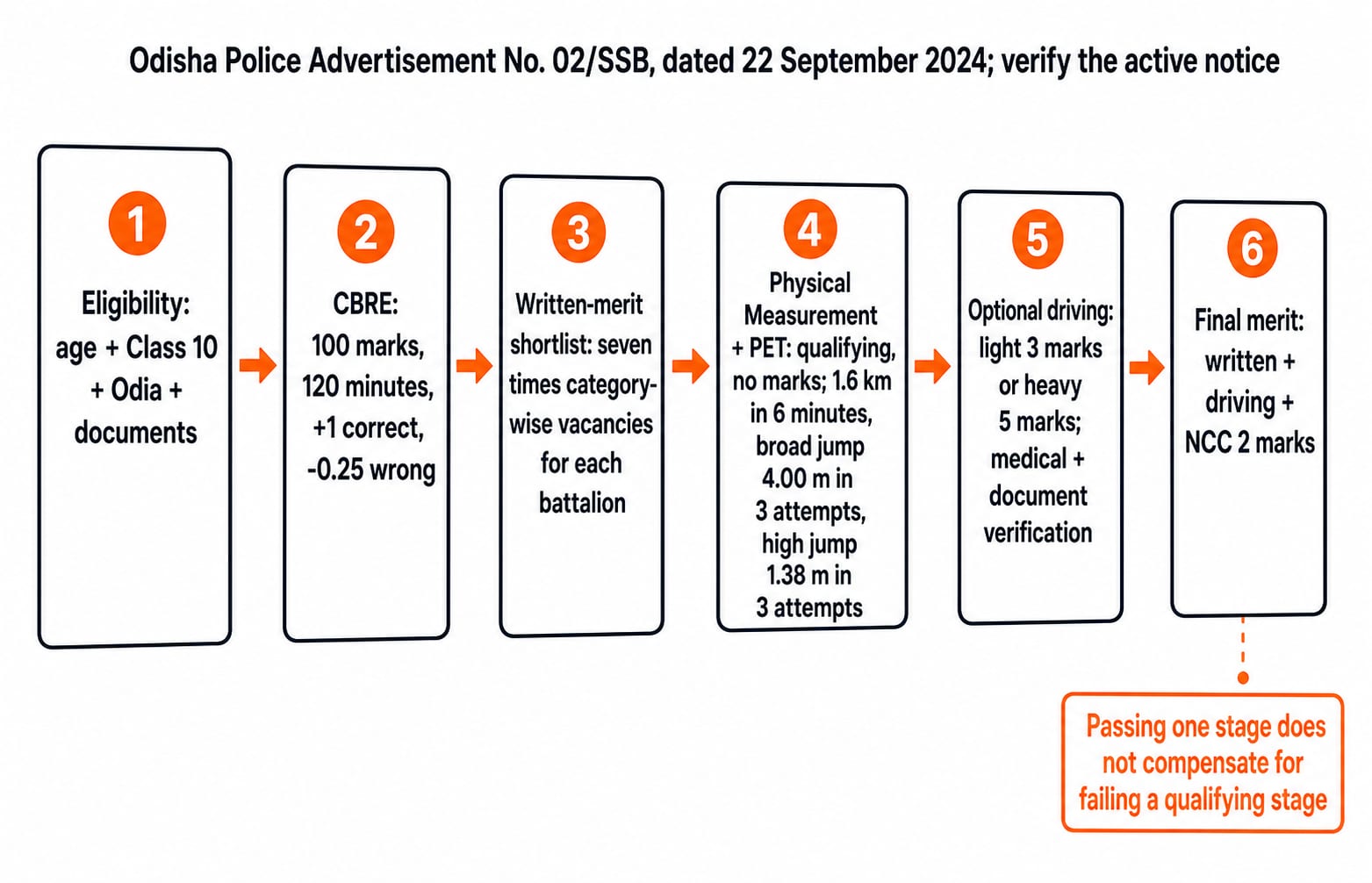
Odisha Police Advertisement No. 02/SSB of 2024 set the battalion selection stages: age and Odia eligibility bars, a 100-mark written paper in 120 minutes, and qualifying physical tests.
KnowledgeGate Team
Exam prep & CS education
Updated 17 Aug 20267 min read
Search results for Odisha Police Constable mix Civil Police Constable rules with battalion Sepoy and Constable rules, and current cycles with old ones, so aspirants train against the wrong age limit or the wrong chest measurement. Every figure here traces to Odisha Police Advertisement No. 02/SSB of 22 September 2024, which recruited for the OSAP, IR, SIR and Special Security battalions. Your eligibility for any post is settled by that post's own active notice.
Related reading: Police recruitment written and skill stages and Police recruitment eligibility.
1. Odisha Police Constable selection stages at a glance
Stage | 2024 battalion specification | Marks or role |
|---|---|---|
Eligibility/documents | Age, Class 10, Odia, conditions | Qualifying screen |
CBRE | One objective paper | 100 marks |
Measurement/PET | Standards, three events | Qualifying, 0 marks |
Driving | Optional, valid claimed licence | 3 light, 5 heavy |
Medical/documents | Fitness and original claims | Qualifying |
Final merit | Written, driving, NCC | Driving 3 or 5, NCC 2 |
Candidates went forward to the physical stages at seven times each battalion's category-wise vacancies, so clearing the written paper put you in a queue, not in a job. Central recruitment is built differently: the SSC CGL tier structure spreads marks across several scored tiers, while this notice put all 100 marks on one paper and made every physical stage pass or fail.
2. Odisha Police Constable eligibility under the 2024 battalion notice
Age was 18 to 23 years as on 1 January 2024, with five years of upper-age relaxation for SC, ST and SEBC candidates and the separate relaxation the notice specified for ex-servicemen. Education was the BSE Odisha HSC or Matriculation certificate, or a recognised equivalent. The condition that catches outside applicants is language: a candidate had to speak, read and write Odia, and to have passed Odia at HSC level or a recognised Middle English school equivalent standard.
The rest were Indian citizenship, good character, sound health, freedom from any disqualifying condition the medical board could record, and the notice's marital-status condition. This advertisement was open to men only. Other Odisha Police posts, Civil Police Constable among them, are advertised separately with their own eligibility rules.
Work an example against 1 January 2024. Someone who had turned 21 by then, holds Class 10, has passed Odia and is an Indian citizen clears the age, education and language bars, with document checks, category proof and medical fitness still ahead. Someone who was 24 that day is past the unreserved limit of 23; the same age under SC, ST or SEBC fits the five-year relaxation, but only with a valid category certificate.
3. Written exam pattern: 100 marks, 120 minutes and the subject list
Advertisement No. 02/SSB specified:
Item | 2024 provision |
|---|---|
Mode | Computer Based Recruitment Examination |
Paper | One objective MCQ paper |
Maximum marks and duration | 100 marks in 120 minutes |
Marking | +1 correct, -0.25 wrong, 0 blank |
Medium | English and Odia, except the Odia language questions |
The paper drew on seven areas at Class 10-pass standard: Odia, English, Arithmetic, General Knowledge, Situational Awareness, Logical Reasoning and Basic Computer Knowledge. The notice gave no section-wise split of the 100 marks, so nobody could bank on a set number of Arithmetic or Odia questions. Qualifying floors were 35 out of 100 for unreserved and SEBC candidates and 30 for SC and ST. A floor keeps you in the process; the cutoff was wherever the seven-times shortlist ended in your battalion and category.
4. Negative marking and final-merit arithmetic: a worked example
Take a mock in which Ravi answers 72 correctly, gets 16 wrong and leaves 12 blank, accounting for the whole paper: 72 + 16 + 12 = 100. Correct answers earn 72 x 1 = 72. Wrong answers cost 16 x 0.25 = 4. Blanks cost nothing, 12 x 0 = 0. His net written score is 72 - 4 = 68/100.
The notice then added bonus marks. A properly claimed heavy-vehicle licence, backed by a passed driving test, added 5, and a verified NCC certificate added 2: 68 + 5 + 2 = 75. With neither, Ravi stays at 68. Those 7 marks equal seven more correct answers on a paper that docks a quarter mark for every wrong one, a large swing for two documents you either hold or do not.
Log the same five numbers for every mock: correct, wrong, blank, penalty, net. Watch net score and error count rather than attempts, because attempting more while getting more wrong moves your net down.
5. Physical Measurement Test: height, weight and chest standards
Category under the 2024 notice | Height | Weight | Chest, unexpanded and expanded |
|---|---|---|---|
UR/SEBC men | 168 cm | 55 kg | 79 cm and 84 cm |
SC/ST men | 163 cm | 50 kg | 76 cm and 81 cm |
This stage carried no marks and was pass or fail, and the chest also had to expand by at least 5 cm. For an unreserved man at 168 cm and 55 kg, 79 cm and 84 cm gives 84 - 79 = 5 cm and clears the bar; 79 cm and 83 cm gives 4 cm and fails, though his height, weight and unexpanded chest are fine. The measurements do not trade off, so extra height buys nothing against a short expansion.
Get measured properly in week one, at a gym or clinic rather than with a tape at home, because a single centimetre decides this stage. Chest expansion responds to months of training; height does not respond at all.
6. PET, optional driving test, medical and document verification
The PET was three events, identical for every male candidate under this notice: a 1.6 km run inside 6 minutes, a 4.00-metre broad jump within three attempts, and a 1.38-metre high jump within three attempts. All three were pass or fail and none added a mark. Failing any one ended the candidature there, whatever the written score was.
The driving test was optional and the only stage after the written paper that could add marks. The licence had to be claimed in the application and held at least six months as on the advertisement date; the light-vehicle test earned 3 marks and the heavy-vehicle test 5. A medical board then assessed fitness and the appointing authority checked every original certificate against what was claimed. A high written score repaired nothing here.
7. Six-week written and physical preparation model
Budget 14 hours a week for six weeks, which is 14 x 6 = 84 hours. Split each week into 9 written hours and 5 physical and administrative hours. The 9 written hours go 2 to Arithmetic, 2 to Logical Reasoning with Situational Awareness, 2 to Odia and English, 1.5 to General Knowledge, 0.5 to Basic Computer Knowledge and 1 to a mixed test with its review: 2 + 2 + 2 + 1.5 + 0.5 + 1 = 9.
The other 5 hours split 4 and 1. The 4 physical hours cover two gradual running sessions, one supervised jump session on a soft surface, and mobility work, on separate days. The last hour goes on the error log, the notice and getting certificates in order, which is where candidates lose places they had already earned.
Weeks 1 and 2 set baselines: one untimed pass over each subject, one easy measured run. Weeks 3 and 4 add timed mixed sets and a measured attempt at each PET event. Weeks 5 and 6 add 120-minute simulations, kept clear of the hard physical days.
There is no Odisha-specific course here. What transfers is the reasoning, general awareness, aptitude and basic-computer practice in the UP Police Computer Operator Course, built for another state's pattern but drilling four of the seven areas this paper tests. Take the Odia paper, the Odisha general knowledge and the exact standards from the notice itself. Our UPTET eligibility and exam structure guide shows the same notice-first reading on a teacher recruitment.
8. Odisha Police Constable pattern and eligibility: short version and next step
Advertisement No. 02/SSB of 22 September 2024: OSAP, IR, SIR and Special Security battalions, men only.
Eligibility: 18 to 23 years on 1 January 2024, Class 10 or equivalent, Odia passed at HSC level.
Written: one objective CBRE paper, 100 marks in 120 minutes, +1 correct and -0.25 wrong.
Measurements: 168 cm and 55 kg unreserved and SEBC, 163 cm and 50 kg SC and ST, 5 cm chest expansion throughout.
PET: 1.6 km in 6 minutes, a 4.00 m broad jump and a 1.38 m high jump, all qualifying.
Merit: written score plus an optional 3 or 5 driving marks and 2 NCC marks.
Do three things this week. Find the exact post and active advertisement you intend to apply for, and replace every 2024 figure here with what that notice states. Sit a 120-minute baseline mock for a real net score. Get your height, weight and chest measured properly, without attempting an untrained maximum-effort run or jump. For practice across government exam papers, see our Govt Job Exam Preparation Courses; for the rules themselves, the Odisha Police recruitment archive settles eligibility, pattern and selection.
Keep learning
NABARD Grade A Finance Preparation: Resources and an 8-Week Plan
Build a Finance specialist study plan around accounting, calculations and management applications. Use a 12-hour weekly schedule, a worked project appraisal and an error-based review routine.
5 Oct 20265 min readBanking Exams
LIC AAO Preparation for Repeat Attempts: A Six-Week Reset Plan
Familiar chapters need a sharper review method. Use your previous attempt and recent errors to plan six weeks of focused repair, protected mains work and manageable retests.
30 Sep 20265 min readBanking Exams
RBI Grade B Preparation Strategy: A 16-Week Phase-by-Phase Plan
A working aspirant must build early-stage speed without leaving economics, finance, management and writing cold. This plan turns 15 hours a week into foundations, timed practice, mock repair and a post-Phase-I bridge.
Updated 27 Aug 20265 min readBanking Exams
RBI Grade B Syllabus 2026: Phase 1 and Phase 2 Decoded
Separate RBI's official General Cadre syllabus from practical study buckets, then use diagnostics and worked examples to build a balanced weekly plan.
Updated 26 Aug 20265 min read55 viewsBanking Exams