IBPS SO IT Officer vs IBPS PO: Which Should a CS Graduate Target?
Compare the specialist and generalist banking routes by daily work, exam focus, eligibility and preparation overlap. A four-question framework makes the final choice practical.
KnowledgeGate Team
Exam prep & CS education
20 Jul 20265 min read115 views
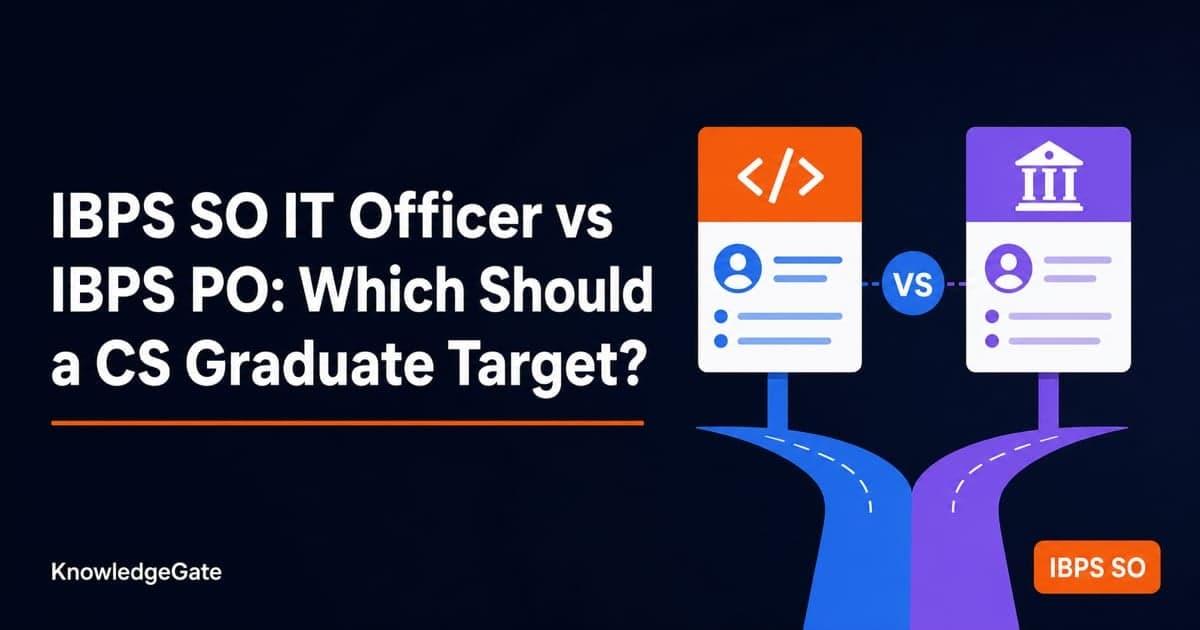
Many CS graduates treat IBPS PO as the default banking exam and notice the IT Officer route much later. That can waste a real advantage. The right choice depends on whether you want a specialist technology role or a general banking role, and whether you want computer science to remain central to your selection.
Related reading: IT Officer responsibilities and IBPS PO exam pattern.
IBPS SO IT Officer vs IBPS PO at a glance
Decision point | IBPS SO IT Officer | IBPS PO |
|---|---|---|
What you are hired for | Specialist technology track: banking applications, information security, infrastructure, databases, networks and technology projects | Generalist officer track: branch operations, customer service, credit, compliance, sales and team coordination |
What our preparation ladder covers | Prelims, mains and interview | Prelims and mains |
The layer that decides selection | A professional-knowledge paper at mains, built on computer science and IT subjects | Reasoning, quantitative aptitude and English carried through both stages |
Eligibility gate | A specific IT or CS qualification named in the notification | Broader graduate eligibility, not built around a computer-science degree |
Where a CS degree pays | Directly in the paper that carries marks | In comfort and speed on computer awareness, not in the core papers |
Choose it if | You want technology to stay central to both your selection and your work | You want wide banking exposure and are content to be judged as a generalist |
Those rows are separate questions and they do not have to agree. A CS graduate can clear the SO IT eligibility gate comfortably and still be better suited to PO work.
IT Officer role vs Probationary Officer role
An IBPS SO IT Officer is recruited for a specialist technology track in a participating bank. The work can involve banking applications, information security, infrastructure, databases, networks, vendor coordination, support and technology projects. The exact assignment depends on the bank, team and posting, so the title does not guarantee one narrow desk role.
An IBPS PO enters a generalist officer track. Branch operations, customer service, credit, compliance, sales responsibilities and team coordination can all become part of the job. Rotations and postings can expose a PO to several banking functions rather than keeping the role tied to a CS specialisation.
This is the first decision, not a minor detail. Choose SO IT if you want technology to be the reason you enter banking. Choose PO if you want the broader banking career and are comfortable being evaluated as a generalist.
Where the two exams differ
Both routes require disciplined aptitude preparation, but their decisive layers are different. SO IT puts a professional-knowledge paper at the mains stage, built around computer science and IT. Topics such as DBMS, operating systems, networking, data structures, software engineering and computer organisation therefore become selection subjects, not just interview background.
The PO route is banking-generalist preparation. Reasoning, quantitative aptitude and English carry the prelims load, and mains widens the demand rather than narrowing it towards any single degree. No PO stage turns into a computer-science subject examination, so a CS degree buys familiarity with the computer-awareness questions and little more. Marks, question counts, durations and negative marking are set per cycle and live in the current IBPS notification.
The practical consequence is simple: a strong CS graduate may convert existing degree knowledge into an SO IT advantage. The same graduate starts much closer to the general applicant pool in PO preparation. The IBPS SO IT professional-knowledge topic map shows the specialist side, while the Bank PO prelims and mains preparation split shows how the generalist route changes across stages.
The eligibility difference matters first
SO IT requires an accepted IT or CS qualification route. A related degree may look relevant in ordinary conversation yet still fail the notification's exact wording. PO eligibility is broader and is not designed around a computer-science qualification.
Do not decide from a coaching summary or an old advertisement. Match your degree title, discipline and completion status against the current notification on the official IBPS website. If the SO IT eligibility line does not accept your qualification, the comparison ends before preparation begins.
SO IT vs PO competition: where a CS degree actually helps
SO IT and PO attract different applicant pools. PO is accessible to graduates from many disciplines, so your CS knowledge is not a direct paper advantage. SO IT has a narrower qualification gate, and the professional-knowledge paper asks candidates to use the material a CS graduate has already studied.
That does not make SO IT automatically easy. A degree certificate is not the same as recall under time pressure. Weak fundamentals in DBMS or networks will still show. The advantage appears only when you revise the subjects, solve mixed questions and learn to reject close distractors.
Fit is the part you control. Applicant numbers and cutoffs are not, and they move every cycle, so a choice built on guessing them is built on nothing. Pick the paper you can score in and let the cutoff land where it lands.
Can you prepare for both?
Yes, if you treat the overlap and the divergence separately. Reasoning, English and quantitative aptitude are shared ground and can be built once for both routes. Professional knowledge belongs to SO IT alone. PO mains carries its own broader demand and needs hours of its own.
A sensible cycle plan has one primary target and one secondary application. Build the shared aptitude base once, then protect fixed weekly blocks for the primary route's differentiator. If SO IT is primary, professional knowledge cannot be postponed until after prelims. If PO is primary, do not let CS revision consume the time needed for its broader mains preparation.
If SO IT is your primary, the IBPS SO IT Mains Preparation Course is where the professional-knowledge work actually sits, and the IBPS IT Officer (Scale I) bundle keeps prelims, mains and the professional-knowledge material on one track instead of isolated practice.
A four-question decision framework
Write down your answers before buying material or building a timetable.
What work do I want? Technology and systems point towards SO IT. Branch, credit and general banking exposure point towards PO.
Is my qualification explicitly accepted? Verify SO IT eligibility word for word on IBPS.
Where is my present advantage? Honest strength in core CS supports SO IT. Strong aptitude with genuine interest in banking-generalist work supports PO.
Which preparation can I sustain? Choose the syllabus you can study deeply for months, not the title that sounds safer today.
The short version and next step
SO IT is a specialist route with computer science at the centre of the exam and role. PO is a broader banking route with wider functional exposure. Neither is universally better for a CS graduate.
Verify eligibility and the current exam structure on IBPS, choose one primary route, and use the IBPS PO and SO IT preparation category to organise the relevant course path. Your degree gives you an SO IT opportunity, but your preferred work should make the final decision.
Keep learning
RBI Grade B Last 60 Days Plan: What to Revise, When to Mock
Make the final 60 days useful with a realistic time budget, recall practice and mocks you actually review. This General-cadre plan keeps a small Phase II habit alongside Phase I revision.
Updated 26 Oct 20264 min readBanking Exams
RBI Grade B Preparation Mistakes: 7 Habits to Fix Before Your Next Mock
Watching lessons regularly can still leave the same mock errors untouched. Audit seven preparation habits and use simple drills to test recall, improve written answers and repair recurring mistakes.
24 Oct 20265 min readBanking Exams
RBI Grade B Previous Year Analysis: Recurring Topics and Study Priorities
Use recurring topic families to choose what to revise, then let your errors decide the time allocation. Work through DI, reasoning and reading examples before building a practical weekly plan.
22 Oct 20264 min readBanking Exams
RBI Grade B Exam Pattern and Marking Scheme: Phases, Scores and Penalties
Clearing Phase I and earning final-merit marks are different jobs. Understand the General-cadre stages, section timers and score calculations before planning your next mock.
18 Oct 20265 min readBanking Exams