Banking Exams Reasoning Puzzles: A Repeatable Grid Method
Learn a six-step puzzle method through one complete five-person day and city set. Build separate grids, control branches, finish the arrangement and verify every clue.
KnowledgeGate Team
Exam prep & CS education
Updated 19 Aug 20266 min read
Most puzzle sets are lost the same way. You read each clue and understand it, then start drawing before the reading is finished, so people and cities land on one grid, and eight clues later the arrangement contradicts itself with no way to tell which placement went wrong. The repair is a fixed procedure: turn every set into an inventory, a constraint ledger, two separate grids and a checked arrangement. One complete five-person day and city set is enough to learn it, and the same six steps then carry across the seating, floor, box and scheduling sets that fill banking and insurance exam preparation.
1. Separate Entities, Attributes and Positions Before Drawing
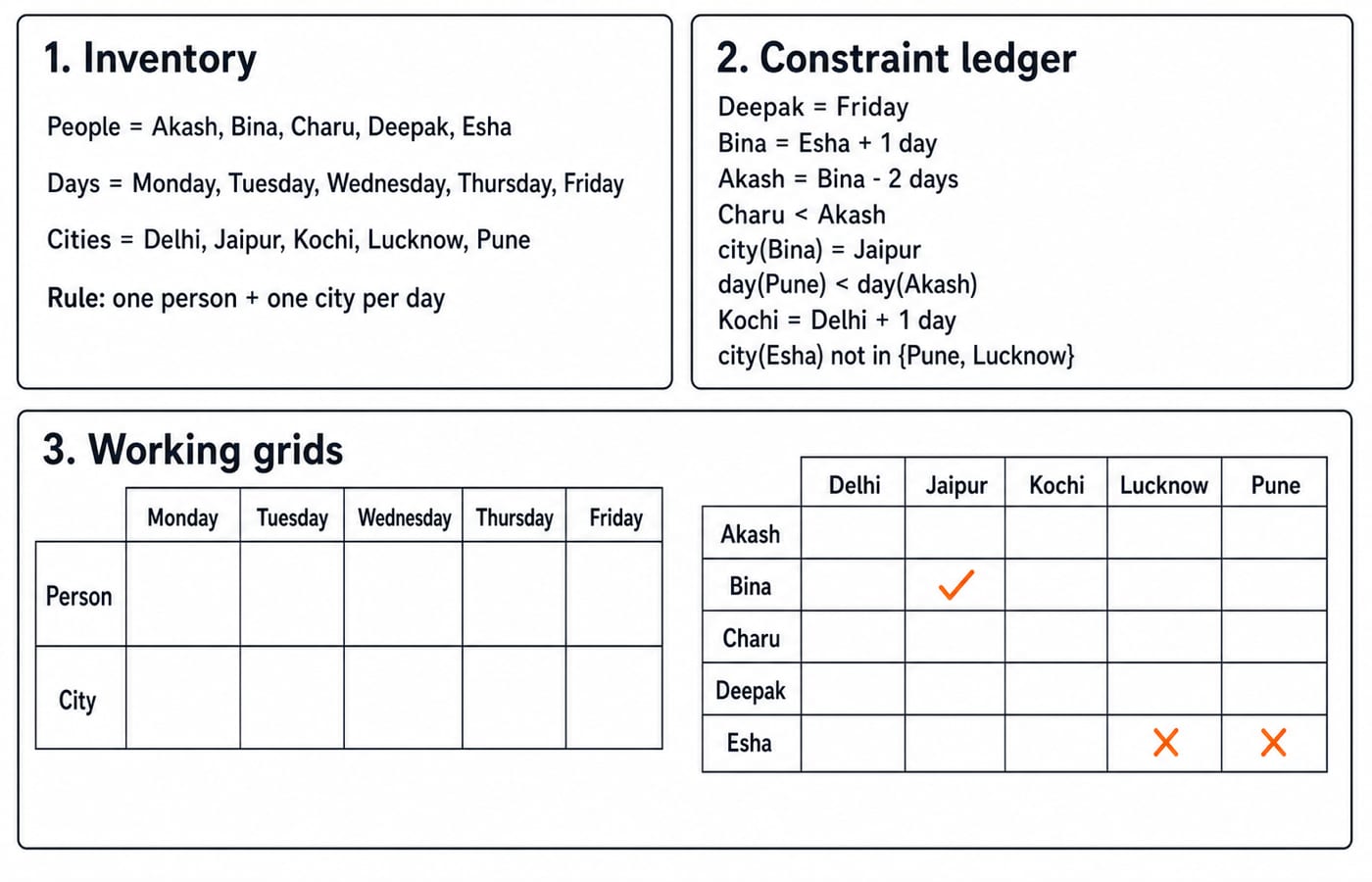
This set has three layers. The entities are five people: Akash, Bina, Charu, Deepak and Esha. Position is the ordered day axis: Monday, Tuesday, Wednesday, Thursday and Friday. City is a second attribute: Delhi, Jaipur, Kochi, Lucknow and Pune.
Write the one-to-one rule: each person receives one day and one city, and each day and city is used once. Count before drawing: 5 people = 5 days = 5 cities. If the sizes differ, reread the stem. Never assume uniqueness, direction or one-to-one use unless stated.
Use six steps: inventory -> encode -> anchor -> chain -> eliminate -> check. On the first pass, record only names and domains. On the second, translate every clue. Start solving only after both passes are complete.
2. Encode the Complete Worked Set as a Constraint Ledger
Preserve every clue in a ledger. Use < only for “earlier than”, never for “immediately before”. Mark fixed anchors and exact chains dark; keep negative exclusions light until needed.
Clue | Type | Symbolic form | Placed yet? |
|---|---|---|---|
Deepak is scheduled on Friday. | Fixed anchor |
| Yes |
Bina is scheduled immediately after Esha. | Exact chain |
| No |
Akash is scheduled two days before Bina. | Exact chain |
| No |
Charu is scheduled earlier than Akash. | Order |
| No |
Bina visits Jaipur. | Fixed anchor |
| Yes |
The Pune visit is earlier than Akash's day. | Order |
| No |
The Delhi visit is immediately before the Kochi visit. | Exact chain |
| No |
Esha visits neither Pune nor Lucknow. | Negative exclusion |
| No |
Keep a five-column day table and a separate person-by-city grid.
3. Solve the Day Axis From the Most Restrictive Chain
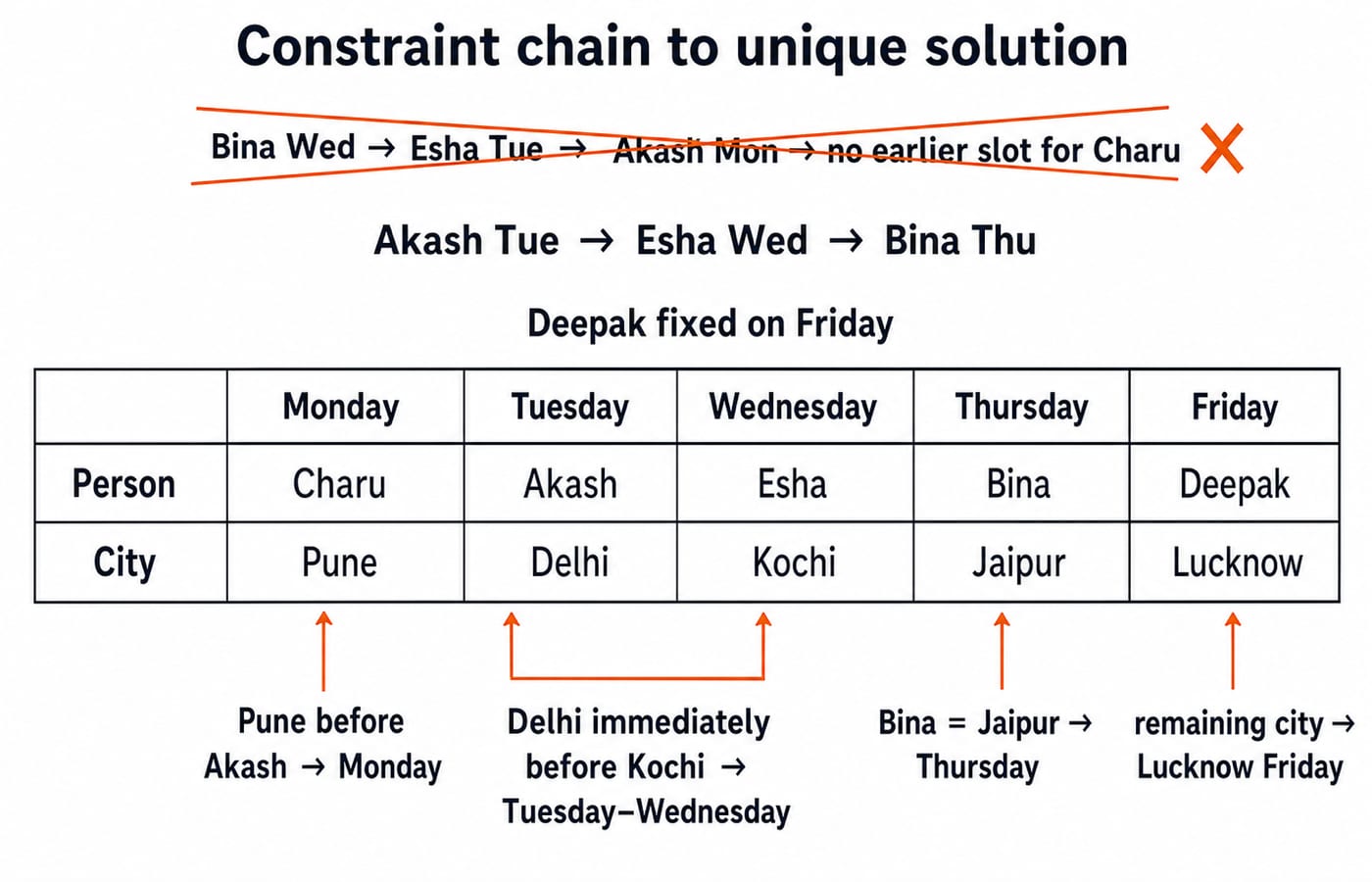
Place Deepak = Friday, then join the clues. Esha is one day before Bina, Akash is two days before Bina, and Charu is earlier than Akash. Friday is taken, so Bina is not Friday. Bina cannot be Monday or Tuesday either, because Akash would then need a day two places earlier and no such day exists. Only Wednesday and Thursday are left for Bina.
Test both branches explicitly:
If
Bina = Wednesday, thenEsha = TuesdayandAkash = Monday. Charu would take Thursday, which is not earlier than Monday. Cross out the branch.Therefore
Bina = Thursday, which givesEsha = WednesdayandAkash = Tuesday. The only unused non-Friday position isCharu = Monday.
Read back the row: Monday Charu | Tuesday Akash | Wednesday Esha | Thursday Bina | Friday Deepak. Check every person-day clue before adding cities. The controlled branch came from a closed chain, not a random guess.
4. Add Cities on a Separate Row and Finish the Arrangement
Place Jaipur under Bina on Thursday. Pune is earlier than Akash's Tuesday slot, so Pune can only be Monday. Thus Charu = Pune. “Earlier” becomes immediate here only because Monday is the sole earlier day.
Apply the Delhi-Kochi consecutive pair. Monday-Tuesday is blocked by Pune. Wednesday-Thursday and Thursday-Friday are blocked by Jaipur. The only valid pair is Tuesday Delhi | Wednesday Kochi, so Akash = Delhi and Esha = Kochi.
The remaining city, Lucknow, goes to Deepak on Friday. Esha is in Kochi, satisfying the exclusion of Pune and Lucknow. The unique final table is:
Day | Monday | Tuesday | Wednesday | Thursday | Friday |
|---|---|---|---|---|---|
Person | Charu | Akash | Esha | Bina | Deepak |
City | Pune | Delhi | Kochi | Jaipur | Lucknow |
5. Check the Grid by Answering, Reversing and Recounting
Run three checks. Domain: each person, day and city appears once. Clues: read all eight against the table. Reverse: start with Friday's Deepak-Lucknow, then move left through Bina-Jaipur, Esha-Kochi, Akash-Delhi and Charu-Pune. Trace each placement to the ledger.
Now answer from the table, without solving again:
Who visits Kochi? Esha, in Wednesday's column.
On which day does Bina visit Jaipur? Thursday, in Bina's column.
Who is immediately after Akash? Esha, because Wednesday follows Tuesday.
How many people are between Charu and Bina? Two, Akash and Esha.
Which city is two days before Jaipur? Delhi, on Tuesday, two days before Thursday.
One arrangement survives, so every relation is definite. For “could be true” or “cannot be determined”, inspect every surviving branch.
6. Repair the Four Mistakes That Make Puzzle Grids Collapse
Drawing while reading. Later chains get copied inconsistently. Finish the inventory and ledger first.
Merging domains. A day relation can become a false person-city exclusion. Keep the two grids separate.
Treating earlier as immediately before.
Pune < Tuesdaybecomes Monday only after Akash is fixed.Delhi immediately before Kochistays consecutive throughout.Hiding a guess. Label the
Bina = Wednesdaytest, then erase the whole branch when Charu has no earlier slot.
Keep a compact error log after practice:
Set | First wrong placement | Missed clue type | Repair |
|---|---|---|---|
Day-city set 04 | Bina Wednesday retained | Ordering clue missed | Test |
Log the first wrong placement, not only the final wrong answer.
7. How Banking Reasoning Practice Tests This Method
Change the surface and the six steps do not move. A linear row swaps the day axis for seat 1 to seat 5 and adds a facing direction, so “immediately after” has to be read against that direction before it is encoded. A circular set replaces the ordered axis with a cyclic one, where position 5 is adjacent to position 1 and no seat is an end anchor, which is exactly why a circular set with no fixed seat branches so widely. Floor and box sets keep the ordered axis but usually number it bottom to top, so “above” means a larger index, not a smaller one. A second attribute, whether it is a city, a profession or a subject, always gets its own row and never a column inside the position grid. Only the axis changes. The Bank PO reasoning topic map sets these arrangement families alongside syllogisms, inequalities and coding-decoding. Do not assume any family has fixed weight or appears in every paper.
Build the selection habit on a timed block, then rank the sets before committing to any. Scan three sets for 60 seconds each, so 3 x 60 = 180 seconds = 3 minutes.
Set A is a five-person day-city set with two fixed anchors and two closed chains. Solve five questions in
8 minutesand score5/5.Set B is an eight-person circular set with no fixed seat and three open branches. Leave it after the scan.
Set C is a five-floor profession set with one fixed floor and a closed adjacency chain. Solve it in
7 minutesand score4/5.
Total time is 3 + 8 + 7 = 18 minutes. The attempted sets contain 5 + 5 = 10 questions; 5 + 4 = 9 correct gives 9/10. Review for 5 + 10 + 5 = 20 minutes: check Set C's error, construct Set B untimed, then log its missed clue type. Leaving is followed by analysis, not permanent avoidance.
8. The Short Version: Inventory, Encode, Anchor, Chain, Eliminate, Check
List every domain. Translate every clue. Place fixed anchors, combine exact chains, eliminate with order and negative clues, then validate every clue and domain. Today, rebuild the day axis and then the city row from the eight clues until you can reproduce Charu-Pune | Akash-Delhi | Esha-Kochi | Bina-Jaipur | Deepak-Lucknow from Monday to Friday without looking at the grid. Then run the same six steps on a set you have already solved once, and watch how much of the time goes into deciding what to draw rather than into drawing it. For a longer practice route, work through the Aptitude & Reasoning hub, or take reasoning inside the IBPS PO Prelims course or the SBI PO Prelims course.
Keep learning

NABARD Grade A Finance Preparation: Resources and an 8-Week Plan
Build a Finance specialist study plan around accounting, calculations and management applications. Use a 12-hour weekly schedule, a worked project appraisal and an error-based review routine.
5 Oct 20265 min readBanking Exams
LIC AAO Preparation for Repeat Attempts: A Six-Week Reset Plan
Familiar chapters need a sharper review method. Use your previous attempt and recent errors to plan six weeks of focused repair, protected mains work and manageable retests.
30 Sep 20265 min readBanking Exams
RBI Grade B Preparation Strategy: A 16-Week Phase-by-Phase Plan
A working aspirant must build early-stage speed without leaving economics, finance, management and writing cold. This plan turns 15 hours a week into foundations, timed practice, mock repair and a post-Phase-I bridge.
Updated 27 Aug 20265 min readBanking Exams

RBI Grade B Syllabus 2026: Phase 1 and Phase 2 Decoded
Separate RBI's official General Cadre syllabus from practical study buckets, then use diagnostics and worked examples to build a balanced weekly plan.
Updated 26 Aug 20265 min read56 viewsBanking Exams