IBPS PO Mains Preparation After Prelims: A Realistic 6-Week Transition Plan
Move from prelims speed drills to deeper selection, recall, writing, and mock analysis with a six-week plan built around realistic hours and clear recovery rules.
KnowledgeGate Team
Exam prep & CS education
Updated 12 Sep 20265 min read
Prelims preparation has trained you to work quickly, but repeating the same routine will not prepare you for deeper set selection, data interpretation, awareness recall, descriptive control, and serious mock review. The next six weeks need different work, not vague promises of longer study. Build your preparation around an honest weekly hour budget, a rising mock cadence, and a recovery rule for missed days. Organise preparation around selection, mock review, awareness recall, English, and descriptive practice. Recheck the exact applicable pattern in the current notification on IBPS.
Related reading: IBPS PO descriptive writing and IBPS PO syllabus.
1. IBPS PO Mains after Prelims: change the work, not just the hours
Make three shifts: isolated speed drills become longer mixed sets, passive current-affairs reading becomes active recall, and a mock score becomes an error diagnosis.
Prelims work still matters. Keep short arithmetic, reasoning, and English maintenance blocks. Use the IBPS PO syllabus guide as a coverage checklist, then confirm the applicable details in the current IBPS notification.
Fix selection and accuracy first, add exam-condition practice next, then taper. Daily full mocks without review hide repeated mistakes.
2. IBPS PO Mains Week 1: build a diagnostic before the timetable
Take one baseline full mock using the timing and format in the applicable IBPS notification. By preparation lane, record attempts, correct, wrong, unattempted, time spent, and error cause. This is not a cutoff prediction. Choose diagnostic topics from the weakest lanes in your baseline; past patterns do not guarantee future weightage.
In a 24-question reasoning block, suppose 18 are attempted, 12 are correct, 6 are wrong, and 6 are left.
Attempt accuracy =
12 / 18 x 100 = 66.7%.Code the 6 errors as 3 poor set selections, 2 missed conditions, and 1 rushed read.
Next week: 2 untimed setup drills, 2 timed selection drills, and all 6 errors redone after 48 hours.
The action plan matters more than the percentage alone.
3. IBPS PO Mains six-week timetable: 18 honest hours, then a controlled surge
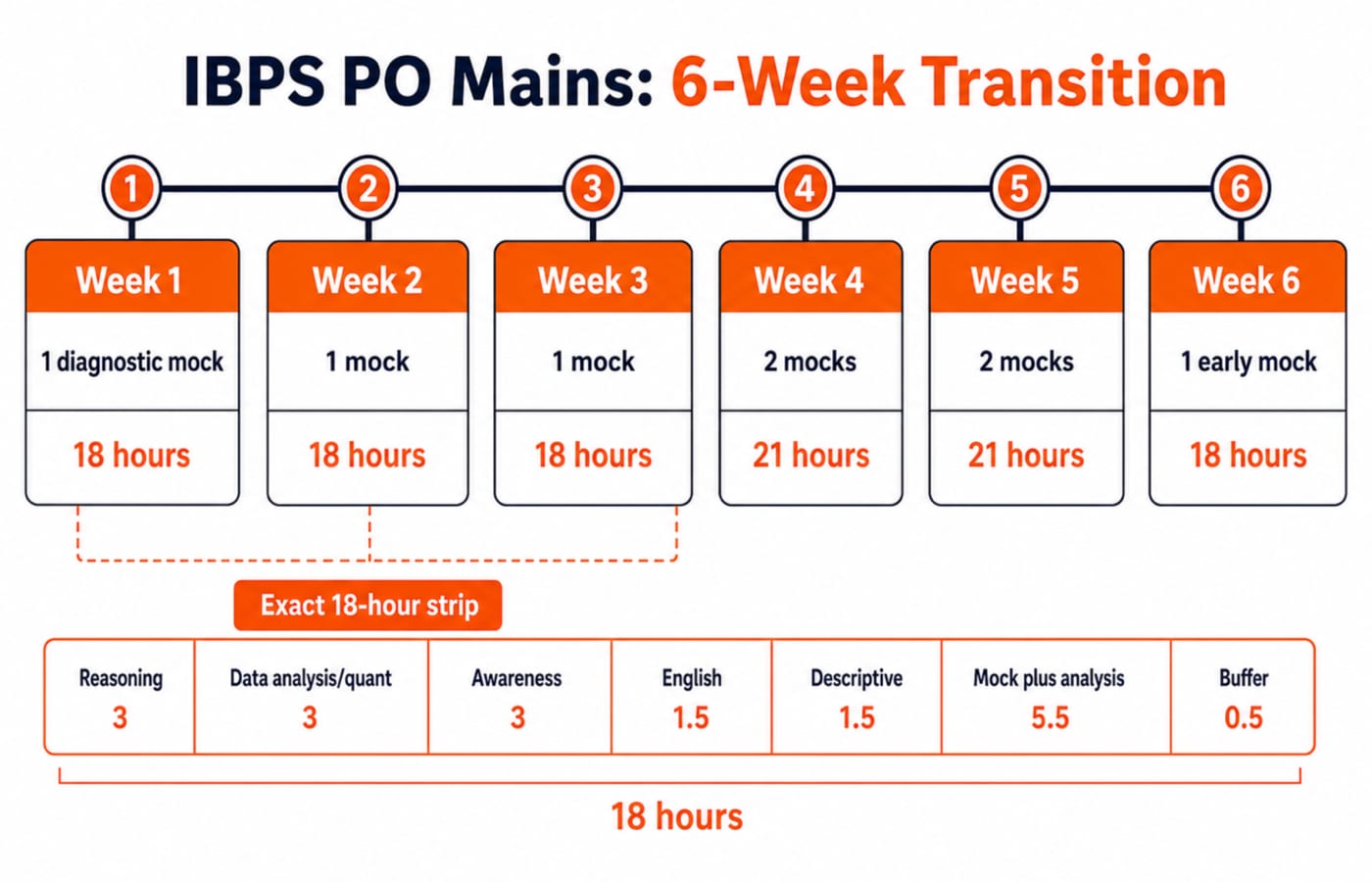
A normal week gives 5 x 2 = 10 hours from Monday to Friday and 2 x 4 = 8 hours on the weekend. Total: 10 + 8 = 18 hours. In Weeks 4 and 5, 90 extra minutes on each weekend day add 3 hours, creating a 21-hour week.
Week | Main job | Mock cadence | Hour model |
|---|---|---|---|
1 | Baseline, error coding, coverage gaps | 1 diagnostic full mock | 18 hours |
2 | Reasoning and data-analysis depth | 1 full mock | 18 hours |
3 | Mixed practice plus awareness and descriptive routine | 1 full mock | 18 hours |
4 | First simulation week | 2 full mocks | 21 hours |
5 | Second simulation week, fewer new topics | 2 full mocks | 21 hours |
6 | One early mock, repair, recall, taper | 1 full mock early in the week | 18 hours |
Weeks 1 to 3 allocate 3 hours each to reasoning, data analysis and quantitative work, and awareness; 1.5 each to English and descriptive practice; 5.5 to mock plus analysis; and 0.5 to buffer. Check: 3 + 3 + 3 + 1.5 + 1.5 + 5.5 + 0.5 = 18.
Weeks 4 and 5 reserve 11 hours for two mocks and reviews, 3.5 for error-led drills, 3 for awareness, 1 for English, 1.5 for descriptive work, and 1 for buffer. Check: 11 + 3.5 + 3 + 1 + 1.5 + 1 = 21. Mock sittings follow the current official format, not an assumed duration.
4. Reasoning and data analysis in Weeks 2 and 3: practise selection before speed
For each lane, do 2 untimed setup-first sets, 2 set-selection drills, 2 timed mixed sets, then redo every error after 48 hours. Choose the mix from your diagnostic and the applicable notification, not a universal weightage claim.
A learner initially completes a reasoning set in 42 minutes with 4 errors. After writing every condition first and rejecting one low-confidence set early, the redo takes 31 minutes with 1 error. Improvement: 42 - 31 = 11 minutes and 4 - 1 = 3 fewer errors. Setup and selection improved, not calculation speed alone. This six-week transition uses that result to choose mixed Mains work. For a longer calculation, arithmetic, and DI skill ladder, use IBPS PO Quant Preparation: Build Arithmetic and DI Accuracy; that plan owns calculation fluency and DI method, while this one owns the post-prelims transition across Mains lanes.
KnowledgeGate has over 1,800 IBPS questions in its practice bank for additional depth. Not every item is necessarily an IBPS PO Mains question.
5. Awareness, English, and descriptive work: use small daily accumulation
Use five 30-minute awareness capture-and-recall sessions: 5 x 30 = 150 minutes. Add one 30-minute quiz and correction block. Total: 150 + 30 = 180 minutes, or 3 hours. The banking awareness static-plus-current guide organises both lanes without claiming a fixed official split.
English gets three 30-minute blocks: reading and inference, grammar or usage correction, and mixed review. Descriptive work gets two 45-minute cycles, each 10 minutes to outline, 25 to write, and 10 to edit: 10 + 25 + 10 = 45 minutes. This is practice timing, not an official duration. Match response types to the applicable notification.
6. IBPS PO Mains mock analysis in Weeks 4 to 6: review every attempt twice
Take 1 mock in Week 1, 1 each in Weeks 2 and 3, 2 each in Weeks 4 and 5, and 1 early in Week 6. Total: 1 + 1 + 1 + 2 + 2 + 1 = 8 full mocks, each under the applicable official format.
Review twice. The same day, classify every miss as selection, concept, calculation, reading, or time management. After 48 hours, re-solve without the answer visible. Close an error only with a correct solution and reason.
In a 20-question mixed block, 16 attempted, 12 correct, 4 wrong, and 4 left gives 12 / 16 x 100 = 75% attempt accuracy. For 2 selection errors, 1 calculation error, and 1 misread condition, prescribe 2 selection drills, 1 calculation sheet, and a clean redo of the misread item. Calculate no marks without the applicable official marking rule.
7. A missed-day recovery rule that protects the core plan
Missing Tuesday and Thursday loses 2 + 2 = 4 hours. Add 1 hour to Saturday and 1 to Sunday, use the 0.5-hour buffer, and remove one 1.5-hour low-priority repeat drill. Recovery: 2 + 0.5 + 1.5 = 4 hours.
Keep the mock, review, awareness recall, and both descriptive cycles. After losing two or more days, never double the next day or add an unreviewed mock. Carry forward only a named concept gap and discard duplicate practice. Each Sunday, mark unfinished tasks keep, move, or delete.
8. Start with one diagnostic and six visible weeks
Diagnose in Week 1, deepen in Weeks 2 and 3, simulate in Weeks 4 and 5, then repair and taper in Week 6. Review quality and repeatable hours beat collecting resources.
For an organised sequence, explore the IBPS PO Mains preparation course. To compare the wider line-up, use the IBPS PO and SO IT exam preparation category.
Keep learning
IBPS PO Preparation Mistakes: 7 Errors That Cost Final Selection
Hard work is not enough when attempt counts, new resources and rigid timetables hide weak accuracy. Replace seven common errors with measurable habits.
Updated 4 Oct 20265 min readIBPS Exams
IBPS PO Last 60 Days Plan: Revision, Mocks and Error Repair
Turn the final 60 days into a measured cycle of diagnosis, revision, mocks, retests and tapering, with worked schedules for a realistic 14-hour week.
Updated 29 Sep 20264 min readIBPS Exams
IBPS PO Cutoff Trends: Set a Defensible Target Score
Learn how to separate IBPS PO cutoff history by cycle, stage, category and denominator, then turn comparable Main values into a transparent practice target.
Updated 25 Sep 20265 min readIBPS Exams
IBPS PO Previous Year Analysis: Recurring Question Formats and Attempt Priorities
See what genuinely recurs across IBPS PO papers, solve representative format drills, and turn your own accuracy and speed into a practical attempt priority.
Updated 24 Sep 20265 min readIBPS Exams